
惯性聚合 高效追踪和阅读你感兴趣的博客、新闻、科技资讯
阅读原文 在惯性聚合中打开

推荐订阅源

Vercel News
Vercel News
Recorded Future
Recorded Future
CTFtime.org: upcoming CTF events
The GitHub Blog
The GitHub Blog
Application and Cybersecurity Blog
Google DeepMind News
cs.AI updates on arXiv.org
Microsoft Azure Blog
K
KPMG report finds enterprise disconnect between AI and its ROI | CIO
M
MIT News - Artificial intelligence
云风的 BLOG
云风的 BLOG
Y
Y Combinator Blog
N
News | PayPal Newsroom
freeCodeCamp Programming Tutorials: Python, JavaScript, Git & More
Help Net Security
Help Net Security
博客园 - Franky
SecWiki News
SecWiki News
Recent Announcements
T
Troy Hunt's Blog
The Register - Security
The Last Watchdog
The Last Watchdog
Webroot Blog
Webroot Blog
S
Security Affairs
博客园 - 司徒正美
S
Schneier on Security
I
InfoQ
博客园_首页
www.infosecurity-magazine.com
T
Threat Research - Cisco Blogs
Forbes - Security
Forbes - Security
腾讯CDC
N
Netflix TechBlog - Medium
N
News and Events Feed by Topic
Cloudbric
Cloudbric
T
The Exploit Database - CXSecurity.com
P
Proofpoint News Feed
A
About on SuperTechFans
Engineering at Meta
Engineering at Meta
Recent Commits to openclaw:main
B
Blog
V
Vulnerabilities – Threatpost
C
Check Point Blog
Google DeepMind News
Google Online Security Blog
C
Cyber Attacks, Cyber Crime and Cyber Security
Hacker News - Newest:
Hacker News - Newest: "LLM"
C
Cisco Blogs
Schneier on Security
O
OpenAI News
K
Kaspersky official blog

Sysdig Blog

Masterclass: AI is more than ChatGPT and LLMs CVE-2026-39987 update: How attackers weaponized marimo to deploy a blockchain botnet via HuggingFace Kubernetes 1.36 - New security features 5 steps to securing AI workloads Marimo OSS Python Notebook RCE: From Disclosure to Exploitation in Under 10 Hours Security briefing: March 2026 The Sysdig MCP server is now available in AWS Marketplace Risk isn’t reduced until you take action: How teams resolve issues in the cloud AI infrastructure security: Why it deserves its own category Three pillars for building effective runtime-powered cloud defense, the right way Closing the cloud security gap with runtime security Seeing risk isn’t stopping it: Why visibility alone isn’t enough TeamPCP expands: Supply chain compromise spreads from Trivy to Checkmarx GitHub Actions AI coding agents are running on your machines — Do you know what they're doing? Runtime security for AI coding agents: Protecting AI-assisted development How runtime insights power every cloud security use case CVE-2026-33017: How attackers compromised Langflow AI pipelines in 20 hours Inline Cloud Response: Accelerating AWS threat containment for SOC teams Runtime malware detection for AWS Fargate Detecting CVE-2026-3288 & CVE-2026-24512: Ingress-nginx configuration injection vulnerabilities for Kubernetes Malware detection with Sysdig Security briefing: February 2026 Leveling up Kubernetes Posture: From baselines to risk-aware admission Eliminating runtime blind spots: How CleanStart and Sysdig build continuous trust across the container lifecycle LLMjacking: From Emerging Threat to Black Market Reality Real risks live at runtime: Why CISOs must care about deep telemetry in 2026 Sysdig named a Leader in the Forrester Wave™: Cloud Native Application Protection Solutions, Q1 2026 How to run rootless containers AI-assisted cloud intrusion achieves admin access in 8 minutes Security briefing: January 2026 Securing GPU-accelerated AI workloads in Oracle Kubernetes Engine Our customers have spoken: Sysdig rated a Strong Performer in Gartner® Voice of the Customer for Cloud-Native Application Protection Platforms Protecting sensitive business data in preparation for the organization's Gen AI VoidLink threat analysis: Sysdig discovers C2-compiled kernel rootkits AI is still a workload: A practical guide to securing AI workloads How threat actors are using self-hosted GitHub Actions runners as backdoors How Sysdig Sage delivers AI-powered, real-world vulnerability management Security briefing: December 2025 Top 10 ways to get breached in 2026 EtherRAT dissected: How a React2Shell implant delivers 5 payloads through blockchain C2 Introducing runtime file integrity monitoring and response with Sysdig FIM How to detect multi-stage attacks with runtime behavioral analytics EtherRAT: DPRK uses novel Ethereum implant in React2Shell attacks Detecting React2Shell: The maximum-severity RCE vulnerability affecting React Server Components and Next.js The rise of AI agents: How autonomous AI Is transforming cloud security Kubernetes 1.35 - New security features The Urgency of Securing AI Workloads for CISOs Security briefing: November 2025 Quantum and the cloud: Science fiction turned security strategy Cloud security, the right way: What the industry should demand (and why "good enough" isn't) Return of the Shai-Hulud worm affects over 25,000 GitHub repositories Detecting CVE-2024-1086: The decade-old Linux kernel vulnerability that’s being actively exploited in ransomware campaigns What’s old is new again: How to demystify AI security with AIBOMs Securing Kubernetes with agentic cloud security How agentic cloud security reduces real risks Hunting reverse shells: How the Sysdig Threat Research Team builds smarter detection rules Shifting left with AI and MCP: Sysdig + Amazon Q Developer How Falco and Stratoshark close the gap between open source runtime detection and deep forensic analysis Investigating security issues with ChatGPT and the GitHub MCP server New runc vulnerabilities allow container escape: CVE-2025-31133, CVE-2025-52565, CVE-2025-52881 Harden your LLM security with OWASP Security briefing: October 2025 How agentic AI is changing cloud security Kubernetes Incident Response: Detect, investigate, and contain in under 10 minutes Sysdig recognized as a Cloud Security Leader in Latio Tech Cloud Security Market Report AI echolocation of cloud risks using Sysdig & Snyk MCP servers Sysdig MCP Server: Bridging AI and cloud security insights Understanding CVE-2025-49844: “RediShell” Critical Remote Code Execution in Redis How Sysdig secures your containers and Kubernetes Sysdig Security Briefing: September 2025 Cloud security, the right way: The 3 pillars of real-time defense Open source spotlight: Bringing web application security to Falco with Falcoya's Nginx plugin Malicious NPM packages: Are you exposed? AI for SOC teams: 5 cloud security prompts to start your day with Sysdig Sage™ Shai-Hulud: The novel self-replicating worm infecting hundreds of NPM packages ZynorRAT technical analysis: Reverse engineering a novel, Turkish Go-based RAT Modern vulnerability management, built for the cloud Build your AWS incident response playbook with open source tools 2025 Gartner® CNAPP Market Guide: Runtime visibility is no longer optional Threat hunting with Sysdig: Uncovering “IngressNightmare” Open source spotlight: From alerts to action with AI-powered Falco Vanguard From triage to action: How Sysdig’s agentic cloud security platform slashes noise and accelerates remediation The vision comes to life: Agentic cloud security with Sysdig Sage™ Data security findings: A technical deep dive Connecting runtime to source: Sysdig and Semgrep integration Fix what matters, faster: How Sysdig and Semgrep are unifying security without silos – from code to runtime Defending sensitive data with Sysdig Secure Redefining cloud security, the right way Join the movement: The Sysdig Open Source Community is live A smarter, safer cloud in the age of AI Unifying detection and response: Sysdig + Cortex XSOAR for security at cloud speed The future of security is open, and it needs a unified hub: The Sysdig Open Source Community is here CVE-2025-53104: Command injection via GitHub Actions workflow in gluestack-ui Why MCP server security is critical for AI-driven enterprises What’s new in Sysdig — June 2025 AI-powered CNAPP with Sysdig Sage™ Revolutionizing Cybersecurity Search with Sysdig Sage™ Sysdig Threat Bulletin: Iranian Cyber Threats The end of the prioritization-only era: Vulnerability management needs action Dangerous by default: Insecure GitHub Actions found in MITRE, Splunk, and other open source repositories
Bringing OSS runtime security to AWS: Falco integration with AWS Security Hub CSPM
Dan Belmonte · 2026-01-29 · via Sysdig Blog

Security in cloud-native environments starts with knowing what is happening at runtime. With containers, usually orchestrated by Kubernetes, powering modern applications, from AI-driven workloads to traditional services, teams must maintain visibility into ephemeral containers that may exist for seconds or run for hours. This is where runtime security becomes essential, and where Falco fills a critical gap.

What is Falco?

Falco is a CNCF-graduated open-source project that provides runtime security for cloud-native environments. Falco monitors your containers at the kernel level using eBPF probes to detect suspicious behavior in real-time.

Think of Falco as a security camera for your workloads, it watches for activities like:

  • Unexpected shell spawns inside containers
  • Access to sensitive files (like /etc/shadow)
  • Unusual network connections
  • Privilege escalation attempts
  • Modifications to critical system files

When Falco detects these behaviors, it generates alerts based on customizable rules. The default ruleset coming with Falco is aligned with frameworks like MITRE ATT&CK.

For a deeper dive into Falco's capabilities, components and more, check out this Falco blogpost.

The challenge: Making OSS runtime security AWS-native

Setting up Falco with security tools like AWS Security Hub CSPM can be a significant effort, requiring the configuration of multiple AWS services and Kubernetes resources:

  • Deploy Falco along with a log forwarder (FalcoSidekick) on your Amazon Elastic Kubernetes Service (EKS) cluster with proper configuration
  • Manage the entire deployment lifecycle (Helm Charts and Stacks with CloudFormation)
  • Configure AWS CloudWatch Log Groups and streams
  • Set up proper IAM roles and permissions across all services
  • Create and configure Lambda functions to transform raw data from Falco logs’ for sending to AWS Security Hub CSPM using the AWS Security Finding Format (ASFF) standard.

Getting this workflow fully operational takes time, and that's before automating it within an AWS CloudFormation stack.

Wait…what is AWS Security Hub CSPM?

AWS Security Hub CSPM (Cloud Security Posture Management) is AWS's unified security dashboard that consolidates findings from multiple sources. Here's why it's the ideal destination for Falco alerts:

Single Pane of Glass: Instead of managing separate dashboards for different security tools, Security Hub CSPM brings everything together. Falco alerts will appear alongside findings from GuardDuty, Inspector, Macie, and other security services that you have configured.

Built-in Workflow Management: Filter findings by severity (Critical, High, Medium, Informational), track workflow status (New, Notified, Resolved), and maintain record states (Active, Archived, etc.).

Compliance Alignment: AWS Security Hub CSPM supports standards like CIS AWS Foundations Benchmark, PCI DSS, and more, helping you map security findings to compliance requirements.

Automation Support: Integrate with EventBridge to trigger automated responses. Create tickets in your ITSM, send Slack notifications, or kick off remediation workflows.

The solution: Falco + AWS Security Hub CSPM integration via AWS Marketplace

This solution eliminates the need for a DIY integration by deploying through the AWS Marketplace:

Step 1: Search and Subscribe

Find "Cloud Native Security with Falco (CSPM Integration)" in the AWS Marketplace and subscribe with a single click.

Step 2: Self-Service Deployment

Launch the deployment workflow directly from the Marketplace by providing your EKS cluster name and networking details needed to deploy the EC2 (bootstrap VM) instance.

Step 3: Automated Configuration

The solution automatically:

  • Deploys Falco to your specified EKS cluster
  • Provisions all required AWS resources (CloudWatch, Lambda, IAM roles)
  • Establishes the integration pipeline
  • Enables AWS Security Hub CSPM in your account

Step 4: Immediate Value

Within minutes, runtime security findings from your EKS cluster are visible in your AWS Security Hub CSPM dashboard, ready for triage and response.
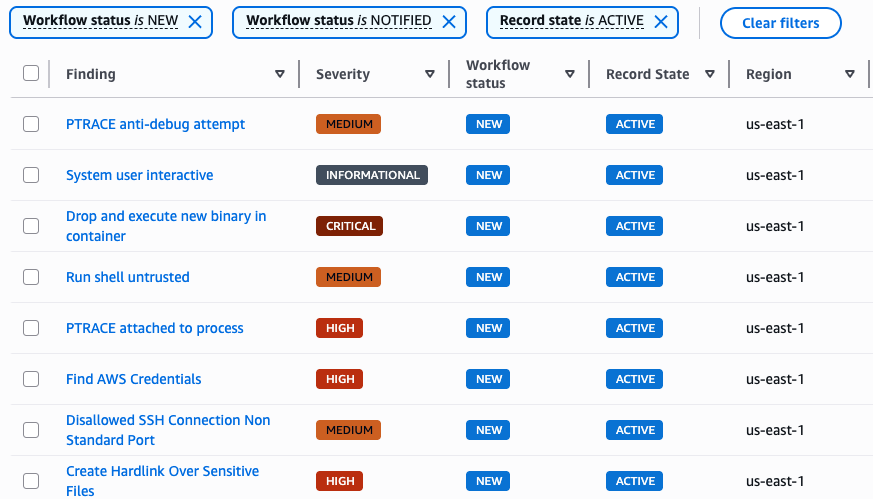
AWS Security Hub CSPM dashboard

How it works

The solution follows a streamlined workflow:
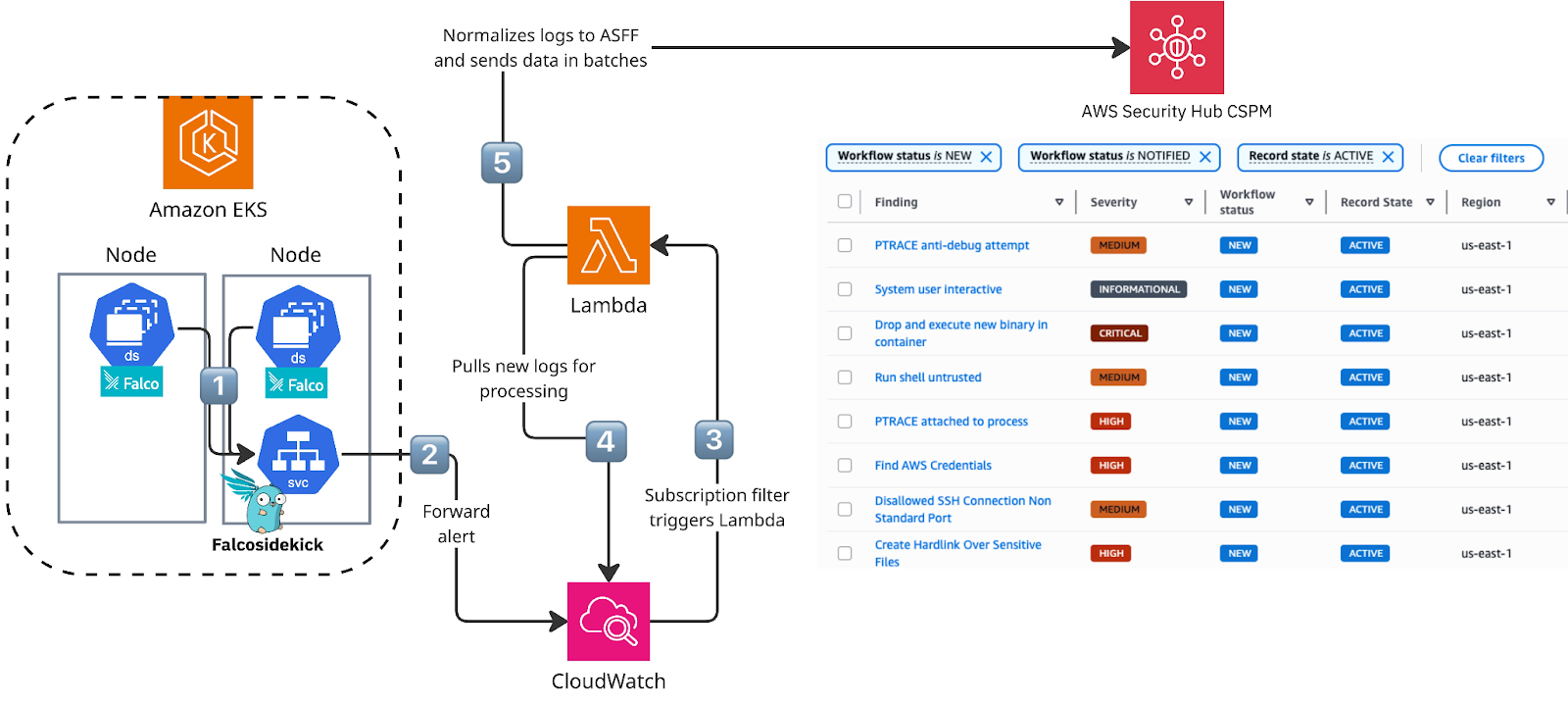
  1. Falco runs on every node in your EKS cluster, monitoring syscalls at the kernel level. When an event matches a rule (coming from the default ruleset), it will be sent to FalcoSidekick.
  2. FalcoSidekick aggregates alerts and forwards them to CloudWatch (in specific LogGroup paths)
  3. CloudWatch subscription filters trigger a Lambda function when new alerts arrive
  4. Lambda transforms the data from Cloudwatch into AWS Security Finding Format (ASFF) and forwards it to AWS Security Hub CSPM
  5. Security findings appear in AWS Security Hub CSPM where you can view, filter, and act on them

“Cloud Native Security with Falco (CSPM Integration)” alert workflow

Real-world detection examples

Once deployed, the solution immediately detects and reports various security threats coming from the default rule set like:

  • Shell spawned in container: Detects potential malicious interactive access to containers
  • Sensitive file access: Alerts when processes read critical files like /etc/shadow
  • Unexpected K8s API connections: Identifies unusual communication patterns with the Kubernetes API
  • Privilege escalation attempts: Catches attempts to gain elevated permissions
  • Suspicious network activity: Monitors for unusual network connections from containers

All these detections appear as properly categorized findings in AWS Security Hub CSPM with appropriate severity levels, contextual information, and actionable details.
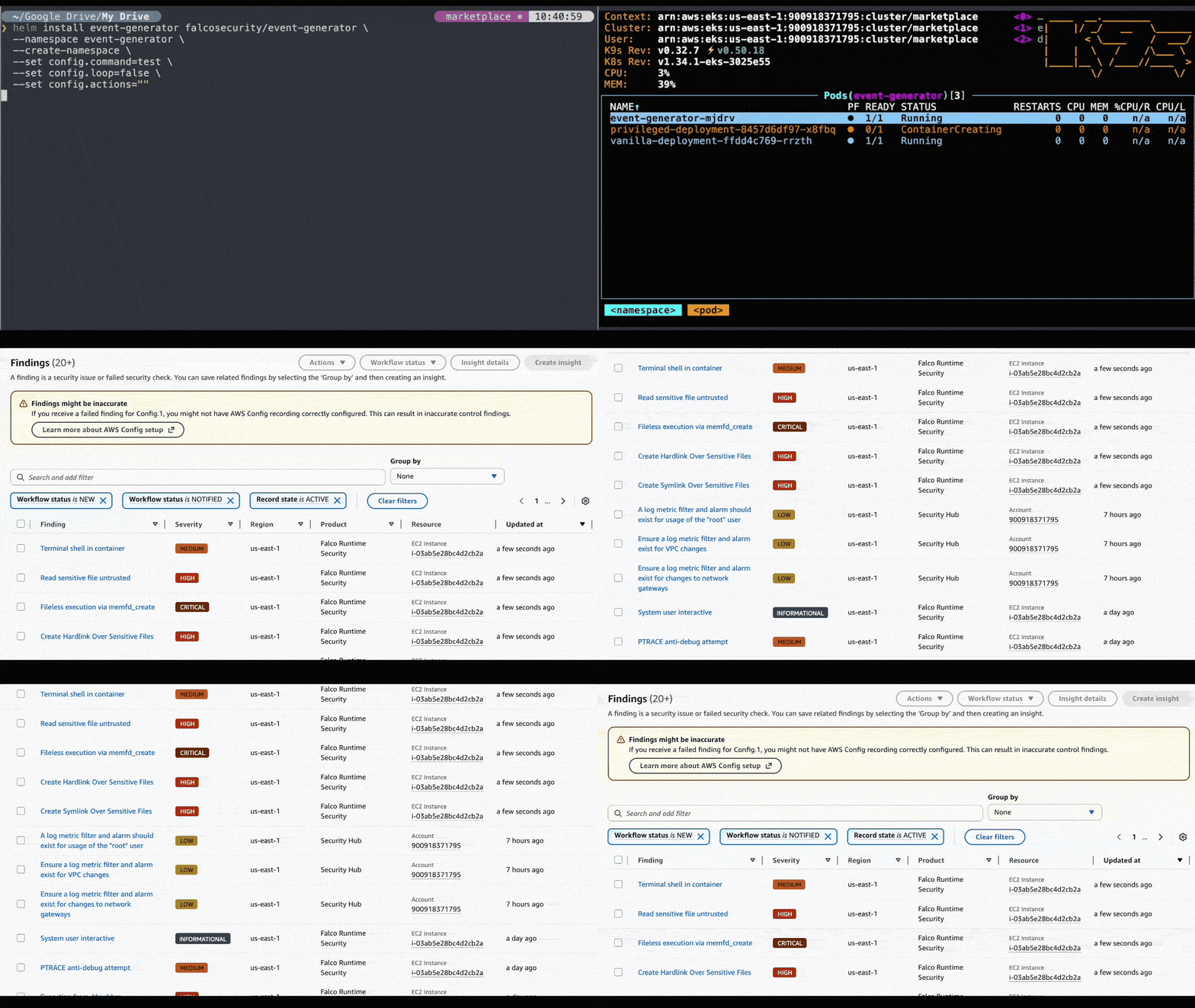
Alerts take seconds to appear in AWS Security Hub CSPM dashboard

Who should use this?

This solution is ideal for:

  • DevOps teams running EKS clusters who want runtime security without the setup overhead
  • Security teams looking to consolidate threat detection in AWS Security Hub CSPM
  • Organizations that want open-source security tools with enterprise-grade integration
  • Companies evaluating runtime security before committing to commercial CNAPP solutions

Getting started

The solution is available in AWS Marketplace. Search for "Cloud Native Security with Falco (CSPM Integration)" and look for the Falco logo. Deployment requires:

  • An existing EKS cluster
  • A VPC with internet access and EKS cluster connectivity
  • AWS Security Hub CSPM enabled (or the solution can enable it for you)

From there, CloudFormation handles everything: IAM roles and permissions, Lambda function, log groups, and the Falco Helm chart deployment to your cluster.

Do you want more details or want to contribute to this solution? Check our Github repository to know how this AWS Marketplace solution works.

Conclusion

Runtime security shouldn't be optional, and it shouldn't take weeks to deploy.

Our AWS Marketplace solution brings Falco's powerful open-source runtime detection directly into AWS Security Hub CSPM, securing your environment from runtime threats after a 10-minute deployment.

Key Benefits:

  • Open-source transparency: Falco is CNCF-graduated with an active community
  • Native AWS integration: Findings flow directly into AWS Security Hub CSPM
  • Automated deployment: No manual infrastructure setup required, just a functional EKS cluster
  • Immediate value: Start detecting runtime threats within minutes of deployment (recommended to tune your rules as per your business needs)

Ready to test runtime security on your first EKS cluster? Find us in the AWS Marketplace.

Questions about the integration or want to learn more about Falco? Join our community.