In modern software development, deciding between a REST, gRPC or any other API approach dictates how easily your systems will scale, integrate, and deliver value.
Your API design choices are no longer just internal implementation details, they shape your entire development lifecycle.
Postman's 2025 State of the API Report highlights this shift:
- APIs are no longer just powering applications. They're powering agents.
- 65% of organizations generate revenue directly from their API programs.
Because APIs carry this much weight, picking between REST and gRPC will directly impact your system's speed,
scalability, and automated testing pipelines. For software, QA, and platform engineers,
this decision influences the entire software development lifecycle.
Rather than asking which approach is universally better, the real question is which architecture aligns with the realities of how we build APIs in 2026.
REST APIs
REST (Representational State Transfer) has been the dominant API style for over a decade. It relies on stateless client-server communication, typically over HTTP, representing resources as URLs manipulated via standard HTTP methods (GET, POST, PUT, DELETE).
The strengths
- It's everywhere: REST is globally understood. It is supported by a massive ecosystem of tools, libraries, and documentation, meaning there is almost zero learning curve for new team members.
- Horizontal scaling: Because it is stateless, scaling your servers horizontally is simple. Plus, setting up standard HTTP caching can drastically cut down your server load.
- Flexible and forgiving: Because the client and server are loosely coupled, you can easily add new fields to your data structures without instantly breaking older clients.
The trade-offs
- Inefficient data payloads: As your API grows, REST endpoints often suffer from over-fetching (sending too much data) or under-fetching (making you hit multiple URLs just to get what you need).
- Version management: Keeping track of API changes can get messy at scale, often leading to cloned endpoints or bloated legacy paths that are terrifying to delete.
In 2026, REST remains a solid, dependable choice when you prioritize clarity, easy debugging, and broad compatibility, assuming your team keeps a disciplined eye on versioning.
gRPC
gRPC, developed by Google, focuses on service methods rather than resource URLs. It defines services and strongly typed schemas using Protocol Buffers (protobufs) shared between clients and servers.
The strengths
- Performance: Binary serialization results in smaller payloads and faster communication than JSON. Paired with HTTP/2 and HTTP/3, it is ideal for low-latency, high-throughput systems.
- Built-in streaming: gRPC supports unary requests alongside server, client, and bidirectional streaming, making it highly effective for real-time systems and event-driven workflows.
- Cross-language code generation (via Protobuf): Because you define the schema first, the tooling automatically generates clean client and server code for almost any programming language, ensuring everyone uses the exact same interface.
The trade-offs
- Complexity: gRPC is harder to setup, and binary payloads make manual debugging difficult.
- Browser limitations: Web browsers still don't natively support gRPC, meaning web applications require extra translation layers like gRPC-Web to talk to your backend.
- More configuration overhead: Setting up standard components like authentication, monitoring, and logging requires a bit more intentional, manual setup than a standard REST API.
In 2026, gRPC is highly rewarding for teams willing to invest in robust tooling, clear API versioning, and automated testing workflows.
So which should you choose?
The right tool depends entirely on where your API is going to live.
Choose REST when:
- Broad compatibility and quick third-party adoption are priorities.
- Human-readable payloads are required for easy troubleshooting.
- Architectural simplicity outweighs raw execution speed.
Choose gRPC when:
- Extreme performance and data efficiency are critical.
- Your internal microservices need to talk to each other constantly with minimal latency.
- You want strict compile-time safety and strict API contracts.
- Real-time data streaming is a core feature of your app.
note
You don't have to choose just one. Many modern systems use a hybrid architecture: REST acts as the public-facing gateway for the outside world, while gRPC handles high-speed, internal service-to-service communication under the hood.
Closing
API architecture decisions compound over time, influencing how you test, validate changes, and deploy without regressions. Understanding these trade-offs makes it easier to design dependable systems that scale smoothly.
When working with a hybrid stack, having a single workspace to explore requests and automate checks simplifies daily workflows.
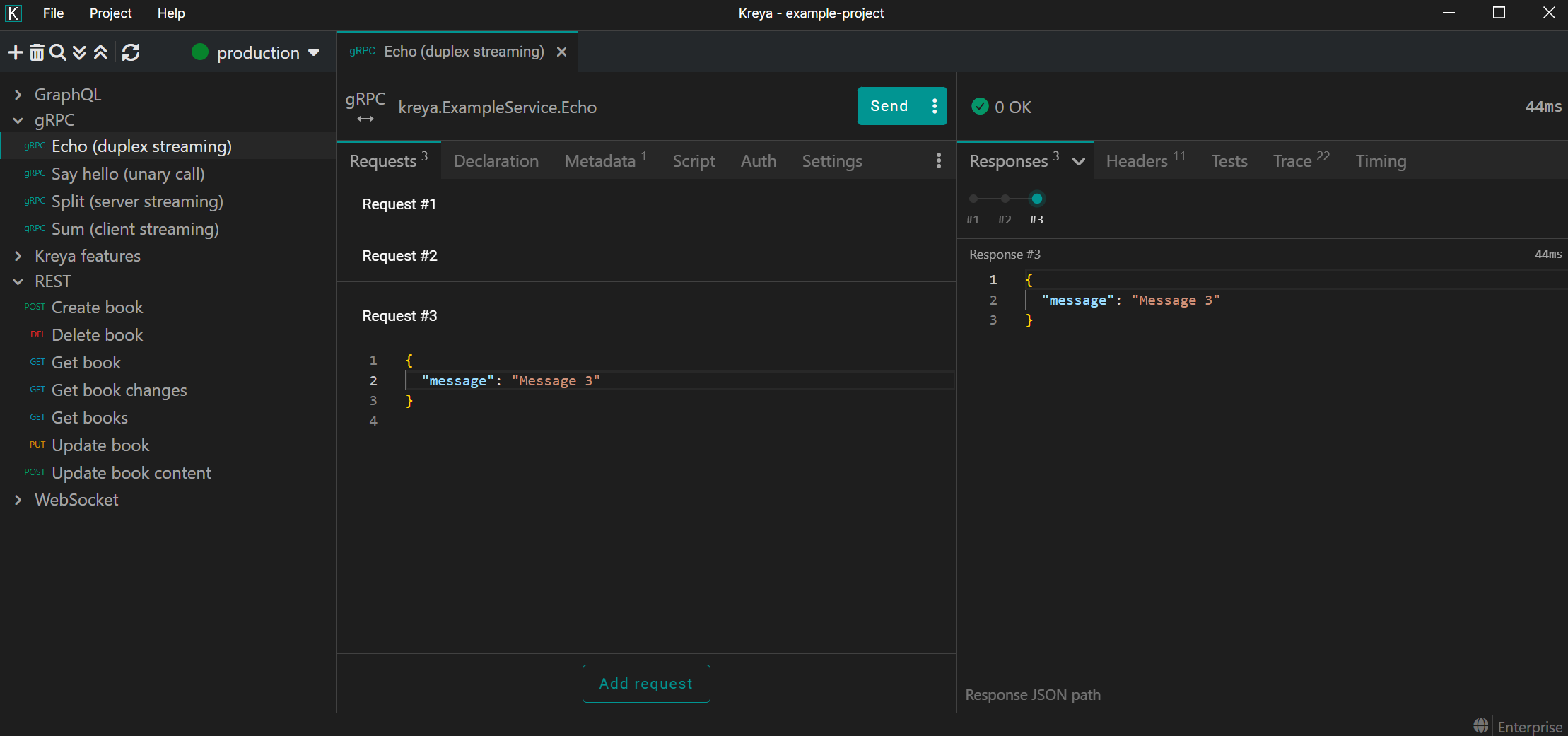
Tools like Kreya provide a local-first, protocol-agnostic environment to test REST and gRPC side-by-side, helping you reason about performance and change without adding extra SaaS overhead.






