





We founded Simple Analytics in 2018, as a bold statement to the overly complex and data devouring machine called Google Analytics. Our first users consisted of privacy-enthusiasts, big tech rejects and overall ethically minded developers.
Once we started reaching a bigger audience, new users seemed to love the simplicity angle of our product. Especially after Google Analytics switched versions (to GA4) in 2023. In the last year, a new and more promising use case has popped up: Closing the data gap.
We created a case study around this with one of customers, Hebban (a media production company from The Netherlands), that uses Simple Analytics alongside Google Analytics with Usercentrics as their consent banner partner.
Let's dive in!
TLDR:
- Hebban legally needs a consent banner for website visitors from the EU (among others).
- Visitors are given the option to either accept or reject your consent banner.
- If they reject, it means Hebban can't trigger the Google Analytics script to collect data.
- Studies show that around 20%-30% of visitors reject the consent banner
- So that is lost? No. Usercentrics can still report the number of "rejects", which can then can be added to calculate your total amount of website visits.
- The issue here is that you can't attribute or label these vistis properly
- There is a solution: Use a privacy-first analytics tool that legally collects data on visits, even if the consent banner is rejected. Run it alongside your GA4 setup to have the most complete picture
Companies like Hearst Media, Cinch, KIA and many more use this setup to close the data gap.
Want to see how this works?
Cookie-based vs cookie-less website analytics
Google Analytics has been the standard for tracking website visitors since ever. However, in the last few years, stricter privacy regulations and user behavior change impacted the accuracy of Google Analytics.
When you use a cookie banner, some visitors won’t consent to tracking, which means Google Analytics misses their activity. This, in combination with the increased use of ad-blockers, further widens this gap.
We ran the numbers to see how big the data gap is.
Case Study: A 20% data gap
Hebban is a Dutch media production company and publisher. Like most online media companies, it relies heavily on accurate data to serve the audience and generate revenue.
Their current setup consists of three tools:
Google Analytics for “deep” visitor data that is activated once a visitor consents for the use of cookies.
Simple Analytics that “runs” in front of the cookie banner and accurately measure the total visitor numbers without the need for consent.
Cookiebot, a Usercentrics product that provides consent management software to automate privacy compliance.
 Cookiebot, a Usercentrics product
The numbers:
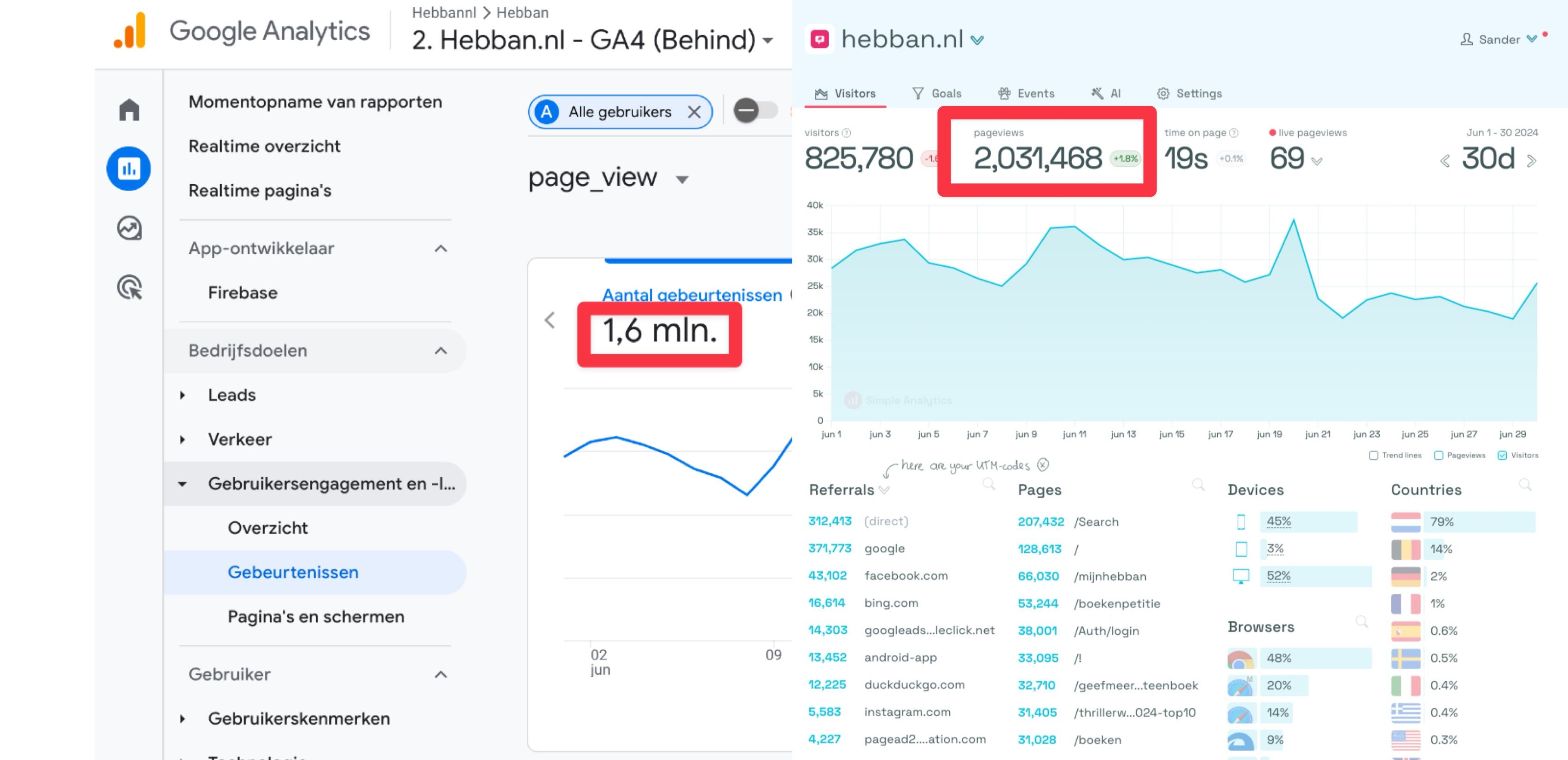 Comparing Hebban numbers in Google Analytics vs. Simple Analytics
As you can see from the image, when comparing pageview data between Google Analytics and Simple Analytics, there is a huge gap:
| Metric | Google Analytics | Simple Analytics | Difference |
|---|---|---|---|
| Pageviews | 1600000* | 2031468 | +431468 |
*pageviews numbers in GA4 are rounded.
That’s a 20% gap, meaning Google Analytics missed over 400,000 pageviews.
There is a side-note here: Usercentrics still reports on the number of "rejects", so you do know the total amount of pageviews. However, it just records "the click". There is zero information available on the website visit, hence no attribution or proper labeling is possible.
Explaining the data gap
The main reason is that Simple Analytics doesn’t use cookies or trackers, so it doesn’t require consent to collect data.
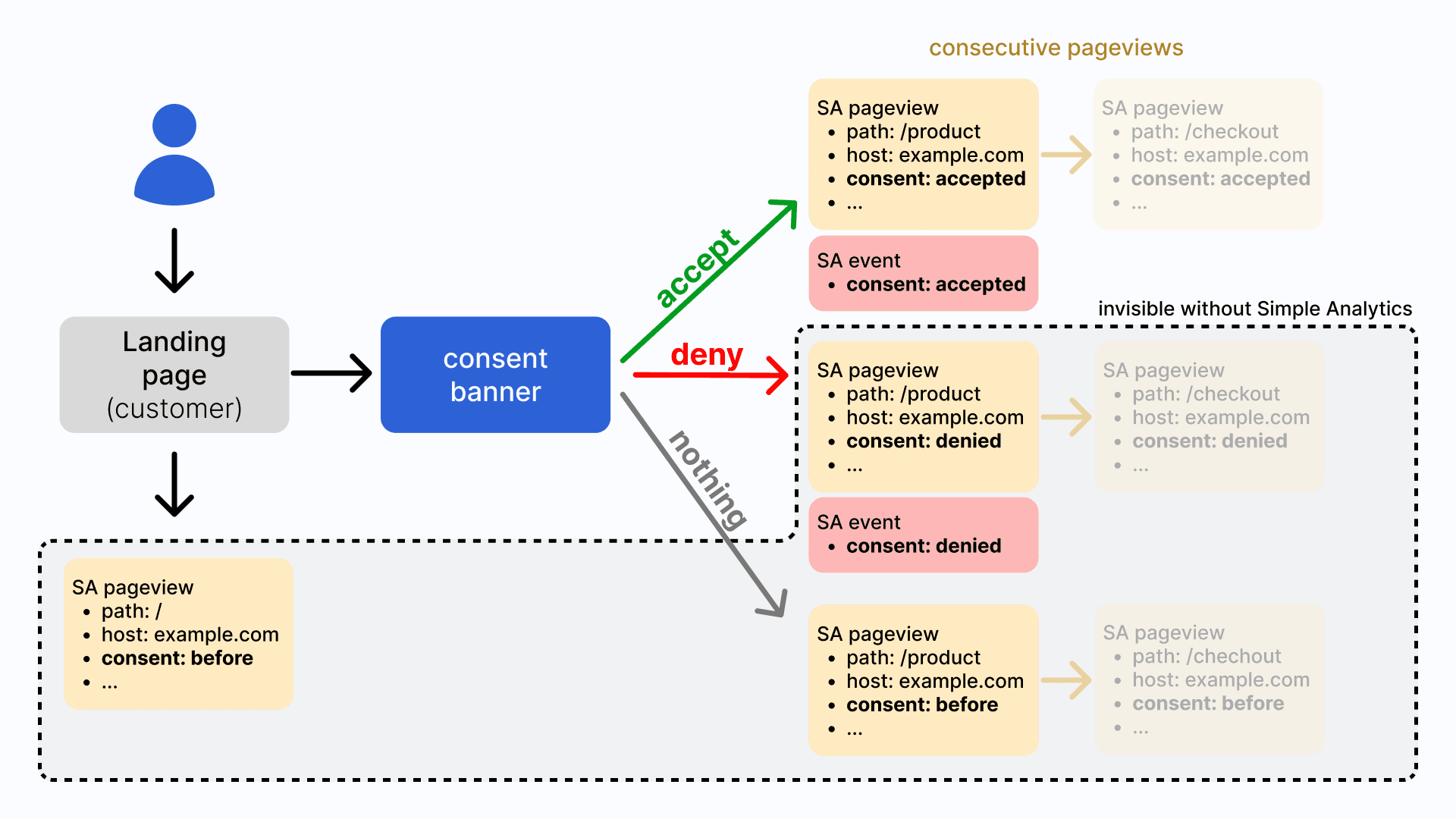 Data invisible without Simple Analytics (dashed area)
Allow me to explain the above image:
- Before consent: GA can't fire script, so no data collection. Simple Analytics collects data.
- No consent: GA4 can't fire script, but CMP collects "click". Simple Analytics collects data.
- Consent given: GA4 and Simple Analytics can both collect data.
- Nothing happens: GA4 can't fire script. Simple Analytics collects data
If you don't use Simple Analytics, you can't collect information on the part with the dotted lines. Additionally, we can set up events to segment "non-consent" website visitors from "consented" website visitors.
Ad-blocker bypass
To make your analytics even more complete, we also avoid being blocked by ad-blockers (using our ad-blocker bypass). In contrast, Google Analytics relies on cookies and is commonly blocked by popular adblocking software.
I don’t need to tell you that missing 20% of your traffic impacts your business. You are making decisions while missing one-fifth of the data. Especially for content teams relying on engagement insights this is a major issues. It leads to wrong conclusions or misallocation of your marketing budget.
Let’s fix that.
Combining cookie-less and cookie-based analytics
In my world, there shouldn’t be a need to track cookies at all. That’s why we built Simple Analytics in the first place. If you just want high-level aggregate data on what’s happening on your website, Simple Analytics should do the trick.
However, I understand there is more than just “my world.” Companies relying on visitor-level data, running ads, or just needing more info to optimize their website will stick with Google Analytics.
Instead of choosing between Google Analytics and Simple Analytics, you can combine them two to get the best of both worlds.
- Google Analytics for detailed data from users who accept cookies.
- Simple Analytics for an accurate big-picture overview, filling the gaps from users who decline cookies or use ad-blockers.
This might feel unintuitive to do, but more and more companies use this setup to get the most accurate insights. Even last week, we helped Hearst Media uncover their missing traffic stats.
Especially larger organizations that manage big budgets can't afford to make decisions on incomplete engagement insights.
Final Thoughts
Well, this is the point where I want to talk to you about our solution: Simple Analytics. I summed up the most important point quickly. Here is why you should at least check us out:
No cookie banner required. Simple Analytics doesn’t use cookies or personal tracking, so it’s fully compliant with privacy laws and doesn’t need user consent. We can track and label no-consent and pre-consent visits.
Accurate data. We also make sure our script doesn’t get blocked by adblockers. Combining the first and second points provides the most accurate overview of your website traffic.
Easy to set up. It’s simple to integrate using Google Tag Manager and works perfectly fine alongside existing tools like Google Analytics without slowing down your website (since our script is super small - 3kb vs 45kb for GA4)
Privacy-first. Your data is yours. Unlike Google Analytics, we don’t sell your data to third parties. That must mean something to you.
Complying with GDPR-ruling is essential for organizations serving European website visitors. Hence, CMP's like Usercentrics are a non-negotiable in your tech stack.
However, it does not have to mean that complying with the rules, will have your website insights cut by 20%. There is an easy fix to this. By running Simple Analytics alongside your current setup (Google Analytics and Usercentrics) will give you a 360 degrees view without sacrificing compliance.
Cheers, Iron