



惯性聚合 高效追踪和阅读你感兴趣的博客、新闻、科技资讯
阅读原文 在惯性聚合中打开

推荐订阅源

A
About on SuperTechFans
C
Cybersecurity and Infrastructure Security Agency CISA
N
News and Events Feed by Topic
C
Cisco Blogs
Cisco Talos Blog
Cisco Talos Blog
A
Arctic Wolf
Scott Helme
Scott Helme
P
Palo Alto Networks Blog
S
Schneier on Security
D
Darknet – Hacking Tools, Hacker News & Cyber Security
T
Tor Project blog
量子位
G
Google Developers Blog
H
Hackread – Cybersecurity News, Data Breaches, AI and More
B
Blog RSS Feed
NISL@THU
NISL@THU
Exploit-DB.com RSS Feed
AWS News Blog
AWS News Blog
爱范儿
爱范儿
Last Week in AI
Last Week in AI
Y
Y Combinator Blog
L
LINUX DO - 最新话题
Security Archives - TechRepublic
Threat Intelligence Blog | Flashpoint
S
Secure Thoughts
Cloudbric
Cloudbric
aimingoo的专栏
aimingoo的专栏
L
Lohrmann on Cybersecurity
TaoSecurity Blog
TaoSecurity Blog
Recent Commits to openclaw:main
Hacker News: Ask HN
Hacker News: Ask HN
freeCodeCamp Programming Tutorials: Python, JavaScript, Git & More
The GitHub Blog
The GitHub Blog
有赞技术团队
有赞技术团队
S
Security @ Cisco Blogs
cs.CL updates on arXiv.org
C
Cyber Attacks, Cyber Crime and Cyber Security
G
GRAHAM CLULEY
P
Proofpoint News Feed
V
V2EX
Martin Fowler
Martin Fowler
C
CERT Recently Published Vulnerability Notes
Attack and Defense Labs
C
CXSECURITY Database RSS Feed - CXSecurity.com
The Cloudflare Blog
SecWiki News
SecWiki News
罗磊的独立博客
CTFtime.org: upcoming CTF events
小众软件
小众软件
The Last Watchdog
The Last Watchdog

Blog — PlanetScale

Keeping a Postgres queue healthy — PlanetScale Patterns for Postgres Traffic Control — PlanetScale Graceful degradation in Postgres — PlanetScale High memory usage in Postgres is good, actually — PlanetScale Stripe Projects partnership: Provision PlanetScale Postgres and MySQL databases from the Stripe CLI — PlanetScale Enhanced tagging in Postgres Query Insights — PlanetScale Behind the scenes: How Database Traffic Control works — PlanetScale Introducing Database Traffic Control — PlanetScale Scaling Postgres connections with PgBouncer — PlanetScale Drizzle joins PlanetScale — PlanetScale Video Conferencing with Postgres — PlanetScale Faster PlanetScale Postgres connections with Cloudflare Hyperdrive — PlanetScale Introducing the PlanetScale MCP server — PlanetScale Database Transactions — PlanetScale Automating our changelog with Cursor commands — PlanetScale Postgres 18 is now available — PlanetScale Using MotherDuck with PlanetScale — PlanetScale $50 PlanetScale Metal is GA for Postgres — PlanetScale AI-Powered Postgres index suggestions — PlanetScale $5 PlanetScale is live — PlanetScale Announcing Vitess 23 — PlanetScale Report on our investigation of the 2025-10-20 incident in AWS us-east-1 — PlanetScale $5 PlanetScale — PlanetScale Benchmarking Postgres 17 vs 18 — PlanetScale Larger than RAM Vector Indexes for Relational Databases — PlanetScale Partnering with Cloudflare to bring you the fastest globally distributed applications — PlanetScale Processes and Threads — PlanetScale PlanetScale for Postgres is now GA — PlanetScale Postgres High Availability with CDC — PlanetScale Announcing Neki — PlanetScale Caching — PlanetScale The principles of extreme fault tolerance — PlanetScale Announcing PlanetScale for Postgres — PlanetScale Benchmarking Postgres — PlanetScale Announcing Vitess 22 — PlanetScale The Real Failure Rate of EBS — PlanetScale IO devices and latency — PlanetScale Announcing PlanetScale Metal — PlanetScale PlanetScale Metal: There’s no replacement for displacement — PlanetScale Upgrading Query Insights to Metal — PlanetScale Automating cherry-picks between OSS and private forks — PlanetScale Database Sharding — PlanetScale Anatomy of a Throttler, part 3 — PlanetScale Introducing sharding on PlanetScale with workflows — PlanetScale Announcing Vitess 21 — PlanetScale Announcing the PlanetScale vectors public beta — PlanetScale Anatomy of a Throttler, part 2 — PlanetScale Instant deploy requests — PlanetScale Anatomy of a Throttler, part 1 — PlanetScale Increase IOPS and throughput with sharding — PlanetScale Tracking index usage with Insights — PlanetScale Faster backups with sharding — PlanetScale Building data pipelines with Vitess — PlanetScale The State of Online Schema Migrations in MySQL — PlanetScale Optimizing aggregation in the Vitess query planner — PlanetScale Dealing with large tables — PlanetScale Announcing Vitess 20 — PlanetScale Self-managed Vitess vs Managed Vitess with PlanetScale — PlanetScale Achieving data consistency with the consistent lookup Vindex — PlanetScale The MySQL adaptive hash index — PlanetScale Introducing global replica credentials — PlanetScale Profiling memory usage in MySQL — PlanetScale Summer 2023: Fuzzing Vitess at PlanetScale — PlanetScale How PlanetScale makes schema changes — PlanetScale Identifying and profiling problematic MySQL queries — PlanetScale The Problem with Using a UUID Primary Key in MySQL — PlanetScale Announcing Vitess 19 — PlanetScale PlanetScale forever — PlanetScale Introducing schema recommendations — PlanetScale Amazon Aurora Pricing: The many surprising costs of running an Aurora database — PlanetScale Three common MySQL database design mistakes — PlanetScale OAuth applications are now available to everyone — PlanetScale Deprecating the Scaler plan — PlanetScale PlanetScale branching vs. Amazon Aurora blue/green deployments — PlanetScale Databases at scale — PlanetScale Considerations for building a database disaster recovery plan — PlanetScale Working with Geospatial Features in MySQL — PlanetScale PlanetScale vs Amazon Aurora replication — PlanetScale Introducing the Vantage and PlanetScale integration — PlanetScale MySQL isolation levels and how they work — PlanetScale Introducing the schemadiff command line tool — PlanetScale $ pscale ping — PlanetScale Announcing foreign key constraints support — PlanetScale The challenges of supporting foreign key constraints — PlanetScale What is HTAP? — PlanetScale Introducing Insights Anomalies — PlanetScale Webhook security: a hands-on guide — PlanetScale Announcing the Fivetran integration — PlanetScale Introducing webhooks — PlanetScale What is MySQL replication and when should you use it? — PlanetScale Sync user data between Clerk and a PlanetScale MySQL database — PlanetScale Introducing database reports — PlanetScale Distributed caching systems and MySQL — PlanetScale What is MySQL partitioning? — PlanetScale MySQL High Availability: Connection handling and concurrency — PlanetScale Personalizing your onboarding with Markdoc — PlanetScale PlanetScale vs. Amazon Aurora — PlanetScale PlanetScale vs. Amazon RDS — PlanetScale PlanetScale is bringing vector search and storage to MySQL — PlanetScale PlanetScale Managed is now PCI compliant — PlanetScale
$50 PlanetScale Metal — PlanetScale
Sam Lambert · 2025-11-03 · via Blog — PlanetScale

Sam Lambert [@samlambert] |

Note

$50 Metal databases are now available. Learn more

We’re making Metal's performance more accessible with a new entry point: $50/month. Additionally, we are launching much more granular storage sizing for Metal so customers can allocate CPU and Memory independently from storage size.

When PlanetScale Metal was announced we set a new bar for database performance inside AWS and GCP. Products like Cash App, Intercom, and Cursor have seen unprecedented performance improvements by running on Metal.

Metal performance

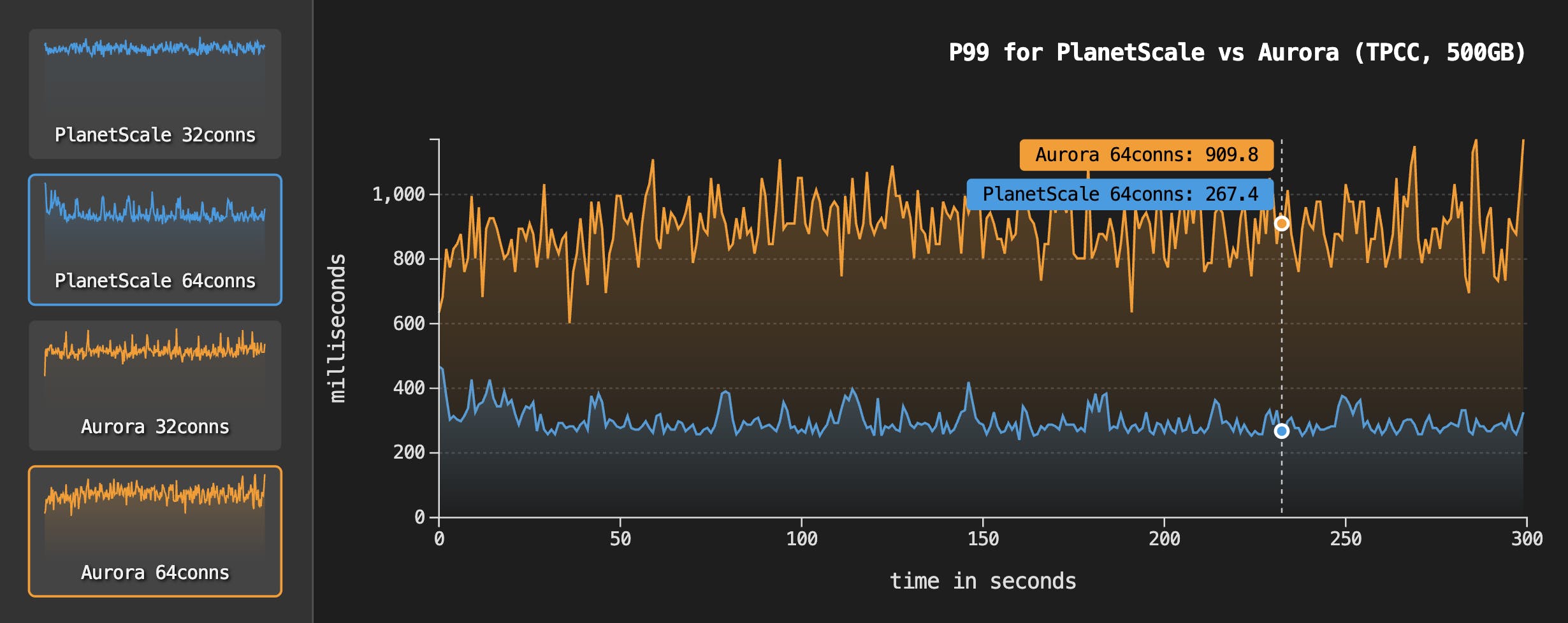
Our Metal benchmarks showed drastic drops in latency and increases in QPS compared to every provider we tested against. But the $600/month entry price often made it inaccessible to budget-conscious startups that would otherwise benefit from the performance improvements.
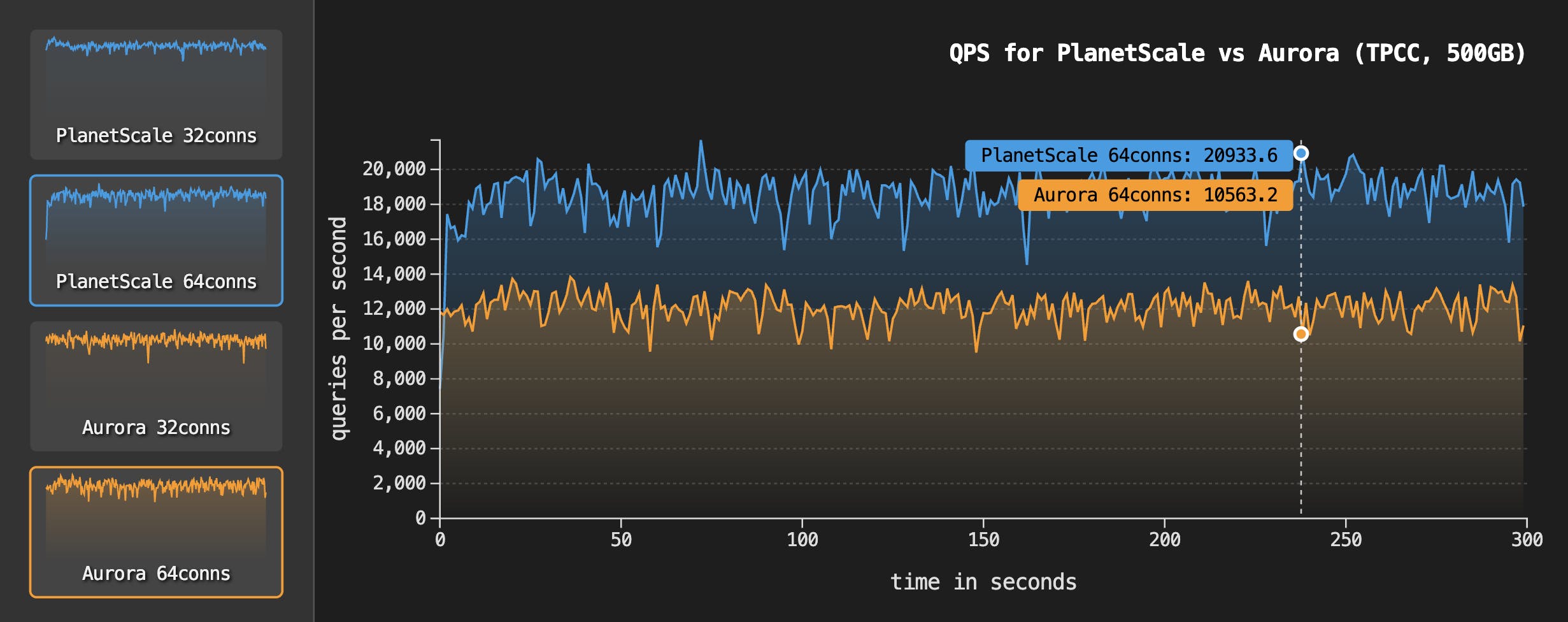
PlanetScale Metal vs Aurora benchmarks on Metal - QPS

PlanetScale Metal vs Aurora benchmarks on Metal - p99 latency

Pricing for smaller Metal sizes

Customers can access the new M- class clusters starting at $50/month. These clusters are available in both AWS and GCP and have a smaller footprint than the current M- class clusters.

Unlimited I/O on every M- class means you can expect exceptional performance while your product grows. We've made it so you can interleave different amounts of disk size and vCPUs/RAM to meet your needs:

Available node types:

  • M-10: 1/8 ARM vCPU, 1 GB RAM, 3 nodes
  • M-20: 1/4 ARM vCPU, 2 GB RAM, 3 nodes
  • M-40: 1/2 ARM vCPU, 4 GB RAM, 3 nodes
  • M-80: 1 ARM vCPU, 8 GB RAM, 3 nodes
  • M-160: 2 ARM vCPU, 16 GB RAM, 3 nodes
Disk SizeM-10M-20M-40M-80M-160
10 GB$50$80$150
25 GB$60$90$160
50 GB$80$110$180
100 GB$110$140$200$320$570
200 GB$180$210$270$390$630
400 GB$330$460$680
800 GB$530$650$890
1200 GB$610$740$980

Smaller sizes are now generally available for Postgres, with smaller sizes for Vitess to follow. Our Vitess fleet is significantly larger than our Postgres fleet, so enabling smaller Metal sizes for Vitess will take more time.

We are excited to see what you build with this new level of performance. See our $50 PlanetScale Metal is GA for Postgres announcement for more details.