



惯性聚合 高效追踪和阅读你感兴趣的博客、新闻、科技资讯
阅读原文 在惯性聚合中打开

推荐订阅源

aimingoo的专栏
aimingoo的专栏
Microsoft Security Blog
S
SegmentFault 最新的问题
Forbes - Security
Forbes - Security
爱范儿
爱范儿
Stack Overflow Blog
Stack Overflow Blog
cs.AI updates on arXiv.org
C
CERT Recently Published Vulnerability Notes
S
Schneier on Security
Scott Helme
Scott Helme
C
Check Point Blog
T
Tenable Blog
博客园 - 三生石上(FineUI控件)
Threat Intelligence Blog | Flashpoint
L
Lohrmann on Cybersecurity
Google DeepMind News
人人都是产品经理
人人都是产品经理
N
News and Events Feed by Topic
B
Blog
P
Privacy International News Feed
I
Intezer
T
Threatpost
Google DeepMind News
L
LangChain Blog
Last Week in AI
Last Week in AI
Cyber Security Advisories - MS-ISAC
L
LINUX DO - 最新话题
博客园_首页
H
Hackread – Cybersecurity News, Data Breaches, AI and More
Hacker News - Newest:
Hacker News - Newest: "LLM"
C
Cybersecurity and Infrastructure Security Agency CISA
N
News and Events Feed by Topic
钛媒体:引领未来商业与生活新知
钛媒体:引领未来商业与生活新知
N
News | PayPal Newsroom
The Hacker News
The Hacker News
S
Security @ Cisco Blogs
罗磊的独立博客
PCI Perspectives
PCI Perspectives
Y
Y Combinator Blog
Exploit-DB.com RSS Feed
大猫的无限游戏
大猫的无限游戏
U
Unit 42
Hacker News: Ask HN
Hacker News: Ask HN
D
Docker
AI
AI
小众软件
小众软件
博客园 - 叶小钗
H
Help Net Security
TaoSecurity Blog
TaoSecurity Blog
P
Privacy & Cybersecurity Law Blog

Blog — PlanetScale

Keeping a Postgres queue healthy — PlanetScale Patterns for Postgres Traffic Control — PlanetScale Graceful degradation in Postgres — PlanetScale High memory usage in Postgres is good, actually — PlanetScale Stripe Projects partnership: Provision PlanetScale Postgres and MySQL databases from the Stripe CLI — PlanetScale Enhanced tagging in Postgres Query Insights — PlanetScale Behind the scenes: How Database Traffic Control works — PlanetScale Introducing Database Traffic Control — PlanetScale Scaling Postgres connections with PgBouncer — PlanetScale Drizzle joins PlanetScale — PlanetScale Video Conferencing with Postgres — PlanetScale Faster PlanetScale Postgres connections with Cloudflare Hyperdrive — PlanetScale Introducing the PlanetScale MCP server — PlanetScale Database Transactions — PlanetScale Automating our changelog with Cursor commands — PlanetScale Postgres 18 is now available — PlanetScale Using MotherDuck with PlanetScale — PlanetScale $50 PlanetScale Metal is GA for Postgres — PlanetScale AI-Powered Postgres index suggestions — PlanetScale $5 PlanetScale is live — PlanetScale Announcing Vitess 23 — PlanetScale $50 PlanetScale Metal — PlanetScale Report on our investigation of the 2025-10-20 incident in AWS us-east-1 — PlanetScale $5 PlanetScale — PlanetScale Benchmarking Postgres 17 vs 18 — PlanetScale Larger than RAM Vector Indexes for Relational Databases — PlanetScale Partnering with Cloudflare to bring you the fastest globally distributed applications — PlanetScale Processes and Threads — PlanetScale PlanetScale for Postgres is now GA — PlanetScale Postgres High Availability with CDC — PlanetScale Announcing Neki — PlanetScale Caching — PlanetScale The principles of extreme fault tolerance — PlanetScale Announcing PlanetScale for Postgres — PlanetScale Benchmarking Postgres — PlanetScale Announcing Vitess 22 — PlanetScale The Real Failure Rate of EBS — PlanetScale IO devices and latency — PlanetScale Announcing PlanetScale Metal — PlanetScale PlanetScale Metal: There’s no replacement for displacement — PlanetScale Upgrading Query Insights to Metal — PlanetScale Automating cherry-picks between OSS and private forks — PlanetScale Database Sharding — PlanetScale Anatomy of a Throttler, part 3 — PlanetScale Introducing sharding on PlanetScale with workflows — PlanetScale Announcing Vitess 21 — PlanetScale Announcing the PlanetScale vectors public beta — PlanetScale Anatomy of a Throttler, part 2 — PlanetScale Instant deploy requests — PlanetScale Anatomy of a Throttler, part 1 — PlanetScale Increase IOPS and throughput with sharding — PlanetScale Tracking index usage with Insights — PlanetScale Faster backups with sharding — PlanetScale Building data pipelines with Vitess — PlanetScale The State of Online Schema Migrations in MySQL — PlanetScale Optimizing aggregation in the Vitess query planner — PlanetScale Dealing with large tables — PlanetScale Announcing Vitess 20 — PlanetScale Self-managed Vitess vs Managed Vitess with PlanetScale — PlanetScale Achieving data consistency with the consistent lookup Vindex — PlanetScale The MySQL adaptive hash index — PlanetScale Introducing global replica credentials — PlanetScale Profiling memory usage in MySQL — PlanetScale Summer 2023: Fuzzing Vitess at PlanetScale — PlanetScale How PlanetScale makes schema changes — PlanetScale Identifying and profiling problematic MySQL queries — PlanetScale The Problem with Using a UUID Primary Key in MySQL — PlanetScale Announcing Vitess 19 — PlanetScale PlanetScale forever — PlanetScale Introducing schema recommendations — PlanetScale Amazon Aurora Pricing: The many surprising costs of running an Aurora database — PlanetScale Three common MySQL database design mistakes — PlanetScale OAuth applications are now available to everyone — PlanetScale Deprecating the Scaler plan — PlanetScale PlanetScale branching vs. Amazon Aurora blue/green deployments — PlanetScale Databases at scale — PlanetScale Considerations for building a database disaster recovery plan — PlanetScale Working with Geospatial Features in MySQL — PlanetScale PlanetScale vs Amazon Aurora replication — PlanetScale Introducing the Vantage and PlanetScale integration — PlanetScale MySQL isolation levels and how they work — PlanetScale Introducing the schemadiff command line tool — PlanetScale $ pscale ping — PlanetScale Announcing foreign key constraints support — PlanetScale The challenges of supporting foreign key constraints — PlanetScale What is HTAP? — PlanetScale Introducing Insights Anomalies — PlanetScale Webhook security: a hands-on guide — PlanetScale Announcing the Fivetran integration — PlanetScale Introducing webhooks — PlanetScale What is MySQL replication and when should you use it? — PlanetScale Sync user data between Clerk and a PlanetScale MySQL database — PlanetScale Introducing database reports — PlanetScale Distributed caching systems and MySQL — PlanetScale What is MySQL partitioning? — PlanetScale MySQL High Availability: Connection handling and concurrency — PlanetScale Personalizing your onboarding with Markdoc — PlanetScale PlanetScale vs. Amazon Aurora — PlanetScale PlanetScale vs. Amazon RDS — PlanetScale PlanetScale is bringing vector search and storage to MySQL — PlanetScale
Three surprising benefits of sharding a MySQL database — PlanetScale
Brian Morris · 2023-11-20 · via Blog — PlanetScale

Brian Morrison II |

Organizations often shard their database to scale beyond what simply adding resources to a single server can provide.

When you horizontally shard your database, you essentially break the data up and split it across multiple database servers. Hearing this, you might think that adding more servers means adding more maintenance overhead to your staff, and more expenses on your budget, with the tradeoff that your organization can handle more database traffic. While there is definitely some truth to that in certain situations, there’s oftentimes more to the story that's not as obvious.

In this article, we’ll cover three ways that sharding your database can benefit your organization beyond additional throughput.

Minimized impact on failures

There’s an old saying in architecting infrastructure: two is one, and one is none.

The implication is that you should never have one of anything, as it creates a single point of failure. This is true for your database as well, perhaps more so since it is a critical part of your application. In a typical MySQL environment, if the database server goes down, the entire application goes down with it.

In sharded environments, this failure domain is actually spread out.

Consider a scenario where you shard based on ranges of customers using the customer ID.
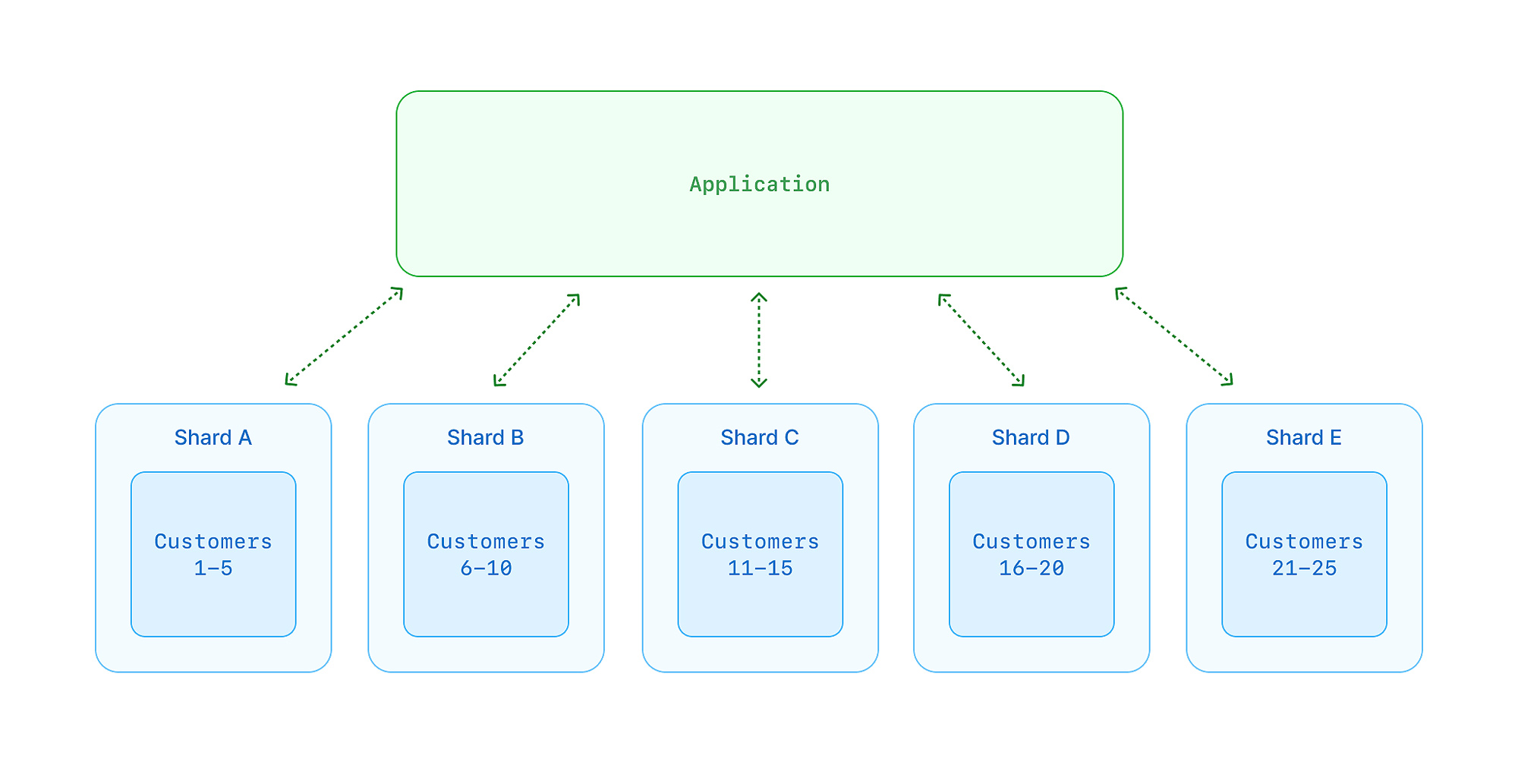
A sharded database diagram with five customer shards

If shard A goes down, it will make a bad day for customers 1-5, but the remaining shards are actually still online and can serve data with no problem. Since the impact of an outage is more isolated, there is less of an impact on various teams across your organization as they work to communicate with customers and recover from the failure.

This does not consider any lost revenue from the outage, which is also minimized.

Maintenance tasks are more efficient

The larger a MySQL environment gets, the harder it gets to manage.

Consider backing up a 1TB database. Not only does the process take a long time, but it can have a significant impact on how fast your database responds to queries. Now let's take that same database and create a sharded environment where the data is evenly split across five shards, similar to the previous example.

Not only is backing up 5× 200 GB databases quicker, but if you ever have to restore data from those databases, that process will be faster as well.

Backups are just one example of how sharding makes database management easier.

Schema migrations are another task that can be performed more efficiently. For example, when you merge in a Deploy Request on PlanetScale, we’ll create a new table on the target database branch with the updated version of the schema and sync data from the live table into this “ghost table”. Once the changes are merged in, the old table is dropped and the “ghost table” becomes the new production table.

Using the same scenario from above, performing this operation on the smaller databases in parallel will dramatically reduce the time it takes to complete.

You might actually save money

I know the thought going through your head right now: “How can sharding save me money if I’m adding more servers?”

Let’s first consider the vertical scaling approach. When you provision a server, you need enough resources (CPU, memory, IOPS) to run whatever it is you are trying to run, as well as the necessary overhead to accommodate usage spikes. As the application scales, you’ll eventually start reaching the limits of your server and need to bump resources along with even more overhead to support the service.

This cycle continues, resulting in you always paying for more than you actually use.

Now consider a world where you have a database that’s sharded across five servers as shown earlier in this article.

Whenever the load exceeds what the allocated resources can handle, you add another server into the environment with the same specs and rebalance the load across those servers. There may still be some overhead, but it's significantly lower than what's required when scaling vertically. Plus, since you are adding another server with the same specs, the overall cost increases more linearly and predictably, something your finance team will appreciate.
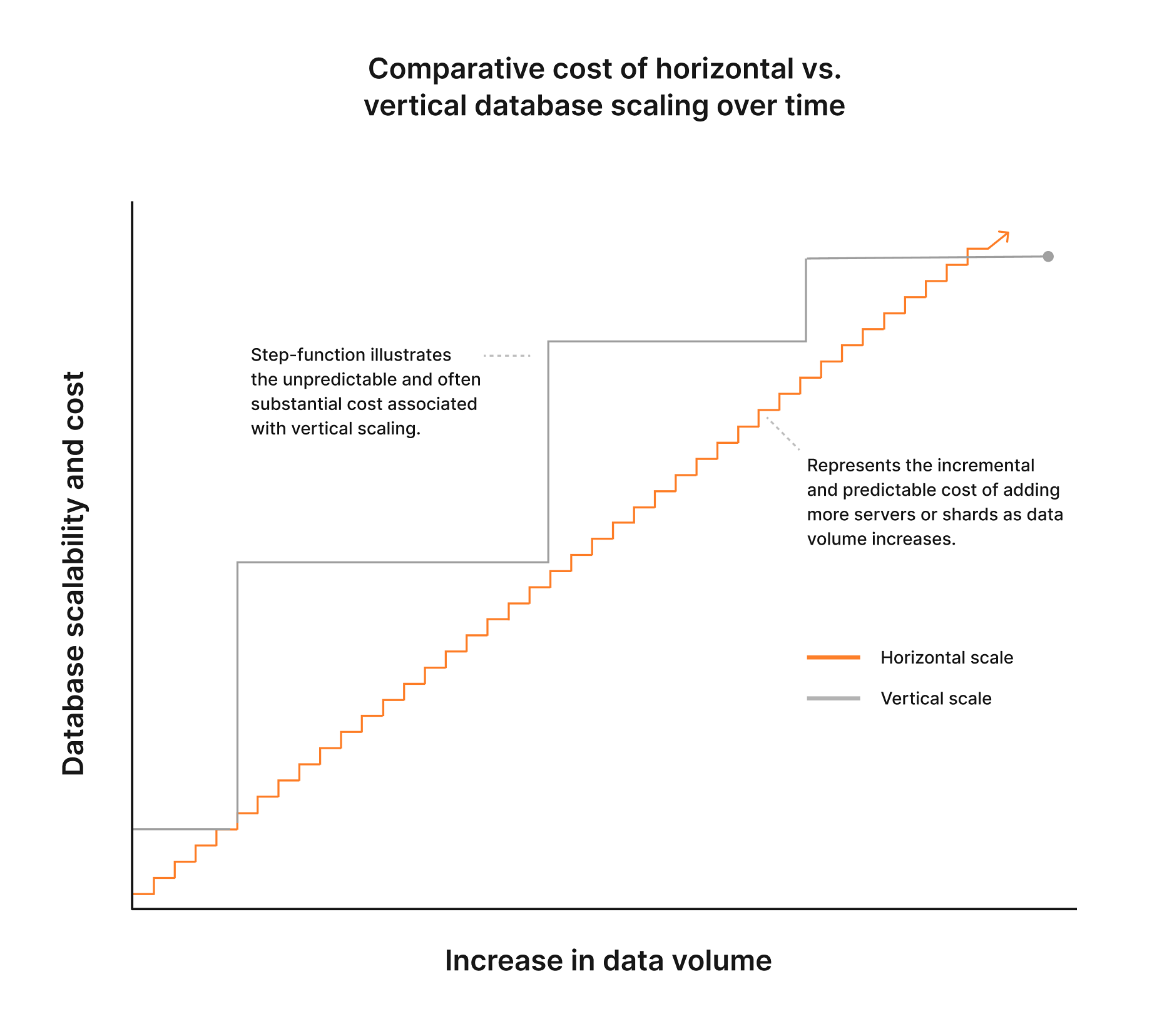
A graph comparing scalability vs cost between horizontal and vertical scaling methods.

Another way that sharding can save you money is by utilizing commodity disks in cloud infrastructure.

As your database is used more and more, it increases the demand on the underlying storage in the form of more required IOPS. Lower-cost virtual disks often have a set limit to the amount of IOPS granted to them before you have to select a more costly option. This can creep up on cloud architects if it’s not accounted for.

By sharding your database across multiple, lower-cost disks, you can save money by avoiding the additional costs of their more expensive counterparts.

Conclusion

As a database grows, so do many of the struggles that are associated with databases in general, not only data contention. After reading this article, you should now have a better idea of several other key benefits of sharding beyond additional throughput.

If you’ve sharded your database, what other benefits have you found that might not be provided here? Share it on X and tag us @planetscale!