


惯性聚合 高效追踪和阅读你感兴趣的博客、新闻、科技资讯
阅读原文 在惯性聚合中打开

推荐订阅源

The Hacker News
The Hacker News
C
Cisco Blogs
P
Privacy & Cybersecurity Law Blog
Cloudbric
Cloudbric
S
Security Affairs
PCI Perspectives
PCI Perspectives
The Last Watchdog
The Last Watchdog
AWS News Blog
AWS News Blog
Threat Intelligence Blog | Flashpoint
N
News and Events Feed by Topic
W
WeLiveSecurity
T
Tenable Blog
L
LINUX DO - 最新话题
T
Tor Project blog
Help Net Security
Help Net Security
cs.AI updates on arXiv.org
P
Proofpoint News Feed
爱范儿
爱范儿
O
OpenAI News
Hacker News - Newest:
Hacker News - Newest: "LLM"
Y
Y Combinator Blog
I
Intezer
C
Check Point Blog
Stack Overflow Blog
Stack Overflow Blog
Recent Announcements
Google DeepMind News
S
Securelist
P
Privacy International News Feed
cs.CL updates on arXiv.org
V
Vulnerabilities – Threatpost
Schneier on Security
量子位
SecWiki News
SecWiki News
L
Lohrmann on Cybersecurity
T
Threat Research - Cisco Blogs
Recent Commits to openclaw:main
M
MIT News - Artificial intelligence
H
Hackread – Cybersecurity News, Data Breaches, AI and More
Scott Helme
Scott Helme
H
Help Net Security
Vercel News
Vercel News
云风的 BLOG
云风的 BLOG
Spread Privacy
Spread Privacy
Know Your Adversary
Know Your Adversary
I
InfoQ
TaoSecurity Blog
TaoSecurity Blog
Blog — PlanetScale
Blog — PlanetScale
N
News | PayPal Newsroom
小众软件
小众软件
C
CERT Recently Published Vulnerability Notes

Blog — PlanetScale

Keeping a Postgres queue healthy — PlanetScale Patterns for Postgres Traffic Control — PlanetScale Graceful degradation in Postgres — PlanetScale High memory usage in Postgres is good, actually — PlanetScale Stripe Projects partnership: Provision PlanetScale Postgres and MySQL databases from the Stripe CLI — PlanetScale Enhanced tagging in Postgres Query Insights — PlanetScale Behind the scenes: How Database Traffic Control works — PlanetScale Introducing Database Traffic Control — PlanetScale Scaling Postgres connections with PgBouncer — PlanetScale Drizzle joins PlanetScale — PlanetScale Video Conferencing with Postgres — PlanetScale Faster PlanetScale Postgres connections with Cloudflare Hyperdrive — PlanetScale Introducing the PlanetScale MCP server — PlanetScale Database Transactions — PlanetScale Automating our changelog with Cursor commands — PlanetScale Postgres 18 is now available — PlanetScale Using MotherDuck with PlanetScale — PlanetScale $50 PlanetScale Metal is GA for Postgres — PlanetScale AI-Powered Postgres index suggestions — PlanetScale $5 PlanetScale is live — PlanetScale Announcing Vitess 23 — PlanetScale $50 PlanetScale Metal — PlanetScale Report on our investigation of the 2025-10-20 incident in AWS us-east-1 — PlanetScale $5 PlanetScale — PlanetScale Benchmarking Postgres 17 vs 18 — PlanetScale Larger than RAM Vector Indexes for Relational Databases — PlanetScale Partnering with Cloudflare to bring you the fastest globally distributed applications — PlanetScale Processes and Threads — PlanetScale PlanetScale for Postgres is now GA — PlanetScale Postgres High Availability with CDC — PlanetScale Announcing Neki — PlanetScale Caching — PlanetScale The principles of extreme fault tolerance — PlanetScale Announcing PlanetScale for Postgres — PlanetScale Benchmarking Postgres — PlanetScale Announcing Vitess 22 — PlanetScale The Real Failure Rate of EBS — PlanetScale IO devices and latency — PlanetScale Announcing PlanetScale Metal — PlanetScale PlanetScale Metal: There’s no replacement for displacement — PlanetScale Upgrading Query Insights to Metal — PlanetScale Automating cherry-picks between OSS and private forks — PlanetScale Database Sharding — PlanetScale Anatomy of a Throttler, part 3 — PlanetScale Introducing sharding on PlanetScale with workflows — PlanetScale Announcing Vitess 21 — PlanetScale Announcing the PlanetScale vectors public beta — PlanetScale Anatomy of a Throttler, part 2 — PlanetScale Instant deploy requests — PlanetScale Anatomy of a Throttler, part 1 — PlanetScale Increase IOPS and throughput with sharding — PlanetScale Tracking index usage with Insights — PlanetScale Faster backups with sharding — PlanetScale Building data pipelines with Vitess — PlanetScale The State of Online Schema Migrations in MySQL — PlanetScale Optimizing aggregation in the Vitess query planner — PlanetScale Dealing with large tables — PlanetScale Announcing Vitess 20 — PlanetScale Self-managed Vitess vs Managed Vitess with PlanetScale — PlanetScale Achieving data consistency with the consistent lookup Vindex — PlanetScale The MySQL adaptive hash index — PlanetScale Introducing global replica credentials — PlanetScale Profiling memory usage in MySQL — PlanetScale Summer 2023: Fuzzing Vitess at PlanetScale — PlanetScale How PlanetScale makes schema changes — PlanetScale Identifying and profiling problematic MySQL queries — PlanetScale The Problem with Using a UUID Primary Key in MySQL — PlanetScale Announcing Vitess 19 — PlanetScale PlanetScale forever — PlanetScale Introducing schema recommendations — PlanetScale Amazon Aurora Pricing: The many surprising costs of running an Aurora database — PlanetScale Three common MySQL database design mistakes — PlanetScale OAuth applications are now available to everyone — PlanetScale Deprecating the Scaler plan — PlanetScale PlanetScale branching vs. Amazon Aurora blue/green deployments — PlanetScale Databases at scale — PlanetScale Considerations for building a database disaster recovery plan — PlanetScale Working with Geospatial Features in MySQL — PlanetScale PlanetScale vs Amazon Aurora replication — PlanetScale Introducing the Vantage and PlanetScale integration — PlanetScale MySQL isolation levels and how they work — PlanetScale Introducing the schemadiff command line tool — PlanetScale $ pscale ping — PlanetScale Announcing foreign key constraints support — PlanetScale The challenges of supporting foreign key constraints — PlanetScale What is HTAP? — PlanetScale Introducing Insights Anomalies — PlanetScale Webhook security: a hands-on guide — PlanetScale Announcing the Fivetran integration — PlanetScale Introducing webhooks — PlanetScale What is MySQL replication and when should you use it? — PlanetScale Sync user data between Clerk and a PlanetScale MySQL database — PlanetScale Introducing database reports — PlanetScale Distributed caching systems and MySQL — PlanetScale What is MySQL partitioning? — PlanetScale MySQL High Availability: Connection handling and concurrency — PlanetScale Personalizing your onboarding with Markdoc — PlanetScale PlanetScale vs. Amazon Aurora — PlanetScale PlanetScale vs. Amazon RDS — PlanetScale PlanetScale is bringing vector search and storage to MySQL — PlanetScale
Behind the scenes: How we built Password Roles — PlanetScale
How Vitess handles user authorization · 2022-07-27 · via Blog — PlanetScale

Phani Raju |

We recently released a new feature that allows you to use granular roles for your database passwords. When you generate a new password, you have the option to select from the following roles: read-only, write-only, read/write, admin.

We implemented password roles using Vitess Access Control Lists and VTTablet, but we ran into a couple of roadblocks on the way. In this post, we look at some of the issues we faced while implementing this, and how we were able to get around them.

Vitess supports authorization via a static configuration file supplied to its vttablet.

You can see an example of what this file looks like below:

{
  "table_groups": [
    {
      "name": "planetscale user groups",
      "table_names_or_prefixes": ["%"],
      "readers": ["planetscale-reader", "planetscale-writer", "planetscale-admin"],
      "writers": ["planetscale-writer", "planetscale-writer-only", "planetscale-admin"],
      "admins": ["planetscale-admin"]
    }
  ]
}

Dissecting the ACL configuration file

  • table_names_or_prefixes — This is the list of tables that this policy applies to. % means all tables.

  • readers — This set of users can read data and schema from tables and views in the database.

  • writers — This set of users can write data to tables in the database.

  • admins — This set of users can read, update data, and alter schema in the database.

Although this configuration is static, Vitess allows you to customize this list over the runtime of a vttablet by reloading this file from disk at a specific interval using the --table-acl-config-reload-interval argument.

This static file approach is great for customers who:

  1. Have a pre-defined set of users that can access the database. Managing the various access groups in the above file is easier if the entire set of users is well-known.
  2. Have a small set of ACL configuration files that are custom to each of their Vitess clusters.
  3. Can plan for a maintenance schedule when updating this file on the pod/shared volume for their Vitess deployments.

Why doesn’t this work for PlanetScale?

None of the qualifiers above apply to PlanetScale customers. As a design principle, we try to avoid keeping authentication and authorization state on the actual vttablet pods themselves.

We can run into all kinds of issues depending on a refresh interval for a file on the vttablet pod. Let’s look at some of them.

  1. Our user story of “Customers can create passwords with roles and they work immediately” prevents the dependence on a timed refresh loop on the vttablets. Since we don’t know when the file will be refreshed next, we can’t guarantee that your credentials will work immediately.
  2. The operator, responsible for managing the vttablet, will need to write to a file on the pod and might not be able to update all vttablet pods at once, leading to a race condition where a given credential might be admin on one pod and reader on another.
  3. If a pod goes down and needs to be restarted, we don’t have an external ACL store to figure out what the ACL state for each database should be before bringing it up again.
  4. We’d need to maintain a separate set of state for each customer database that cannot be common to all PlanetScale databases.

With these issues in mind, we were able to come up with a solution that gave our customers a seamless experience they have come to expect from PlanetScale.

How we use the static ACL file to implement password roles

For every password created by a user, we store the following bits of information in the credential database:

Display nameRolepassword_sha1_hashpassword_sha2_hash

The Role property determines which of the three vttablet ACL roles (readers, writer, or admins) you’ll get mapped to.

If you create a write-only password and connect to your PlanetScale database, the query hits the user query frontend, which is a service responsible for all user-facing functionality for PlanetScale databases.
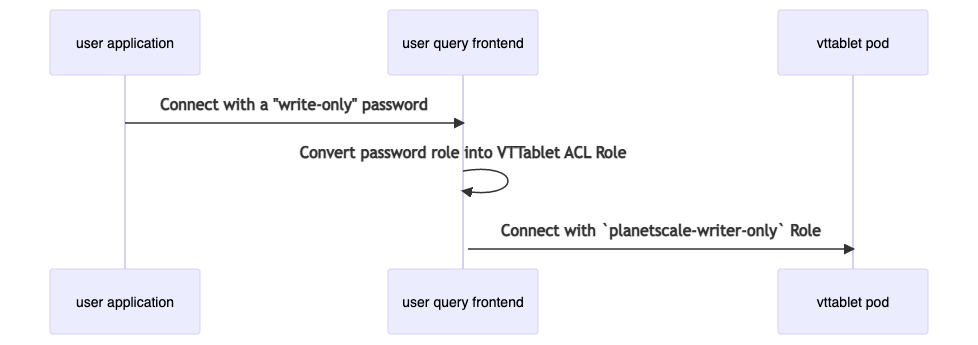
ACL conversion

As shown in the diagram above, this approach lets us solve all of the issues we discussed in the previous section.

  1. Having a dynamic user credential store allows us to create/delete user mappings to roles instantly, without the need for a refresh interval.
  2. We have a predefined set of user names which describe the access grant for each of the roles we support, e.g. planetscale-reader can only read data and schema. By mapping all PlanetScale users’ roles to the username from the Vitess ACL configuration, we can do an “on the fly” rewrite of the security principal so that connections to the database get the right access levels.
  3. Since all authentication and authorization data is stored on an external data store, all pods that we create for a database will have the same ACL state.
  4. Since the base ACL configuration is the same across all PlanetScale databases, debugging and fixing any issues with ACL enforcement is simplified.

Wrap up

If you’d like to learn more about password roles, please check out our Password roles documentation. You can sign up for a PlanetScale account and try it out today.

If you have any questions, make sure to find us on Twitter.