

惯性聚合 高效追踪和阅读你感兴趣的博客、新闻、科技资讯
阅读原文 在惯性聚合中打开

推荐订阅源

GbyAI
GbyAI
爱范儿
爱范儿
奇客Solidot–传递最新科技情报
奇客Solidot–传递最新科技情报
月光博客
月光博客
腾讯CDC
Last Week in AI
Last Week in AI
OSCHINA 社区最新新闻
OSCHINA 社区最新新闻
博客园_首页
量子位
博客园 - 聂微东
Jina AI
Jina AI
小众软件
小众软件
The Cloudflare Blog
有赞技术团队
有赞技术团队
V
V2EX
博客园 - 司徒正美
Apple Machine Learning Research
freeCodeCamp Programming Tutorials: Python, JavaScript, Git & More
大猫的无限游戏
大猫的无限游戏
博客园 - 三生石上(FineUI控件)
WordPress大学
WordPress大学
阮一峰的网络日志
阮一峰的网络日志
B
Blog
MongoDB | Blog
MongoDB | Blog
L
LangChain Blog
宝玉的分享
宝玉的分享
C
Check Point Blog
H
Hackread – Cybersecurity News, Data Breaches, AI and More
IT之家
IT之家
N
Netflix TechBlog - Medium
I
InfoQ
J
Java Code Geeks
S
SegmentFault 最新的问题
V
Visual Studio Blog
Microsoft Security Blog
博客园 - 叶小钗
D
DataBreaches.Net
让小产品的独立变现更简单 - ezindie.com
B
Blog RSS Feed
S
Schneier on Security
Webroot Blog
Webroot Blog
P
Proofpoint News Feed
cs.CL updates on arXiv.org
T
Threatpost
Project Zero
Project Zero
Scott Helme
Scott Helme
C
CERT Recently Published Vulnerability Notes
P
Privacy International News Feed
T
The Exploit Database - CXSecurity.com
D
Darknet – Hacking Tools, Hacker News & Cyber Security

Jim Nielsen’s Blog

Podcast Notes: Iain McGilchrist on “The Great Simplification” What’s an Icon in 2026? Family Feud: Mac-assed Mac App Edition Making a Shuffle Button This Page Left Intentionally Blank Notes from Bryan Cantrill’s “Intelligence is not Enough” My Om Malik Story Blogging Can Just Be Stating The Obvious Full Page Paralysis Being “Good” at Things Coding Is Designing An Ode to the Exacting Pedantry of Computers Book Notes: “Poor Charlie’s Almanack” Something’s Rotten in the State of macOS Icon Design Building Software Requires Digestion Out With the JS, In With the HTML Reminder: You Can Stitch Together Lots of Little HTML Pages With Navigations For Interactions Collective Speed Is Not the Summation of Individual Speed Hook It Up to the Machine Speed is Not Conducive to Wisdom That’s a Skill Issue Fewer Computers, Fewer Problems: Going Local With Builds & Deployments
Consistency, But in Excellence Not Appearance
Jim Nielsen · 2026-06-23 · via Jim Nielsen’s Blog

Consistency serves a purpose in visual design, but it seems to have become the purpose of a lot of visual design.

Look no further than these evolutions of macOS icons (image courtesy of BasicAppleGuy):
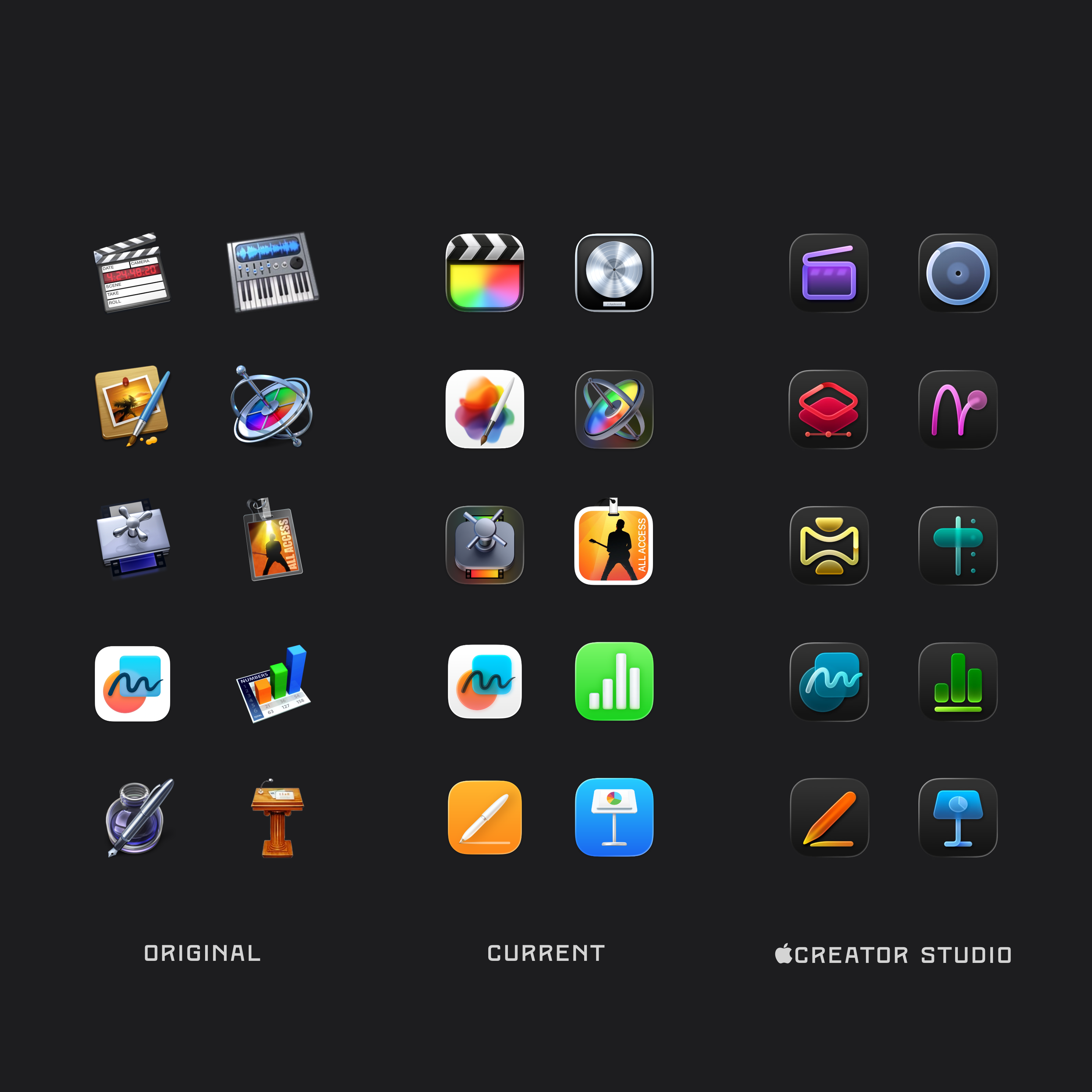
Comparison of Apple app icon designs across three eras, arranged in a grid. The “Original” (skeuomorphic) column shows detailed 3D-style icons for apps like Final Cut Pro, Logic Pro, Pages, Motion, Compressor, MainStage, Keynote, Numbers, etc. The “Current” column shows the modern flat/gradient icon style for these apps. And the 'Creator Studio' column shows a unified, dark-background icon set with simplified glyphs in purple, blue, red, green, orange, etc., all for the same set of apps.

The Creator Studio icons are undeniably consistent visually: rounded rectangles, controlled gradients, simplified forms, restrained depth, etc.

In contrast (and by modern standards) the originals seem heretically inconsistent. They lack coherence in visual details like shape, material, and lighting.

But what they lack in visual consistency between one another, they make up for in excellence individually.

In fact, their aversion to familial visual consistency almost seems like an intentional choice — a deliberate augmentation of individual purpose.

What purpose? To be singularly representative and deeply iconic.

Icons that are iconic.

To be iconic, by definition, is to be famously distinctive.

None of the Creator Studio icons, especially when held up as a suite, are iconic. None are atypical, they’re merely typical.

All in pursuit of what, consistency — amongst each other and across platforms — as the overriding goal?

This over-emphasis on “systems” design seems endemic to modern software.

Systems prescribe rules because they are the easiest attributes to document, enforce, and automate — “All icons must use this shape, this lighting, this stroke.”

Excellence, by contrast, is harder to systematize. It requires judgment, taste, care, experience, and a sensitivity to context — all in service of meaning and purpose, not superficial similarity.

When you strive for consistency across a suite, individual elements lose their ability to be exceptional and iconic on their own terms. Consistency for the group becomes a ceiling on individual excellence.

But if you flip that, if you make excellence the goal for each individual element, something interesting can happen: excellence becomes your motif of consistency. It’s no longer a consistency of shapes and gradients, but one of quality and intention that serves a deeper meaning and purpose than superficial visuals.

Give me a consistency of excellence any day over a consistency of appearance.