When an organization's storage systems were primarily managed internally by IT staff, compliance best practices typically focused on documenting required controls, maintaining retention schedules, restricting access, verifying backups and gathering evidence for periodic reviews.
That model has been changing.
In the past decade, expectations for data storage compliance have evolved significantly in response to changes in IT architecture, expanding data volumes, fragmented regulatory requirements and new security and AI-related governance risks. When organizations still managed critical data on-premises in corporate data centers, best practices for enterprise storage typically focused on capacity planning, data availability, performance and audit readiness.
While these concerns still matter, today's best practices for enterprise data storage must also address the growing role storage plays in policy enforcement. To be effective, compliance initiatives need to help organizations build storage architectures that can be managed as centrally as possible through automated control planes. This transition is often described as a change in focus from infrastructure-centric storage to data-centric storage.
Why data storage compliance is complex
The challenge today is that many enterprises have heterogeneous storage environments made up of cloud platforms, traditional on-premises arrays, dedicated backup platforms and legacy SAN/NAS infrastructure. While advancements in automation have helped organizations centralize and standardize policy intent significantly, it is still unlikely that any single tool or vendor service will be able to enforce policy consistently everywhere an organization's data resides.
In a perfect world, storage compliance policies could be transformed into code that enforces policy consistently across all environments. For example, if a compliance regulation required personally identifiable information to be encrypted, retained for a specific number of years and deleted upon verified request, those controls could be programmed into encryption settings in cloud storage, retention settings in backup systems and access controls in identity services. Logs from each system could then be aggregated into platforms like Splunk or Microsoft Sentinel and normalized into a format that supports analysis, validation and reporting.
In the real world, however, comprehensive machine-enforceable workflows for compliance enforcement are likely to still be years away. While governance platforms like Microsoft Purview can help organizations reduce enforcement drift by linking data classification to downstream mechanisms, policy enforcement ultimately depends on what integration points and technical controls each underlying storage system supports.
Best practices for enforcing storage compliance
Misalignment between policy intent and real-world enforcement is a significant source of legal, financial and reputational risk. The following best practices can help organizations close enforcement gaps:
- Use data discovery and classification tools to inventory data, map where it is stored and identify who has ownership and/or administrative access.
- Define governance policies in business terms rather than platform terms to reduce ambiguity and encourage internal teams to implement controls on different platforms as consistently as possible.
- Convert common compliance controls into policy-as-code where feasible and use compensating controls when automation is not feasible.
- When considering what to automate, focus attention first on platforms that store regulated data and repositories that require substantial manual administration.
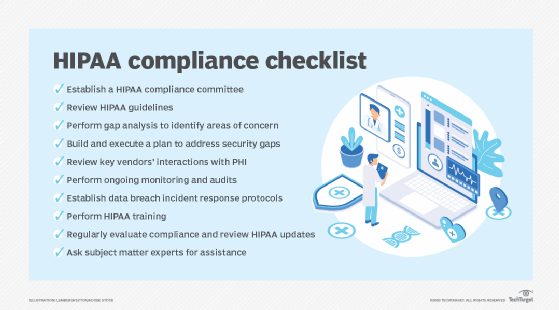
- Use a governance platform like Microsoft Purview to connect regulated data with common downstream controls for regulations and standards like GDPR, HIPAA and PCI DSS.
- Adopt zero trust principles for storage access and encrypt data at rest and data in transit.
- Strengthen access governance with role-based access controls (RBAC) that support the principle of least privilege.
- Enable WORM-style immutability within existing storage, archive and backup platforms.
- Centralize logs, audit trails and automated evidence collection to reduce manual review effort and improve confidence in audit results. (These practices also support SOC 2 recommendations for storage compliance.)
- Continuously test control effectiveness by validating deletion workflows, retention triggers, backup recoverability and access revocation processes to help identify enforcement drift before it becomes a material compliance risk.
- Turn exceptions into a managed program. Document where identical policy enforcement is not possible, assign owners, define compensating controls and track remediation timelines.
- Use refresh cycles and digital transformation initiatives to retire legacy systems that create the greatest enforcement gaps over time.
Roles and responsibilities
Even though machine-driven compliance enforcement may be the target goal for many organizations, people will still continue to play a key role in defining policy, handling exceptions, validating controls and maintaining accountability.
Even though machine-driven compliance enforcement may be the ultimate goal for some organizations, people will continue to play a critical role in defining policy, handling exceptions, validating controls and maintaining accountability.
In the enterprise, this division is often formalized through an RACI matrix that clarifies roles and responsibilities. For example, the organization's compliance legal team may be accountable for interpreting compliance requirements and defining policy; the security team may be responsible for designing controls; the storage team may be responsible for implementing controls; and the operations team may be responsible for validating controls work as intended.
Takeaway
Data storage compliance has changed significantly in the past decade, and best practices can no longer be treated merely as a checklist for periodic audits or regulatory reviews. Organizations that treat storage compliance as a continuous engineering discipline will be better positioned to scale governance, reduce risk and adapt to changing regulations and standards.
Margaret Rouse is an award-winning writer and technologist known for her ability to explain the value of emerging technology to business users.