
We have all experienced it: meeting after meeting, followed by post-meeting meetings, transcripts, recordings, automated notes and analysis. It can feel like collaboration has entered a new phase -- one in which no thought is lost and no interaction goes uncaptured.
On the surface, that sounds productive. But there can also be too much of a good thing.
Coordinating all of that communication takes resources, both human and technological. In many organizations, the effort to piece together those fragments creates an endless loop of coordination. Teams can stay busy all day and still not move the work very far. People talk, document, follow up and jump from one touchpoint to the next, but a clean decision never quite lands.
After a while, it starts wearing on people. It also shows up in slower follow-through, weaker accountability and opportunities that slip by. At that point, collaboration is not really helping the work anymore. It is starting to bog it down.
Collaboration overload is not just a meeting problem
This issue is bigger than too many meetings. A crowded calendar is often just the symptom.
The deeper problem is a broken operating model built around unclear ownership, weak decision rights and too many ways to communicate without enough clarity about who is supposed to decide, act and move the work forward.
A full calendar by itself does not tell you much. The warning sign is when all that meeting time is not making delivery any faster. More check-ins start taking the place of actual calls. Once that happens, the organization is not really running on authority. It is running on coordination.
This is also why overload gets read the wrong way so often. From a leadership seat, all that visible activity can look healthy. People are in meetings, answering quickly, sharing notes and staying in constant contact. It is easy to see that and assume the organization is working well together.
From inside the system, the same behavior can feel very different. What looks like engagement from above can feel like compensation from below.
People looking busy as a substitute for real progress is nothing new. Organizations have long mistaken busyness for effectiveness. What is different now is the sheer volume of ways people can communicate and collaborate, along with the flood of transcripts, automated notes, summaries and analysis that surround all that activity. The upside is real. Teams can work together from almost anywhere, at almost any time, and extract more from meetings and interactions than they could a few years ago.
But the downside is easier to miss, precisely because there is now so much visible activity. Leaders can end up rewarding responsiveness, availability and participation when what the business really needs is ownership, output and clear decision-making. What looks like teamwork can mask unclear priorities, weak processes and fragmented tools.
Today's work environments enable an unprecedented level of teamwork. But when priorities are unclear, processes are weak and tools are fragmented, even high levels of engagement will not produce the results enterprises expect. In fact, collaboration overload can drive defensive behavior and burnout.
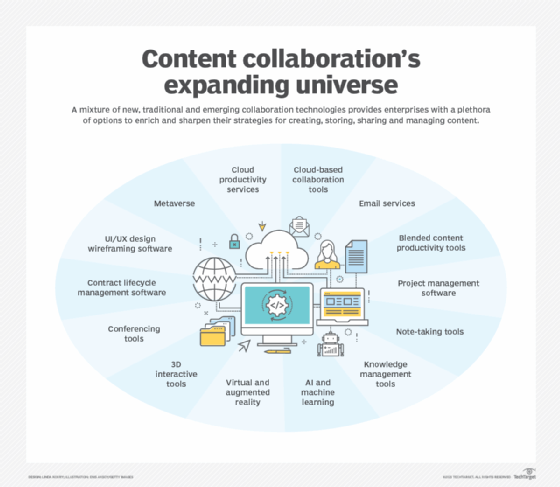
Employees keep checking in, documenting, following up and looping in more people because they are trying to keep work from falling apart.
What looks positive on the surface could actually be the organization compensating for its own structural weaknesses.
Weak decision rights turn teamwork into coordination labor
This is where decision rights matter. The problem is not just too many meetings; it is that organizations often lack clear ownership over the meetings, takeaways, action items and, most importantly, the decisions themselves.
Decision rights determine who gets to decide in a given situation, who is accountable for moving the work forward and who owns the outcome once the discussion ends. When that is unclear, organizations compensate with more communication, more coordination and often more software and workflow layers. In that sense, collaboration sprawl is not just a technology problem; it is often the downstream result of organizational design and planning failures.
The bigger mistake is treating overload like a culture issue when it is really a structural one. Telling people to set better boundaries or to be more disciplined will not fix much if ownership is still murky. If the operating model never made authority clear in the first place, the extra collaboration is just filling that gap.
Once collaboration platforms become the default path for updates, approvals and decisions, they stop behaving like simple productivity tools and start behaving more like operating infrastructure. Collaboration platforms are increasingly shaping how organizations control cost, workflow and execution.
Tool sprawl can make collaboration more expensive
And that sprawl has real costs. Collaboration overload is often a symptom of a fragmented, redundant and operationally messy environment that is more expensive to run than it should be, both in terms of money and human effort.
At some point, the mismatch gets hard to ignore. People can be in meetings all day and still not move things the way the business expects. That is when leaders need to stop saying, "We're collaborating a lot," and ask what is actually going on underneath. Who really owns these tools? Where does a decision actually become final? Are these platforms being run by any common rules, or did the company just keep adding things over time and hope they would somehow line up?
Clarity from the start around ownership, decision rights, data governance, architecture standards and cross-functional accountability has become essential in modern software environments. Those elements are often treated as the foundation for digital transformation and AI deployment, but they matter just as much in the daily operation of collaboration and communication. Clear decision rights, platform ownership and governance guardrails help prevent fragmentation, cost escalation and operational instability.
Take that foundation away, and the coordination burden tends to spread fast. People start compensating for ambiguity with more messages, more meetings and more tool switching. Put the foundation in place, though, and communication has a better chance of staying tied to actual execution instead of endless follow-up.
Fragmented platforms cost more than they look like they do at first. Yes, there is the direct software spend. But there is also the slower decision-making, the duplicated work, the integration hassle and the extra management effort required to keep disconnected systems from getting in each other's way. Governing a messy stack one piece at a time is simply harder than running an environment built on shared standards.
Better governance can reduce collaboration drag
So, collaboration overload is not just a wellness story, though wellness absolutely matters here. It is also an execution story, a governance story and a business-performance story.
The wrong kind of collaboration slows things down. It can blur accountability, hide where work is getting stuck and create the appearance of progress without much real movement behind it. Visible effort is not the same thing as forward motion.
That is also why this is not a simple tooling problem. New tools can help at the edges. Better note-taking, summaries and search may reduce some friction. But no tool can fix an org chart that does not make ownership clear, a workflow that never settled who decides what or a culture that treats constant responsiveness as proof of effectiveness. The most advanced collaboration stack in the world will not solve a design problem at the center of the business. Unified communications platforms work best when they are treated as operating infrastructure rather than add-on productivity tools.
There is real upside in modern collaboration. Better communication, richer records and faster coordination can all help organizations work more effectively. But those gains start to erode when collaboration becomes a workaround for broken ownership, weak process and fragmented systems. That is the point at which teamwork starts becoming operational drag.
And once that happens, the question is no longer whether people are engaged. The question is why so much engagement is producing so little clarity.
James Alan Miller is a veteran technology editor and writer who leads Informa TechTarget's Enterprise Software group. He oversees coverage of ERP & Supply Chain, HR Software, Customer Experience, Communications & Collaboration and End-User Computing topics.