
惯性聚合 高效追踪和阅读你感兴趣的博客、新闻、科技资讯
阅读原文 在惯性聚合中打开

推荐订阅源

L
LangChain Blog
博客园 - 司徒正美
美团技术团队
WordPress大学
WordPress大学
奇客Solidot–传递最新科技情报
奇客Solidot–传递最新科技情报
人人都是产品经理
人人都是产品经理
让小产品的独立变现更简单 - ezindie.com
T
Troy Hunt's Blog
S
Schneier on Security
T
The Exploit Database - CXSecurity.com
P
Proofpoint News Feed
云风的 BLOG
云风的 BLOG
Engineering at Meta
Engineering at Meta
Cisco Talos Blog
Cisco Talos Blog
T
Tor Project blog
B
Blog
NISL@THU
NISL@THU
月光博客
月光博客
博客园 - 【当耐特】
AWS News Blog
AWS News Blog
cs.CL updates on arXiv.org
腾讯CDC
L
Lohrmann on Cybersecurity
The Cloudflare Blog
L
LINUX DO - 最新话题
S
Security @ Cisco Blogs
S
Secure Thoughts
Spread Privacy
Spread Privacy
有赞技术团队
有赞技术团队
The Last Watchdog
The Last Watchdog
Project Zero
Project Zero
cs.AI updates on arXiv.org
Vercel News
Vercel News
H
Hacker News: Front Page
S
SegmentFault 最新的问题
Schneier on Security
aimingoo的专栏
aimingoo的专栏
P
Privacy & Cybersecurity Law Blog
博客园 - 三生石上(FineUI控件)
Forbes - Security
Forbes - Security
C
CXSECURITY Database RSS Feed - CXSecurity.com
I
InfoQ
T
Tailwind CSS Blog
Application and Cybersecurity Blog
G
GRAHAM CLULEY
W
WeLiveSecurity
小众软件
小众软件
Recorded Future
Recorded Future
Cyberwarzone
Cyberwarzone
cs.CV updates on arXiv.org

Aikido Security's Blog

Axios CVE-2026-40175: a critical bug that’s… not exploitable GlassWorm goes native: New Zig dropper infects every IDE on your machine Aikido Attack finds multiple 0-days in Hoppscotch The cybersecurity doomerism around Mythos doesn't match what we see on the ground axios compromised on npm: maintainer account hijacked, RAT deployed Popular telnyx package compromised on PyPI by TeamPCP Aikido × Lovable: Vibe, Fix, Ship CanisterWorm Gets Teeth: TeamPCP's Kubernetes Wiper Targets Iran TeamPCP deploys CanisterWorm on NPM following Trivy compromise Security testing is validating software that no longer exists Aikido Recognized by Frost & Sullivan with the 2026 Customer Value Leadership Award in ASPM GlassWorm Hides a RAT Inside a Malicious Chrome Extension fast-draft Open VSX Extension Compromised by BlokTrooper Glassworm Strikes Popular React Native Phone Number Packages Glassworm Is Back: A New Wave of Invisible Unicode Attacks Hits Hundreds of Repositories How Security Teams Fight Back Against AI-Powered Hackers Introducing Betterleaks, an open source secrets scanner by the author of Gitleaks Trump’s 2026 cybersecurity strategy: From compliance to consequence How does AI pentesting work with compliance? What continuous pentesting actually requires Rare Not Random: Using Token Efficiency for Secrets Scanning Persistent XSS/RCE using WebSockets in Storybook’s dev server Why Determinism Is Still a Necessity in Security WAF vs. RASP vs. ADR Introducing Aikido Infinite: A new model of self-securing software How Aikido secures AI pentesting agents by design Astro Full-Read SSRF via Host Header Injection How to Get Your Board to Care About Security (Before a Breach Forces the Issue) What is Slopsquatting? The AI Package Hallucination Attack Already Happening SvelteSpill: A Cache Deception Bug in SvelteKit + Vercel Top 6 Wiz Code Alternatives Aikido recognized as Platform Leader in Latio Tech's 2026 Application Security Report From detection to prevention: How Zen stops IDOR vulnerabilities at runtime npm backdoor lets hackers hijack gambling outcomes Why Trying to Secure OpenClaw is Ridiculous Claude Opus 4.6 found 500 vulnerabilities. What does this change for software security? Introducing Aikido Expansion Packs: Safer defaults inside the IDE International AI Safety Report 2026: What It Means for Autonomous AI Systems Self-Securing Software: What It Is, Why It Matters, and How It Works npx Confusion: Packages That Forgot to Claim Their Own Name What Is Continuous Pentesting? Introducing Aikido Package Health: a Better Way to Trust Your Dependencies AI Pentesting: Minimum Safety Requirements for Security Testing Secure SDLC for Engineering Teams (+ Checklist) Fake Clawdbot VS Code Extension Installs ScreenConnect RAT G_Wagon: npm Package Deploys Python Stealer Targeting 100+ Crypto Wallets Gone Phishin': npm Packages Serving Custom Credential Harvesting Pages Malicious PyPI Packages spellcheckpy and spellcheckerpy Deliver Python RAT Top 10 AI Security Tools For 2026 Agent Skills Are Spreading Hallucinated npx Commands Understanding Open-Source License Risk in Modern Software The CISO Vibe Coding Checklist for Security Top 6 Graphite alternatives for AI code review in 2026 From “No Bullsh*t Security” to $1B: We Just Raised Our $60m Series B Critical n8n Vulnerability Allows Unauthenticated Remote Code Execution (CVE-2026-21858) Top 14 VS Code Extensions for 2026 AI-Driven Pentesting of Coolify: Seven CVEs Identified Top Continuous Pentesting Tools in 2026 SAST vs SCA: Securing the Code You Write and the Code You Depend On JavaScript, MSBuild, and the Blockchain: Anatomy of the NeoShadow npm Supply-Chain Attack How Engineering and Security Teams Can Meet DORA’s Technical Requirements IDOR Vulnerabilities Explained: Why They Persist in Modern Applications Shai Hulud strikes again - The golden path MongoBleed: MongoDB Zlib Vulnerability (CVE-2025-14847) and How to Fix It First Sophisticated Malware Discovered on Maven Central via Typosquatting Attack on Jackson The Fork Awakens: Why GitHub’s Invisible Networks Break Package Security Top 10 Cyber Security Tools For 2026 SAST in the IDE is now free: Moving SAST to where development actually happens AI Pentesting in Action: A TL;DV Recap of Our Live Demo The Top 7 Threat Intelligence Tools in 2026 React & Next.js DoS Vulnerability (CVE-2025-55184): What You Need to Fix After React2Shell OWASP Top 10 for Agentic Applications (2026): What Developers and Security Teams Need to Know DAST vs Pentesting v AI Pentesting: Why DAST Cannot Replace Modern Pentesting PromptPwnd: Prompt Injection Vulnerabilities in GitHub Actions Using AI Agents Top 7 Cloud Security Vulnerabilities Critical React & Next.js RCE Vulnerability (CVE-2025-55182): What You Need to Fix Now How to Comply With the UK Cybersecurity & Resilience Bill: A Practical Guide for Modern Engineering Teams Shai Hulud 2.0: What the Unknown Wonderer Tells Us About the Attackers’ Endgame SCA Everywhere: Scan and Fix Open-Source Dependencies in Your IDE Safe Chain now enforces a minimum package age before install Shai Hulud Attacks Persist Through GitHub Actions Vulnerabilities Shai Hulud Launches Second Supply-Chain Attack: Zapier, ENS, AsyncAPI, PostHog, Postman Compromised CORS Security: Beyond Basic Configuration Revolut Selects Aikido Security to Power Developer-First Software Security The Future of Pentesting Is Autonomous How Aikido and Deloitte are bringing developer-first security to enterprise Secrets Detection: A Practical Guide to Finding and Preventing Leaked Credentials Invisible Unicode Malware Strikes OpenVSX, Again AI as a Power Tool: How Windsurf and Devin Are Changing Secure Coding Building Fast, Staying Secure: Supabase’s Approach to Secure-by-Default Development OWASP Top 10 2025: Official List, Changes, and What Developers Need to Know Top 10 JavaScript Security Vulnerabilities in Modern Web Apps The Return of the Invisible Threat: Hidden PUA Unicode Hits GitHub repositorties Top 7 Black Duck Alternatives in 2026 What Is IaC Security Scanning? Terraform, Kubernetes & Cloud Misconfigurations Explained AutoTriage and the Swiss Cheese Model of Security Noise Reduction Top Software Supply Chain Security Vulnerabilities Explained The Top 7 Kubernetes Security Tools Top 10 Web Application Security Vulnerabilities Every Team Should Know What Is CSPM (and CNAPP)? Cloud Security Posture Management Explained
Introducing Upgrade Impact Analysis: When breaking changes actually matter to your code
Sooraj Shah · 2026-02-13 · via Aikido Security's Blog

TL;DR

Aikido checks if a dependency update contains breaking changes and shows what changed. It then analyzes the codebase to determine whether those changes actually impact your codebase. Teams get clear answers before merging a security fix.

Check out the docs here.

We all know developers want to keep in the flow state, but security issues often pull them out of it. Not just because it interrupts focus, but because it introduces uncertainty about what to do next. Developers are overwhelmed by alerts, but If they don’t know if their code is safe to merge or the library is safe to upgrade, they often avoid taking action altogether.

And it shows: 65% of developers, security engineers, and leaders said they bypassed security checks, dismissed findings or delayed fixes because of fatigue and lack of trust in findings, according to 2026 Aikido's State of AI in Security & Development.

Aikido aims to give developers this confidence back. One of the ways we’re doing that is through two complementary features for open source dependencies: Breaking Changes and Upgrade Impact Analysis.

Developers don’t want to be told that they ought to make a fix without understanding why. They also want to know what the side effects of any such action are: would it, for instance, break their application?

This is exactly the kind of uncertainty that makes developers uneasy. 

Breaking changes visibility

Providing context upfront, instead of adding to developers’ cognitive load, is what the breaking changes feature is all about.

Before an upgrade is merged, Aikido analyzes the changelog to determine whether it introduces breaking changes. Every upgrade falls into one of three buckets: all clear, breaking changes apparent, or manual validation required.

1. All clear

If there are no breaking changes, the upgrade is clearly marked as safe.

Developers can then be confident to go ahead with the fix.

The dependency issue shows the minimal version required to fix it. In this Spring Security example below, it’s clear that the CVE will be fixed by upgrading to version 6.1.2. 
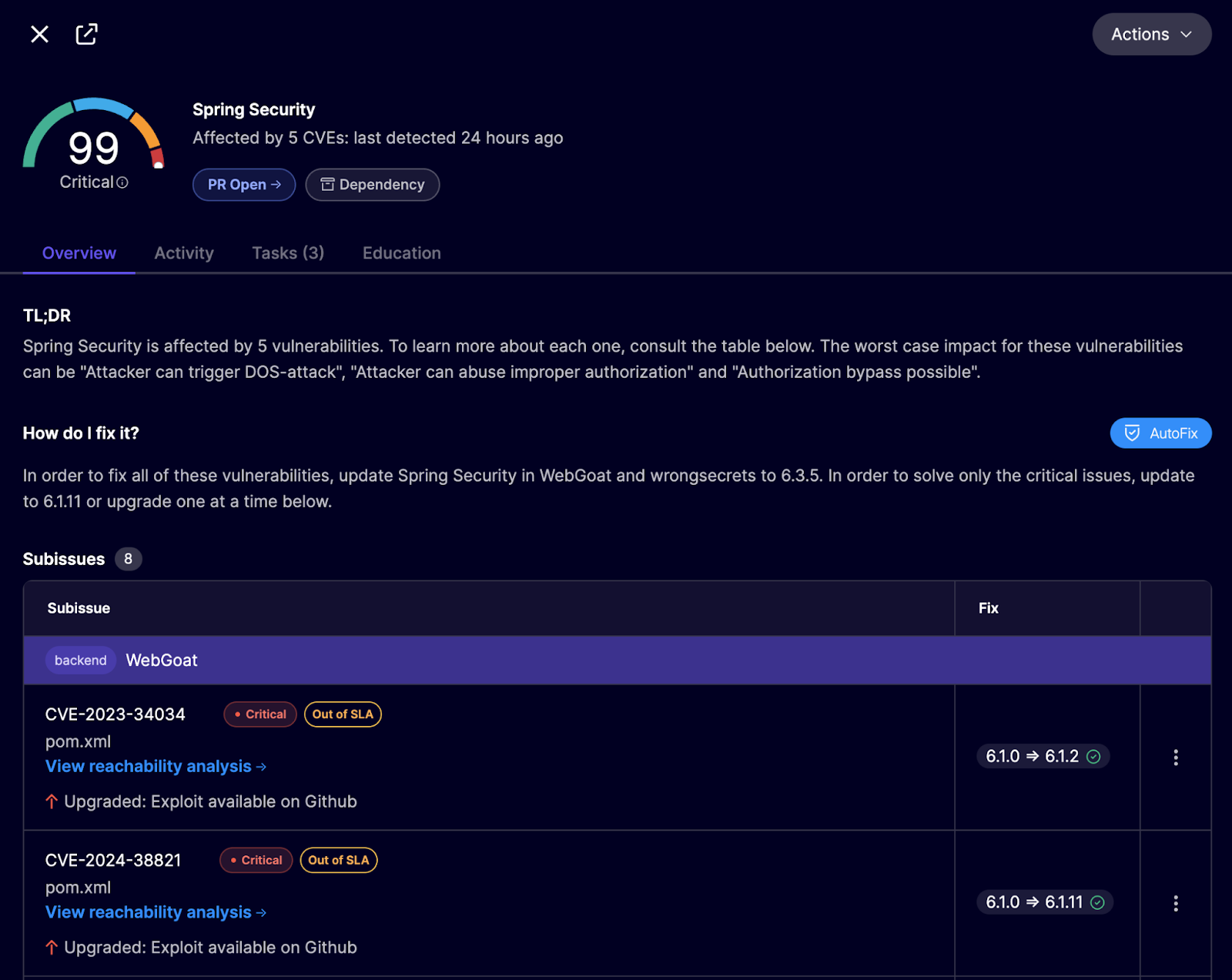
The upgrade is clearly marked as safe, with the relevant changelog linked for verification, reassuring developers that nothing will break when the upgrade is applied.

2. Breaking changes appear

If there are breaking changes that affect your application, then Aikido will flag this.

The breaking changes are summarized directly alongside the upgrade.
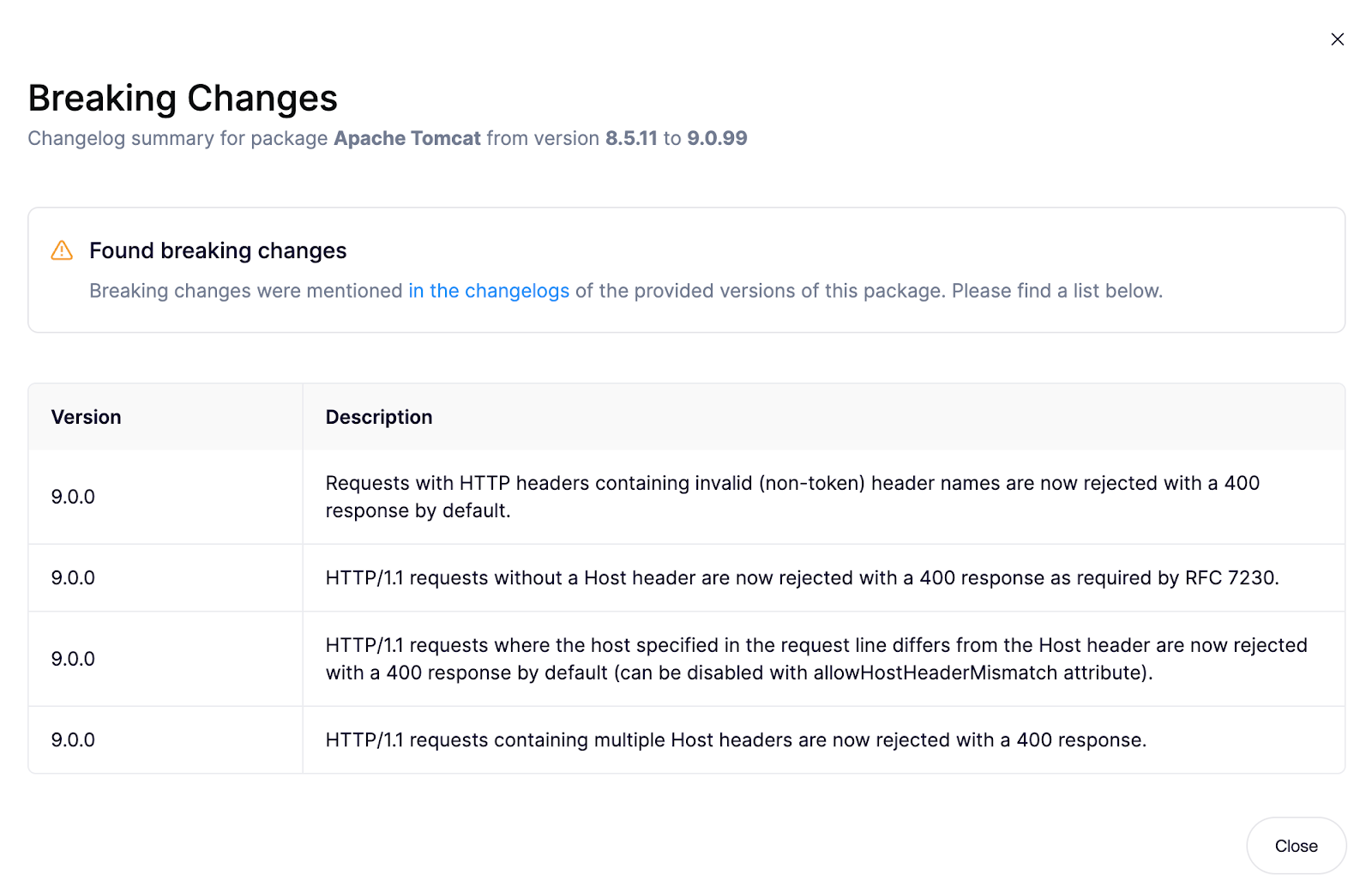
In this example, Tomcat may have previously allowed requests with slightly malformed headers, or those that had a missing <host> header, or even conflicting host information. The new version rejects those requests with a 400 Bad Request by default.

The upgrade doesn’t modify your application code, but it can break interactions with legacy clients or internal tools that send those types of requests, along with other edge cases. 

Instead, they can either upgrade immediately, knowing that no legacy clients exist and that all traffic goes through well-configured proxies, or alternatively, they could test before merging, schedule the upgrade for a sprint where infrastructure work makes more sense, or even upgrade for the CVE fix but temporarily relax the strict setting.

3. Manual validation required

If no changelog exists, that uncertainty is made explicit.
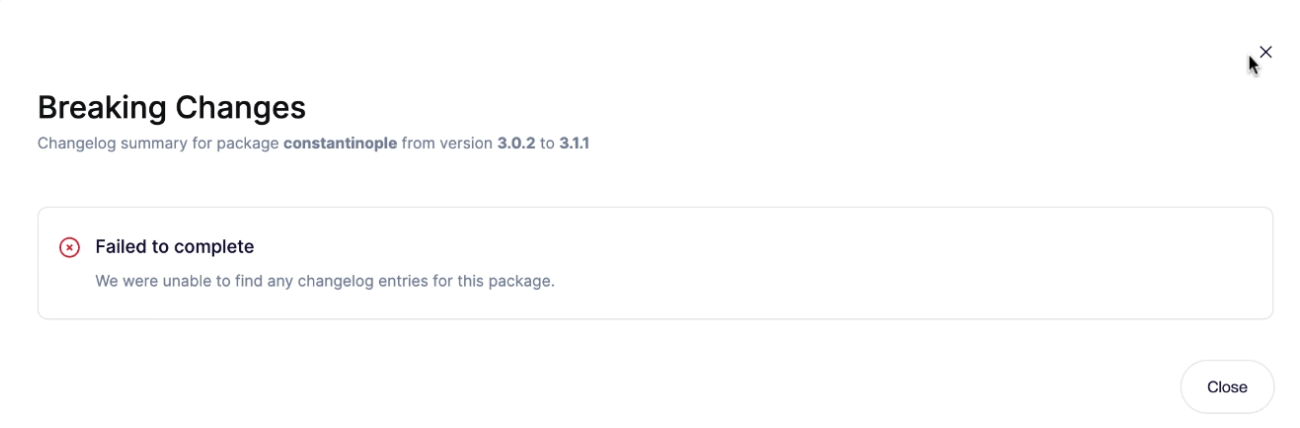
That provides the developer with transparency that there is no evidence either way on breaking changes. This could be down to the maintainer not documenting breaking changes or poor project maintenance. When no changelog is available, the upgrade is riskier, which signals to developers that they need to validate the upgrade manually.

Introducing Upgrade Impact Analysis

Identifying breaking changes is only half the picture.

Upgrade impact analysis goes further by analyzing the codebase to determine whether those changes are actually exercised. The analysis runs automatically as part of the pull request.

In the example below, upgrading Mongoose introduces two breaking changes. The pull request identifies the exact files and lines that rely on deprecated behavior, explains what changed, and outlines what needs to be updated.
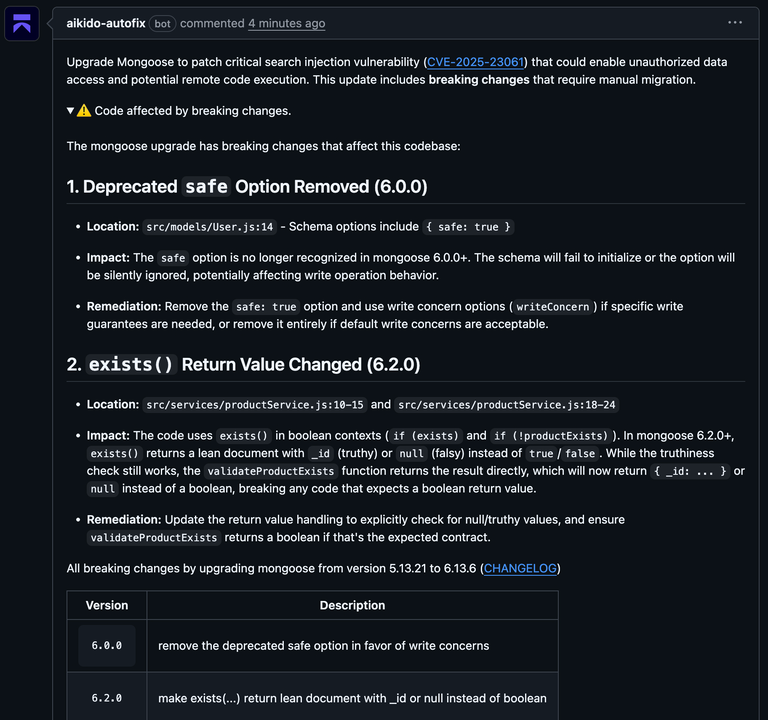
Aikido surfaces what would normally require reading release notes and tracing usages directly in the pull request.

Upgrading a dependency shouldn’t require guesswork. When the effect of a change is clear, teams can move forward without hesitation (and security fixes are more likely to get merged).

Breaking Changes and Upgrade Impact Analysis are available for JavaScript, Python, Java (including Kotlin and Scala), Go, .NET, PHP, and Clojure projects.