









When your clusters scale in minutes and new workloads deploy by the hour, the margin for error becomes razor-thin. A single overlooked configuration or outdated image can ripple across your entire system before anyone notices.
Now, in reality, most teams don’t fail with Kubernetes because they ignore security; they fail because they can’t keep up. According to the Red Hat’s State of Kubernetes Security Report, 67% of organizations have had to slow down or delay deployments due to security concerns. That number alone tells you everything: security isn’t an afterthought anymore, it’s a dependency.
Yet, even as threats keep evolving, so do the tools.
AI-driven scanners, smarter runtime monitors, and unified security dashboards are helping teams catch issues long before they reach production.
And this shift is part of a broader industry trend. Aikido’sState of AI in Security & Development 2026 report, found that many organizations struggled with the integration of cloud security and application security, and that those who used one vendor for both suffered from fewer incidents.
In this article, we’ll explore 7 Kubernetes security tools helping teams strike that balance, from open-source tools to state-of-the-art solutions like Aikido, offering best-of-breed products that simplify security from code to cloud.
Aikido is the leader when it comes to securing Kubernetes, with no noise and real protection. What truly sets it apart is AI-powered AutoFix, which continuously scans for misconfigs, exposures, and policy violations – across AWS, Azure, GCP, and more – and fixes them fast.
It also unifies code, container, and cloud security into a single, streamlined platform that integrates naturally with your existing workflow.
Aikido also filters out up to 95% of false positives before analysis, giving teams clear, high-confidence findings they can act on fast. For security teams, that means full Kubernetes coverage without juggling multiple tools or drowning in data. Aikido’s free tier makes it easy to start protecting your clusters right away, scaling as your workloads grow.
Kubernetes became the go-to platform for managing containerized applications because it automates deployment, scaling, and operations across clusters with remarkable efficiency. Its ability to orchestrate thousands of containers seamlessly made it the backbone of modern cloud-native systems.
Kubernetes security is the practice of protecting Kubernetes clusters, workloads, and the infrastructure they run on from misconfigurations, vulnerabilities, and malicious activity.
Beneath the smooth surface of resilient microservice platforms lies a complex cluster of containers, nodes, APIs, and network connections. Its complexity opens a rapidly expanding attack surface.
At its core, Kubernetes security encompasses the tools, controls, and processes you use to protect these clusters. This could be anything from image scanning and runtime detection to network policies and access controls.
This is important because your cluster is no longer just infrastructure; it’s the foundation of your digital operations. A single misstep in configuration, identity, or runtime behavior can expose sensitive data, disrupt services, or enable lateral movement. For example, a misconfigured pod might allow privilege escalation; an exposed API server might grant unchecked access.
As environments evolve from monoliths to distributed services, the same maturity that drives speed should also demand security maturity. In other words, the faster your cluster moves, the faster threats evolve, and you’re between those forces.
That’s where a focused security strategy comes in, one that aligns with your operational cadence, platform engineering standards, and DevSecOps culture. And as you dive in, you’ll see how Aikido supports this alignment by connecting vulnerability management, policy enforcement, and runtime visibility into a unified view.
The complexity of Kubernetes deployments creates a variety of security weak spots, and many teams can only cover a few. Let’s go through the common trouble spots you’ll want to keep an eye on:
1. Misconfigurations Everywhere: Kubernetes gives you flexibility, lots of it, which can be great for scale, but it also means there are dozens of buttons to press. If someone on the team enables host-networking by mistake, or leaves a pod running as root, they’ve just created a bigger attack window. It’s anything but a minor issue; in fact, platform engineers with years of experience admit that slight configuration drift can cause significant problems.
2. Vulnerable Container Images: You may have built a solid and reliable CI/CD pipeline that effectively builds and deploys container images, but if those images contain outdated libraries or unpatched vulnerabilities, you’re exposed before your deployment is completed. A container running an outdated version of OpenSSL, or an unpatched base image, is like giving threat actors priority access to your environment.
3. Secrets Management Gaps: Secrets such as API keys, database credentials, and tokens are the backbone of many services inside Kubernetes. But if they’re stored as plain text in a ConfigMap or reused across multiple services with broad access, then you’re inviting privilege escalation. Proper secret rotation, vault integration and least-privilege access are non-negotiable.
4. Over-permissive Role-Based Access Controls (RBAC): Granting cluster-admin access, even for faster access, bypasses isolation and increases potential damage from compromised accounts. You can limit the blast radius should a pod or service be breached by implementing properly scoped RBAC roles.
5. Runtime Security Risk: While static scanning offers benefits, it's insufficient for dynamic environments. Real-time threats like malicious container injections, altered permissions, or kernel exploits can occur at runtime. Without continuous, real-time visibility into your cluster, you lack critical security insight.
With those challenges in mind, it’s worth looking at the tools built to solve them. Below is a comparison table of some of the leading Kubernetes security solutions, evaluated across coverage, false positive reduction, AI autofix, and policy enforcement.
These tools address different parts of the Kubernetes security lifecycle, from image and IaC scanning to runtime protection and network policy enforcement.
| Tool | Coverage | False Positive Reduction | AI-Powered AutoFix | Policy Enforcement | Best For |
|---|---|---|---|---|---|
| Aikido | ✅ IaC, container & runtime security | ✅ Auto-triage cuts up to 95% of noise | ✅ Detect and fix misconfigs and over-permissioned roles | ✅ Automated compliance checks | Any organization looking to stay secure with less overhead |
| Aqua Security | ✅ Broad, enterprise-level coverage | ⚠️ Manual tuning required | ❌ No | ✅ Advanced | Large enterprises with complex compliance requirements |
| Falco | ⚠️ Runtime-only coverage | ⚠️ Requires rule tuning | ❌ No | ❌ No | Teams needing deep runtime visibility |
| Kubescape | ⚠️ Posture & misconfigurations | ⚠️ Manual review | ❌ No | ⚠️ Limited | Teams focusing on hardening cluster posture |
| Trivy | ⚠️ Build-time scanning | ⚠️ Requires manual filtering | ❌ No | ❌ No | Developers integrating scanning into CI/CD pipelines |
| Checkov | ⚠️ IaC & policy scanning | ⚠️ Manual policy setup | ❌ No | ❌ No | IaC-first DevSecOps teams |
| Cilium | ⚠️ Network & runtime enforcement | ⚠️ Manual tuning | ❌ No | ✅ Core strength | Multi-tenant or high-security Kubernetes clusters |
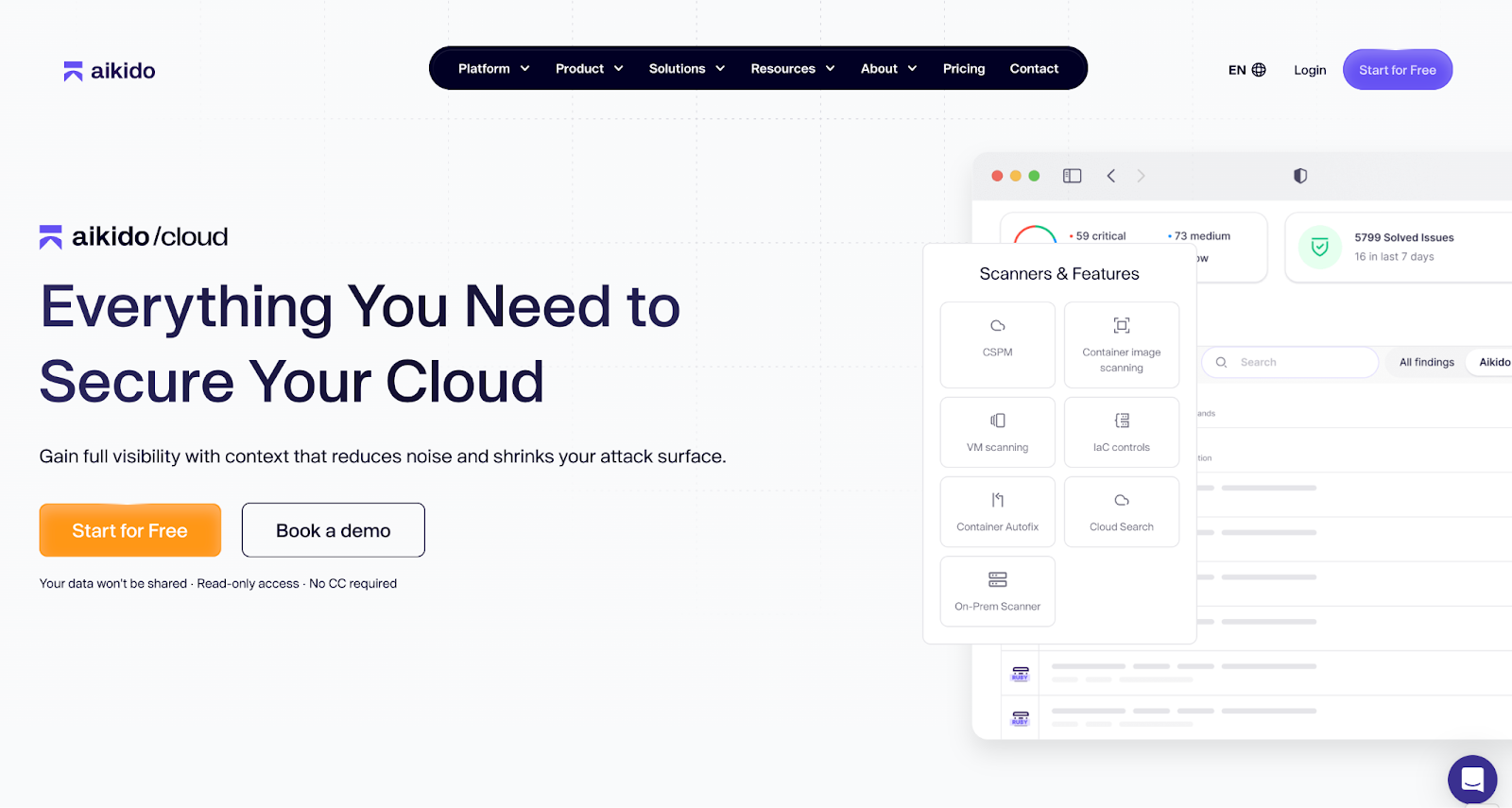
Aikido makes Kubernetes security faster, smarter, and far less noisy. It identifies real security risks across your container images, automatically filtering out false positives and irrelevant alerts using more than 25 validation rules.
Aikido is way more than a cluster or container-scanning Kubernetes tool, for organizations that want end-to-end security, it lets you track your code repositories, container images, IaC (Infrastructure as Code), Kubernetes manifests, secrets, and cloud workloads, all in one unified dashboard.
Key Features
Pros
Pricing Model
Aikido offers flexible plans designed to scale with your team’s size and security needs.
Pricing starts from the free tier, with higher tiers available based on scale and required features.
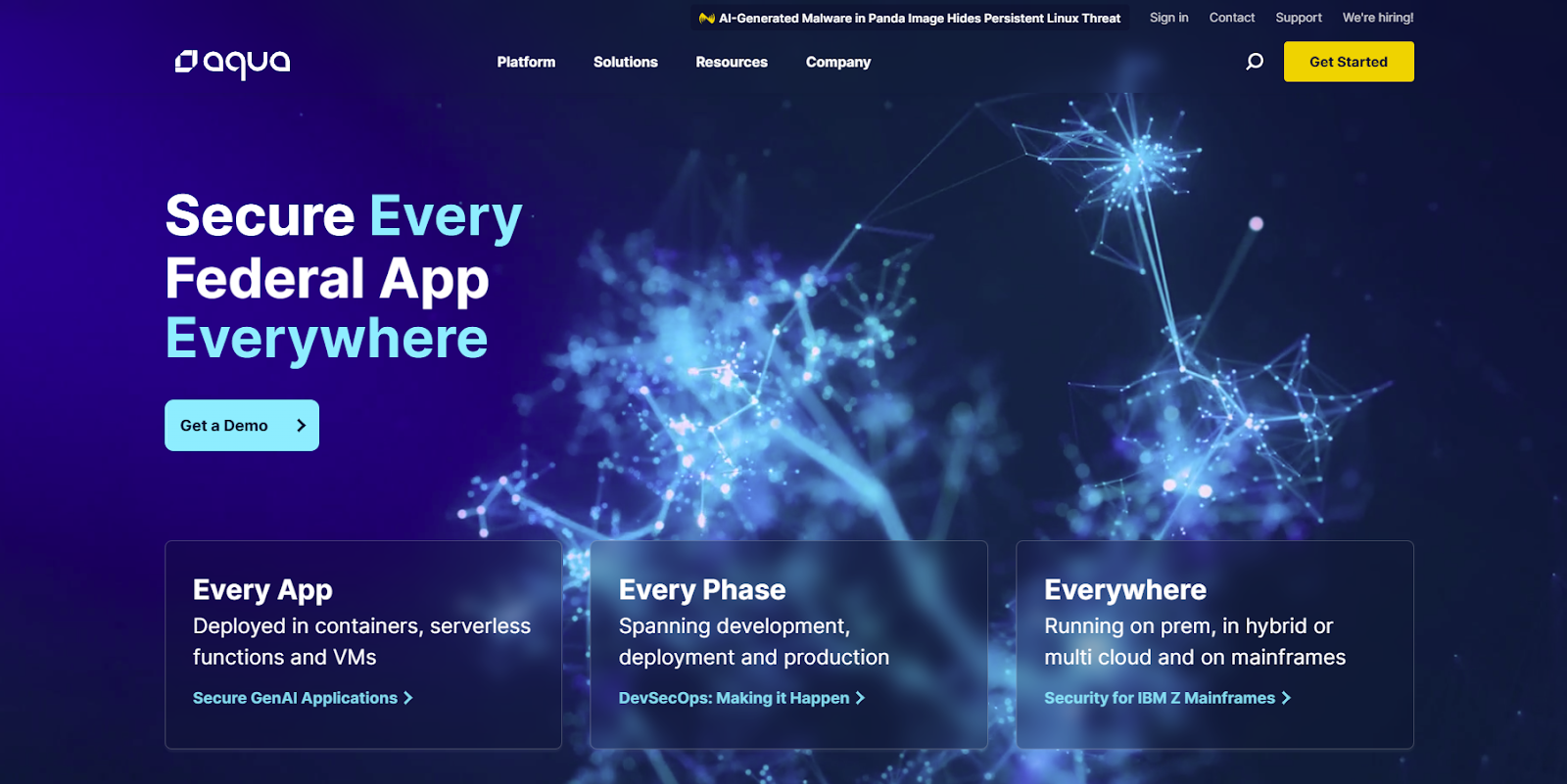
Aqua Security is a long-standing player in the cloud-native security space, with a broad array of capabilities covering containers, Kubernetes, serverless and cloud workloads. It integrates with major clouds and enterprise SIEM/command centers to provide unified visibility in large-scale environments.
Key Features
Pros
Cons
Pricing Model
Aqua Security doesn’t list pricing on its website. Instead, you can request a demo to see the platform in action and get a tailored quote based on your infrastructure size and security requirements.
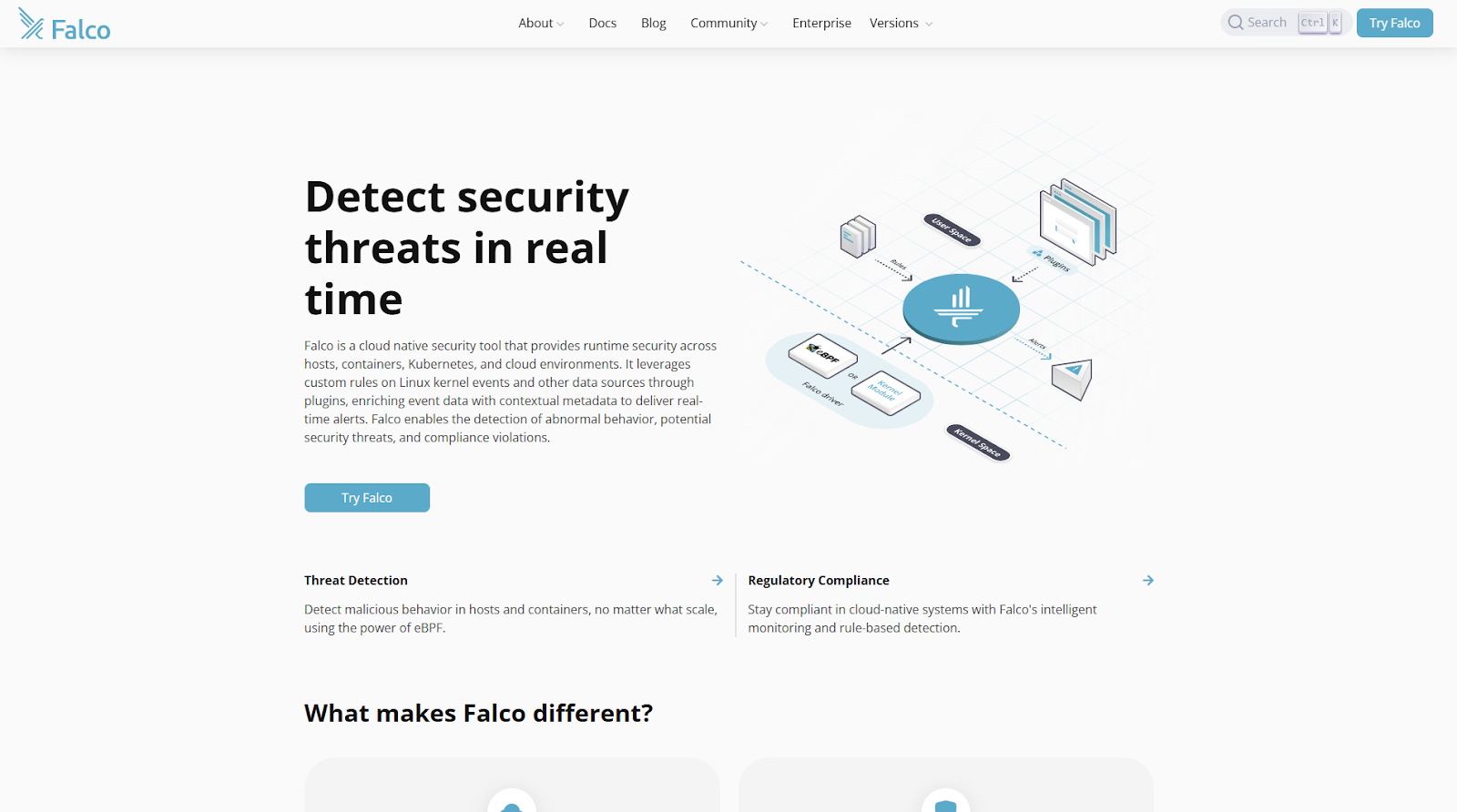
Falco is an open-source runtime security and behavioral-monitoring tool aimed at detecting anomalous activity within Kubernetes and container environments. It watches host/kernel events (via eBPF/syscalls) enriched with Kubernetes metadata and container contexts, and flags behavior like unexpected process execution, privilege escalation or system calls that deviate from norms.
Key Features
Pros
Cons
Pricing Model
Falco is free and open source, maintained by the Cloud Native Computing Foundation (CNCF). Any expenses come only from the related services you choose to integrate with it.
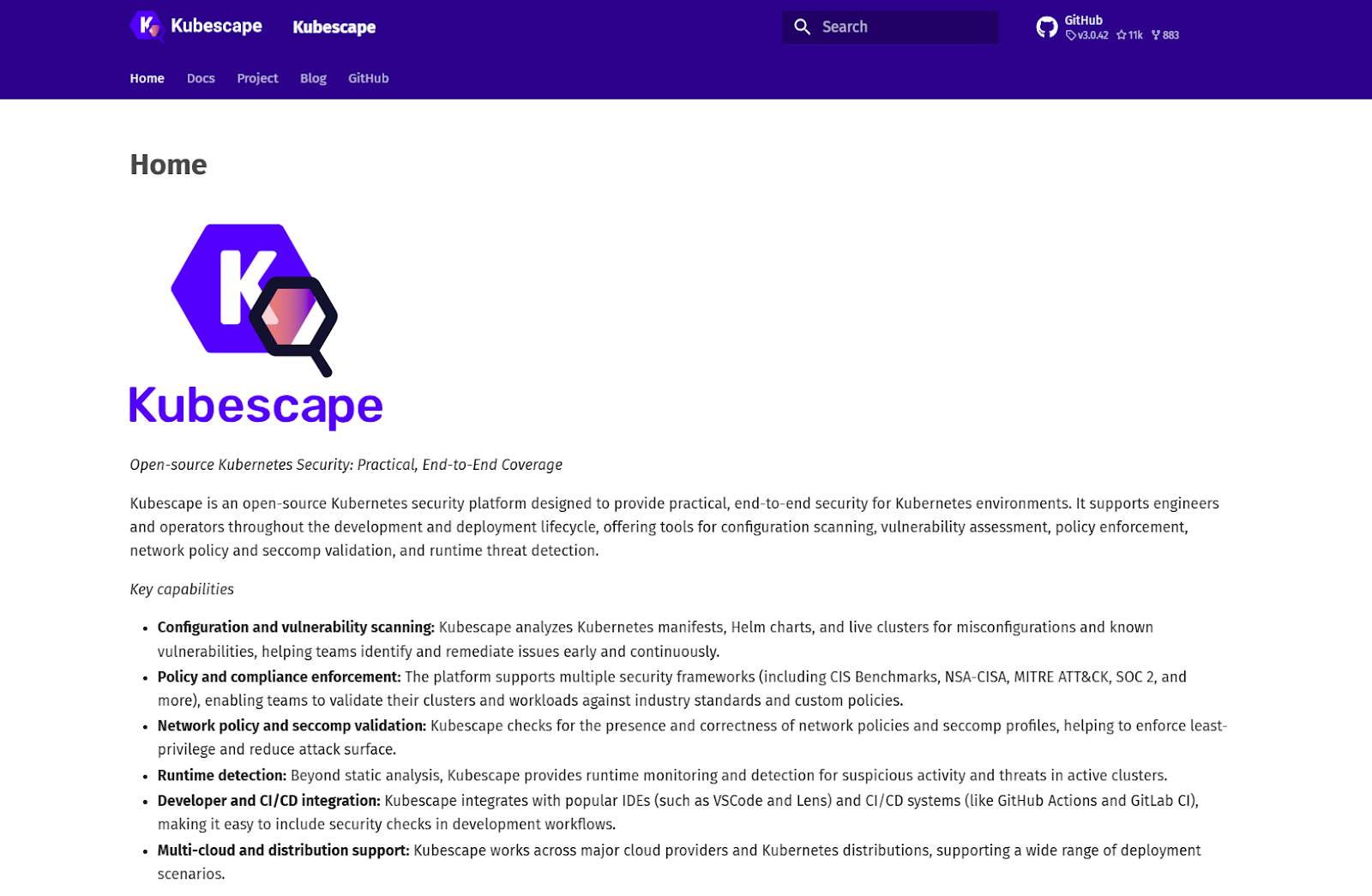
Kubescape is an open-source Kubernetes-specific security tool that spans posture management, manifest scanning and runtime threat detection. Originally a CLI tool, it now supports scanning of manifests/Helm charts, local YAML/JSON, and live cluster resources, and provides policy frameworks (NSA, CIS, MITRE) out-of-the-box.
Key Features
Pros
Cons
Pricing Model
The pricing model of Kubescape depends on a few factors specific to your cloud environment, such as the number of vCPUs and other cloud resources. You’d have to fill out a demo request form to get started.
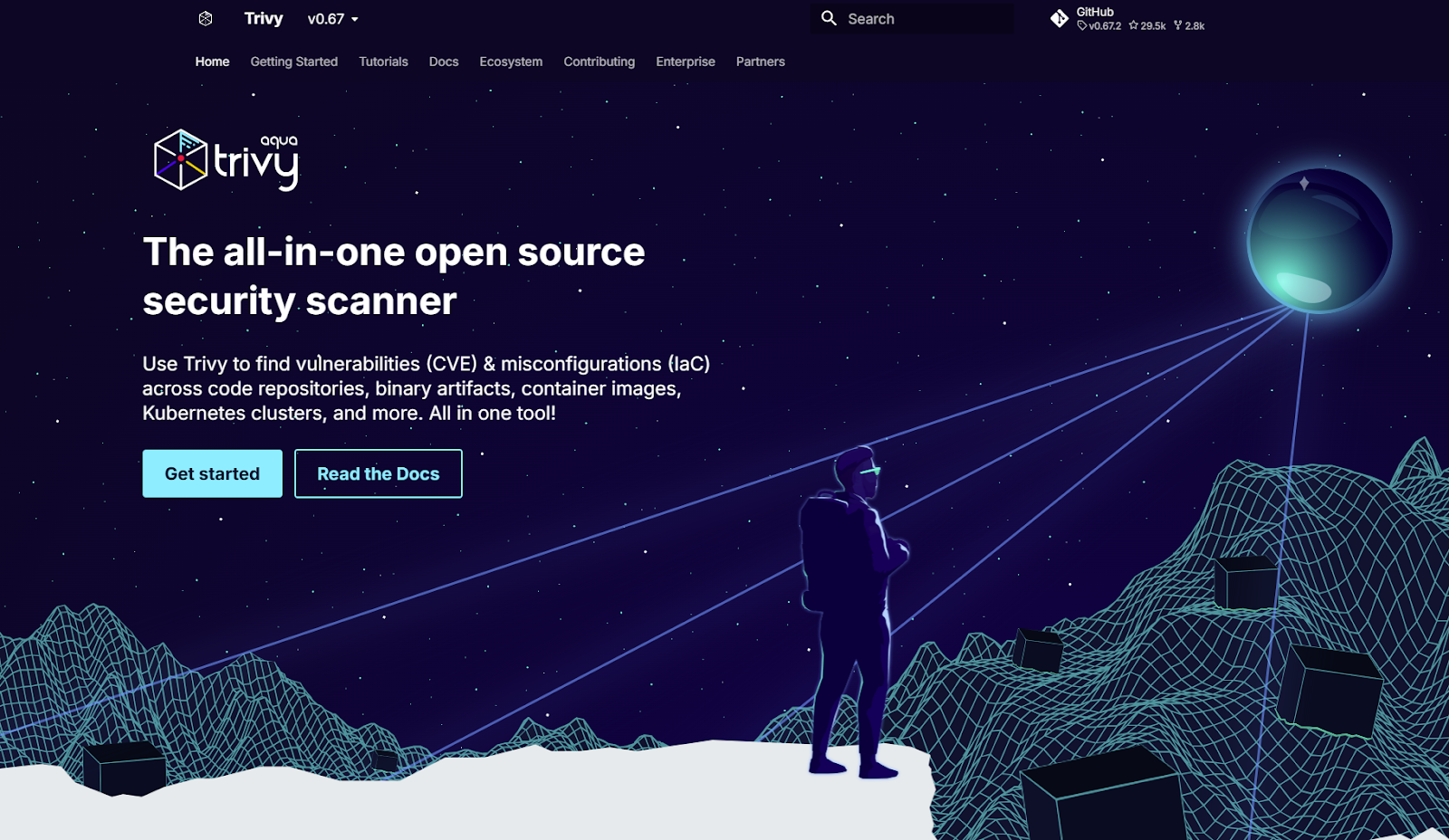
Trivy is a widely adopted open-source scanner focused on vulnerability scanning of container images, file systems, IaC, Git repositories and Kubernetes clusters. It aims to provide broad coverage and fast feedback with minimal effort. For Kubernetes users, Trivy supports scanning the cluster (via trivy k8s) for vulnerabilities, misconfigurations, and secrets in images, manifests, and deployed workloads.
Key Features
Pros
Cons
Pricing Model
Trivy is free and open-source, with no subscription or expiry.
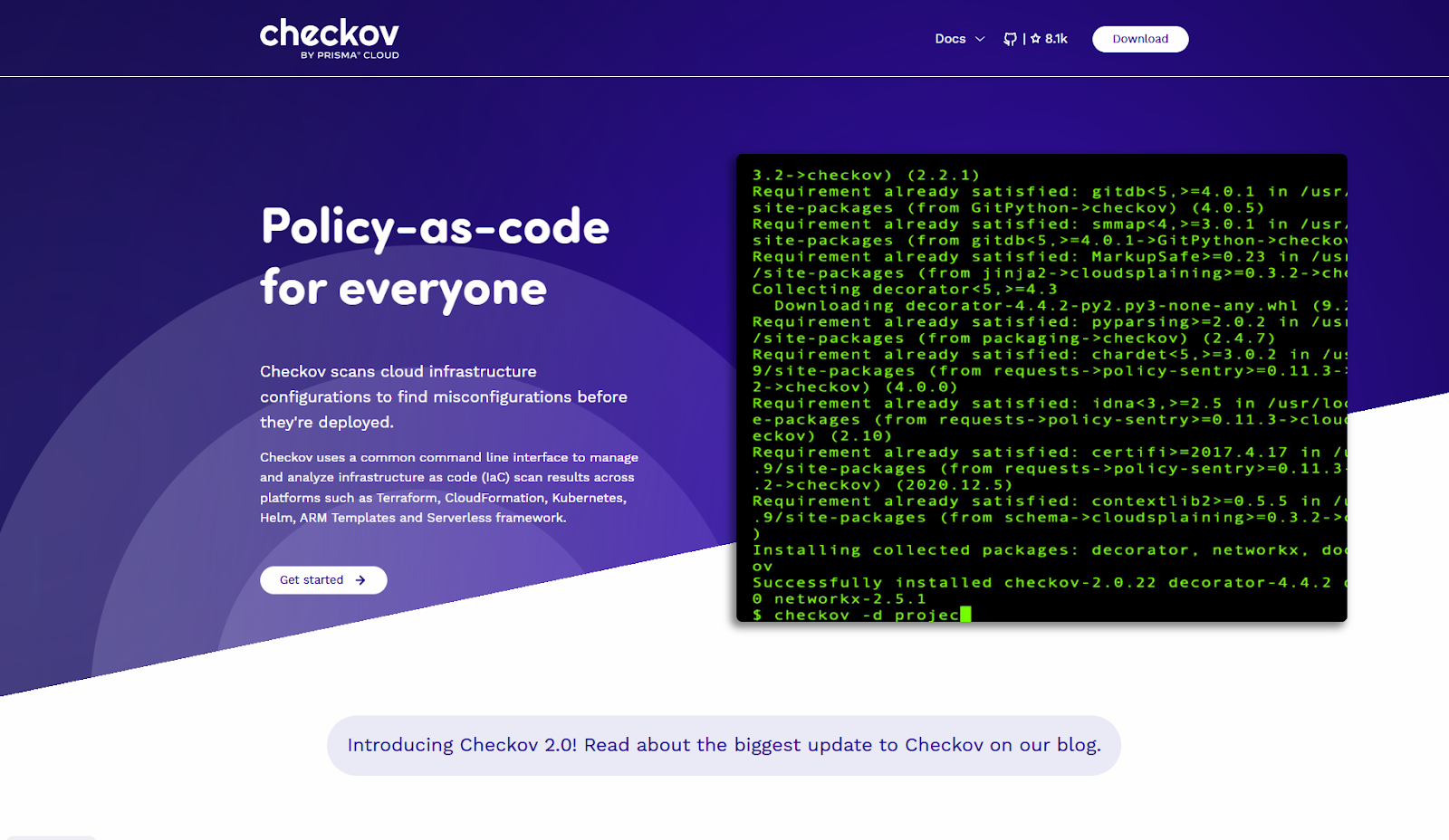
Checkov is an open-source Infrastructure-as-Code (IaC) scanning tool that supports Terraform, CloudFormation, Kubernetes manifests/Helm, and other infrastructure definitions. It helps enforce policy and detect misconfigurations and security issues before infrastructure is provisioned. For Kubernetes workflows, Checkov can catch risks in YAML/Helm charts or Terraform resources that instantiate Kubernetes clusters or workloads.
Key Features
Pros
Cons
Pricing Model
Checkov is available as both a free open-source tool and as part of the paid Prisma Cloud suite from Palo Alto Networks.
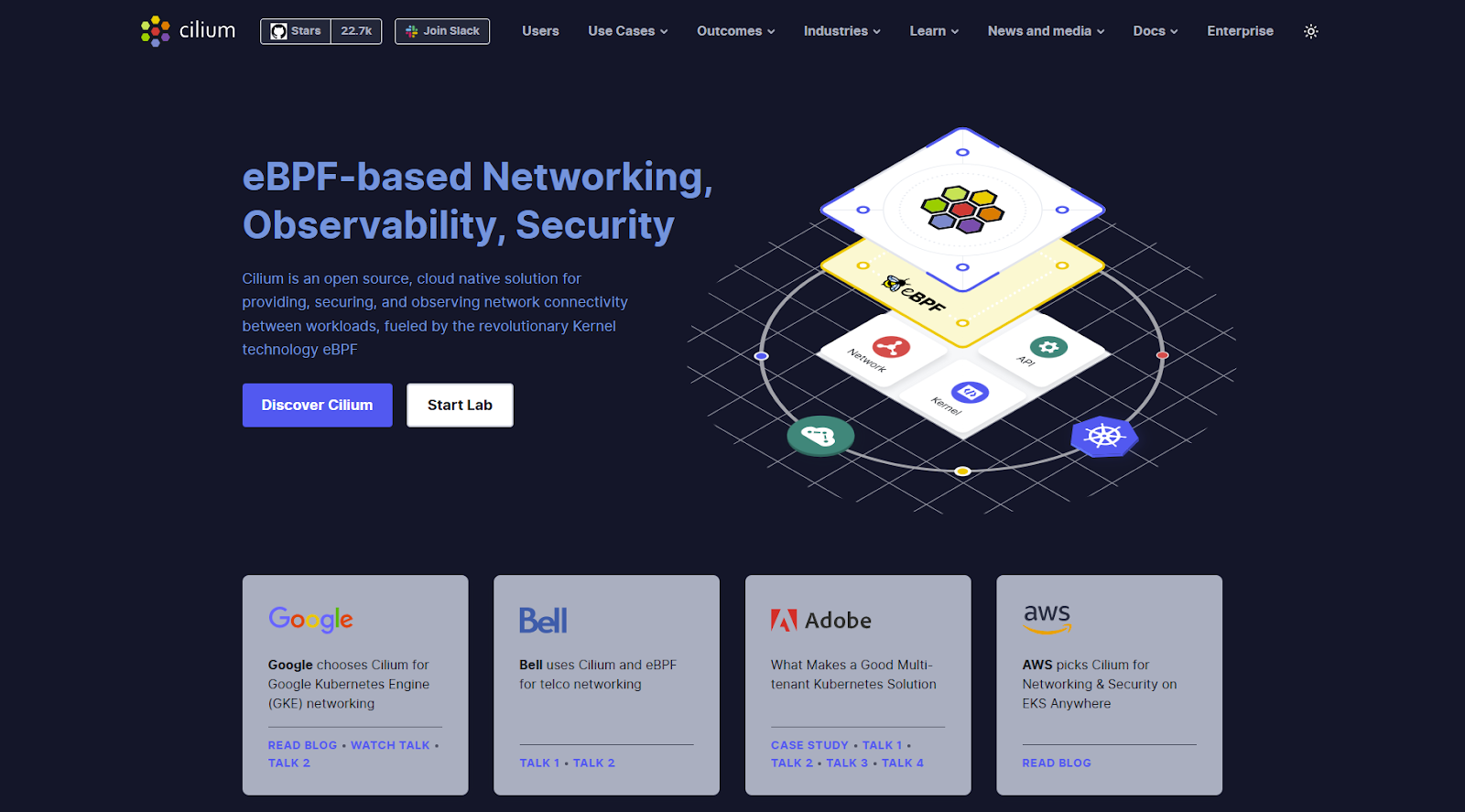
Cilium is an open-source networking, security and observability platform for containers and Kubernetes built on eBPF (extended Berkeley Packet Filter). Its Tetragon component adds runtime observability and enforcement capabilities. For Kubernetes platforms, Cilium offers advanced network policy enforcement (L3-L7), service mesh integration, visibility into inter-pod communication, and enforcement of runtime rules at the kernel level.
Key Features
Pros
Cons
Pricing Model
Cilium offers both a free open-source version and a paid enterprise edition.
Choosing the right Kubernetes security tool can feel overwhelming, not because options are scarce, but because there are too many promising the same thing. Each claims to secure your clusters, simplify compliance, or cut false positives in half.
Understand and make the following considerations when choosing a Kubernetes security tool:
1. Choosing a Kubernetes security tool goes beyond ticking boxes: It’s about finding what fits your team’s rhythm; your stack, your scale, and your workflow. A good tool should feel like part of your process, not a hindrance.
For DevSecOps and SRE teams, that means prioritizing seamless integration with your CI/CD pipelines, Kubernetes clusters, and monitoring stack. Security should move at the same speed as your deployments. The moment it slows you down, it risks being ignored.
So, evaluate how naturally a tool blends into your environment. Does it work with GitOps? Can it scan your Helm charts or IaC templates? Does it plug into the systems your team already uses daily, like Slack or Jira? These touchpoints determine whether a tool becomes a trusted partner or just another dashboard to maintain.
2. Coverage and Scalability: Many teams start with basic image scanning and later realise they need visibility into runtime behavior, network policies, or configuration drift. That’s why the best tools scan and connect the dots between build-time, deploy-time, and run-time risks. A unified platform like Aikido makes that easier by consolidating scanning, misconfiguration detection, and runtime insight under one roof. But even if you choose multiple tools, make sure they complement rather than compete. Think of them as layers in a single defence system.
3. Cost and Usability: A tool that takes weeks to deploy or floods you with false positives won’t survive real-world workloads. You want something that helps you act, not just alerts you. Evaluate how it prioritizes vulnerabilities, how much context it provides, and how easy it is to automate fixes. Security should empower engineers, not exhaust them. And while price matters, total cost includes the time spent managing alerts, maintaining integrations, and training new users.
4. Long-term Usage: Kubernetes evolves fast; think, new APIs and changing runtime architectures. Your chosen tool should grow with it. Look at the vendor’s track record, roadmap, and community support. The best tools adapt alongside Kubernetes, not behind it. In the end, the right security solution is the one that fits your operational DNA, scalable, pragmatic, and built to protect your clusters without slowing your team’s momentum.
Kubernetes security is the foundation of trust in how your systems run and scale. We’ve explored what makes it critical, the challenges of securing distributed workloads, and the tools designed to help you stay ahead of risk. From configuration drift to runtime exploits, the right toolchain can mean the difference between confidence and chaos.
In a space crowded with scanners, dashboards, and alerts, what truly matters is simplicity that delivers depth. That’s where Aikido stands out. It brings together the layers of Kubernetes security, code, images, configuration, and runtime into one place, giving your team clarity rather than noise.
此内容由惯性聚合(RSS阅读器)自动聚合整理,仅供阅读参考。 原文来自 — 版权归原作者所有。