


Tenable Nessus is a widely deployed vulnerability scanner, with a plugin library of more than 300,000 checks and a 25-year track record in network and infrastructure security. It identifies software flaws, missing patches, and misconfigurations across servers, network devices, cloud services, and configurations, with highly-rated scan accuracy. For security teams managing compliance requirements around frameworks like CIS, PCI-DSS, and ISO 27001, it remains a reliable and audit-ready choice.
But reviewers consistently flag a limited built-in remediation workflow, with findings needing to be exported manually to ticketing systems. And native integration options are described as basic. A powerful tool that sits disconnected from your ticketing system, your Slack, your CI/CD pipeline, and your developer workflows is one that nobody acts on. If you are searching for Tenable Nessus alternatives, you likely need a tool that connects to how your engineers already work and helps automate remediation. Tenable users should ask themselves this question: Do you want a tool that's powerful, but so hard to use that no one touches it? Or do you want something that plugs seamlessly into your engineers' day-to-day workflows?
This article walks through five credible alternatives to Tenable Nessus, focusing on platform breadth, developer workflow fit, remediation experience, and pricing.
Best overall: Aikido Security for teams that need SAST, DAST, SCA, secrets detection, IaC, container scanning, AI Pentesting, and cloud posture in one developer-first platform, without the overhead of stitching together separate tools or managing a findings backlog that engineers learn to ignore. Snyk is worth evaluating if your needs don't extend beyond open source dependencies, but costs and complexity grow fast. Wiz is strong on cloud visibility but leaves application security largely uncovered. Rapid7 is the closest Nessus alternative in spirit, but shares many of the same limitations. Checkmarx suits large enterprises with deep pockets and dedicated security teams, but is overkill for most.
Tenable Nessus has a large vulnerability plugin library, with coverage across a wide range of operating systems, network devices, cloud services, and configurations. Scan accuracy is consistently rated highly, and the tool has a long track record of staying current with emerging CVEs. For security teams responsible for network and infrastructure security across a large environment, or operating in regulated industries where network vulnerability management is a core requirement, Tenable Nessus remains a strong choice.
Most teams are looking for a Tenable Nessus alternative because findings sit in a dashboard engineers rarely check, coverage gaps leave parts of the stack unmonitored, and the cost keeps climbing.
Vulnerability scanners that do not integrate with how engineering teams already work create a hidden visibility problem. As Render's security team found when using Tenable, findings that cannot flow into ticketing systems, communication tools, or CI/CD pipelines require someone to manually check a separate dashboard and translate results into action. "The organization lacked integration with Linear or Slack, reducing visibility for engineers. It also made triaging more difficult." By the time a finding reached the developer who could fix it, the context for that fix was often already gone. Developers had moved on, the code had changed, and what could have been a one-line fix in a pull request now competed with roadmap work and incident response.
The friction extended beyond integrations. Within Tenable itself, managing findings was cumbersome. Ignoring a finding, adding a note, or writing a justification all required navigating a workflow built for security professionals running formal audits, rather than engineers trying to move quickly through a backlog.
Onboarding engineers to Tenable adds another layer of friction. SSO exists but configuration is cumbersome, making it hard to give the broader engineering team visibility into findings and slowing down the kind of organization-wide adoption that makes a security tool effective. The result is a tool that security teams run in isolation rather than one the whole engineering organization engages with.
Nessus covers infrastructure vulnerabilities well, but dependencies, secrets, IaC misconfigurations, containers, and cloud posture all need coverage too. Most teams end up bolting additional tools alongside Nessus to fill those gaps. Each one adds a new dashboard, a new alert stream, and a new integration to maintain without necessarily improving outcomes.
The cost of Nessus itself has also become harder to justify. Some users report pricing has tripled over the last few years, and Tenable introduced another price rise for Nessus Pro in March 2026, affecting both new and renewal subscriptions. When that cost sits alongside a growing list of complementary tools, total spend adds up quickly.
Once you have decided to look beyond Nessus, the risk is replacing one narrow or cumbersome tool with another. These four criteria can help you decide which tool best suits your needs:
| Tool | Platform breadth | Developer workflow fit | Remediation experience | Pricing transparency |
|---|---|---|---|---|
| Aikido | ✅ SCA, SAST, AI Pentesting, Device Protection, secrets, IaC, container scanning | ✅ Slack, Jira, Linear, Vanta, CI/CD native | ✅ Autofix in pull requests, one-click fixes | ✅ Published pricing, free tier available |
| Snyk | ⚠️ Strong on SCA; cloud coverage is separate | ✅ Developer-first, strong Git and IDE integration | ⚠️ Advanced auto-remediation requires higher tier plans | ⚠️ Published but scales quickly |
| Checkmarx | ✅ SAST, SCA, DAST, containers, IaC, API, secrets | ⚠️ CI/CD integrations exist but steep learning curve | ❌ Slow reports, steep learning curve, auto-remediation lags behind competitors | ❌ Quote-based, opaque licensing |
| Wiz | ⚠️ Strong on cloud, limited on SCA and SAST | ⚠️ Limited developer-facing integrations | ⚠️ AutoFix limited to main branch, not built for PR workflows | ❌ Quote-based, expensive at scale |
| Rapid7 | ⚠️ Strong on infrastructure and VM, uneven on AppSec | ⚠️ Limited developer-facing integrations | ⚠️ Improving but historically security-team-first | ❌ Quote-based, varies by module |
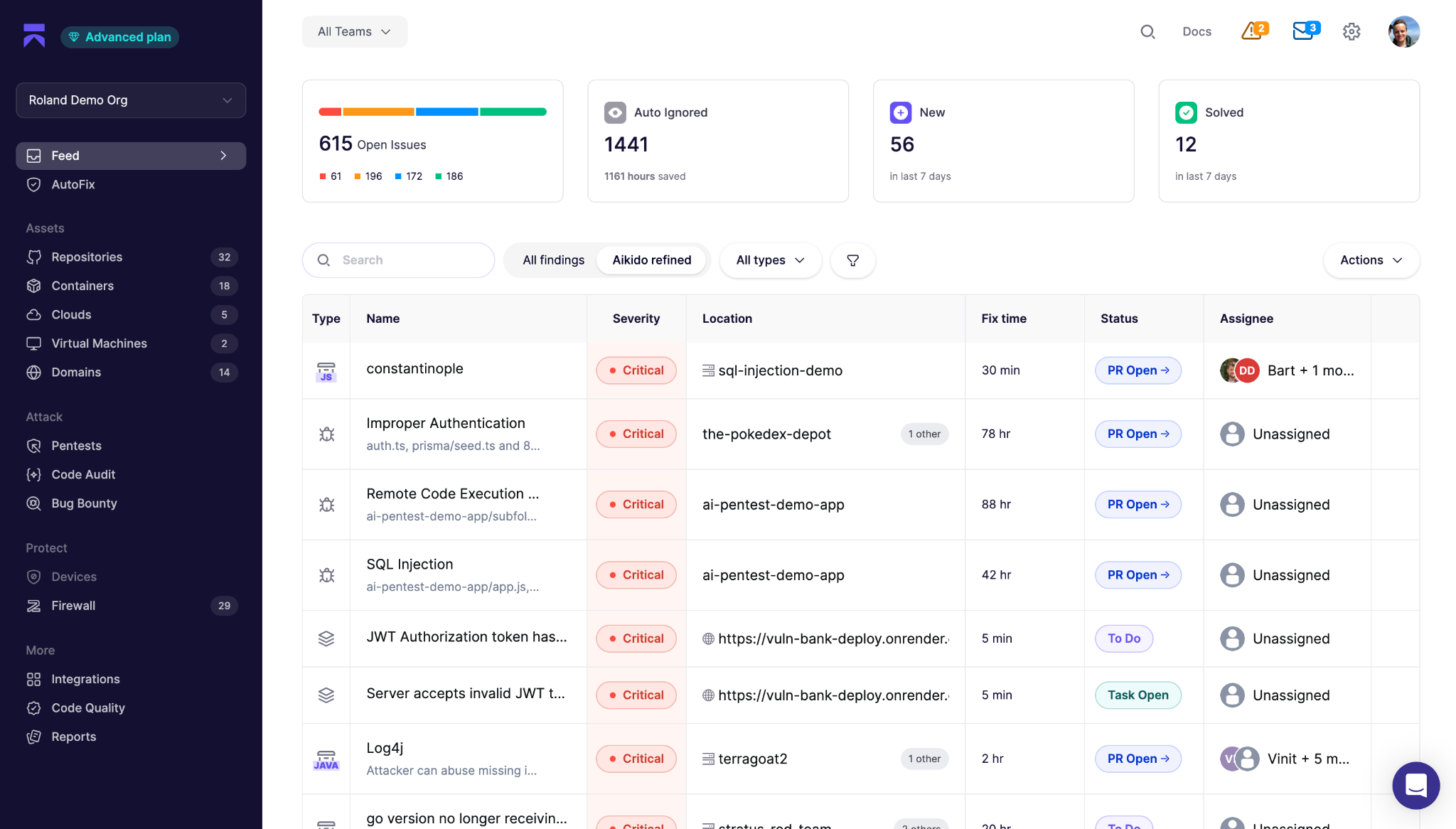
Aikido Security is the best overall option for teams that want to move beyond infrastructure scanning and into one platform for SAST, SCA, secrets detection, IaC scanning, container scanning, AI Pentesting, Device Protection, CSPM, and compliance reporting. Render's experience illustrates why platform consolidation matters. They initially evaluated Aikido to replace Tenable for DAST, but quickly saw the value in bringing SAST in under the same roof. Instead of managing two separate tools, consolidating them into a single platform eliminated the configuration overhead. New repositories could be added without repeating setup steps or maintaining scanning logic in multiple places.
Where Nessus detects vulnerabilities in running systems, Aikido catches them before they reach production, in source code, open source dependencies, configurations, and pipelines. Findings surface directly in pull requests with AutoFix suggestions attached, so developers can act without leaving their workflow. Aikido integrates natively with the tools engineering teams already use, including Slack, Jira, Linear, and Vanta, so findings flow into existing workflows rather than sitting in a separate dashboard nobody checks.
Aikido holds a 4.9/5 on Gartner Peer Insights and a 4.7/5 on Capterra, GetApp, and SourceForge. Reviewers consistently highlight ease of onboarding, noise reduction, and developer workflow fit as the standout differences from legacy tools.
Key features
Best for: engineering-led teams that want broad AppSec coverage without the overhead of managing multiple tools or a findings backlog that developers ignore.
Limitations: Aikido is built for application security rather than network and infrastructure vulnerability management. Teams that need deep network scanning will be better served by a dedicated infrastructure tool.
Pricing: Free plan available, with published platform tiers and custom enterprise options.
The table below highlights the differences discussed in this post between Aikido and Tenable Nessus. For a more detailed side-by-side breakdown of how Aikido compares to Tenable Nessus across specific features, integrations, and use cases, Aikido maintains a full comparison page that covers the key differences directly.
| Feature | Aikido | Tenable Nessus |
|---|---|---|
| Primary focus | Developer-first AppSec | Infrastructure and network vulnerability management |
| Platform breadth | SAST, SCA, secrets scanning, IaC, containers, AI Pentesting, Device Protection | Infrastructure, network, cloud posture |
| Remediation | Autofix in pull requests | Manual export to ticketing systems required |
| Developer workflow fit | Slack, Jira, Linear, Vanta, CI/CD native | Basic, limited native integrations |
| Pricing | Published tiers, free plan available | Annual subscription, prices have increased recently |
| Best for | Engineering-led teams wanting broad AppSec coverage | Enterprise teams managing infrastructure risk |
{{cta}}
Snyk is a platform for developer-first security across open-source dependencies, custom code, infrastructure as code, and containers. It is known for SCA and has easy initial adoption, but teams that outgrow its core use case often find themselves hitting the edges of what it was designed to do.
Snyk's strength is narrow by design. It handles open source dependencies well, but broader AppSec coverage requires bolting on additional Snyk products, each with its own pricing and configuration. At scale, finding volume increases, costs escalate quickly, and the platform starts to resemble the kind of fragmented tooling it was supposed to replace.
Key features
Best for: Teams with a narrow focus on open source and dependency risk who don't yet need broader AppSec coverage.
Limitations: Snyk can become noisy at scale, and advanced features are split across separate products, which adds complexity as requirements grow. Costs escalate quickly with usage, making it harder to justify as teams expand. Secrets detection is limited to the IDE, meaning secrets in repositories or pipelines require additional tooling. Runtime protection exists but is a recent addition focused primarily on AI agent security rather than broad in-app threat blocking. Teams that need cloud posture management will still need a separate tool. For a broader platform view, see this Snyk comparison.
Pricing: Free tier available. Team and enterprise plans are usage-based and scale with the number of contributing developers.
Checkmarx is an enterprise-grade application security platform with deep SAST capabilities and a long track record in regulated industries. For large enterprises with dedicated AppSec teams, Checkmarx delivers comprehensive coverage. For everyone else, the tradeoffs are hard to ignore. False positive rates are high, scan times are long, and the interface and reporting reflect a product built for security professionals rather than the developers. IDE auto-remediation lags behind newer tools, and pricing is opaque, requiring sales conversations and multi-year commitments before costs become clear.
Key features:
Best for: large enterprises in regulated industries with dedicated security teams and the budget and patience to configure and maintain an enterprise platform.
Limitations: Checkmarx generates a high volume of false positives that typically require dedicated triage resources to manage. Scan times are long enough to disrupt development velocity, and the interface carries a steep learning curve that reflects a product designed for security professionals rather than developers. IDE auto-remediation lags behind newer tools. Pricing is enterprise-grade, requires a sales conversation to understand, and multi-year contracts are typically expected. For a broader platform view, see this Checkmarx comparison.
Pricing: Quote-based. No publicly listed pricing. Multi-year contracts typical at enterprise scale.
Wiz is the CNAPP market leader, recently acquired by Google, with exceptional cloud security coverage and a Security Graph approach that gives security teams a clear view of risk across multi-cloud environments. If your primary concern is cloud posture, Wiz is one of the strongest options available.
The limitations become apparent when teams need coverage beyond cloud infrastructure. SAST and SCA capabilities exist but are secondary to the platform's infrastructure focus, and they are not particularly developer-friendly. Findings are surfaced without much context or prioritisation for developers, AutoFix is constrained to the main branch in many implementations making it impractical for PR-based workflows, and pricing is quote-based and widely reported as expensive at scale. Teams looking to replace a broad set of AppSec tools alongside Nessus will find Wiz covers one part of that problem well and the rest only partially. For a broader platform overview, see this Wiz comparison.
Key features:
Best for: enterprise security teams whose primary requirement is cloud posture management and visibility across multi-cloud environments.
Limitations: SAST and SCA are secondary capabilities; AutoFix limited to main branch and not built for PR workflows; not designed for developer-facing AppSec; quote-based pricing expensive at scale; limited coverage of application code and open source dependencies.
Pricing: Quote-based. No publicly listed pricing. Widely reported as one of the more expensive options at enterprise scale.
Rapid7 is a broad security platform covering vulnerability management, DAST, SIEM, and incident detection. It has been a fixture in enterprise security operations for years and has meaningful depth in infrastructure vulnerability management, making it a closer direct comparison to Nessus than the other tools on this list.
Where Rapid7 falls short for teams looking beyond traditional vulnerability management is in the developer experience. The platform was built for security operations teams first, and that shows in how findings are presented and actioned. Noise can be significant without careful tuning, developer integrations are less mature than purpose-built AppSec tools, and pricing varies considerably by module, making total cost of ownership hard to predict. Teams looking for a single platform that spans code, cloud, and developer workflow will find Rapid7 better suited to the infosec side of that equation than the AppSec side.
Key features:
Best for: enterprise security operations teams that need vulnerability management alongside SIEM and incident response in one platform.
Limitations: Developer experience lags behind purpose-built AppSec tools; noisy without tuning; pricing varies by module and is not publicly listed; application code and dependency scanning coverage is limited compared to dedicated AppSec platforms.
Pricing: Quote-based. Pricing varies significantly by module and deployment.
What is Tenable Nessus used for?
Tenable Nessus is a vulnerability scanner used primarily for identifying security weaknesses across network infrastructure, servers, cloud services, and configurations. It is widely used by enterprise security teams for compliance auditing against frameworks like CIS, PCI-DSS, and ISO 27001.
Why do teams look for Tenable Nessus alternatives?
The most common reasons are limited remediation workflow, weak native integrations with developer tools, and rising costs. Tenable Nessus finds vulnerabilities but does not help engineering teams fix them, which creates friction as organisations move to faster release cycles.
What is the best Tenable Nessus alternative in 2026?
Aikido Security is the best overall alternative for engineering-led teams that need broad AppSec coverage across code, cloud, and runtime in one platform. For teams focused primarily on open source dependencies, Snyk is worth evaluating. For cloud posture management, Wiz leads the market.
Is Tenable Nessus good for application security?
Nessus was designed for network and infrastructure scanning rather than application security. It does not natively cover source code analysis, open source dependencies, secrets detection, or IaC misconfigurations. Teams that need application security coverage typically use Nessus alongside dedicated AppSec tools, or replace it with a platform like Aikido that spans both.
Is Tenable Nessus free?
Tenable offers Nessus Essentials as a free tier, though it is now limited to a 30-day evaluation with a cap of five IP addresses. Nessus Professional and Expert require annual paid subscriptions, and pricing has increased in recent years.
{{walkthrough}}
Last updated on:
Jun 4, 2026
<script type="application/ld+json">
{
"@context": "https://schema.org",
"@graph": [
{
"@type": "BlogPosting",
"@id": "https://www.aikido.dev/blog/tenable-nessus-alternatives#blogposting",
"mainEntityOfPage": {
"@type": "WebPage",
"@id": "https://www.aikido.dev/blog/tenable-nessus-alternatives"
},
"headline": "Top 5 Tenable Nessus Alternatives in 2026",
"description": "Tenable Nessus finds vulnerabilities but won't help you fix them. Compare the five best alternatives based on platform breadth, developer workflow fit, remediation experience, and pricing transparency.",
"image": {
"@type": "ImageObject",
"url": "https://www.aikido.dev/blog/tenable-nessus-alternatives/og-image.png",
"width": 1200,
"height": 630
},
"datePublished": "2026-06-03T00:00:00Z",
"dateModified": "2026-06-03T00:00:00Z",
"author": {
"@type": "Person",
"@id": "https://www.aikido.dev/authors/nicholas-thomson",
"name": "Nicholas Thomson",
"jobTitle": "Senior SEO & Growth Lead",
"worksFor": {
"@type": "Organization",
"name": "Aikido Security",
"url": "https://www.aikido.dev"
},
"sameAs": [
"https://www.linkedin.com/",
"https://x.com/"
]
},
"publisher": {
"@type": "Organization",
"@id": "https://www.aikido.dev#organization",
"name": "Aikido Security",
"url": "https://www.aikido.dev",
"logo": {
"@type": "ImageObject",
"url": "https://www.aikido.dev/logo.png"
}
},
"url": "https://www.aikido.dev/blog/tenable-nessus-alternatives",
"keywords": [
"Tenable Nessus alternatives",
"vulnerability scanner alternatives",
"application security platform",
"DevSecOps tools",
"SAST",
"DAST",
"SCA",
"AppSec",
"developer workflow security",
"Aikido Security",
"Snyk",
"Checkmarx",
"Wiz",
"Rapid7",
"vulnerability management",
"IaC scanning",
"secrets detection",
"cloud security posture management",
"CSPM",
"remediation workflow"
],
"articleSection": "DevSec Tools & Comparisons",
"inLanguage": "en",
"timeRequired": "PT10M",
"about": [
{
"@type": "SoftwareApplication",
"name": "Tenable Nessus",
"applicationCategory": "SecurityApplication",
"url": "https://www.tenable.com/products/nessus"
},
{
"@type": "SoftwareApplication",
"name": "Aikido Security",
"applicationCategory": "SecurityApplication",
"url": "https://www.aikido.dev"
}
],
"mentions": [
{
"@type": "SoftwareApplication",
"name": "Snyk",
"url": "https://snyk.io"
},
{
"@type": "SoftwareApplication",
"name": "Checkmarx",
"url": "https://checkmarx.com"
},
{
"@type": "SoftwareApplication",
"name": "Wiz",
"url": "https://wiz.io"
},
{
"@type": "SoftwareApplication",
"name": "Rapid7",
"url": "https://www.rapid7.com"
},
{
"@type": "DefinedTerm",
"name": "SAST",
"description": "Static Application Security Testing — analysis of source code for security vulnerabilities before deployment."
},
{
"@type": "DefinedTerm",
"name": "DAST",
"description": "Dynamic Application Security Testing — security testing of running applications to find vulnerabilities at runtime."
},
{
"@type": "DefinedTerm",
"name": "SCA",
"description": "Software Composition Analysis — scanning of open source dependencies for known vulnerabilities."
},
{
"@type": "DefinedTerm",
"name": "CSPM",
"description": "Cloud Security Posture Management — continuous monitoring of cloud environments for misconfigurations and compliance risks."
}
],
"speakable": {
"@type": "SpeakableSpecification",
"cssSelector": ["h1", "h2", ".article-summary"]
}
},
{
"@type": "WebPage",
"@id": "https://www.aikido.dev/blog/tenable-nessus-alternatives",
"url": "https://www.aikido.dev/blog/tenable-nessus-alternatives",
"name": "Top 5 Tenable Nessus Alternatives in 2026",
"description": "Tenable Nessus finds vulnerabilities but won't help you fix them. Compare the five best alternatives based on platform breadth, developer workflow fit, remediation experience, and pricing transparency.",
"isPartOf": {
"@type": "WebSite",
"@id": "https://www.aikido.dev#website",
"url": "https://www.aikido.dev",
"name": "Aikido Security"
},
"breadcrumb": {
"@id": "https://www.aikido.dev/blog/tenable-nessus-alternatives#breadcrumb"
},
"inLanguage": "en"
},
{
"@type": "BreadcrumbList",
"@id": "https://www.aikido.dev/blog/tenable-nessus-alternatives#breadcrumb",
"itemListElement": [
{
"@type": "ListItem",
"position": 1,
"name": "Home",
"item": "https://www.aikido.dev"
},
{
"@type": "ListItem",
"position": 2,
"name": "Blog",
"item": "https://www.aikido.dev/blog"
},
{
"@type": "ListItem",
"position": 3,
"name": "Top 5 Tenable Nessus Alternatives in 2026",
"item": "https://www.aikido.dev/blog/tenable-nessus-alternatives"
}
]
},
{
"@type": "ItemList",
"@id": "https://www.aikido.dev/blog/tenable-nessus-alternatives#itemlist",
"name": "Top 5 Tenable Nessus Alternatives in 2026",
"description": "A ranked list of the best alternatives to Tenable Nessus for DevSecOps and AppSec teams.",
"numberOfItems": 5,
"itemListElement": [
{
"@type": "ListItem",
"position": 1,
"name": "Aikido Security",
"url": "https://www.aikido.dev",
"description": "Best overall alternative for teams that need SAST, SCA, secrets detection, IaC, container scanning, AI Pentesting, and cloud posture in one developer-first platform."
},
{
"@type": "ListItem",
"position": 2,
"name": "Snyk",
"url": "https://snyk.io",
"description": "Best for teams focused primarily on open source dependency risk who do not yet need broader AppSec coverage."
},
{
"@type": "ListItem",
"position": 3,
"name": "Checkmarx",
"url": "https://checkmarx.com",
"description": "Best for large enterprises in regulated industries with dedicated security teams and compliance requirements."
},
{
"@type": "ListItem",
"position": 4,
"name": "Wiz",
"url": "https://wiz.io",
"description": "Best for enterprise security teams whose primary requirement is cloud posture management across multi-cloud environments."
},
{
"@type": "ListItem",
"position": 5,
"name": "Rapid7",
"url": "https://www.rapid7.com",
"description": "Best for enterprise security operations teams that need vulnerability management alongside SIEM and incident response."
}
]
},
{
"@type": "FAQPage",
"@id": "https://www.aikido.dev/blog/tenable-nessus-alternatives#faq",
"mainEntity": [
{
"@type": "Question",
"name": "What is Tenable Nessus used for?",
"acceptedAnswer": {
"@type": "Answer",
"text": "Tenable Nessus is a vulnerability scanner used primarily for identifying security weaknesses across network infrastructure, servers, cloud services, and configurations. It is widely used by enterprise security teams for compliance auditing against frameworks like CIS, PCI-DSS, and ISO 27001."
}
},
{
"@type": "Question",
"name": "Why do teams look for Tenable Nessus alternatives?",
"acceptedAnswer": {
"@type": "Answer",
"text": "The most common reasons are limited remediation workflow, weak native integrations with developer tools, and rising costs. Tenable Nessus finds vulnerabilities but does not help engineering teams fix them, which creates friction as organisations move to faster release cycles."
}
},
{
"@type": "Question",
"name": "What is the best Tenable Nessus alternative in 2026?",
"acceptedAnswer": {
"@type": "Answer",
"text": "Aikido Security is the best overall alternative for engineering-led teams that need broad AppSec coverage across code, cloud, and runtime in one platform. For teams focused primarily on open source dependencies, Snyk is worth evaluating. For cloud posture management, Wiz leads the market."
}
},
{
"@type": "Question",
"name": "Is Tenable Nessus good for application security?",
"acceptedAnswer": {
"@type": "Answer",
"text": "Nessus was designed for network and infrastructure scanning rather than application security. It does not natively cover source code analysis, open source dependencies, secrets detection, or IaC misconfigurations. Teams that need application security coverage typically use Nessus alongside dedicated AppSec tools, or replace it with a platform like Aikido that spans both."
}
},
{
"@type": "Question",
"name": "Is Tenable Nessus free?",
"acceptedAnswer": {
"@type": "Answer",
"text": "Tenable offers Nessus Essentials as a free tier, though it is now limited to a 30-day evaluation with a cap of five IP addresses. Nessus Professional and Expert require annual paid subscriptions, and pricing has increased in recent years."
}
}
]
},
{
"@type": "Organization",
"@id": "https://www.aikido.dev#organization",
"name": "Aikido Security",
"url": "https://www.aikido.dev",
"logo": {
"@type": "ImageObject",
"url": "https://www.aikido.dev/logo.png"
},
"sameAs": [
"https://www.linkedin.com/company/aikido-security",
"https://x.com/AikidoSecurity"
]
}
]
}
</script>
Tired of false positives?
Try Aikido like 100k others.
Start Now
Get a personalized walkthrough
Trusted by 100k+ teams
Book Now
Scan your app for IDORs and real attack paths
Trusted by 100k+ teams
Start Scanning
See how AI pentests your app
Trusted by 100k+ teams
Start Testing
Security your engineers will actually use
Trusted by 100k+ teams
Start Now
•
DevSec Tools & Comparisons
AI SAST is emerging as a new SAST category, but the meaning is unclear. We clarify the difference between AI-native SAST and AI-assisted SAST, as well as how AI SAST sits in the stack between traditional SAST and AI pentesting.

•
DevSec Tools & Comparisons
Compare the Top GitGuardian Alternatives for secrets scanning in 2026. See where Aikido Security, GitHub Secret Protection, TruffleHog, Gitleaks, Semgrep, Snyk, Cycode, Checkmarx, and GitLab fit best.
•
DevSec Tools & Comparisons
Looking for a Gitleaks alternative? We compare Betterleaks, TruffleHog, Aikido, GitHub Advanced Security, and Spectral so you can find the best secrets scanner for your team.
Secure your code, cloud, and runtime in one central system.
Find and fix vulnerabilities fast automatically.
No credit card required | Scan results in 32secs.

此内容由惯性聚合(RSS阅读器)自动聚合整理,仅供阅读参考。 原文来自 — 版权归原作者所有。