





AI coding agents like Claude Code, Cursor, Codex, Gemini, and GitHub Copilot are now standard tools across engineering organizations. They write code, resolve dependencies, interact with external services, and ship changes through your entire development pipeline — often with minimal human oversight.
The security challenge this creates goes far beyond AI-generated code quality. It spans the entire software development lifecycle, from the development environment where an AI coding agent first runs, through the code repository where it pushes changes, to the CI/CD pipeline where it builds and deploys.
Recent attacks prove this isn't theoretical. The Shai-Hulud "Second Coming" campaign compromised npm packages that executed on developer machines, stole credentials, and weaponized AI CLI tools for reconnaissance. The NX Build System compromise hit developers through a VSCode extension that silently ran malicious code at activation. And the Trust Wallet incident showed how stolen developer credentials led to a malicious browser extension published to the Chrome Web Store, impacting thousands of their users.
These attacks share a common thread: they target the stages of development where AI coding agents now operate.
.png)
Agentic software development follows a three-stage flow, and each stage introduces a distinct attack surface.
This is where vibe coding begins. An AI coding agent receives a natural language prompt and starts building. Whether running locally or in an ephemeral cloud environment, it operates with access to credentials, SSH keys, cloud tokens, and source code.
IDE extensions can be compromised (the NX Console VSCode extension silently ran malicious code at activation). MCP servers connecting AI agents to development tools lack authentication standards. Rules File Backdoor attacks can poison agent behavior invisibly. And when credential theft occurs at this stage, the consequences cascade as the Trust Wallet incident demonstrated, stolen developer credentials enabled attackers to publish a malicious release that bypassed the organization's internal approval process entirely.
AI coding agents dynamically resolve and install packages based on task analysis, and those dependencies enter the codebase through pull requests. The agent optimizes for task completion, not supply chain risk assessment. When a supply chain incident breaks, security teams need to instantly answer: where is this package across my entire organization?
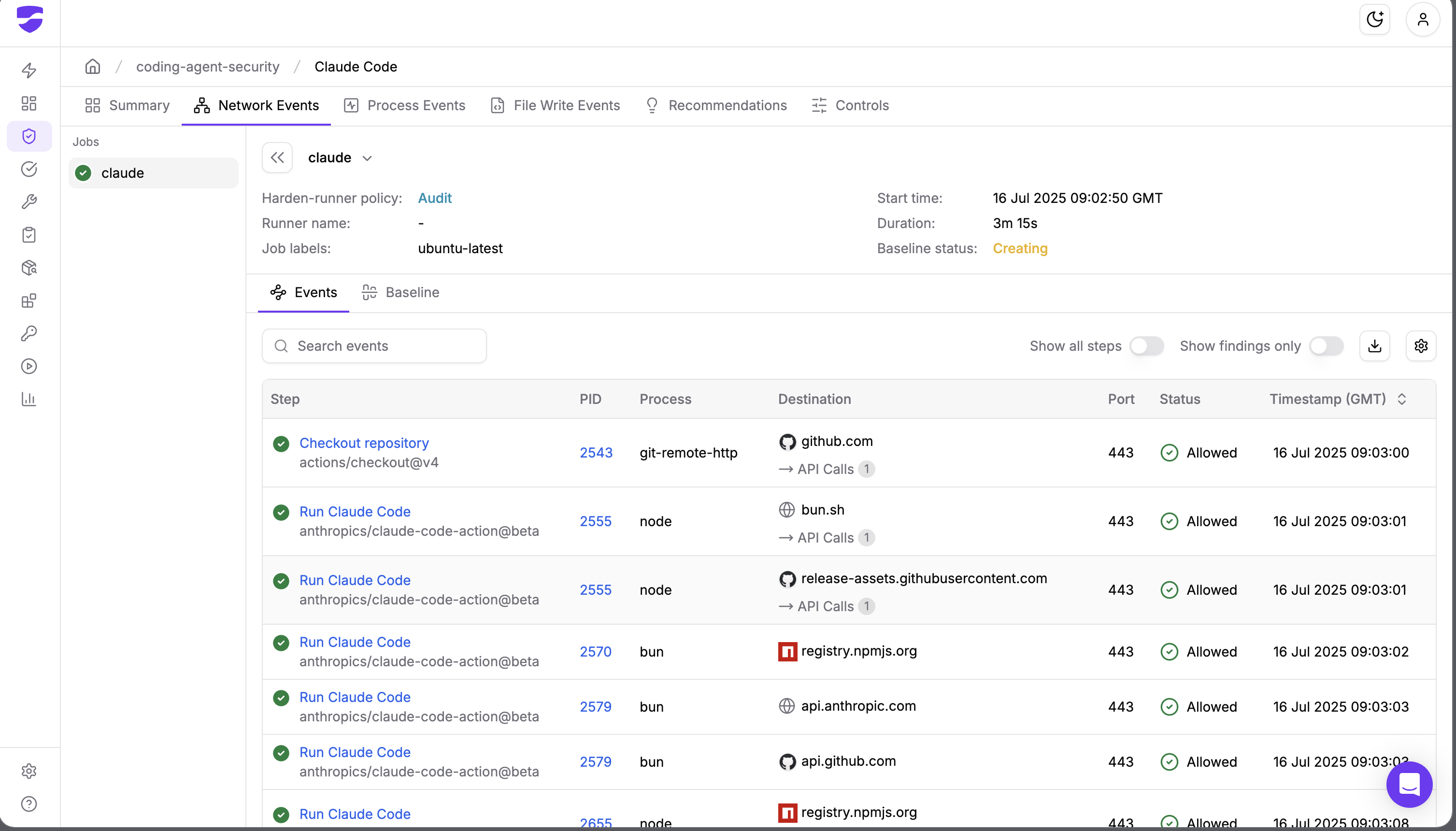
All coding agents such as Claude Code, Codex, and GitHub Copilot now operate directly inside GitHub Actions with GITHUB_TOKEN privileges; creating branches, pushing commits, installing dependencies, and interacting with GitHub APIs autonomously. CI/CD pipelines have privileged access to production secrets and infrastructure, yet security teams face a critical visibility gap: you can't see what processes an AI coding agent spawns, what endpoints it contacts, or what packages it installs at runtime.
.png)
A growing number of security vendors are positioning around "vibe coding security," but almost all focus on a single stage of the agentic development lifecycle.
IDE-layer solutions scan AI-generated code or govern plugins but provide zero visibility into CI/CD pipelines or npm supply chain attacks at scale. SAST/DAST tools scan code output but don't monitor agent runtime behavior. EDR/XDR lacks CI/CD context. CNAPP/CSPM is built for cloud infrastructure, not ephemeral runners or developer workstations.
The core gap: no single point solution provides visibility and enforcement across developer machines, code repositories, and CI/CD pipelines simultaneously. Attackers know this, the Shai-Hulud campaign exploited all three stages in a single operation.
.png)
StepSecurity provides end-to-end defense across all three stages of the agentic software development lifecycle: AI coding agents on developer machines, code repositories, and CI/CD pipelines.
These capabilities are battle-tested. StepSecurity was the first to detect the tj-actions supply chain attack and several major supply chain attacks in 2025 providing customers with early warning before public advisories existed.
.png)
The development environment, where sensitive credentials live and untrusted code executes daily, has historically lacked purpose-built supply chain security controls. StepSecurity Dev Machine Guard fills this gap.
When an AI coding agent receives a prompt to "build a login system with OAuth," it may install packages, connect to MCP servers, and invoke IDE extensions; all before any code reaches a repository. If any of those components is compromised, the organization's credentials are at risk.

AI coding agents dynamically resolve packages and push them into your codebase through pull requests, often without human review. StepSecurity's NPM Supply Chain Security capabilities provide proactive defense at this stage.
Explore the interactive demo to see how npm Package Search works in action:
AI coding agents operating in CI/CD pipelines have privileged access to production secrets and infrastructure. Securing this stage requires purpose-built runtime monitoring that understands CI/CD context, something traditional EDR fundamentally cannot provide.
Modern supply chain attacks don't respect stage boundaries. Shai-Hulud compromised npm packages, stole credentials from developer machines, and used those credentials to publish malicious releases bypassing CI/CD controls. The NX compromise simultaneously hit the npm registry and VSCode extensions. Trust Wallet showed how a Stage 1 credential theft cascaded into a malicious production release.
Point solutions covering a single stage leave the other two wide open. StepSecurity is the only platform providing unified visibility and enforcement across all three stages.
Enterprise adoption of vibe coding and agentic software development is accelerating. The attack surface is growing in lockstep and modern supply chain attacks are multi-stage operations that cross boundaries between developer machines, package registries, and CI/CD pipelines.
Security solutions focused on a single stage leave critical gaps. Defending against these attacks requires controls at every stage where AI coding agents operate: the development environment where vibe coding begins, the code repository where AI-generated dependencies enter the codebase, and the CI/CD pipeline where production secrets are at stake.
StepSecurity provides that end-to-end defense, battle-tested against real-world attacks, trusted by leading enterprises and open-source projects, built for the agentic development era.
Interested in securing your agentic software development lifecycle? Request a demo or start free today.
此内容由惯性聚合(RSS阅读器)自动聚合整理,仅供阅读参考。 原文来自 — 版权归原作者所有。