



惯性聚合 高效追踪和阅读你感兴趣的博客、新闻、科技资讯
阅读原文 在惯性聚合中打开

推荐订阅源

Martin Fowler
Martin Fowler
OSCHINA 社区最新新闻
OSCHINA 社区最新新闻
T
Troy Hunt's Blog
Latest news
Latest news
Vercel News
Vercel News
S
SegmentFault 最新的问题
V
Vulnerabilities – Threatpost
博客园 - Franky
P
Privacy International News Feed
A
Arctic Wolf
T
The Blog of Author Tim Ferriss
S
Schneier on Security
T
The Exploit Database - CXSecurity.com
P
Palo Alto Networks Blog
T
Tor Project blog
Jina AI
Jina AI
GbyAI
GbyAI
The Hacker News
The Hacker News
博客园 - 叶小钗
Google DeepMind News
T
Threatpost
C
CERT Recently Published Vulnerability Notes
P
Proofpoint News Feed
Scott Helme
Scott Helme
WordPress大学
WordPress大学
www.infosecurity-magazine.com
Microsoft Azure Blog
CTFtime.org: upcoming CTF events
博客园 - 司徒正美
A
About on SuperTechFans
Recorded Future
Recorded Future
爱范儿
爱范儿
L
LangChain Blog
V
V2EX
C
Cybersecurity and Infrastructure Security Agency CISA
The Cloudflare Blog
阮一峰的网络日志
阮一峰的网络日志
K
Kaspersky official blog
Webroot Blog
Webroot Blog
Security Archives - TechRepublic
D
DataBreaches.Net
宝玉的分享
宝玉的分享
Google Online Security Blog
C
Cisco Blogs
L
Lohrmann on Cybersecurity
Help Net Security
Help Net Security
AWS News Blog
AWS News Blog
M
MIT News - Artificial intelligence
奇客Solidot–传递最新科技情报
奇客Solidot–传递最新科技情报
G
GRAHAM CLULEY

Step Security Blog

Securing Vibe Coding and AI Coding Agents: An End-to-End Approach with StepSecurity - StepSecurity Introducing StepSecurity Dev Machine Guard: Protecting Developer Machines from Supply Chain Attacks - StepSecurity Top 2024 Predictions for CI/CD Security - StepSecurity Dev Machine Guard Is Now Open Source: See What's Really Running on Your Developer Machine - StepSecurity Datadog's DevSecOps 2026 Report Validates What We've Been Building - StepSecurity hackerbot-claw: An AI-Powered Bot Actively Exploiting GitHub Actions - Microsoft, DataDog, and CNCF Projects Hit So Far - StepSecurity Cline Supply Chain Attack Detected: cline@2.3.0 Silently Installs OpenClaw - StepSecurity StepSecurity’s Unified Protection Across the SDLC Infrastructure Threat Framework (SITF) - StepSecurity @velora-dex/sdk Compromised on npm: Malicious Version Drops macOS Backdoor via launchctl Persistence - StepSecurity axios Compromised on npm - Malicious Versions Drop Remote Access Trojan - StepSecurity Behind the Scenes: How StepSecurity Detected and Helped Remediate the Largest npm Supply Chain Attack - StepSecurity 10 Layers Deep: How StepSecurity Stops TeamPCP's Trivy Supply Chain Attack on GitHub Actions - StepSecurity Malicious IoliteLabs VSCode Extensions Target Solidity Developers on Windows, macOS, and Linux with Backdoor - StepSecurity TeamPCP Plants WAV Steganography Credential Stealer in telnyx PyPI Package - StepSecurity litellm: Credential Stealer Hidden in PyPI Wheel - StepSecurity Checkmarx KICS GitHub Action Compromised: Malware Injected in All Git Tags - StepSecurity CanisterWorm: How a Self-Propagating npm Worm Is Spreading Backdoors Across the Ecosystem - StepSecurity Trivy Compromised a Second Time - Malicious v0.69.4 Release, aquasecurity/setup-trivy, aquasecurity/trivy-action GitHub Actions Compromised - StepSecurity bittensor-wallet 4.0.2 Compromised on PyPI - Backdoor Exfiltrates Private Keys - StepSecurity Malicious npm Releases Found in Popular React Native Packages - 130K+ Monthly Downloads Compromised - StepSecurity Malicious Polymarket Bot Hides in Hijacked dev-protocol GitHub Org and Steals Wallet Keys - StepSecurity ForceMemo: Hundreds of GitHub Python Repos Compromised via Account Takeover and Force-Push - StepSecurity xygeni-action Compromised: C2 Reverse Shell Backdoor Injected via Tag Poisoning - StepSecurity kubernetes-el Compromised: How a Pwn Request Exploited a Popular Emacs Package - StepSecurity How StepSecurity Caught a Release Storm in Microsoft’s @types Packages - StepSecurity Harden Runner Now Supports Windows and macOS GitHub Actions Runners - StepSecurity 10,000 Open-Source Projects Now Secured by Harden-Runner Community-Tier: A Milestone Three Years in the Making - StepSecurity 20+ Popular NPM Packages Compromised (Chalk, Debug, Strip-ANSI, Color-Convert, Wrap-ANSI...) - StepSecurity 2024 in Review: The Evolution of CI/CD Security & What's Next - StepSecurity How to Use Docker in Actions Runner Controller (ARC) Runners Securely - StepSecurity Celebrating 1000 Repositories Secured with Harden Runner: A Journey of Growth and Collaboration - StepSecurity StepSecurity Detects Early Supply Chain Risk Signals in kilocode npm - StepSecurity Another npm Supply Chain Attack: The 'is' Package Compromise - StepSecurity anthropics/claude-code-action Security: How to Secure Claude Code in GitHub Actions with Harden-Runner - StepSecurity Harden-Runner detection: tj-actions/changed-files action is compromised - StepSecurity StepSecurity's Catalog of Fixes - StepSecurity Orchestrating Security: StepSecurity's Impact on 400+ Repositories and Future Plans - StepSecurity Announcing Anomalous Outbound Call Detection Using Machine Learning - StepSecurity Announcing GitHub Actions Advisor and StepSecurity Maintained Actions - StepSecurity Analysis of Backdoored XZ Utils Build Process with Harden-Runner - StepSecurity Announcing General Availability of Harden Runner - StepSecurity Milestone Achieved: 2500+ Public Repositories Secured with Harden-Runner - StepSecurity Build secretless CI/CD pipelines using wait-for-secrets - StepSecurity Introducing Apps & PATs: Centralized Visibility for GitHub Apps and Personal Access Tokens - StepSecurity CVE-2026-22709: Critical Sandbox Escape Vulnerability in vm2 - StepSecurity StepSecurity Now Supports Dark Mode - StepSecurity 2025 in Review: The Evolution of Supply Chain Security & What's Next - StepSecurity Bake Harden-Runner Into GitHub's Custom Runner Images for Organization-Wide CI/CD Security - StepSecurity StepSecurity Is Now Available on Azure Marketplace - StepSecurity Critical Remote Code Execution Vulnerabilities Discovered in React Server Components and Next.js - StepSecurity How Harden Runner Detected the Sha1-Hulud Supply Chain Attack in CNCF's Backstage Repository - StepSecurity Sha1-Hulud: The Second Coming - Zapier, ENS Domains, and Other Prominent NPM Packages Compromised - StepSecurity Supply Chain Security Alert: eslint-config-prettier Package Shows Signs of Compromise - StepSecurity 9,000 Open-Source Projects Now Secured by Harden-Runner - StepSecurity Shai-Hulud: Self-Replicating Worm Compromises 500+ NPM Packages - StepSecurity Introducing npm Package Search: Find Where Any Package Was Introduced Across Your GitHub Organizations - StepSecurity StepSecurity Is Sponsoring GitHub Universe 2025 - StepSecurity s1ngularity: Popular Nx Build System Package Compromised with Data-Stealing Malware - StepSecurity Introducing StepSecurity Threat Intelligence: Real-Time Supply Chain Attack Alerts for Your SIEM - StepSecurity 8,000 Strong: Harden-Runner's Growing Impact on CI/CD Security - StepSecurity Securing Google Gemini in GitHub Actions with Harden-Runner - StepSecurity GhostAction Campaign: Over 3,000 Secrets Stolen Through Malicious GitHub Workflows - StepSecurity Introducing the NPM Package Cooldown Check - StepSecurity Securing GitHub Copilot in GitHub Actions with Harden-Runner - StepSecurity Calculate Your CI/CD Security ROI with StepSecurity's New ROI Calculator - StepSecurity How StepSecurity Harden Runner Detected Unexpected Microsoft Defender Installation on GitHub-hosted Ubuntu Runners - StepSecurity StepSecurity Harden Runner: Detect source code tampering during the build process - StepSecurity Suspicious Tag Movement in AWS’s GitHub Action: What Happened and Why It Matters - StepSecurity When 'Changed Files' Changed Everything: Our Black Hat 2025 Presentation on the tj-actions Supply Chain Breach - StepSecurity Lessons from AWS CodeBuild’s Memory-Dump Incident (CVE-2025-8217) - StepSecurity Supply Chain Security Alert: num2words PyPI Package Shows Signs of Compromise - StepSecurity When AI Meets CI/CD: Coding Agents in GitHub Actions Pose Hidden Security Risks - StepSecurity The GitHub Warning Everyone Ignores: 'This Commit Does Not Belong to Any Branch' - StepSecurity 8 GitHub Actions Secrets Management Best Practices to Follow - StepSecurity reviewdog GitHub Actions are compromised - StepSecurity 7,000 Open-Source Projects Now Secured by Harden-Runner - StepSecurity Replace Third-Party Actions with StepSecurity Maintained Actions via Automated Pull Requests - StepSecurity StepSecurity Is Now Available on AWS Marketplace - StepSecurity Introducing StepSecurity Artifact Monitor: Detect Unauthorized Software Releases in minutes, not months - StepSecurity Introducing Workflow Run Policies: Guardrails for Blocking Non-Compliant GitHub Actions Runs - StepSecurity Harden-Runner Detects New Traffic to release-assets.githubusercontent.com Across Multiple Customers - StepSecurity Grafana GitHub Actions Security Incident - StepSecurity Export Harden-Runner Security Insights and Detections to Amazon S3 - StepSecurity Evolving Harden-Runner’s disable-sudo Policy for Improved Runner Security - StepSecurity Announcing Policy-Driven Automated Pull Requests for CI/CD Misconfiguration Remediation - StepSecurity Announcing StepSecurity’s Integration with RunsOn: Secure and Optimized CI/CD Pipelines - StepSecurity Secure Repo Just Got Better: New Features for GitHub Actions Security Best Practices - StepSecurity Why Compliance Auditors Are Looking at Your CI/CD Runners - And How to Prepare - StepSecurity Harden-Runner Flags Anomalous Outbound Call, Leading to Docker Documentation Update - StepSecurity StepSecurity Harden-Runner Now Secures GitHub Actions Workflows for Over 5,000 Open Source Projects - StepSecurity GitHub Actions Pwn Request Vulnerability - StepSecurity Prevent Ultralytics Style CI/CD Security Attacks with Network Security Controls - StepSecurity PyTorch Supply Chain Compromise - StepSecurity Unified Network Egress View: Centralize GitHub Actions Network Destinations for Your Enterprise - StepSecurity Uniting Developers and Security: Celebrating the Success of 500+ Open Source Projects Using StepSecurity's Orchestration Platform - StepSecurity 5 Effective Third-Party GitHub Actions Governance Best Practices - StepSecurity StepSecurity Recognized Among CRN’s "10 Hottest DevOps Startups Of 2024" - StepSecurity Streamline Your GitHub Actions Workflows with StepSecurity’s Latest Feature - StepSecurity StepSecurity Steps Up the Security Game with SOC 2 Type 2 Compliance - StepSecurity StepSecurity's Alignment with CISA's CI/CD Security Guidance - StepSecurity
Prevent npm and Python Supply Chain Attacks on Developer Machines with Package Configs - StepSecurity
2026-06-17 · via Step Security Blog

Over the past few months, a wave of supply chain attacks has hit the npm and PyPI ecosystems: the axios and TanStack compromises, the Shai-Hulud worm, and most recently the fast-spreading Miasma and Hades worms. They share a pattern. A trusted package ships a malicious version, it installs on a developer's machine, and it runs with that developer's access to steal the secrets stored there. The core risk is to everyone who installs these packages.

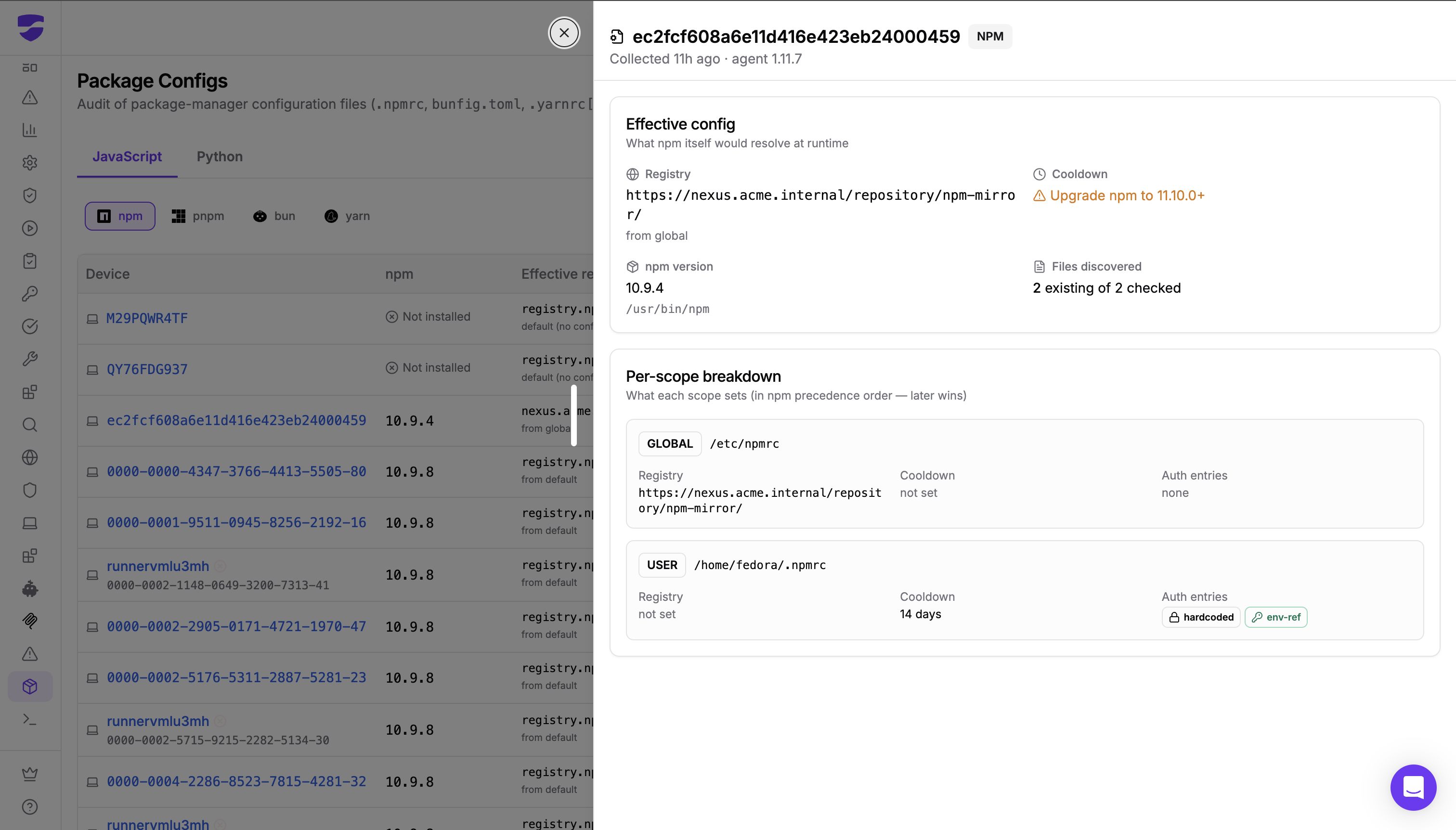
The strongest defenses against this already exist: routing every install through an internal registry or Secure Registry that blocks known-compromised packages, and a cooldown policy that keeps brand-new versions out of builds until they have been vetted. The catch is that these controls only protect a machine that is actually configured to use them. Dev Machine Guard's new Package Configs feature shows you, across your entire fleet, exactly how each developer machine fetches packages: which registry it resolves from, whether cooldown is in effect, and where registry credentials are exposed.

The StepSecurity research team has been at the forefront of these campaigns, frequently first to report them: the Nx / s1ngularity compromise, the chalk and debug compromise affecting more than 20 packages downloaded billions of times a week, and the Shai-Hulud worm that infected over 500 npm packages. Most recently, the team tracked each wave of the Miasma and Hades campaign as it broke: the Miasma npm wave on June 3, the attack on Microsoft's Azure organizations that disabled 73 repositories on June 5, and the Hades PyPI campaign on June 8. Package Configs comes directly out of that research, built to close the configuration gaps these attacks exploit.

Why this is urgent

Miasma and Hades are self-replicating worms, and the registry is their highway. Once the worm lands on a developer machine, it harvests any npm or PyPI publishing token it can find, then republishes infected versions of every package that token can publish. Each compromised developer becomes a new launch point. On June 3 the npm wave compromised 57 packages across more than 286 malicious versions in under two hours, and five days later the same actor surfaced on PyPI as Hades, compromising ensmallen and roughly two dozen related machine-learning and bioinformatics packages.

Two registry-level controls break this cycle:

A cooldown policy holds back newly published package versions until they have aged, so a malicious version pushed by the worm is not installed the moment it lands. This is one of the most effective defenses available, because most malicious packages are discovered within roughly 24 hours of publication, and a multi-day waiting period keeps the worm's freshly published versions out of your builds entirely.

An internal registry or artifact manager, fronted by a Secure Registry, gives you a single controlled path for packages, where cooldown and policy can be enforced and where you have an audit trail instead of every laptop reaching out to the public registry independently.

These are exactly the right defenses against a fast-spreading worm. The problem is knowing whether they are actually in force on every machine.

The control you configured is not always the control that runs

Configuring cooldown and an internal registry centrally does not guarantee they apply on a developer's laptop. Package-manager configuration is layered and easy to override, often without anyone noticing.

A .npmrc checked into a project can silently point npm at the public registry instead of your internal mirror, taking that machine off the protected path. A device can be missing the configuration that enables cooldown, or running a package-manager version too old to support it, so new versions install immediately. And registry credentials are routinely hardcoded directly into a config file rather than referenced from the environment, leaving a long-lived token on disk in exactly the place a worm like Hades goes looking. None of this is visible from a central policy dashboard, because the gap lives on the endpoint.
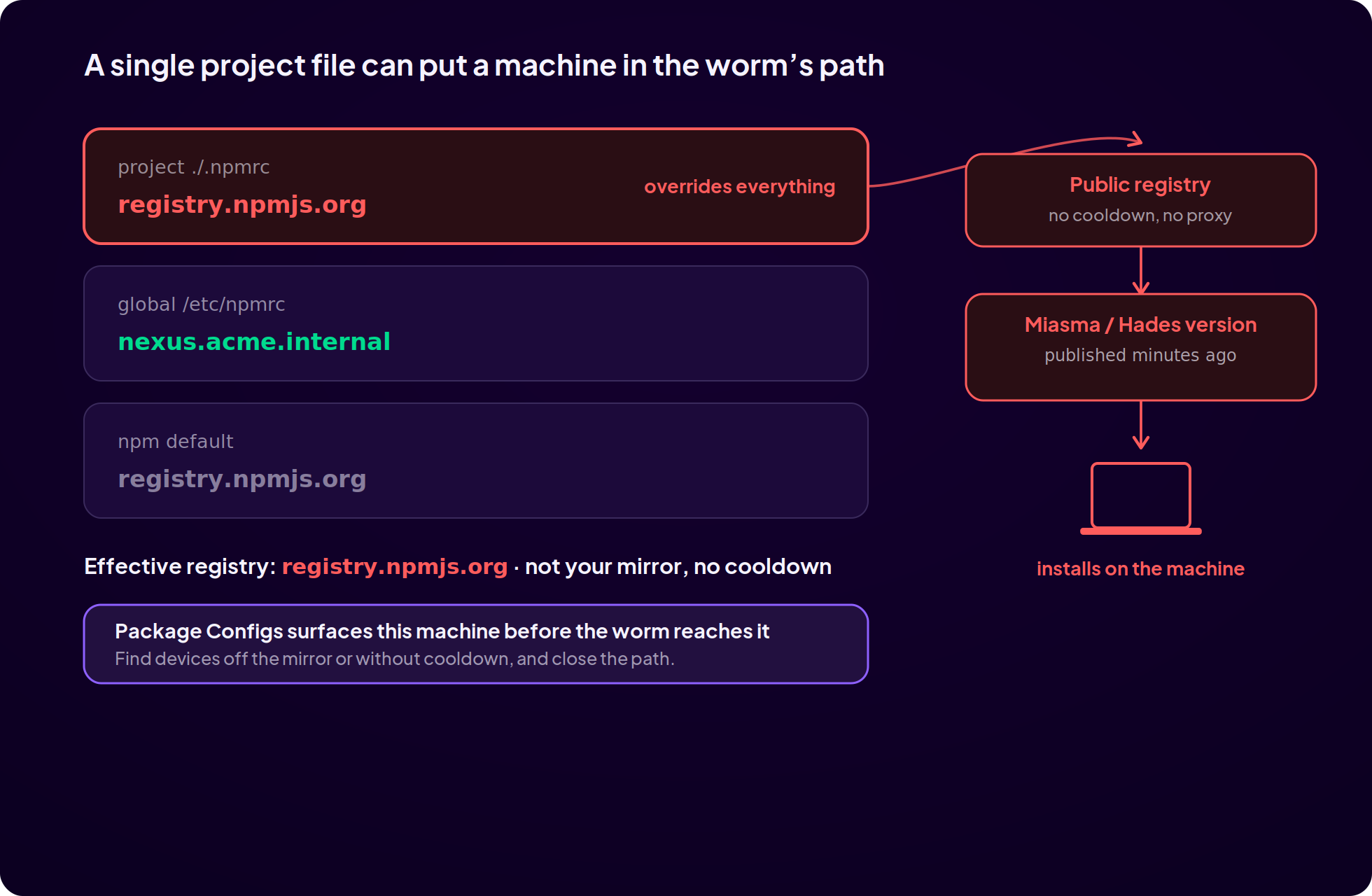
This is the same lesson the campaign keeps teaching: the defense you think you have is only as good as its weakest configured machine. A single laptop pointed at the public registry with no cooldown is the unguarded door the worm walks through.

What Package Configs audits

Package Configs inventories the package-manager configuration files across every scope on each developer machine: .npmrc, bunfig.toml, .yarnrc and .yarnrc.yml, and pip.conf. It covers the JavaScript ecosystem (npm, pnpm, bun, and yarn) and Python (pip). For every device, it resolves three things that decide whether that machine is exposed to a campaign like Miasma or Hades.

Effective registry

Where does this machine actually get its packages? Package Configs resolves the effective registry per device, accounting for configuration precedence across global, user, and project scopes, and shows where the value came from. A device resolving from an internal Artifactory or Nexus mirror is on your protected path. A device showing the public registry default is fetching directly from the public registry, outside any Secure Registry or proxy protection, and is exposed to whatever the worm published in the last few minutes.

Cooldown

Whether a cooldown policy is in effect. Cooldown is the single most direct defense against a worm that spreads by publishing new malicious versions, but it only protects machines configured to use it. Package Configs flags devices that are unprotected, and where the package manager is too old to support cooldown, it tells you exactly what to upgrade.

Authentication surface

How registry credentials are configured. Package Configs summarizes the auth surface per device, distinguishing credentials hardcoded into a config file from those referenced safely through an environment variable. Hardcoded registry tokens are exactly what Miasma and Hades harvest, so a static token sitting in a .npmrc is not just a hygiene issue, it is the fuel these worms run on.
How Package Configs defends against compromised packages

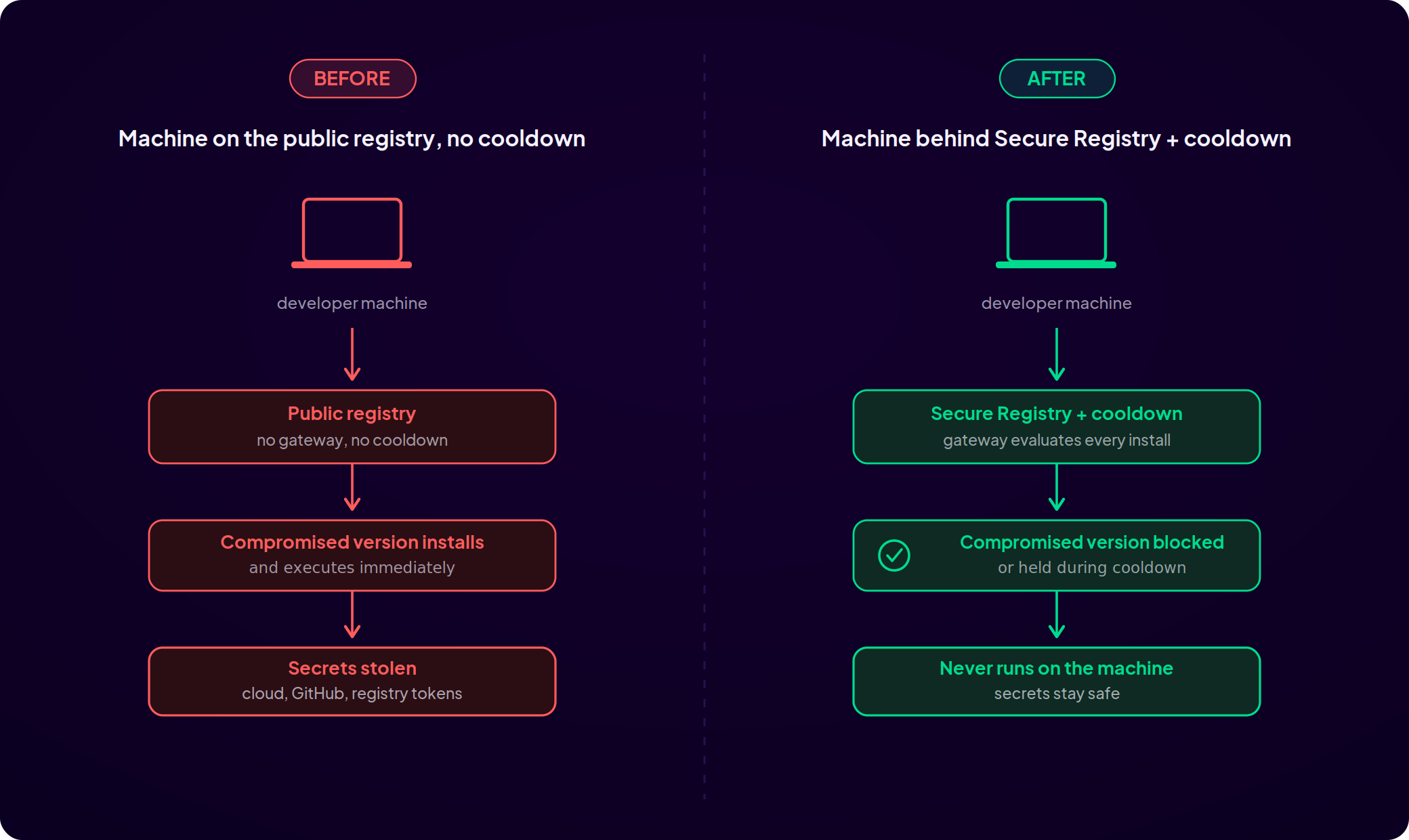
The attacks above succeed through a specific chain: a compromised version is published, it is installed on a developer machine, it executes, and it steals secrets or spreads. Each thing Package Configs surfaces helps security teams ensure the controls that break that chain are actually in place.

Confirm every machine is behind a gateway that blocks compromised packages. The primary defense is making sure all developer machines resolve packages through StepSecurity Secure Registry or an approved internal registry, so the gateway can block known-compromised versions before they are fetched. Package Configs shows you exactly which machines are on that path and which have drifted off it, often through a single project .npmrc, so you can bring the exposed ones back behind the gateway.

Confirm cooldown is in effect. With npm package managers, a cooldown policy can prevent a compromised component from running on a developer machine even if that machine is not yet behind your internal registry, because the attacker's freshly published version sits in the waiting period until it is caught. Package Configs shows every machine where cooldown is missing or unsupported, so you can close that gap as a second layer.

Find exposed credentials before the worm does. The secrets these packages steal include registry publishing tokens, and a hardcoded token in a .npmrc is the easiest to take. Package Configs flags every machine carrying a static token in a config file, turning "we hope no one has tokens on disk" into a concrete list you can act on.

Put together, this lets a security team respond to an active campaign in minutes: pull up the fleet, find the machines not behind the gateway or without cooldown, surface exposed tokens, and fix the specific gaps a compromised package would exploit, instead of hoping the central policy reached every endpoint.
Built from frontline research

Package Configs reflects how StepSecurity has watched these campaigns operate. The research team is consistently among the first to detect major supply chain attacks, having been officially credited for discovering several, including the compromises of axios and TanStack, and has tracked Miasma and Hades from their first waves. Seeing how these attacks reach developer machines and steal what is on them is what shaped the three things Package Configs surfaces. As the campaigns evolve, the audit evolves with them.

Get started with Dev Machine Guard

Package Configs is part of Dev Machine Guard and is collected by the same lightweight agent you already deploy through your existing MDM or EDR tooling, on macOS, Windows, and Linux. There is nothing extra to install.

If you already run Dev Machine Guard, Package Configs is available now in your dashboard under Developer Machines. Open it to see how every device in your fleet fetches packages, and sort by cooldown and configuration coverage to find the gaps first. With npm and Python supply chain attacks landing almost weekly, the machines pointed at the public registry with no cooldown are the ones to fix today.

If you are not yet using Dev Machine Guard, get started by deploying it across your fleet to protect your developers from compromised packages.

See the Package Configs documentation and the Installation Script guide for rollout, or request a demo to see Dev Machine Guard in action.