

惯性聚合 高效追踪和阅读你感兴趣的博客、新闻、科技资讯
阅读原文 在惯性聚合中打开

推荐订阅源

美团技术团队
N
Netflix TechBlog - Medium
WordPress大学
WordPress大学
云风的 BLOG
云风的 BLOG
J
Java Code Geeks
V
Visual Studio Blog
H
Help Net Security
Engineering at Meta
Engineering at Meta
Hugging Face - Blog
Hugging Face - Blog
Microsoft Security Blog
腾讯CDC
博客园 - 【当耐特】
B
Blog
Stack Overflow Blog
Stack Overflow Blog
freeCodeCamp Programming Tutorials: Python, JavaScript, Git & More
大猫的无限游戏
大猫的无限游戏
GbyAI
GbyAI
博客园 - 司徒正美
博客园 - 叶小钗
Y
Y Combinator Blog
MyScale Blog
MyScale Blog
钛媒体:引领未来商业与生活新知
钛媒体:引领未来商业与生活新知
G
Google Developers Blog
酷 壳 – CoolShell
酷 壳 – CoolShell

Step Security Blog

Announcing Dependabot Configuration Enhancements: Cooldown and Group Support - StepSecurity Securing Vibe Coding and AI Coding Agents: An End-to-End Approach with StepSecurity - StepSecurity Introducing StepSecurity Dev Machine Guard: Protecting Developer Machines from Supply Chain Attacks - StepSecurity Top 2024 Predictions for CI/CD Security - StepSecurity Dev Machine Guard Is Now Open Source: See What's Really Running on Your Developer Machine - StepSecurity Datadog's DevSecOps 2026 Report Validates What We've Been Building - StepSecurity hackerbot-claw: An AI-Powered Bot Actively Exploiting GitHub Actions - Microsoft, DataDog, and CNCF Projects Hit So Far - StepSecurity Cline Supply Chain Attack Detected: cline@2.3.0 Silently Installs OpenClaw - StepSecurity StepSecurity’s Unified Protection Across the SDLC Infrastructure Threat Framework (SITF) - StepSecurity @velora-dex/sdk Compromised on npm: Malicious Version Drops macOS Backdoor via launchctl Persistence - StepSecurity axios Compromised on npm - Malicious Versions Drop Remote Access Trojan - StepSecurity Behind the Scenes: How StepSecurity Detected and Helped Remediate the Largest npm Supply Chain Attack - StepSecurity 10 Layers Deep: How StepSecurity Stops TeamPCP's Trivy Supply Chain Attack on GitHub Actions - StepSecurity Malicious IoliteLabs VSCode Extensions Target Solidity Developers on Windows, macOS, and Linux with Backdoor - StepSecurity TeamPCP Plants WAV Steganography Credential Stealer in telnyx PyPI Package - StepSecurity litellm: Credential Stealer Hidden in PyPI Wheel - StepSecurity Checkmarx KICS GitHub Action Compromised: Malware Injected in All Git Tags - StepSecurity CanisterWorm: How a Self-Propagating npm Worm Is Spreading Backdoors Across the Ecosystem - StepSecurity Trivy Compromised a Second Time - Malicious v0.69.4 Release, aquasecurity/setup-trivy, aquasecurity/trivy-action GitHub Actions Compromised - StepSecurity bittensor-wallet 4.0.2 Compromised on PyPI - Backdoor Exfiltrates Private Keys - StepSecurity Malicious npm Releases Found in Popular React Native Packages - 130K+ Monthly Downloads Compromised - StepSecurity Malicious Polymarket Bot Hides in Hijacked dev-protocol GitHub Org and Steals Wallet Keys - StepSecurity ForceMemo: Hundreds of GitHub Python Repos Compromised via Account Takeover and Force-Push - StepSecurity xygeni-action Compromised: C2 Reverse Shell Backdoor Injected via Tag Poisoning - StepSecurity kubernetes-el Compromised: How a Pwn Request Exploited a Popular Emacs Package - StepSecurity How StepSecurity Caught a Release Storm in Microsoft’s @types Packages - StepSecurity Harden Runner Now Supports Windows and macOS GitHub Actions Runners - StepSecurity 10,000 Open-Source Projects Now Secured by Harden-Runner Community-Tier: A Milestone Three Years in the Making - StepSecurity 20+ Popular NPM Packages Compromised (Chalk, Debug, Strip-ANSI, Color-Convert, Wrap-ANSI...) - StepSecurity 2024 in Review: The Evolution of CI/CD Security & What's Next - StepSecurity
Announcing Anomalous Outbound Call Detection Using Machin...
2026-02-11 · via Step Security Blog

Introduction

Last month, StepSecurity introduced Harden-Runner for self-hosted VM runners for enhanced CI/CD security. This month, StepSecurity raises the bar further with yet another enhancement of Harden-Runner. On popular demand, Harden-Runner, which is known to provide robust runtime security for GitHub Actions across GitHub-hosted and self-hosted runners, will now also detect anomalous outbound calls. This ML-powered feature will empower developers and security teams with real-time alerts during workflow runs, ensuring an additional layer of security without compromising usability. This feature uses traditional machine learning pattern recognition to empower developers and security teams with real-time alerts during workflow runs, ensuring an additional layer of security without compromising usability. What’s more? For self-hosted runners, this feature will enable all workflows to be automatically monitored without changing any of the workflow files.

Important Note: This feature does not use generative AI or Large Language Models (LLMs). Instead, it employs a straightforward pattern-based machine learning approach that learns and remembers the typical endpoints accessed by each job in your workflows. This model is implemented in our codebase and we do not use any external Machine Learning (ML) provider.

If you’re looking to enhance your GitHub Actions security, you've landed at the right place. Explore StepSecurity Harden-Runner to see how it helps to fortify your GitHub Actions.

Also Read: Celebrating 2,000+ GitHub Repositories Secured with Harden-Runner

Evolution of Harden-Runner: What’s Different?

Up until now, Harden-Runner offered two modes: an audit mode, providing visibility into outbound calls made during a GitHub Actions workflow run, and a block mode, enabling the specification of authorized outbound destinations while blocking unauthorized calls. As per the demand, we’re excited to introduce the anomaly detection feature in audit mode.

Try StepSecurity for Free

How It Works

The anomaly detection feature creates a machine learning model of outbound network calls by analyzing the historical data of the same workflow in previous runs.

Our Machine Learning Approach

To be clear about our technology:

  • What we DO use: Traditional pattern recognition and statistical analysis to learn the normal behavior of each job
  • What we DON'T use: Generative AI, Large Language Models (LLMs), or any form of AI text generation

The model works by:

  1. Learning Phase: The StepSecurity platform observes and records which endpoints each specific job typically accesses during normal execution
  2. Pattern Recognition: The system builds a baseline of expected network destinations for each job based on historical runs
  3. Anomaly Detection: When a job makes an outbound call to a previously unseen endpoint, it's flagged as anomalous
  4. Alerting: Real-time notifications are sent when unexpected network behavior is detected

This is essentially a memory-based system that remembers what endpoints are normal for each job - no complex AI or language models involved.

After the model is trained, real-time notifications are triggered if a new anomalous outbound call occurs in a future run. These notifications can be seamlessly delivered through email and Slack, allowing developers and security teams to promptly review and investigate the legitimacy of the newly detected endpoint.

Here is a sample email notification.

An email notifying of an anomalous outbound network call

You can also detect such anomalous calls in the insights page for the GitHub Actions workflow run.

An anomalous outbound connection listed on the insights page of the workflow run

Enabling the Feature

Follow these simple steps to enable this feature:

  1. Install the StepSecurity Actions Security GitHub App.
  1. Access the organization dashboard through the provided link.
  1. In the settings tab, under "Notification Settings," find the new setting for "Notify when an anomalous outbound call is discovered."
  1. Enable this feature by selecting the checkbox and saving the settings.

Enable anomaly detection for Harden-Runner

Screenshot showing how to enable the feature through the StepSecurity Actions Security GitHub App

For GitHub-hosted runners, add the Harden-Runner GitHub Action to your workflows to receive notifications about anomalous outbound calls. If using self-hosted runners, no additional action is required – all workflows are automatically monitored.

See it in Action in GitHub Actions Goat

As an educational initiative, GitHub Actions Goat simulates common security attacks and vulnerabilities in a GitHub Actions CI/CD environment. We've incorporated the anomaly detection feature into GitHub Actions Goat. To witness it in action, explore the dedicated workflow running on a GitHub-hosted runner, utilizing Harden-Runner in audit mode.
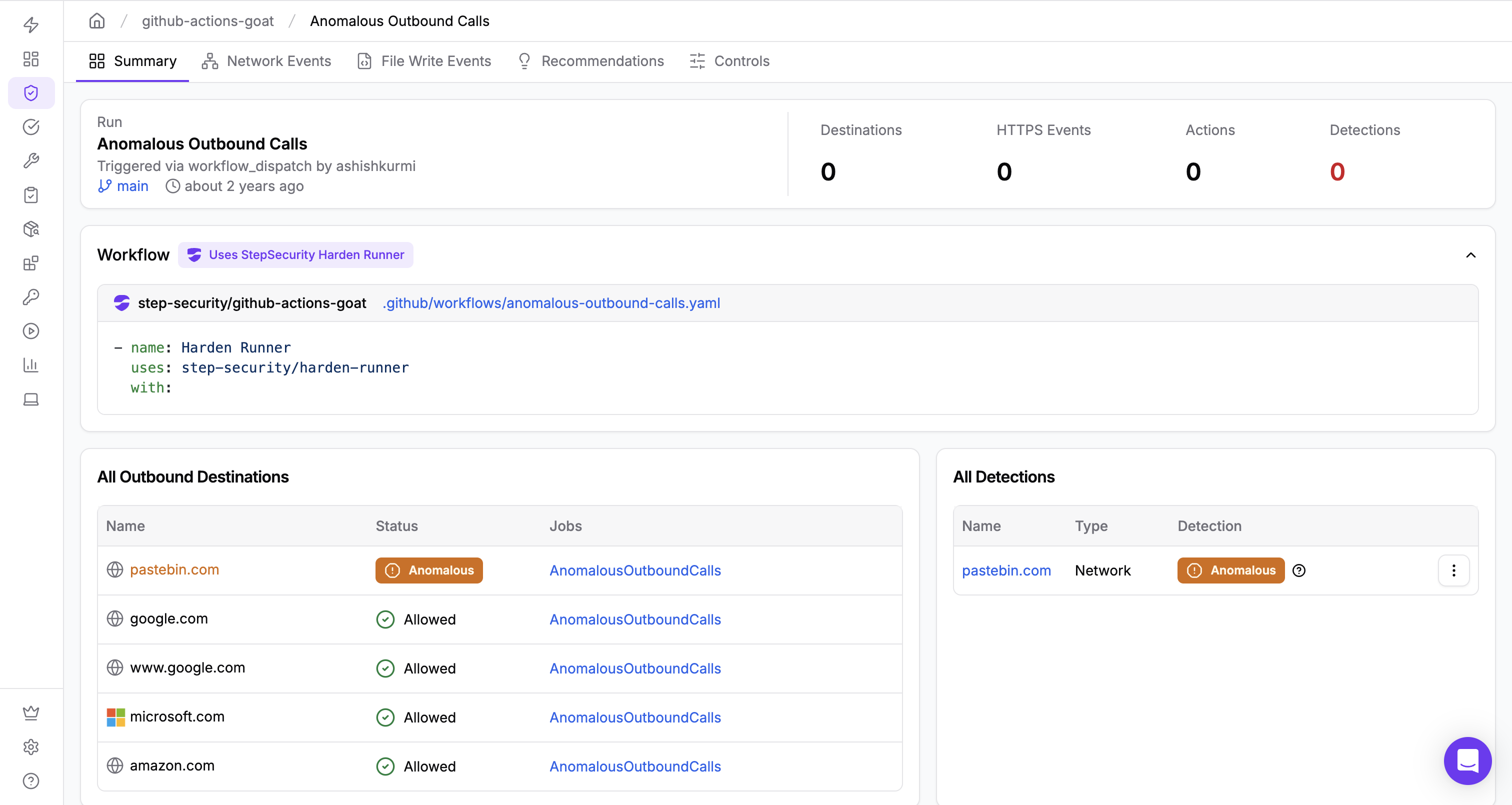
StepSecurity Dashboard

Summary

StepSecurity is thrilled to enable enhanced GitHub Actions security with this new feature. The feature will allow DevOps teams and security teams to detect anomalies in real time and empower organizations to balance security and usability as per their requirements.

If you’re eager to explore the new anomaly detection feature, simply follow the steps above to enable it on the StepSecurity platform. Stay tuned for upcoming feature updates and if you have any questions, please feel free to contact our team.

Try StepSecurity for Free