

惯性聚合 高效追踪和阅读你感兴趣的博客、新闻、科技资讯
阅读原文 在惯性聚合中打开

推荐订阅源

让小产品的独立变现更简单 - ezindie.com
Microsoft Azure Blog
大猫的无限游戏
大猫的无限游戏
月光博客
月光博客
V
V2EX
PCI Perspectives
PCI Perspectives
Latest news
Latest news
博客园 - 三生石上(FineUI控件)
C
CERT Recently Published Vulnerability Notes
W
WeLiveSecurity
Last Week in AI
Last Week in AI
奇客Solidot–传递最新科技情报
奇客Solidot–传递最新科技情报
P
Palo Alto Networks Blog
T
The Exploit Database - CXSecurity.com
K
KPMG report finds enterprise disconnect between AI and its ROI | CIO
cs.AI updates on arXiv.org
WordPress大学
WordPress大学
V
Vulnerabilities – Threatpost
H
Heimdal Security Blog
Attack and Defense Labs
cs.CV updates on arXiv.org
Hacker News: Ask HN
Hacker News: Ask HN
博客园 - 叶小钗
V
Visual Studio Blog
Jina AI
Jina AI
P
Proofpoint News Feed
罗磊的独立博客
SecWiki News
SecWiki News
J
Java Code Geeks
freeCodeCamp Programming Tutorials: Python, JavaScript, Git & More
L
LINUX DO - 热门话题
Security Archives - TechRepublic
The Hacker News
The Hacker News
Hugging Face - Blog
Hugging Face - Blog
N
News and Events Feed by Topic
NISL@THU
NISL@THU
T
Tailwind CSS Blog
T
Tenable Blog
Recent Commits to openclaw:main
Recent Announcements
H
Hacker News: Front Page
Exploit-DB.com RSS Feed
T
Tor Project blog
宝玉的分享
宝玉的分享
Help Net Security
Help Net Security
S
Security Affairs
Microsoft Security Blog
Google DeepMind News
F
Fortinet All Blogs
G
GRAHAM CLULEY

Step Security Blog

Announcing Dependabot Configuration Enhancements: Cooldown and Group Support - StepSecurity Securing Vibe Coding and AI Coding Agents: An End-to-End Approach with StepSecurity - StepSecurity Introducing StepSecurity Dev Machine Guard: Protecting Developer Machines from Supply Chain Attacks - StepSecurity Top 2024 Predictions for CI/CD Security - StepSecurity Dev Machine Guard Is Now Open Source: See What's Really Running on Your Developer Machine - StepSecurity Datadog's DevSecOps 2026 Report Validates What We've Been Building - StepSecurity hackerbot-claw: An AI-Powered Bot Actively Exploiting GitHub Actions - Microsoft, DataDog, and CNCF Projects Hit So Far - StepSecurity Cline Supply Chain Attack Detected: cline@2.3.0 Silently Installs OpenClaw - StepSecurity StepSecurity’s Unified Protection Across the SDLC Infrastructure Threat Framework (SITF) - StepSecurity @velora-dex/sdk Compromised on npm: Malicious Version Drops macOS Backdoor via launchctl Persistence - StepSecurity axios Compromised on npm - Malicious Versions Drop Remote Access Trojan - StepSecurity Behind the Scenes: How StepSecurity Detected and Helped Remediate the Largest npm Supply Chain Attack - StepSecurity 10 Layers Deep: How StepSecurity Stops TeamPCP's Trivy Supply Chain Attack on GitHub Actions - StepSecurity Malicious IoliteLabs VSCode Extensions Target Solidity Developers on Windows, macOS, and Linux with Backdoor - StepSecurity TeamPCP Plants WAV Steganography Credential Stealer in telnyx PyPI Package - StepSecurity litellm: Credential Stealer Hidden in PyPI Wheel - StepSecurity Checkmarx KICS GitHub Action Compromised: Malware Injected in All Git Tags - StepSecurity CanisterWorm: How a Self-Propagating npm Worm Is Spreading Backdoors Across the Ecosystem - StepSecurity Trivy Compromised a Second Time - Malicious v0.69.4 Release, aquasecurity/setup-trivy, aquasecurity/trivy-action GitHub Actions Compromised - StepSecurity bittensor-wallet 4.0.2 Compromised on PyPI - Backdoor Exfiltrates Private Keys - StepSecurity Malicious npm Releases Found in Popular React Native Packages - 130K+ Monthly Downloads Compromised - StepSecurity Malicious Polymarket Bot Hides in Hijacked dev-protocol GitHub Org and Steals Wallet Keys - StepSecurity ForceMemo: Hundreds of GitHub Python Repos Compromised via Account Takeover and Force-Push - StepSecurity xygeni-action Compromised: C2 Reverse Shell Backdoor Injected via Tag Poisoning - StepSecurity kubernetes-el Compromised: How a Pwn Request Exploited a Popular Emacs Package - StepSecurity How StepSecurity Caught a Release Storm in Microsoft’s @types Packages - StepSecurity Harden Runner Now Supports Windows and macOS GitHub Actions Runners - StepSecurity 10,000 Open-Source Projects Now Secured by Harden-Runner Community-Tier: A Milestone Three Years in the Making - StepSecurity 2024 in Review: The Evolution of CI/CD Security & What's Next - StepSecurity How to Use Docker in Actions Runner Controller (ARC) Runners Securely - StepSecurity Celebrating 1000 Repositories Secured with Harden Runner: A Journey of Growth and Collaboration - StepSecurity StepSecurity Detects Early Supply Chain Risk Signals in kilocode npm - StepSecurity Another npm Supply Chain Attack: The 'is' Package Compromise - StepSecurity anthropics/claude-code-action Security: How to Secure Claude Code in GitHub Actions with Harden-Runner - StepSecurity Harden-Runner detection: tj-actions/changed-files action is compromised - StepSecurity StepSecurity's Catalog of Fixes - StepSecurity Orchestrating Security: StepSecurity's Impact on 400+ Repositories and Future Plans - StepSecurity Announcing Anomalous Outbound Call Detection Using Machine Learning - StepSecurity Announcing GitHub Actions Advisor and StepSecurity Maintained Actions - StepSecurity Analysis of Backdoored XZ Utils Build Process with Harden-Runner - StepSecurity Announcing General Availability of Harden Runner - StepSecurity Milestone Achieved: 2500+ Public Repositories Secured with Harden-Runner - StepSecurity Build secretless CI/CD pipelines using wait-for-secrets - StepSecurity Introducing Apps & PATs: Centralized Visibility for GitHub Apps and Personal Access Tokens - StepSecurity CVE-2026-22709: Critical Sandbox Escape Vulnerability in vm2 - StepSecurity StepSecurity Now Supports Dark Mode - StepSecurity 2025 in Review: The Evolution of Supply Chain Security & What's Next - StepSecurity Bake Harden-Runner Into GitHub's Custom Runner Images for Organization-Wide CI/CD Security - StepSecurity StepSecurity Is Now Available on Azure Marketplace - StepSecurity Critical Remote Code Execution Vulnerabilities Discovered in React Server Components and Next.js - StepSecurity How Harden Runner Detected the Sha1-Hulud Supply Chain Attack in CNCF's Backstage Repository - StepSecurity Sha1-Hulud: The Second Coming - Zapier, ENS Domains, and Other Prominent NPM Packages Compromised - StepSecurity Supply Chain Security Alert: eslint-config-prettier Package Shows Signs of Compromise - StepSecurity 9,000 Open-Source Projects Now Secured by Harden-Runner - StepSecurity Shai-Hulud: Self-Replicating Worm Compromises 500+ NPM Packages - StepSecurity Introducing npm Package Search: Find Where Any Package Was Introduced Across Your GitHub Organizations - StepSecurity StepSecurity Is Sponsoring GitHub Universe 2025 - StepSecurity s1ngularity: Popular Nx Build System Package Compromised with Data-Stealing Malware - StepSecurity Introducing StepSecurity Threat Intelligence: Real-Time Supply Chain Attack Alerts for Your SIEM - StepSecurity 8,000 Strong: Harden-Runner's Growing Impact on CI/CD Security - StepSecurity Securing Google Gemini in GitHub Actions with Harden-Runner - StepSecurity GhostAction Campaign: Over 3,000 Secrets Stolen Through Malicious GitHub Workflows - StepSecurity Introducing the NPM Package Cooldown Check - StepSecurity Securing GitHub Copilot in GitHub Actions with Harden-Runner - StepSecurity Calculate Your CI/CD Security ROI with StepSecurity's New ROI Calculator - StepSecurity How StepSecurity Harden Runner Detected Unexpected Microsoft Defender Installation on GitHub-hosted Ubuntu Runners - StepSecurity StepSecurity Harden Runner: Detect source code tampering during the build process - StepSecurity Suspicious Tag Movement in AWS’s GitHub Action: What Happened and Why It Matters - StepSecurity When 'Changed Files' Changed Everything: Our Black Hat 2025 Presentation on the tj-actions Supply Chain Breach - StepSecurity Lessons from AWS CodeBuild’s Memory-Dump Incident (CVE-2025-8217) - StepSecurity Supply Chain Security Alert: num2words PyPI Package Shows Signs of Compromise - StepSecurity When AI Meets CI/CD: Coding Agents in GitHub Actions Pose Hidden Security Risks - StepSecurity The GitHub Warning Everyone Ignores: 'This Commit Does Not Belong to Any Branch' - StepSecurity 8 GitHub Actions Secrets Management Best Practices to Follow - StepSecurity reviewdog GitHub Actions are compromised - StepSecurity 7,000 Open-Source Projects Now Secured by Harden-Runner - StepSecurity Replace Third-Party Actions with StepSecurity Maintained Actions via Automated Pull Requests - StepSecurity StepSecurity Is Now Available on AWS Marketplace - StepSecurity Introducing StepSecurity Artifact Monitor: Detect Unauthorized Software Releases in minutes, not months - StepSecurity Introducing Workflow Run Policies: Guardrails for Blocking Non-Compliant GitHub Actions Runs - StepSecurity Harden-Runner Detects New Traffic to release-assets.githubusercontent.com Across Multiple Customers - StepSecurity Grafana GitHub Actions Security Incident - StepSecurity Export Harden-Runner Security Insights and Detections to Amazon S3 - StepSecurity Evolving Harden-Runner’s disable-sudo Policy for Improved Runner Security - StepSecurity Announcing Policy-Driven Automated Pull Requests for CI/CD Misconfiguration Remediation - StepSecurity Announcing StepSecurity’s Integration with RunsOn: Secure and Optimized CI/CD Pipelines - StepSecurity Secure Repo Just Got Better: New Features for GitHub Actions Security Best Practices - StepSecurity Why Compliance Auditors Are Looking at Your CI/CD Runners - And How to Prepare - StepSecurity Harden-Runner Flags Anomalous Outbound Call, Leading to Docker Documentation Update - StepSecurity StepSecurity Harden-Runner Now Secures GitHub Actions Workflows for Over 5,000 Open Source Projects - StepSecurity GitHub Actions Pwn Request Vulnerability - StepSecurity Prevent Ultralytics Style CI/CD Security Attacks with Network Security Controls - StepSecurity PyTorch Supply Chain Compromise - StepSecurity Unified Network Egress View: Centralize GitHub Actions Network Destinations for Your Enterprise - StepSecurity Uniting Developers and Security: Celebrating the Success of 500+ Open Source Projects Using StepSecurity's Orchestration Platform - StepSecurity 5 Effective Third-Party GitHub Actions Governance Best Practices - StepSecurity StepSecurity Recognized Among CRN’s "10 Hottest DevOps Startups Of 2024" - StepSecurity Streamline Your GitHub Actions Workflows with StepSecurity’s Latest Feature - StepSecurity StepSecurity Steps Up the Security Game with SOC 2 Type 2 Compliance - StepSecurity StepSecurity's Alignment with CISA's CI/CD Security Guidance - StepSecurity
20+ Popular NPM Packages Compromised (Chalk, Debug, Strip-ANSI, Color-Convert, Wrap-ANSI...) - StepSecurity
2026-02-15 · via Step Security Blog

Executive Summary

On September 8, 2025, a critical supply chain attack affected over 20 widely-used NPM packages after maintainer Josh Junon (Qix-) fell victim to a sophisticated phishing attack. Malicious versions of packages including chalk, debug, strip-ansi, ansi-regex, color-convert, wrap-ansi, and many others - collectively downloaded billions of times weekly - were published with cryptocurrency-stealing malware.

This incident highlights the ongoing vulnerability of the open source ecosystem to social engineering attacks targeting maintainers.

Attack Vector and Methodology

The attack began with a highly sophisticated phishing email that appeared to be a legitimate 2FA reset notification from NPM support.

The email, sent from support@npmjs.help, successfully bypassed the maintainer's initial scrutiny. As Josh Junon stated in his disclosure: "It was a 2FA reset email that looked shockingly authentic. I should have paid better attention, but it slipped past me."
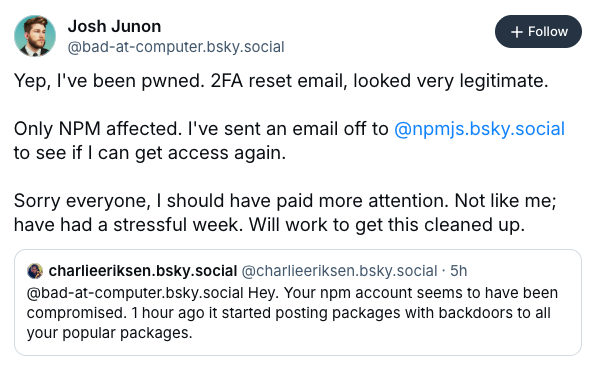
This attack demonstrates a targeted approach, focusing specifically on packages with high download counts while leaving lesser-used packages on the same account untouched. This selective targeting suggests the attackers had specific objectives and understanding of the NPM ecosystem's most impactful packages.

Technical Analysis of the Malicious Code

Based on Aikido's analysis, the injected malicious code, found in the compromised packages, exhibits sophisticated obfuscation techniques and data exfiltration capabilities. The malware includes:

Key Malicious Behaviors:

  1. Ethereum Wallet Detection: Checks for the presence of crypto wallets through window.ethereum
  2. Cryptocurrency Address Replacement: Implements a complex system to detect and replace various cryptocurrency addresses including:
    • Bitcoin (Legacy and SegWit)
    • Ethereum
    • Tron
    • Litecoin
    • Bitcoin Cash
    • Solana
  3. Network Interception: Hijacks fetch and XMLHttpRequest to modify cryptocurrency transactions in real-time
  4. Transaction Manipulation: Specifically targets DeFi platforms including Uniswap, PancakeSwap, SushiSwap, and 1inch

The malware uses extensive obfuscation with over 40 hardcoded cryptocurrency addresses across different blockchains, suggesting a well-organized operation designed to redirect cryptocurrency transactions to attacker-controlled wallets.

Complete List of Affected Packages

The following packages were confirmed compromised with malicious versions:

  • ansi-styles @ 6.2.2
  • strip-ansi @ 7.1.1
  • ansi-regex @ 6.2.1
  • debug @ 4.4.2
  • color-convert @ 3.1.1
  • color-name @ 2.0.1
  • supports-color @ 10.2.1
  • chalk @ 5.6.1
  • wrap-ansi @ 9.0.1
  • slice-ansi @ 7.1.1
  • color @ 5.0.1
  • color-string @ 2.1.1
  • is-arrayish @ 0.3.3
  • simple-swizzle @ 0.2.3
  • supports-hyperlinks @ 4.1.1
  • has-ansi @ 6.0.1
  • chalk-template @ 1.1.1
  • backslash @ 0.2.1

Recovery Steps

Identify Exposure

You can use GitHub search queries to look for compromised versions in your environment. Here is a sample GitHub search query.

To evaluate whether a specific project is vulnerable, use the following commands.

# Check if your project uses any affected packages
npm list chalk debug ansi-styles strip-ansi ansi-regex supports-color wrap-ansi color-convert slice-ansi color-name color color-string is-arrayish simple-swizzle

# Check your package-lock.json for specific versions
grep -E "(chalk|debug|ansi-styles|strip-ansi|ansi-regex|color-convert|wrap-ansi|color-name).*version" package-lock.json

Remove Compromised Packages

# Clear your npm cache
npm cache clean --force

# Remove node_modules and package-lock.json
rm -rf node_modules package-lock.json

# For yarn users
rm -rf node_modules yarn.lock

Rotate secrets and Monitor Crypto Wallets

If a compromised package executed in your environment, take the following steps:

Rotate All Secrets

Rotate all secrets that were exposed such as:

  • API keys
  • Database credentials
  • Authentication tokens
  • Cryptocurrency wallet keys

Monitor Cryptocurrency Wallets

If your application handles cryptocurrency transactions, monitor all wallets for unauthorized activity.

For StepSecurity Enterprise Customers

The following steps are applicable only for StepSecurity enterprise customers. If you are not an existing enterprise customer, you can start our 14 day free trial by installing the StepSecurity GitHub App to complete the following recovery step.


Use NPM Package Cooldown Check

The NPM Cooldown check automatically fails a pull request if it introduces an npm package version that was released within the organization’s configured cooldown period (default: 2 days). Once the cooldown period has passed, the check will clear automatically with no action required.

The rationale is simple - most supply chain attacks are detected within the first 24 hours of a malicious package release, and the projects that get compromised are often the ones that rushed to adopt the version immediately. By introducing a short waiting period before allowing new dependencies, teams can reduce their exposure to fresh attacks while still keeping their dependencies up to date.

Here is an example showing how this check protected a project from using the compromised versions of packages involved in this incident:
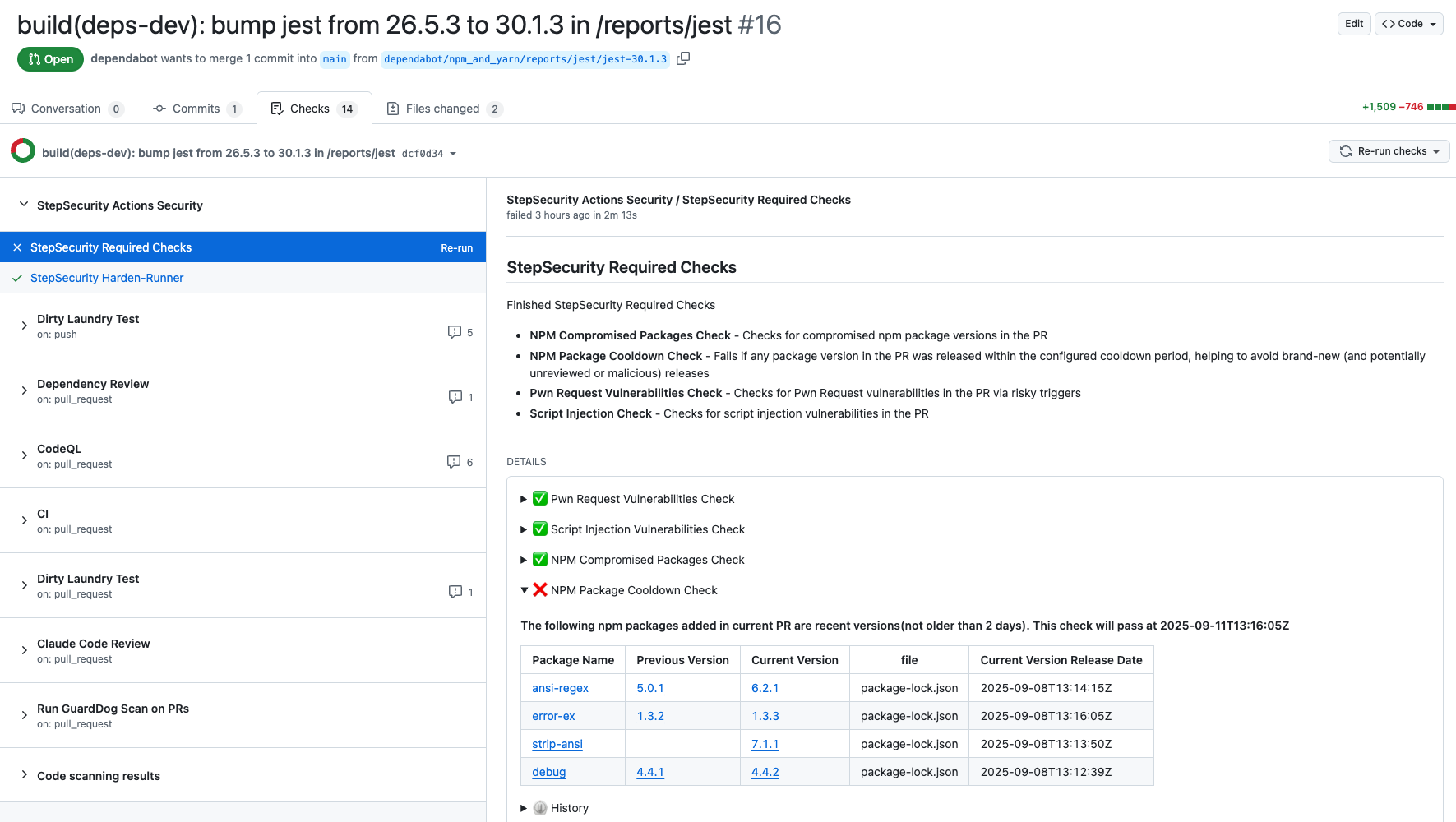
GitHub Check

Discover Pull Requests upgrading to compromised npm packages

We have added a new control specifically to detect pull requests that upgraded to these compromised packages. You can find the new control on the StepSecurity dashboard.

Use StepSecurity Harden-Runner to detect compromised dependencies in CI/CD

StepSecurity Harden-Runner adds runtime security monitoring to your GitHub Actions workflows, providing visibility into network calls, file system changes, and process executions during CI/CD runs. Harden-Runner detects the compromised nx packages when they are used in CI/CD. Here is a sample Harden-Runner insights page demonstrating this detection:
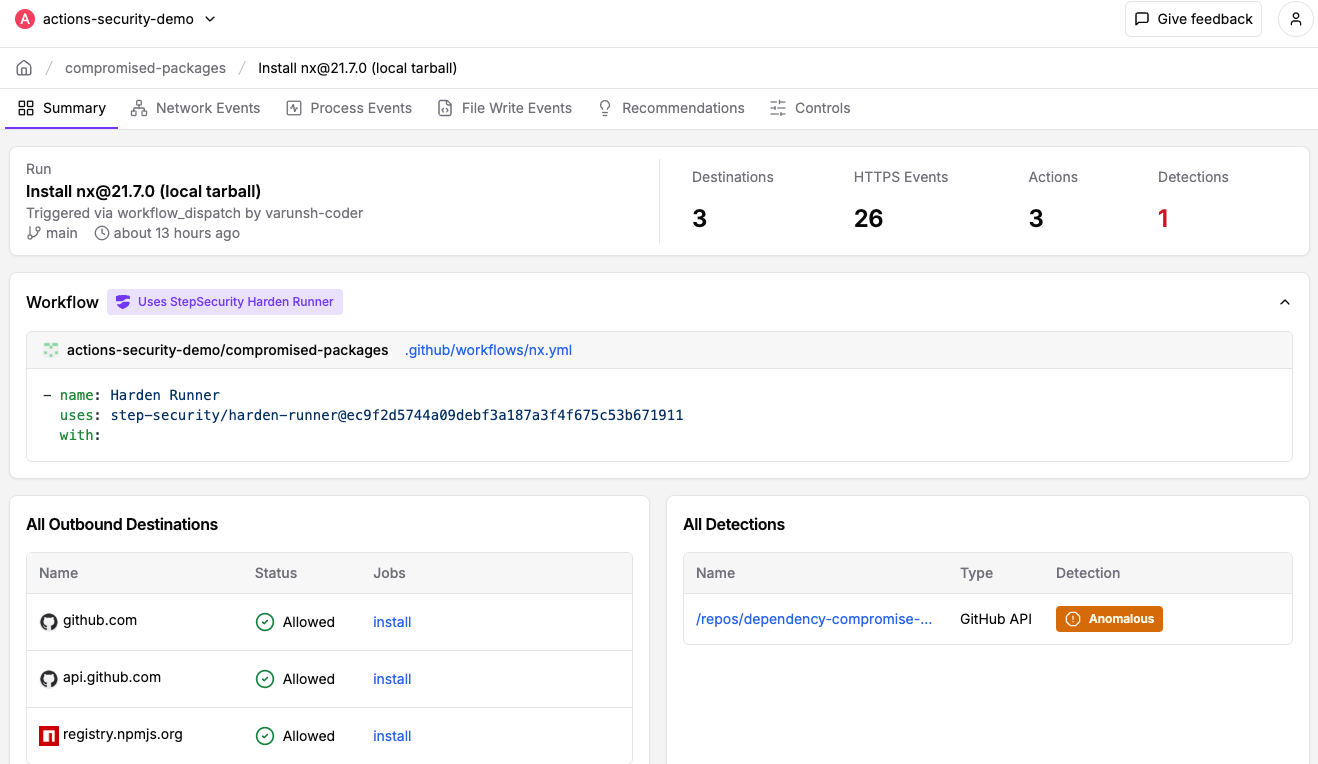
If you're already using Harden-Runner, we strongly recommend you review recent anomaly detections in your Harden-Runner dashboard. You can get started with Harden-Runner by following this guide

Use StepSecurity Artifact Monitor to detect software releases outside of authorized pipelines

StepSecurity Artifact Monitor provides real-time detection of unauthorized package releases by continuously monitoring your artifacts across package registries.

This tool would have flagged this incident by detecting that the compromised versions were published outside of the project's authorized CI/CD pipeline. The monitor tracks release patterns, verifies provenance, and alerts teams when packages are published through unusual channels or from unexpected locations.

By implementing Artifact Monitor, organizations can catch supply chain compromises within minutes rather than hours or days, significantly reducing the window of exposure to malicious packages.
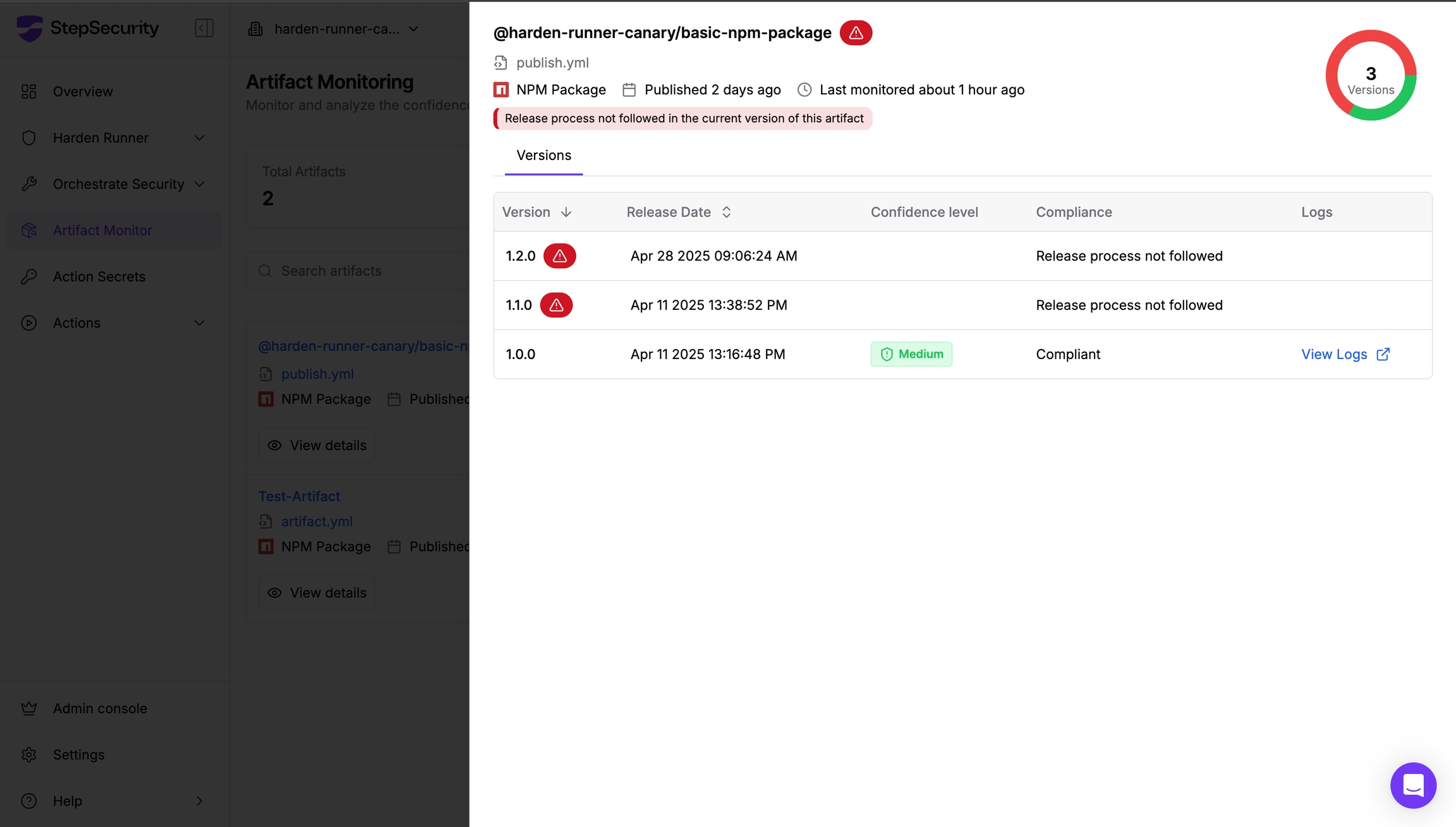
Learn more about implementing Artifact Monitor in your security workflow in our documentation

Industry Response and Mitigation

The open source community responded rapidly to this incident. Sindre Sorhus, maintainer of the Chalk organization, quickly published clean versions and removed the compromised maintainer's access. NPM support initiated incident response procedures, though the maintainer reported initial delays in account recovery.

Credit goes to the security team at Aikido for being the first to detect and publicly report this compromise, enabling rapid community response.

We also want to acknowledge Josh Junon (Qix-), the affected maintainer, for his immediate transparency and responsible disclosure upon discovering the compromise. Josh promptly alerted the community, provided a comprehensive list of affected packages, and worked diligently to remediate the issue.

Lessons Learned and Future Prevention

This incident underscores several critical security considerations:

  • Social Engineering Remains Effective: Even experienced developers can fall victim to sophisticated phishing attacks
  • 2FA Is Not Foolproof: Account takeover can occur despite 2FA when reset mechanisms are compromised
  • Automated Defenses Are Essential: Tools like dependency scanning and package cooldown periods provide critical protection

Conclusion

The compromise of over 20 popular NPM packages through maintainer account takeover represents one of the most significant supply chain security incidents of 2025, affecting the broader JavaScript ecosystem. While the immediate threat has been contained, this attack serves as a critical reminder of the importance of comprehensive supply chain security measures.

Organizations must implement multiple layers of defense, including automated security checks, dependency management policies, and incident response procedures. The rapid detection and response to this incident demonstrates the importance of community vigilance and automated security tooling in protecting the modern software supply chain.