





Since SpeciesNet went open-sourced one year ago, more people than ever have been able to use AI to identify animals and learn about their habitats to promote wildlife monitoring and conservation worldwide.
Dan Morris
Senior Research Scientist, Google Research
General summary
SpeciesNet is an open-source AI model that helps conservationists identify animals in camera trap photos. Since its launch, research groups are using it to analyze data faster. Groups like the Snapshot Serengeti project and the Wildlife Observatory of Australia are using SpeciesNet to monitor wildlife behavior and protect endangered species.
Summaries were generated by Google AI. Generative AI is experimental.
Bullet points
- "How our open-source AI model SpeciesNet is helping to promote wildlife conservation" explains how AI helps wildlife research.
- SpeciesNet, an AI model, identifies almost 2,500 animal types in camera trap photos, saving researchers time.
- Snapshot Serengeti in Tanzania used SpeciesNet to analyze 11 million photos, speeding up vital research.
- In Colombia and Australia, SpeciesNet helps monitor wildlife changes and protect unique local species.
- Idaho uses SpeciesNet to sort millions of camera images, making it easier to track wildlife across the state.
Summaries were generated by Google AI. Generative AI is experimental.
Basic explainer
SpeciesNet is an AI tool that helps people who study animals. It looks at photos from cameras in the wild and figures out what animals are in them. This saves researchers a lot of time, so they can better understand and protect wildlife. Groups all over the world use it to track animals and learn about their behavior.
Summaries were generated by Google AI. Generative AI is experimental.
Explore other styles:
Your browser does not support the audio element.
Listen to article
This content is generated by Google AI. Generative AI is experimental
[[duration]] minutes
From a puma prowling through the Colombian forest at dawn to a cassowary wandering across Australia, motion-triggered cameras give us an unprecedented view of what animals do when humans aren't around. But for wildlife managers, biologists and conservationists, turning millions of these candid snapshots into actionable data is incredibly time-consuming.
That's where SpeciesNet comes in. SpeciesNet is an AI model trained to automatically identify nearly 2,500 categories of mammals, birds and reptiles. The model has been used since 2019 via Wildlife Insights. We launched it as a free, open-source tool a year ago, and today, research groups are using it to make sense of their camera trap data faster than ever.
Africa partner: Snapshot Serengeti
These images from 2024 show a group of elephants at night, a male lion, a zebra in profile, and a warthog that appears to be looking at the camera. Image credit: Snapshot Serengeti; T.M. Anderson
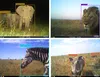
In Africa, the Snapshot Serengeti project has operated camera traps in Tanzania’s Serengeti National Park, in collaboration with the Tanzanian Wildlife Research Institute, since 2010. At first the project recruited online volunteers, but it had too many images for the volunteers to analyze. Project leader Todd Michael Anderson at North Carolina’s Wake Forest University used SpeciesNet to analyze a backlog of 11 million photos, processing decades’ worth of data in just days. The project is analyzing these images to get a long-term view of fauna behavior and abundance in one of Africa’s most biodiverse regions.
South American partner: Colombia’s Humboldt Institute
These images were captured between March and May 2025. They show an ocelot, a small wild cat that’s endangered in the southern U.S. and Mexico but is still common in South America, and a puma (also known as a cougar or mountain lion). Image credit: Project Lucitania/Universidad de los Andes/Red Otus
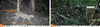
In Colombia, our longtime collaborators at the Humboldt Institute use SpeciesNet as part of the Wildlife Insights platform. Many of the species the institute monitors live in Colombia’s Amazon Rainforest, an extremely biodiverse region that is undergoing rapid changes. The group recently expanded in launching Red Otus, a national-scale network that captures camera trap images on public and private land across the country. The Red Otus project has analyzed tens of thousands of images it has collected to discover changes in the timing of bird migrations and the daily patterns of wildlife across Colombia. Analysis suggests that some mammals are becoming more nocturnal, perhaps to avoid threats, and birds appear later in the morning in developed areas, perhaps to avoid predators.
North American partner: Idaho Department of Fish and Game
These images, captured from July through September 2025, show some of the species IDFG monitors to ensure the population is healthy and stable. The photos show a family of black bears, a coyote, a mule deer and an elk. Photo credit: Idaho Department of Fish and Game
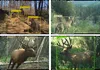
The Idaho Department of Fish and Game (IDFG) is among many state wildlife and transportation agencies in the U.S. and Canada that are using the SpeciesNet AI model to identify animals in their camera trap photos. While aerial surveys are frequently flown in southern Idaho, the agency deploys hundreds of camera traps across the state, particularly in the more forested, northern areas. Human experts conduct a final review, but having SpeciesNet sort the images by species beforehand greatly speeds up reviewing the millions of images collected each year.
Australian partner: Wildlife Observatory of Australia
The images above were captured by WildObs partners in Australian springtime, from August to November 2025. They show a pair of red-legged pademelons, cassowaries out for a midday stroll, and a cassowary peering into the camera. Photo credit: Wildlife Observatory of Australia
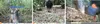
In Australia, our collaborators at the Wildlife Observatory of Australia (WildObs) took the open-source SpeciesNet model and trained it to identify species that weren’t part of the initial model, but that are important locally. Australia is home to many species not found anywhere else in the world, and those species are a priority for monitoring and conservation. A version of SpeciesNet trained on local wildlife lets groups keep an eye on iconic, threatened or endangered species specific to their region in order to sustain wild populations.
SpeciesNet can identify species from multiple angles, in different types of light, and when only a portion of the animal is visible. But sometimes animals get curious and look straight at the camera, producing a true portrait.
The projects above represent just a sample of the groups we’ve worked with to help run SpeciesNet to interpret camera trap photos. We’re grateful to all of our partners who are applying this tool on the ground to better understand and protect the wildlife that also call our planet home. To learn more about the history of SpeciesNet, its model training and performance, read our post on the Google Research Blog.
Done. Just one step more.
Check your inbox to confirm your subscription.
You are already subscribed to our newsletter.
You can also subscribe with a