

惯性聚合 高效追踪和阅读你感兴趣的博客、新闻、科技资讯
阅读原文 在惯性聚合中打开

推荐订阅源

博客园 - 【当耐特】
N
Netflix TechBlog - Medium
钛媒体:引领未来商业与生活新知
钛媒体:引领未来商业与生活新知
雷峰网
雷峰网
MongoDB | Blog
MongoDB | Blog
有赞技术团队
有赞技术团队
Engineering at Meta
Engineering at Meta
M
MIT News - Artificial intelligence
Google DeepMind News
罗磊的独立博客
Hugging Face - Blog
Hugging Face - Blog
WordPress大学
WordPress大学
T
Tailwind CSS Blog
小众软件
小众软件
J
Java Code Geeks
人人都是产品经理
人人都是产品经理
博客园_首页
MyScale Blog
MyScale Blog
博客园 - 聂微东
V
Visual Studio Blog
The Cloudflare Blog
月光博客
月光博客
奇客Solidot–传递最新科技情报
奇客Solidot–传递最新科技情报
U
Unit 42

Blog

From raw data to intelligent actions: inside our next-gen AI analytics data lake stack | Canonical Beyond the 10-year mark: Extending Ubuntu Pro 16.04 LTS security coverage | Canonical Network disaggregation in telecommunication transport networks | Canonical Bring Zenoh to ROS 2 with snaps | Canonical Canonical and CIX Technology announce strategic collaboration for edge innovation | Canonical What the Cyber Resilience Act (CRA) means for Android™ development | Canonical Ubuntu now certified on Qualcomm Dragonwing™ IQ-8275 | Canonical Grace on the currents: Stonking Stingray | Canonical How we create a Canonical Academy exam | Canonical Canonical Data Mesh: scaling data governance | Canonical Canonical joins the Open Secure AI Alliance | Canonical AI harnesses for telco autonomous networks | Canonical Arduino® VENTUNO™ Q is available for pre-order with Ubuntu pre-installed | Canonical Advantech AOM-2721 is now Ubuntu Certified | Canonical Canonical integrates NVIDIA Nemotron 3.5 Lightning with Ubuntu for always-on AI agents | Canonical Ubuntu’s virtualization hardware enablement (HWE) stack: a new model for confidential computing enablement | Canonical Confidential computing and the new regulatory focus on data in use | Canonical A day in the life of an Android developer with Anbox Cloud | Canonical Canonical announces the Enterprise Store as part of Ubuntu Pro | Canonical Tracing a memory leak bug in PID 1 and contributing an upstream fix: a Linux support story | Canonical MAAS installation: bare metal provisioning is easier than ever | Canonical Januscape vulnerability CVE-2026-53359 mitigations available | Canonical Managing Ubuntu on bare metal at scale | Canonical Ubuntu Server: a platform made for enterprise scale | Canonical Building an open source chain of trust: new research uncovers key blockers and ways forward | Canonical Beyond safety and security: Why automotive open source demands dependability  | Canonical DirtyClone Linux kernel local privilege escalation vulnerability fixes available | Canonical pedit COW kernel local privilege escalation vulnerability mitigations | Canonical Canonical becomes Gold Sponsor of Trifecta Tech Foundation | Canonical Challenges designers face in open source (and how to fix them) | Canonical
Native Dell PowerStore integration lands in Canonical LXD...
Miona Aleksic · 2026-09-01 · via Blog

Canonical has broadened enterprise storage options for LXD by introducing a native driver for Dell PowerStore. This collaboration brings together the lightweight, open source virtualization of LXD with adaptable, high-density storage arrays of Dell PowerStore, helping organizations modernize their infrastructure without relying on complex middleware. Thanks to this integration, PowerStore can now also be used as an external storage option with MicroCloud, Canonical’s lightweight open source cloud platform, for a full cloud experience.

Driving infrastructure efficiency with smarter storage

As Dell’s flagship unified storage platform, PowerStore combines all-flash NVMe performance, intelligent automation, and enterprise scalability for data-intensive workloads. Through direct integration, LXD connects with the array to provision thin-block volumes and automatically apply preferred file systems for containerized or custom workloads, eliminating the need for third-party middleware.

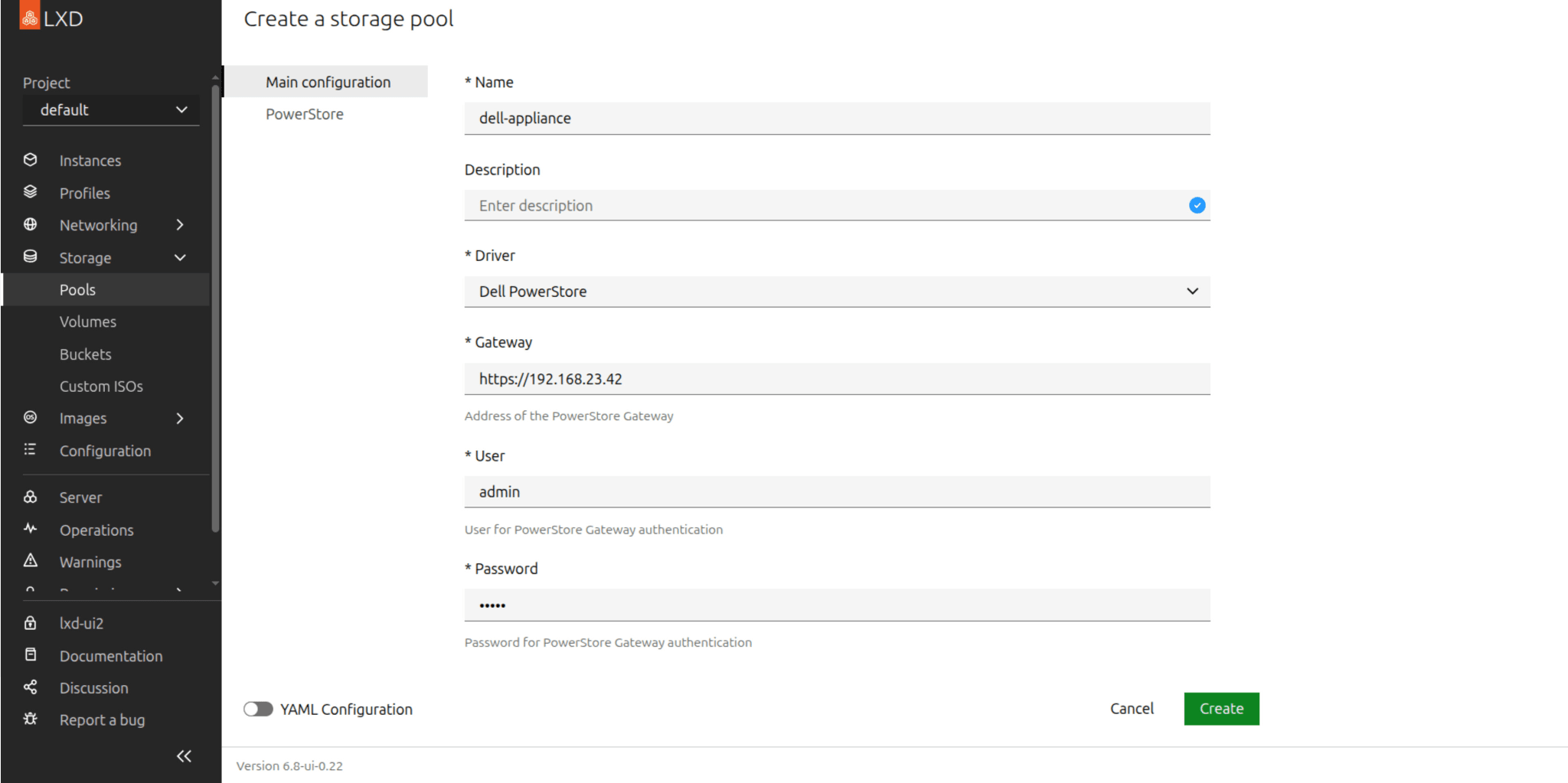
Through this new native integration, LXD and MicroCloud administrators can provision and manage PowerStore block storage directly from the command-line interface, API, or UI – eliminating the overhead and risk of generic third-party abstraction layers.
Seamless scaling and high-throughput clustering

Built on NVMe-based architecture, Dell PowerStore delivers sub-millisecond latency and features intelligent automated data reduction. When paired with LXD’s lightweight control plane, operations remain smooth even under heavy I/O load.

This network-attached block storage architecture offers significant advantages for multi-node deployments:

  • Unified access: all members of a LXD or MicroCloud cluster gain immediate access to the same storage pools
  • Zero-sync overhead: data does not need to be manually replicated or synchronized between hosts, saving critical network bandwidth 
  • On-the-fly scaling: storage capacity and thin-provisioned volumes can be expanded dynamically as application demands shift

Elevating private clouds from edge to data center

Together, LXD and MicroCloud lower the barrier to entry for building resilient private clouds, enabling full cluster deployments in just minutes. Adding native Dell PowerStore support ensures that these environments can confidently host data-intensive, mission-critical applications.

By combining automated storage tiering and compact high-density hardware with efficient system containers and virtual machines, enterprises can significantly shrink their physical data center footprint while maintaining predictable, enterprise-grade performance. With the addition of PowerStore, customers now have Dell’s flagship unified storage platform integrated natively with LXD, expanding choice while reinforcing performance, simplicity, and efficiency.

Compatibility and connection protocols

Dell PowerStore is supported in LXD versions 6.9 or above. 

The new PowerStore driver currently supports storage attachments via iSCSI and FibreChannel (FC), with support for the NVMe/TCP coming in the next release. Setting up a pool requires pre-configuring the PowerStore gateway and providing admin-level authentication credentials during the initial LXD storage configuration.

For full instructions, consult the documentation.


Related posts

Native integration now available for Pure Storage and Canonical LXD

Canonical, the company behind Ubuntu, and Pure Storage, the IT pioneer delivering enterprise-grade all-flash storage, have partnered to introduce a native integration between...

Introducing MicroCloud Cluster Manager

Canonical introduces the beta release of MicroCloud Cluster Manager, a new way to discover, organize, and operate your MicroCloud environments from a single, unified interface.

Native integration available between Canonical LXD and HPE Alletra MP B10000

Native integration available between Canonical LXD and HPE Alletra MP B10000. The integration combines efficient open source virtualization with high performance,...

Native integration available for Dell PowerFlex and Canonical LXD

The integration delivers reliable, cost-effective virtualization for modern IT infrastructure Canonical, the company behind Ubuntu, has collaborated with Dell Technologies on a...