



惯性聚合 高效追踪和阅读你感兴趣的博客、新闻、科技资讯
阅读原文 在惯性聚合中打开

推荐订阅源

The Last Watchdog
The Last Watchdog
博客园_首页
Martin Fowler
Martin Fowler
S
SegmentFault 最新的问题
美团技术团队
小众软件
小众软件
V
V2EX
博客园 - Franky
K
KPMG report finds enterprise disconnect between AI and its ROI | CIO
The GitHub Blog
The GitHub Blog
Microsoft Security Blog
Attack and Defense Labs
S
Security Affairs
Simon Willison's Weblog
I
Intezer
T
The Exploit Database - CXSecurity.com
有赞技术团队
有赞技术团队
S
Schneier on Security
人人都是产品经理
人人都是产品经理
Security Archives - TechRepublic
cs.CL updates on arXiv.org
K
Kaspersky official blog
PCI Perspectives
PCI Perspectives
AI
AI
钛媒体:引领未来商业与生活新知
钛媒体:引领未来商业与生活新知
罗磊的独立博客
O
OpenAI News
Cyber Security Advisories - MS-ISAC
The Register - Security
V
Vulnerabilities – Threatpost
GbyAI
GbyAI
博客园 - 【当耐特】
C
Cisco Blogs
大猫的无限游戏
大猫的无限游戏
Help Net Security
Help Net Security
Google DeepMind News
S
Securelist
Application and Cybersecurity Blog
P
Proofpoint News Feed
博客园 - 三生石上(FineUI控件)
雷峰网
雷峰网
L
LangChain Blog
SecWiki News
SecWiki News
博客园 - 叶小钗
奇客Solidot–传递最新科技情报
奇客Solidot–传递最新科技情报
V2EX - 技术
V2EX - 技术
让小产品的独立变现更简单 - ezindie.com
J
Java Code Geeks
L
LINUX DO - 热门话题
Cisco Talos Blog
Cisco Talos Blog

Blog

MAAS installation: bare metal provisioning is easier than ever | Canonical Januscape vulnerability CVE-2026-53359 mitigations available | Canonical Managing Ubuntu on bare metal at scale | Canonical Ubuntu Server: a platform made for enterprise scale | Canonical Building an open source chain of trust: new research uncovers key blockers and ways forward | Canonical Beyond safety and security: Why automotive open source demands dependability  | Canonical DirtyClone Linux kernel local privilege escalation vulnerability fixes available | Canonical pedit COW kernel local privilege escalation vulnerability mitigations | Canonical Canonical becomes Gold Sponsor of Trifecta Tech Foundation | Canonical Challenges designers face in open source (and how to fix them) | Canonical Hunting a 16-year-old SQLite bug with TLA+: is dqlite affected? | Canonical Anbox Cloud on C4A metal: Android, at scale, without friction | Canonical Canonical announces live kernel patching for Arm64 | Canonical How to use RISC-V custom instructions with Ubuntu | Canonical Ubuntu Summit 26.04: connected by open source | Canonical So you need to add microcontrollers to your fleet: now what? | Canonical Validating real-world skills through Canonical Academy | Canonical Virtualized Android comes to Anbox Cloud | Canonical Beyond Mythos: responding to a new threat landscape | Canonical A look into Ubuntu Core 26: Building a local AI inference appliance in a virtual machine | Canonical This year we celebrate a decade of Ubuntu Server support on the s390x architecture: marking a long-standing collaboration between Canonical and IBM that began at LinuxCon 2015. The first release happened on April 21, 2016, bringing Ubuntu 16.04 LTS (Xenial Xerus) to IBM Z and IBM LinuxONE platforms.  A first for Ubuntu on IBM That […] AI at the edge: simplifying infrastructure with Cisco and Canonical | Canonical The next era of telco clouds: get open infrastructure choice with Sylva and Canonical Kubernetes | Canonical What is RDMA over Converged Ethernet (RoCE)? | Canonical Beyond tokens per watt – using Ubuntu 26.04 LTS for AI | Canonical A look into Ubuntu Core 26: Deploying AI models on Renesas RZ/V series for production | Canonical RISC-V profiles – why is RVA23 significant? | Canonical AI with AMD ROCm on Ubuntu: your questions answered | Canonical When distributed workloads stall because nodes cannot exchange small messages quickly and consistently, the network is the limiting factor. How do you solve that problem? InfiniBand offers one solution. InfiniBand is an interconnect, meaning the end-to-end communication system that links compute, storage, and accelerator nodes. It is impl […] Microsoft has announced the preview of Azure Cobalt 200, its second-generation custom Arm silicon. Learn how Ubuntu and Ubuntu Pro support these new VMs from day one, offering seamless deployment, long-term security maintenance, and Kernel Livepatch without requiring engineering or platform changes […] How Canonical Support solves hard Linux performance bugs  – even in 12-year old code | Canonical Securing AI agent workflows on Ubuntu with the new NVIDIA OpenShell snap | Canonical Canonical announces optimized Ubuntu images for TPU virtual machines by Google Cloud | Canonical VMware hypervisor deployment using MAAS | Canonical Migrating from Apache Spark 3 to Spark 4 | Canonical Introducing Workshop: launch sandboxed development environments on Ubuntu with a single command | Canonical Run agentic workloads on Arm and Ubuntu | Canonical Decoding design: How design and engineering thrive together in open source | Canonical Developing web apps with local LLM inference | Canonical A local privilege escalation (LPE) security vulnerability in the Linux kernel, codename “PinTheft,” was publicly disclosed on May 19, 2026. The vulnerability was fixed in the mainline Linux kernel tree. A proof-of-concept exploit was published along with public disclosure. This has been assigned the CVE ID CVE-2026-43494; other discoverin […] Canonical has announced the general availability of Managed Kubeflow on the Microsoft Azure Marketplace. This fully managed MLOps platform allows enterprise AI teams to deploy a production-ready environment in under an hour, eliminating infrastructure maintenance. […] A look into Ubuntu Core 26: Cloud-powered edge computing with AWS IoT Greengrass and Azure IoT Edge | Canonical CVE-2026-46333 (ssh-keysign-pwn) Linux kernel vulnerability mitigations | Canonical
Template: Streamlining open source design contributions | Canonical
Nina Rojc · 2026-06-16 · via Blog

As designers working at Canonical, we’re always thinking about open source. We believe that encouraging more designers to contribute to open source  benefits everyone, from the project maintainers to the end users themselves.  

In the 2025 edition of FOSSBackstage conference, we presented our research findings on  why designers don’t get involved in open source projects and found a particular breakdown between designers and project maintainers. 

The truth is that designers often struggle to find projects they can contribute to. When they do find a project, the design requirements often are unclear or very limited. Meanwhile, project maintainers struggle to articulate their design needs or may not even know when to ask for design support. 

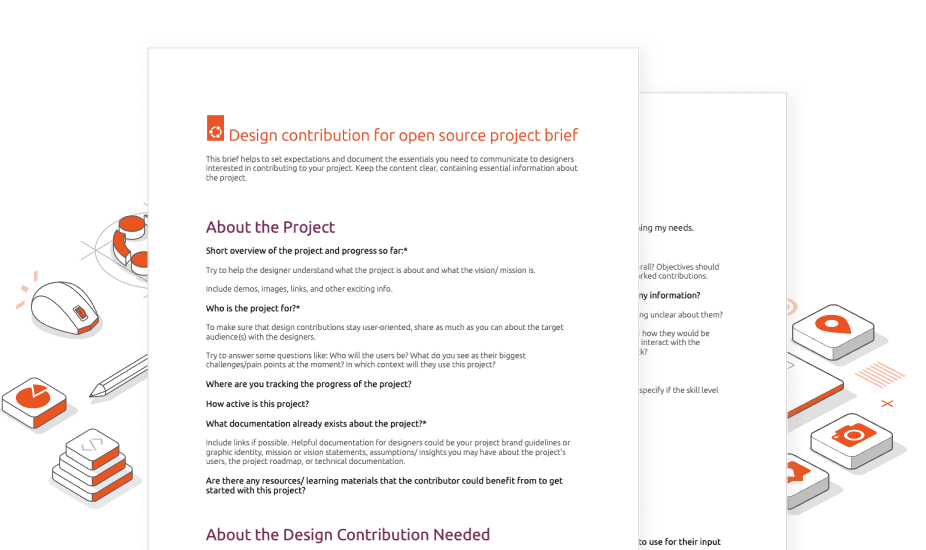
To bridge this gap, we created a template for a design contribution brief for open source projects. This template will help maintainers to clearly articulate their needs and give designers the essential information they need to contribute. 

What’s in the contribution brief?

The brief has 5 sections, one for each area that can cause friction when maintainers try to onboard a designer to a project. The brief includes questions and examples that help maintainers add context to their contribution requirements, so a designer can pick up a project more easily. Here’s what each section covers:

  1. About the project: enables maintainers to get designers up to speed with a project overview, vision, target audience, and progress tracking. This section ensures everyone is on the same page about the project’s goals and context.
  2. About the design contribution needed: here’s where you detail the specific design contributions – from UX and UI, to graphic design and accessibility audits. Explain why you need the contribution, what user needs are, and what design skills are essential.
  3. Logistics: outline deadlines, priority levels, and timelines to keep everyone organized and on track.
  4. Team: introduce the project team and their roles, highlight any existing designers or contributors.
  5. Communications: specify how the team communicates (for example, asynchronously, synchronously), preferred communication platforms, preferred language, and any support for onboarding contributors.

Why use the contribution brief?

Benefits for project maintainers:

  1. Set clear expectations: the template breaks down project expectations to help maintainers articulate what they’re really looking for, and help designers understand the expectations. This makes it easier to communicate design needs and expectations to potential contributors.
  2. Streamline your process: adding all the information to a centralized place makes it easy to reference and saves time and effort. The template addresses the most commonly asked questions, which reduces the need to repeat the same things in different channels. 
  3. Attract the right contributors: clearly articulating design needs helps attract people with the right skills and experience. Maintainers can tag their issues with specific labels and maximize their chance to reach the right audience.

Benefits for designers:

  1. Understand the project: designers can quickly grasp the project’s vision, goals, and target audience, without getting in touch or looking for information in more than one place.
  2. Know your requirements: a specific scope makes it easier to know where to start and how much work will need to be done. The template helps clarify what design contributions are required and the expected outcomes.
  3. Streamline your onboarding: the template makes it easier to understand how the team communicates and where designers can get support quickly.

How to use the template


Join the Canonical design team

We’re looking for designers who care about craft and how systems work under the hood. At Canonical, design sits at the intersection of UX, engineering, and open source where we shape cohesive, accessible experiences across cloud, desktop, and IoT products.

If you enjoy solving complex problems and turning technical depth into clarity, explore our open roles: canonical.com/careers

Related posts


Decoding design: How design and engineering thrive together in open source

Design Article

Open source thrives on engineering-driven processes. Fast feedback loops, terminal tools, Git workflows: they’re the lifeblood of how we build software in the open. But for software to truly excel, we need to create user experiences that empower people to use them. I wanted to bring this conversation into the spotlight as part of Canonica ...