


惯性聚合 高效追踪和阅读你感兴趣的博客、新闻、科技资讯
阅读原文 在惯性聚合中打开

推荐订阅源

Google DeepMind News
人人都是产品经理
人人都是产品经理
H
Hacker News: Front Page
Stack Overflow Blog
Stack Overflow Blog
B
Blog
I
InfoQ
GbyAI
GbyAI
T
The Blog of Author Tim Ferriss
F
Fortinet All Blogs
Y
Y Combinator Blog
Cyber Security Advisories - MS-ISAC
月光博客
月光博客
Hugging Face - Blog
Hugging Face - Blog
爱范儿
爱范儿
F
Full Disclosure
Hacker News - Newest:
Hacker News - Newest: "LLM"
Recent Announcements
freeCodeCamp Programming Tutorials: Python, JavaScript, Git & More
Jina AI
Jina AI
T
Tailwind CSS Blog
S
Secure Thoughts
P
Privacy International News Feed
美团技术团队
钛媒体:引领未来商业与生活新知
钛媒体:引领未来商业与生活新知
L
LINUX DO - 最新话题
H
Hackread – Cybersecurity News, Data Breaches, AI and More
C
Cybersecurity and Infrastructure Security Agency CISA
Last Week in AI
Last Week in AI
W
WeLiveSecurity
Google Online Security Blog
P
Privacy & Cybersecurity Law Blog
D
DataBreaches.Net
Engineering at Meta
Engineering at Meta
Know Your Adversary
Know Your Adversary
P
Palo Alto Networks Blog
I
Intezer
Application and Cybersecurity Blog
Project Zero
Project Zero
V2EX - 技术
V2EX - 技术
H
Heimdal Security Blog
博客园 - Franky
阮一峰的网络日志
阮一峰的网络日志
D
Darknet – Hacking Tools, Hacker News & Cyber Security
T
Troy Hunt's Blog
V
Vulnerabilities – Threatpost
H
Help Net Security
Martin Fowler
Martin Fowler
cs.AI updates on arXiv.org
G
GRAHAM CLULEY
博客园 - 【当耐特】

Runpod Blog.

DeepSeek V4 in the wild, and how to run it on Runpod New Runpod datacenter now live: AP-IN-1 Track GPU spend across your team with Cost Centers The GPU supply supercycle is here. Here’s what AI builders need to know. Community Spotlight: One-click AI image and video generation on Runpod with SwarmUI | Runpod Blog Community Spotlight: LoRA Pilot Data Prep to Inference Introducing the Runpod Assistant: Manage Your Cloud GPU Resources with Natural Language OpenAI's Parameter Golf: Train the Best Language Model That Fits in 16MB on Runpod LLM inference optimization: techniques that actually reduce latency and cost Pruna P-Video and Vidu Q3 public endpoints now available on Runpod Runpod brand spelling guide Quickstart - Runpod Documentation The AI market looks nothing like the narrative Training StyleGAN3 with Vision-Aided GAN on Runpod KoboldAI – The Other Roleplay Front End, And Why You May Want to Use It How to Connect Cursor to LLM Pods on Runpod for Seamless AI Dev Community Spotlight: How AnonAI Scaled Its Private Chatbot Platform with Runpod Prompt Scheduling with Disco Diffusion on Runpod Runpod's Latest Innovation: Dockerless CLI for Streamlined AI Development Run Your Own AI from Your iPhone Using Runpod Introducing Flash: Run GPU workloads on Runpod Serverless: No Docker required Use Claude Code with your own model on Runpod: No Anthropic account required Avoid Errors by Selecting the Proper Resources for Your Pod What hackers built on Runpod at TreeHacks 2026 Easily Back Up and Restore Your Pod with Cloud Sync + Backblaze B2 The Complete Guide to GPU Requirements for LLM Fine-Tuning AI Guides, Tutorials & GPU Infrastructure Insights | Runpod Your first Claude Code project within Runpod: a complete setup guide 10 billion Serverless requests and counting Building for resilience: Runpod’s response to the AWS us-east-1 outage How to Connect Google Colab to Runpod Founder Series #1: The Runpod Origin Story AMD MI300X vs. NVIDIA H100: Mixtral 8x7B Inference Benchmark How to Run the FLUX Image Generator with ComfyUI on Runpod Run Llama 3.1 405B with Ollama on Runpod: Step-by-Step Deployment How to Run FLUX Image Generator with Runpod (No Coding Needed) How to Use 65B+ Language Models on Runpod Deploy Llama 3.1 with vLLM on Runpod Serverless: Fast, Scalable Inference in Minutes Open Source Video & LLM Roundup: The Best of What’s New Run vLLM on Runpod Serverless: Deploy Open Source LLMs in Minutes Introduction to vLLM and PagedAttention New update to Github integration: release rollback! | Runpod Blog A note to the developers who built Runpod with us Deploy ComfyUI as a Serverless API Endpoint Setting up Slurm on Runpod Clusters: A Technical Guide Building an OCR System Using Runpod Serverless From No-Code to Pro: Optimizing Mistral-7B on Runpod for Power Users Lessons While Using Generative Language and Audio For Practical Use Cases Runpod RoundUp 3 – AI Music and Stock Sound Effect Creation New Navigational Changes To Runpod UI Use alpha_value To Blast Through Context Limits in LLaMa-2 Models Runpod Roundup 5 – Visual/Language Comprehension, Code-Focused LLMs, and Bias Detection Runpod is Proud to Sponsor the StockDory Chess Engine Runpod Roundup 4 – Open Source LLM Evaluators, 3D Scene Reconstruction, Vector Search Meta and Microsoft Release Llama 2 as Open Source SuperHot 8k Token Context Models Are Here For Text Generation How to Manage Funding Your Runpod Account Encrypted Volumes on Runpod: Protect Your Data at Rest How to Run a "Hello World" on Runpod Serverless Runpod AI field notes: December 2025 Faster GitHub Builds: Major Performance Improvements to Our Automated Integration Partnering with Defined AI to Bridge the Data Wealth Gap How to Run Serverless AI and ML Workloads on Runpod How to fine-tune a model using Axolotl Transcribe and translate audio files with Faster Whisper Runpod Achieves SOC 2 Type II Certification: Continuing Our Compliance Journey Orchestrating GPU workloads on Runpod with dstack Exploring Runpod Serverless: Create Workers From Templates DeepSeek V3.1: A Technical Analysis of Key Changes from V3-0324 Deep Cogito Releases Suite of LLMs Trained with Iterative Policy Improvement Iterative Refinement Chains with Small Language Models The New Runpod.io: Clearer, Faster, Built for What’s Next Introducing Clusters: On-Demand Multi-Node AI Compute Run DeepSeek R1 on Just 480GB of VRAM How Do I Transfer Data Into My Runpod? Spot vs. On-Demand Instances: What’s the Difference? Deploy GitHub Repos to Runpod with One Click Run GGUF Quantized Models Easily with KoboldCPP on Runpod How to Work with GGUF Quantizations in KoboldCPP Introducing Better Forge: Spin Up Stable Diffusion Pods Faster Supercharge Your LLMs with SGLang: Boost Performance and Customization Mastering Serverless Scaling on Runpod: Optimize Performance and Reduce Costs RAG vs. Fine-Tuning: Which Is Best for Your LLM? Run Larger LLMs on Runpod Serverless Than Ever Before – Llama-3 70B (and beyond!) How to Run vLLM on Runpod Serverless (Beginner-Friendly Guide) Embracing New Beginnings: Welcoming Banana.dev Community to Runpod Stable Diffusion + ComfyUI on Runpod: Easy Setup Guide Runpod RoundUp 2 – 32k Token Context LLMs and New StabilityAI Offerings Runpod Roundup: High-Context LLMs, SDXL, and Llama 2 16k Context LLM Models Now Available On Runpod Savings Plans Are Here For Secure Cloud Pods – How To Purchase a Monthly Plan And Save Big Pygmalion-7b from PygmalionAI has been released, and it's amazing Ada Architecture Pods Are Here – How Do They Stack Up Against Ampere? Spin up a Text Generation Pod with Vicuna and Experience a GPT-4 Rival Using OpenPose to Annotate Poses Within Stable Diffusion Set Up a Chatbot with Oobabooga on Runpod Connect VSCode to Your Runpod Instance (Quick SSH Guide) Deploy a Stable Diffusion UI on Runpod in Minutes Google Colab Pro vs. Runpod: Best GPU Cloud for AI Workloads How to Run a GPU-Accelerated Virtual Desktop on Runpod
Wan 2.2 Releases With a Plethora Of New Features
Brendan McKeag · 2025-08-01 · via Runpod Blog.

The video generation landscape has witnessed a significant leap forward with the release of Wan 2.2, marking a substantial upgrade over its predecessor Wan 2.1. For cloud infrastructure providers and developers running video generation workloads, understanding these improvements is crucial for optimizing deployment strategies and resource allocation.

Executive Summary

Wan 2.2 introduces a Mixture-of-Experts (MoE) architecture into video diffusion models, incorporates meticulously curated aesthetic data, and achieves complex motion generation through significantly larger training datasets (+65.6% more images and +83.2% more videos). This is done through a “high noise” and a “low noise” model that work in tandem, which is a departure from most previous video generation models. The high noise expert handles early denoising stages, while the low noise expert manages later staging, refining video textures and details. This means in ComfyUI you now have two sets of sampler variables (CFG, scheduler, etc.) and can configure at which step you want to move from one expert to the next, which adds a great degree of customization to the process — as well as complication.

Massively Scaled Training Dataset

Wan 2.2's performance gains are significantly attributed to its expanded training corpus:

  • Image Data: +65.6% more images compared to Wan 2.1
  • Video Data: +83.2% more videos compared to Wan 2.1
  • Quality Enhancement: This expansion notably enhances the model's generalization across multiple dimensions such as motions, semantics, and aesthetics

Notably, despite this greatly increased dataset, the compute costs and memory footprint appear to be about the same. In addition, LoRAs trained on Wan 2.1 should work just fine, and in fact in my experience they work even better as the model architecture remains the same but the models are far more performant from their upgraded dataset. If you wish to retrain, then diffusion-pipe has already been upgraded to support Wan 2.2.

TI2V-5B: A New Tool In The Kit

The Text-Image-to-Video 5B (TI2V-5B) model represents perhaps the most significant practical breakthrough in Wan 2.2's lineup. This model supports both text-to-video and image-to-video generation at 720P resolution with 24fps and can also run on consumer-grade graphics cards like 4090.

Understanding the TI2V Architecture

TI2V-5B employs a unified architecture that intelligently handles both text-only and text-with-image inputs through a single model. Unlike the larger A14B models that use Mixture-of-Experts, TI2V-5B utilizes a dense transformer architecture optimized for efficiency and consumer hardware deployment. The model's versatility lies in its conditional processing approach:

  • Text-to-Video Mode: When only a text prompt is provided, the model generates video content from scratch, leveraging its extensive training on text-video pairs to create coherent motion and visual narratives
  • Image-to-Video Mode: When both text and image inputs are supplied, the model uses the image as a conditioning frame, generating video sequences that maintain visual consistency with the input while following the textual guidance
  • Automatic Mode Detection: If the image parameter is configured, it is an Image-to-Video generation; otherwise, it defaults to a Text-to-Video generation

Quick Start Guide

Here’s what you’ll need to do to get started with Wan 2.2 t2v on Runpod in just a few minutes.

Select the GPU of your choice; if you just want to test the model’s maximum capabilities cheaply without worrying about OOMing at a high resolution or framerate, an A100 is a good choice, with 48GB cards or lower more economical if you’re not shooting for the moon for video size. H100s and H200s will provide the fastest inference of all, but with a higher price tag.

We’ll use the Wan 2.1/2.2 template from Hearmeman; make sure that you edit the environment variables to download 2.2.
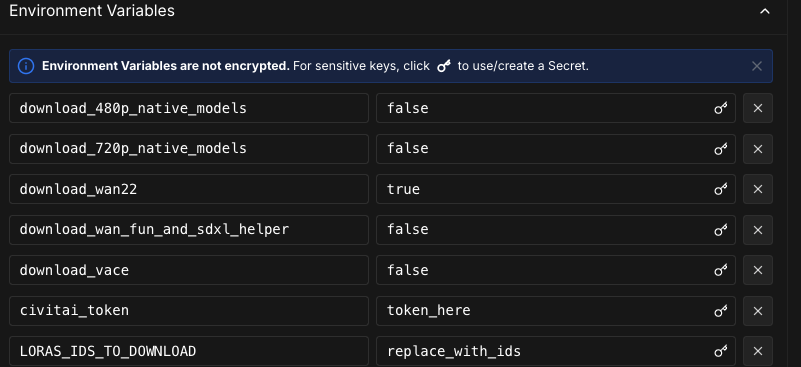
Runpod template environment variables editor with Wan 2.2 model download options

This Reddit post provides some great starter workflows for all modalities; we’ll start by dragging the T2V workflow into our pod’s ComfyUI. Here’s what’s changed in the latest iteration.

Multiple models

You now have two models that work in tandem, as described. Each of these models can have LoRAs applied to them independently, at different strengths. However, they still only use one prompt.
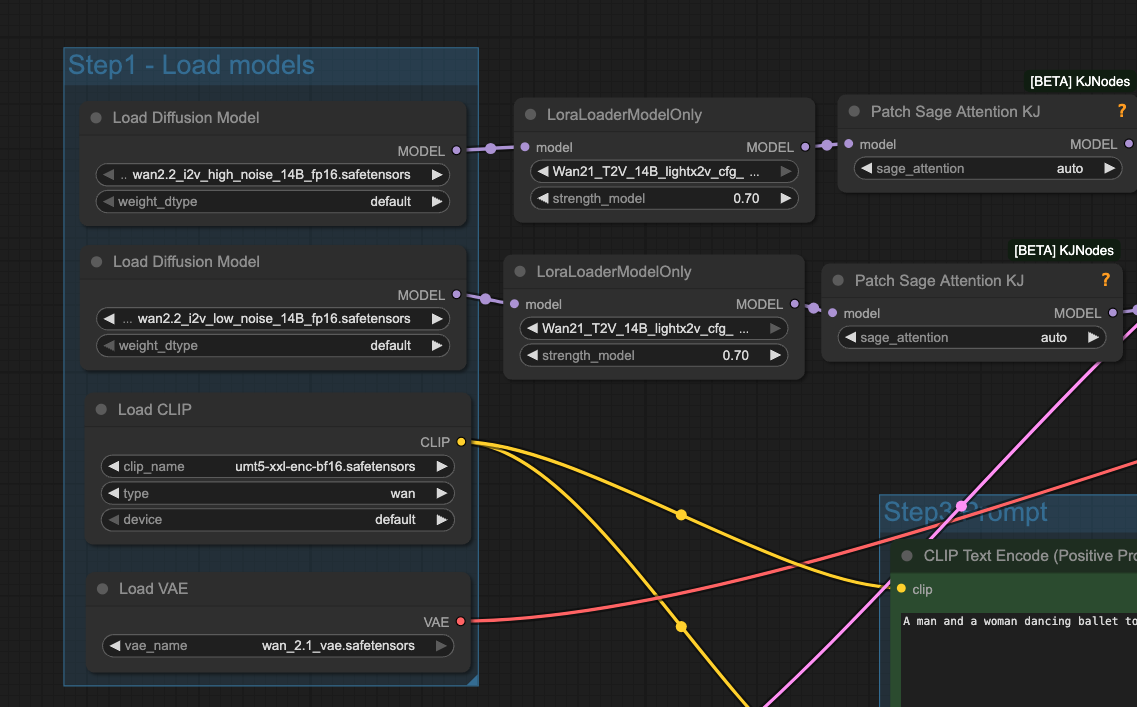
ComfyUI load models step with Wan 2.2 diffusion model, CLIP, and VAE nodes

You also have two sets of samplers, one for each model. Note that the default CFG is now very low; the typical setting of 6 will very easily ‘cook’ outputs under this new paradigm. Each expert (high-noise and low-noise) has learned specialized representations, and when CFG scaling is applied, it amplifies the confidence of both experts simultaneously. Remember that the ‘high’ model is the scene director, and the ‘low’ model is the refiner, so a high CFG on the first model will blow it out faster than on the second.

However, you can also specify which proportion of steps are allocated to which model. This can help mitigate oversaturation effects while still allowing for a high CFG, if the amount of generation time spent in high CFG is properly attenuated.

Long story short, you have many, many more levers to pull, each of which interact with each other in different ways, but ultimately allow for a great detail of fine-tuning that wasn’t there in previous models.
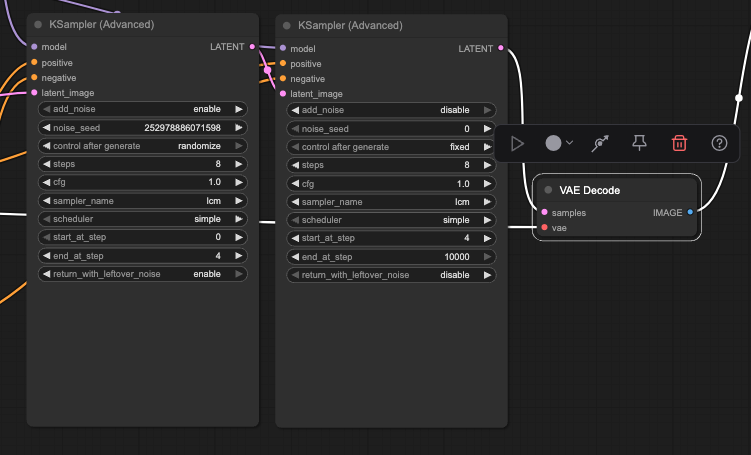
ComfyUI workflow with two advanced KSampler nodes feeding a VAE Decode node

Conclusion

Wan 2.2 represents a significant architectural and performance leap over Wan 2.1, introducing MoE efficiency, enhanced training data, and consumer GPU accessibility. The combination of technical innovation and practical deployment considerations makes it a compelling upgrade for organizations operating video generation infrastructure, while its performance and understanding improvements will please hobbyists as well.

For deployment support and infrastructure optimization for Wan 2.2 on Runpod's GPU cloud platform, check out our Discord for customized solutions and scaling strategies.

Author profile: Brendan McKeag