惯性聚合 高效追踪和阅读你感兴趣的博客、新闻、科技资讯
阅读原文 在惯性聚合中打开

推荐订阅源

量子位
Stack Overflow Blog
Stack Overflow Blog
人人都是产品经理
人人都是产品经理
The GitHub Blog
The GitHub Blog
Engineering at Meta
Engineering at Meta
Vercel News
Vercel News
奇客Solidot–传递最新科技情报
奇客Solidot–传递最新科技情报
Y
Y Combinator Blog
The Cloudflare Blog
Last Week in AI
Last Week in AI
B
Blog
钛媒体:引领未来商业与生活新知
钛媒体:引领未来商业与生活新知
T
Tailwind CSS Blog
V
Visual Studio Blog
博客园 - 三生石上(FineUI控件)
小众软件
小众软件
Google DeepMind News
D
DataBreaches.Net
博客园 - 司徒正美
B
Blog RSS Feed
Microsoft Azure Blog
罗磊的独立博客
Hugging Face - Blog
Hugging Face - Blog
L
LangChain Blog

Runpod Blog.

DeepSeek V4 in the wild, and how to run it on Runpod New Runpod datacenter now live: AP-IN-1 Track GPU spend across your team with Cost Centers The GPU supply supercycle is here. Here’s what AI builders need to know. Community Spotlight: One-click AI image and video generation on Runpod with SwarmUI | Runpod Blog Community Spotlight: LoRA Pilot Data Prep to Inference Introducing the Runpod Assistant: Manage Your Cloud GPU Resources with Natural Language OpenAI's Parameter Golf: Train the Best Language Model That Fits in 16MB on Runpod LLM inference optimization: techniques that actually reduce latency and cost Pruna P-Video and Vidu Q3 public endpoints now available on Runpod Runpod brand spelling guide Quickstart - Runpod Documentation The AI market looks nothing like the narrative Training StyleGAN3 with Vision-Aided GAN on Runpod KoboldAI – The Other Roleplay Front End, And Why You May Want to Use It How to Connect Cursor to LLM Pods on Runpod for Seamless AI Dev Community Spotlight: How AnonAI Scaled Its Private Chatbot Platform with Runpod Prompt Scheduling with Disco Diffusion on Runpod Runpod's Latest Innovation: Dockerless CLI for Streamlined AI Development Run Your Own AI from Your iPhone Using Runpod Introducing Flash: Run GPU workloads on Runpod Serverless: No Docker required Use Claude Code with your own model on Runpod: No Anthropic account required Avoid Errors by Selecting the Proper Resources for Your Pod What hackers built on Runpod at TreeHacks 2026 Easily Back Up and Restore Your Pod with Cloud Sync + Backblaze B2 The Complete Guide to GPU Requirements for LLM Fine-Tuning AI Guides, Tutorials & GPU Infrastructure Insights | Runpod Your first Claude Code project within Runpod: a complete setup guide 10 billion Serverless requests and counting Building for resilience: Runpod’s response to the AWS us-east-1 outage
Ada Architecture Pods Are Here – How Do They Stack Up Aga...
Brendan McKeag · 2023-05-02 · via Runpod Blog.

The Ada architecture is the latest architecture developed by Nvidia that is capable of achieving vastly improved performance on AI and HPC workloads compared to previous Nvidia GPU architectures. Ada also comes equipped with a new generation of Tensor Cores, which greatly accelerate matrix operations commonly used in deep learning algorithms. In addition, Ada brings with it higher clock speeds, lower power consumption, and a die cache size that is 16 times larger than that found on Ampere cards. This architecture represents a significant step forward for Nvidia in its pursuit of providing cutting-edge computing solutions for data centers.

Benchmarking Ada vs Ampere cards

Below are data collected via test runs of two different Ada pods compared to the old Ampere architecture.

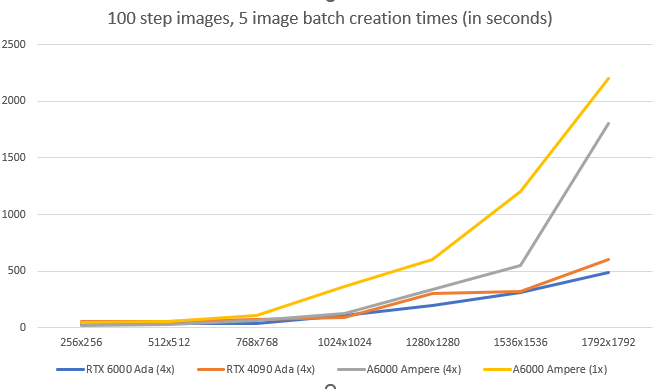
Stable Diffusion task runtime in seconds (100 inference steps, 5 images per batch)

This test was conducted using the Runpod Stable Diffusion Template using the AUTOMATIC1111 interface.

Resolution RTX 6000 Ada (4x) RTX 4090 Ada (4x) A6000 Ampere (4x) A6000 Ampere (1x)
256x25628571647
512x51238582452
768x768397060109
1024x102410491126360
1280x1280195299340600
1536x15363093205491201
1792x179248460218092200

Line chart of 100-step image batch creation times by resolution for RTX 6000 Ada, RTX 4090, and A6000 Ampere GPUs

These results show that aside from the (probably rather questionable) use case of pumping out very small images, the Ada cards show up to a 50% increase on mid-level images and up to tripled or even quadrupled performance on the largest possible images within Stable Diffusion.

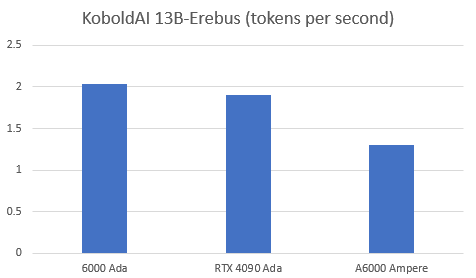
Text generation tokens per second in Oobabooga per model (fully loaded context)

This test was conducted using Oobabooga in the Runpod Text Generation UI Template with a pre-existing text log large enough to completely fill the context buffer.

Model A6000 Ada RTX 4090 Ada A6000 Ampere
Pygmalion 350m15.2115.9114.6
Pygmalion 6b12.311.3110.7
KoboldAI 13B-Erebus2.031.91.3

Bar chart of KoboldAI 13B-Erebus tokens per second for RTX 6000 Ada, RTX 4090, and A6000 Ampere

Looking at text generation, we also see a solid increase in tokens per second even on smaller models that nudges close to being 70% faster on the computationally expensive Erebus model.

How Do I Set Up A Pod On Ada?

Simple - when setting up a pod, just ensure that you select an option at the top displayed under Latest Generation, such as what you see under the Secure Cloud listing. These GPUs tend to be more highly in demand, so grab them while you can!
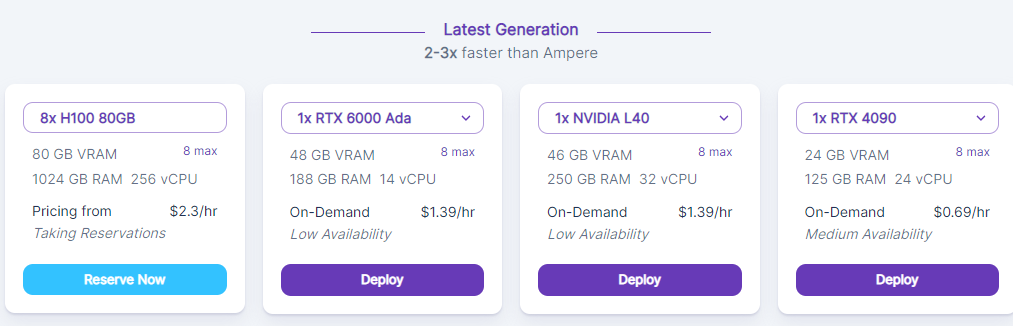
Runpod console GPU selection showing latest-generation cards including H100, RTX 6000 Ada, L40, and RTX 4090

Questions?

Feel free to reach out to us on our Discord - we are here to help!

Author profile: Brendan McKeag