











The first time Joe Lacob invested in women’s basketball, the operation dissolved.
In 1996, Lacob became a lead backer of the American Basketball League, a WNBA rival, and owner of the San Jose Lasers. He was convinced that women’s basketball had a bigger future than the general public realized. The league folded after two and a half seasons.
“Sometimes you don’t succeed in investing not because you had the wrong management, technology, or idea,” Lacob said. “Sometimes you’re just too early.”
Thirty years after investing in the ABL, the Warriors owner now holds the most valuable franchise in the history of women’s sports.
The Golden State Valkyries represent something bigger than a basketball team. A league that was sharing college gyms and drawing crowds of a few thousand at the turn of the decade is now a billion-dollar industry, driven by a new generation of star players and an ownership class finally willing to match the moment with serious money. In just one season, the Valkyries became the blueprint — one defined by major investment, purpose-built facilities, and organizational ambition that’s forcing every other franchise to raise its game.
The question is no longer whether women’s basketball is a viable business. It’s whether the rest of the league can keep up.
“I would say that the WNBA was always moving in that direction but that the Valkyries pushed them ahead much faster,” said Nola Agha, professor of sport management at the University of San Francisco.
Agha cited the willingness of New York Liberty owners Joe Tsai and Clara Wu Tsai’s willingness to pay fines (opens in new tab) so players could fly on chartered planes in 2022 as an example of norms evolving before Lacob bought in. In 2024, the WNBA invested $50 million to begin full-time private charter service.
“You’re partnering with other ownership groups that are pushing forward and investing responsibly,” Agha said. “That’s what I think motivates or speeds up the growth and the change within all the other teams in the league.”

The outlook wasn’t always rosy — not for Lacob, not for women’s basketball in the Bay Area, and certainly not for a league that’s been transformed since the Valkyries were established in 2023 with a record-setting $50 million expansion fee.
Lacob knows the price point was steep. Even a bit absurd.
“We did the league a favor by — I know this is gonna sound funny — paying a $50 million expansion fee,” Lacob said. “No one ever paid close to that. I could have bought a team for $2 million.”
Lacob argued and negotiated with the league over the price. Just four years earlier, the Liberty had changed hands for a record-setting $10 million. Lacob, still a believer in the potential of women’s basketball, conceded and wrote the check anyway.
As it turns out, Lacob was early once again. But not too early. Today, the investment looks like a bargain. The Valkyries sit alone in a women’s sports franchise valuation tier they created: the billion-dollar rung.
“That might be low, to be honest,” Lacob said of CNBC’s recent franchise appraisal (opens in new tab). “We’re put at the average multiple of everyone, but we aren’t the average team.”
The “average team” in the WNBA is worth 435% more than at the start of the 2024 season: $427 million, versus $96 million, according to Sportico (opens in new tab). The Valkyries became the WNBA’s 13th team, and soon after, new owners began lining up to pay expansion fees five times greater than the sum Lacob once scoffed at.
“There’s an enormous amount of demand to buy into these teams now, and there’s an enormous amount of growth potential,” Agha said. “It doesn’t matter if you’re investing in widgets or dog food or sports, as an investor, you’re looking for something with the most upside growth.”
Lacob’s ownership caught the WNBA at an inflection point … and the Valkyries immediately moved the goalpost further.
That was the goal.
“We’ve always known that this moment — that we got a chance to lead as the first expansion team since 2008 — was much bigger than Golden State,” said Jess Smith, Valkyries president and the team’s first employee. “Right, wrong, or indifferent, our success was going to set a bar for the future of this league.”
A year before the Valkyries entered the fold, the popularity of the 2024 WNBA Draft class, headlined by Caitlin Clark and Angel Reese, pushed the league forward at an unprecedented pace. It was then, 28 years into the league’s existence, that the WNBA hit staggering new attendance totals — up 48% from a season prior. TV viewership, digital engagement, and merchandise sales (up 601% from 2023) set new baselines, and those numbers continue to climb year over year.
In July 2024, the WNBA secured an 11-year, $2.2 billion media rights deal (opens in new tab) that is now worth $3.1 billion following agreements with Amazon, Disney, and NBCUniversal (opens in new tab) — a 150% increase (opens in new tab) over its previous deal.
The surge in demand was driven by star power: household names reshaping the game’s visibility and breaking the containment of traditional fandom. But now, in the phase that follows, as stars continue to lift the league, few if any teams have done more to translate that attention into structural change than the Valkyries.
“Just like Caitlin Clark and some of the other players coming in have changed the quality of players in the league a little bit, we can change the quality of the business and the way business is run in this league,” Lacob said. “Not to say that others aren’t good — the Liberty and others certainly do a good job, but I think what we do is on a completely different level.”
The Valkyries’ arrival redefined what ownership in the WNBA is supposed to look like, and what a franchise is expected to deliver in terms of player and fan experience. As new expansion teams enter the grid, that reality is unmistakable.
Smith’s insistence on creating separate branding from the Warriors, establishing a business staff for the Valkyries with more than 70 people, and intentionally catering in-arena experiences to a season-ticket base that shares only an 8% overlap with the Warriors set a standard for the rest of the league to follow.
“We take a lot of pride at Golden State to know that we probably instilled a lot of confidence in the future casting of what this looks like,” Smith said.
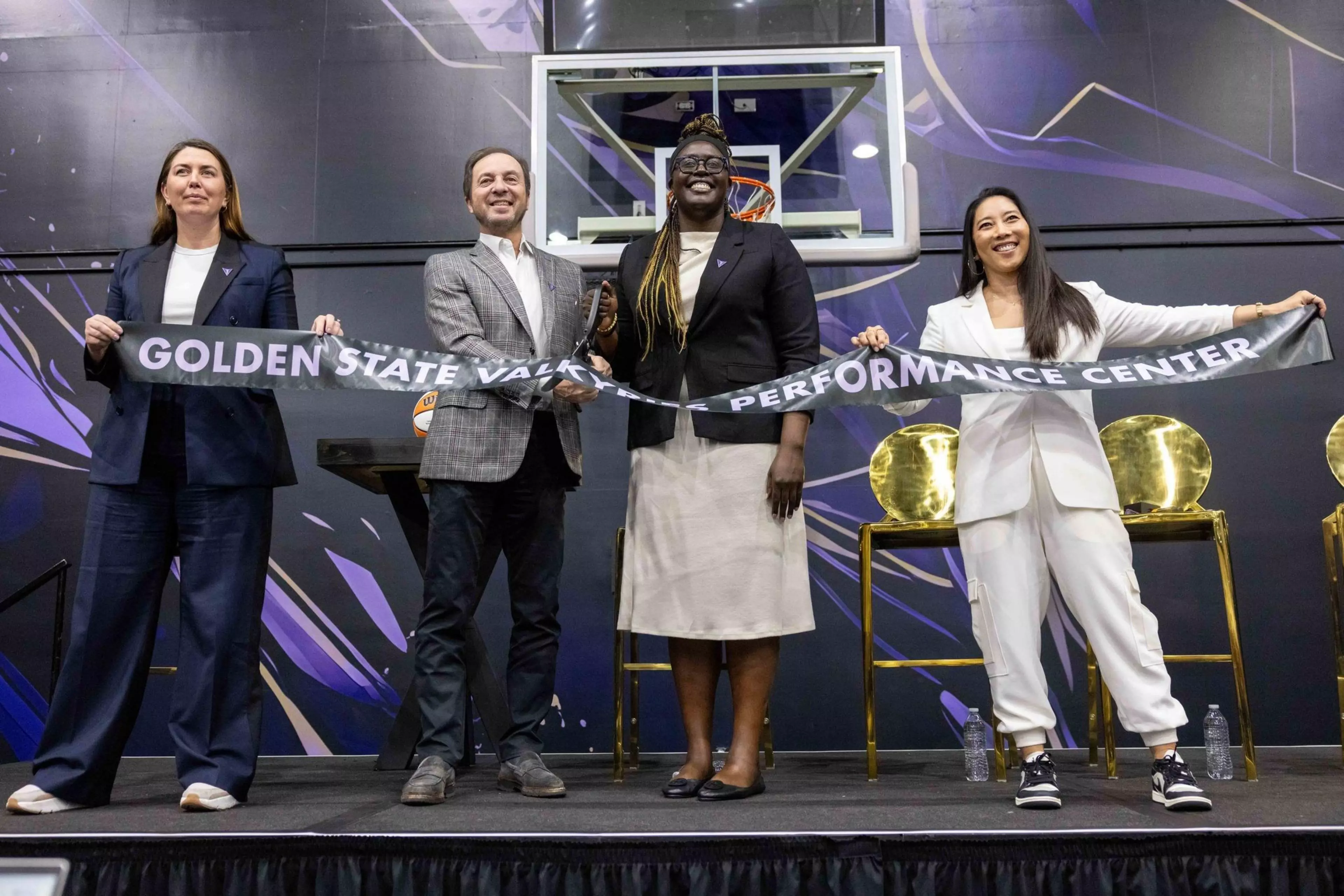
Before the Valkyries built their first roster, ownership approved a $1.45 million renovation of a dedicated practice facility at the Oakland Marriott, a private space that the organization already owned and had once served as the Warriors’ practice facility. At Chase Center — a new $1-billion-plus arena — they carved out a state-of-the-art Valkyries campus and locker room, specialized and ready before any athlete had penned a contract.
“That’s where we have a huge advantage with this ownership group: their willingness to enact capital,” Smith said. “Well, shouldn’t we have our own locker room inside Chase Center? It was a really short runway to yes — even though it’s a 5-year-old facility.”
In 2023, the Las Vegas Aces became the first WNBA organization to build their own practice facility — prior players had known only shared training facilities: college gyms, infrastructure shared with NBA affiliates, or, for the Chicago Sky up until 2024, a suburban recreational center. Now, nearly every franchise is working on a team-specific training campus project.
For the Valkyries, there was the understanding that investment needed to be large in scale from the start.
The Portland Fire, whose ownership group also owns the NWSL’s Portland Thorns, is developing a $150 million training center for women’s sports. The Toronto Tempo, meanwhile, have unveiled plans for a dedicated practice facility, a project expected to exceed $100 million. The three teams set to enter the league by 2030 — Cleveland, Detroit, and Philadelphia — are all backed by NBA ownership groups and are developing WNBA-specific facilities and player amenities.
This wasn’t the norm the last time an expansion team arrived. When the Atlanta Dream entered the league in 2008, six WNBA teams had ceased operations since 2000, and two more would fold the following year. Today’s ownership groups are dealing with a vastly different set of expectations — and investing accordingly.
“What this suggests is the WNBA was too slow to expand, and there are probably fan bases out there that they’re not exploiting,” sports economist said David Berri, a professor of economics at Southern Utah University. “The WNBA is still smaller than the NBA was at the same point in its history. It took a long time to expand, they’ve been overly cautious.”

The Valkyries’ sustained commitment to both fan and player experience is on display at every game. They’ve packed their arena with 18,000 fans for 30 consecutive games, a sellout streak that’s unmatched by any women’s sports franchise. While attendance is growing rapidly throughout the WNBA, it recorded just 48 sellouts across all teams in 2023.
Lacob and Smith’s Day 1 goal was to fill Chase Center’s lower bowl consistently. Now, they’ve built a season-ticket waitlist after capping deposits at 12,000 fans. The organization’s success in ticket sales is a proof of concept that Lacob wants to spread.
“Go to another game around the league and see how professional it feels: some, not so much,” Lacob said. “Go to an arena in certain places and see 3,500 seats like a high school gym. That’s just not going to cut it. It’s not.”
The Atlanta Dream play home games in an arena that seats roughly 3,500. The Washington Mystics can seat 4,200 fans at home, and the Dallas Wings entertain an audience of 7,000.
Chase Center had the largest capacity in the WNBA last season, but one new entrant to the league, the Portland Fire, play at the Moda Center, which can fit more than 19,000. In nine home games, the Fire have averaged 14,104 fans per game.
“We need, truthfully, honestly, openly, everyone to do it,” Lacob said. “If we’re going to have the top league in the world, which we are from a player standpoint, then we need the top facilities in the world.”
The WNBA’s longest-tenured players, including 14th-year Valkyries guard Tiffany Hayes, remember when that wasn’t the case.
“Even having a decent locker room, having the things that women need in a locker room, even sometimes that was not provided,” Hayes said of her early days in the league.
From individual rooms in first-class hotels to chartered flights to raising the minimum salary to $270,000 — from $66,079 last year — the WNBA’s standards have changed. And if teams don’t keep pace, players have leverage to move elsewhere in a free-agent market where the top talent is finally earning more than $1 million each season.

A few years after Lacob tried to negotiate down from $50 million, he found himself giving the opposite advice.
As Houston Rockets owner Tilman Fertitta weighed a reported $300 million purchase of the Connecticut Sun and a relocation of the team to Houston, Lacob couldn’t believe there was any hesitation.
“I said, ‘Are you kidding me? What are you not seeing? You should be all over this.’”
In one sense, it took just three years for the economics of WNBA ownership to transform and for the women’s basketball market to become one of the most attractive growth investments in sports. In another — to Lacob and many others — it was a 30-year journey.
It’s been more than three decades since Lacob’s affinity for the game sprouted as he spent winter evenings courtside at Stanford women’s basketball games, watching the early days of Tara VanDerveer’s dynasty era alongside his two daughters. It’s been 30 years since he invested in the ABL and brought the Lasers to life, only to watch it all fold.
“We’re in a mega trend with sports and women’s basketball in particular,” Lacob said. “Our job is not to screw it up.”
Lacob takes immense pride in being the first to $1 billion. He and Smith believe $2 billion to $3 billion is within reach for the Valkyries, but first, they’re eager to welcome others to the club.
“This league is unrecognizable from the last CBA,” Smith said. “Everyone is aligned in knowing that if all of us continue to do what we’re supposed to do, it’s going to be unrecognizable moving forward.”
此内容由惯性聚合(RSS阅读器)自动聚合整理,仅供阅读参考。 原文来自 — 版权归原作者所有。