

惯性聚合 高效追踪和阅读你感兴趣的博客、新闻、科技资讯
阅读原文 在惯性聚合中打开

推荐订阅源

SecWiki News
SecWiki News
阮一峰的网络日志
阮一峰的网络日志
WordPress大学
WordPress大学
Stack Overflow Blog
Stack Overflow Blog
Google DeepMind News
奇客Solidot–传递最新科技情报
奇客Solidot–传递最新科技情报
T
Tailwind CSS Blog
www.infosecurity-magazine.com
The Last Watchdog
The Last Watchdog
S
Securelist
Threat Intelligence Blog | Flashpoint
T
Tor Project blog
Hacker News - Newest:
Hacker News - Newest: "LLM"
H
Help Net Security
Attack and Defense Labs
O
OpenAI News
博客园 - 聂微东
Y
Y Combinator Blog
N
News | PayPal Newsroom
IT之家
IT之家
C
Cybersecurity and Infrastructure Security Agency CISA
Engineering at Meta
Engineering at Meta
L
LangChain Blog
L
Lohrmann on Cybersecurity
Recent Commits to openclaw:main
有赞技术团队
有赞技术团队
Hugging Face - Blog
Hugging Face - Blog
C
CERT Recently Published Vulnerability Notes
爱范儿
爱范儿
P
Palo Alto Networks Blog
T
Threat Research - Cisco Blogs
N
News and Events Feed by Topic
G
Google Developers Blog
PCI Perspectives
PCI Perspectives
The Register - Security
H
Heimdal Security Blog
V
Visual Studio Blog
F
Fortinet All Blogs
freeCodeCamp Programming Tutorials: Python, JavaScript, Git & More
Jina AI
Jina AI
TaoSecurity Blog
TaoSecurity Blog
博客园 - Franky
T
The Blog of Author Tim Ferriss
AI
AI
Exploit-DB.com RSS Feed
博客园 - 叶小钗
The Hacker News
The Hacker News
U
Unit 42
Security Latest
Security Latest
The GitHub Blog
The GitHub Blog

VnExpress English

Chinese robotics chip founder Wang Xinyang becomes billionaire as shares jump 144% post IPO US humanoid robot Digit deadlifts 29 kg Apple's Tim Cook to step down as CEO in September Canada Research Chair Janusz Pawliszyn, one of the world’s top analytical science figures, joins Chinese university Why Terence Tao is seen as one of the world’s greatest living mathematicians Which is the only Asian country with two universities in the global top 5 for data science and AI? MIT named world’s best for mathematics for nine straight years Humanoid robots race past humans in Beijing half-marathon, showing rapid advances Meet Chris Espinosa, the only Apple employee still with the company since its founding 50 years ago Faulty wireless call buttons at Hanoi cafe disrupt car, motorbike smart keys ViTrox cofounder Chu Jenn Weng returns to Malaysia’s richest list as shares climb ondemand for chip inspection equipment Unitree humanoid robot goes viral after chasing wild boars on Warsaw street Over 300 humanoid robots race in China half-marathon Agibot humanoid robots conduct world-first tablet testing on live factory line Hanoi to add 53 electric buses from April 18 Thousands of mathematicians threaten boycott of US congress where Fields Medal is awarded Khan Academy to launch AI degree under $10,000 to rival Harvard, Stanford US scientists build spring-powered computer that runs without electricity Meet the only two female mathematicians to win Fields Medal in its nearly century-long history China deploys world’s largest all-electric container ship China develops world's first crystal enabling GPS-free navigation for submarines AI reshapes software development as firms adopt more iterative models Unitree starts selling cheapest humanoid robot from $6,800 Vietnam ramps up push for self-reliant semiconductor industry Why world's leading biologist Zhang Kai leaves Yale for China’s university at the height of career Nearly half of US college students consider changing majors over AI’s impact on jobs AI adoption faces hurdles as firms seek practical business value Vietnam's richest man Pham Nhat Vuong’s aerospace firm to launch satellite in 2027 China develops next-generation 2D chip with 1,000-fold faster production speed Chinese AI autonomously solves decade-old math problem in hours Singapore accelerates in global AI race Auto sales double as EV and hybrid demand accelerates Why US flag appears to ‘fly’ on Moon with no wind? Fuel hikes push electric motorbike sales MacBook Neo sells out in Vietnam 8-year-old US boy designs zero-gravity indicator for NASA Artemis II ‘We want to compete at the highest level’: School dropout Luyu Zhang joins wave of Chinese AI founders moving to US Unitree humanoid robot sets 10.1 m/s sprint record, nearing human top speed Asia's third best university to require AI literacy for all students MIT named world’s best for computer science and information systems China debuts world's first boring machine capable of tunneling over 1,000 meters for ore mining Low-altitude economy emerges as new growth driver for Vietnam Unitree to launch cheapest humanoid robot globally next week, starting at over $4,000 30 best US universities for graduate engineering programs How China’s Yitang Zhang rose from sandwich shop worker to math star iPhone 17 Pro Max tops global smartphone sales in Q4 2025 World-leading AI robotics scholar Su Hao appears on Fudan University list amid speculation over move from US to China Which Southeast Asian country is the only one with a top-10 university for mathematics? Apple foldable iPhone set for September debut despite delay concerns Samsung is discontinuing its texting app, tells impacted users to switch to Google Messages 5 tech and science highlights: Lee Shau Kee’s son backs US energy startup, scientist Seeram Ramakrishna joins Tsinghua University Chinese robot maker UBTech offers up to $18M for AI scientist Vietnam wants 10% of population to be entrepreneurs by 2045 Singapore only Asian nation with universities in global computer science and information systems top 10 Singapore’s top university eyes more PhD math candidates from Vietnam Indian billionaire Azim Premji’s Wipro to acquire Singapore-based Olam’s IT unit for $375M Graduates in ‘AI-proof’ fields face negative returns South Korea’s leading universities accused of using ‘ghost professors’ to boost global rankings Da Nang recognized among world's best cities for digital nomads, creators Austrian scientists create world’s smallest QR code that can store data for centuries Grab launches robotaxi service in Singapore Southeast Asia poised to attract AI investment amid global shifts Singapore tech executive charged with fraud conspiracy in case linked to Nvidia chips export probe Singapore the only Asian country with university in global top 10 for mathematics Which is the only Southeast Asian country with two universities in the global top 10 for engineering and technology? Meta to shut down Messenger.com Chinese-American chip founder Zhao Jianhui becomes billionaire Why used phone prices in China have surged by up to 9 times in recent months US teen invents low-cost water filter removing nearly 96% of microplastics China firm unveils humanoid robot housemaid that cooks, cleans, wakes users Hong Kong's former second-richest billionaire Lee Shau Kee's son Peter leads $300M round in US battery startup Chinese robotaxis stall in apparent 'malfunction': police Sci-tech revenue up 17% in March Singapore tightens controls on app downloads for those below 18 NASA launches four astronauts on world's first crewed lunar mission in half a century Iran Guards say will target US tech firms if more leaders killed Singapore the only Asian country with two universities in the global top 5 for data science and AI AI engineer tops fastest-growing jobs in US Job opportunities shrinking for IT grads who can ‘only code’ Rising quantum physicist Zhu Zijie leaves Europe after nearly a decade to join Fudan University MIT named world’s best in engineering and technology Leading chip engineers leave US for China after years abroad Cambridge architecture pioneer Francois Penz leaves UK after more than four decades to join university in China South Korean chip equipment firm founder Sung Kyu-dong joins billionaire ranks as AI boom lifts shares Singapore the only Southeast Asian country with two universities in the global top 10 for engineering and technology World’s leading materials scientist Seeram Ramakrishna leaves Singapore's top university for China’s Tsinghua How much gold is in your computer? Logitech G sells out gaming mouse during 1.5-hour livestream pre-order in Vietnam National University of Singapore leads Asia in engineering and technology rankings 6 tech and science highlights: Top scientists leave US for China's universities, robots advance, computer science grads face job woes Hong Kong universities slide in global ranking for data science and AI Why Elon Musk’s Starlink Internet is capped at 600,000 subscribers in Vietnam Chinese employers monitor workers via smart seats and Wi-Fi Humanoid robots stumble into spotlight with viral mishaps Over 300 humanoid robots to compete in China half-marathon in April The tragedy former tech exec Kristin Cabot says followed viral Coldplay kiss-cam scandal Which master’s tech major is projected to offer the highest starting salary in 2026? China brain surgery robot outperforms humans, cuts procedure time by 29% IT managers named best tech job in US for 2026 South Korea’s humanoid robot shows off agility with moonwalks, football kicks
China builds ‘big science’ model to foster self-reliance
2026-04-20 · via VnExpress English

China is developing a state-led science system combining large-sized research infrastructure, centralized coordination and industrial integration to reduce reliance on foreign technologies.

In December 2025 Reuters reported that Chinese scientists had built a prototype of a machine capable of producing advanced semiconductor chips central to western technological dominance.

Completed in early 2025 and now undergoing testing, the prototype occupies nearly an entire factory floor. It was developed by a team of former engineers from ASML by reverse engineering that company’s extreme ultraviolet lithography (EUV) machines.

For years China has sought to replicate this technology and produce advanced chips using entirely domestically made equipment to reduce reliance on foreign supply chains and strengthen technological independence. The breakthrough marks the culmination of a six-year government initiative to achieve semiconductor self-sufficiency, one of Chinese President Xi Jinping’s top priorities.

While China’s semiconductor ambitions have been widely known, the Shenzhen-based EUV project has been conducted in secrecy. Reuters compared the effort to a modern-day Manhattan Project, the U.S. program to develop the atomic bomb, underscoring the scale of scientific mobilization behind the initiative.

EUV represents one part of a broader shift and reflects the resurgence of "big science," a model increasingly taking shape in China.
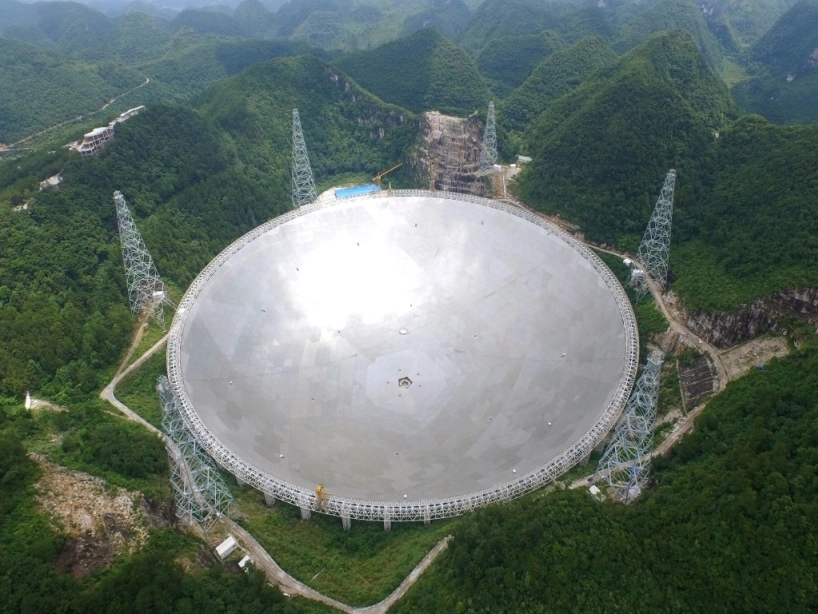
The Five-hundred-meter Aperture Spherical Telescope, the worlds largest single-dish radio telescope. Photo from National Astronomical Observatories, Chinese Academy of Sciences

The Five-hundred-meter Aperture Spherical Telescope, the world's largest single-dish radio telescope. Photo from National Astronomical Observatories, Chinese Academy of Sciences

More than a decade ago Beijing identified weaknesses in its science and innovation system, including fragmented investment, inefficient resource allocation, limited interdisciplinary collaboration, dependence on foreign core technologies, and gaps in research evaluation. In response, it increased funding and boosted output in journals indexed by the Science Citation Index (SCI), quickly becoming a global leader in research publications.

In 2020 the government moved to reduce what it called "excessive reliance" on SCI publications for academic promotions, hiring, and funding decisions, promoting instead a domestic citation system "with Chinese characteristics and international influence," according to education news outlet University World News.

The shift followed remarks by Xi in 2018, when he said academic standards in Chinese universities should not be shaped primarily by western systems and called for independent evaluation frameworks. His remarks reflect China’s push for greater self-reliance in science and technology, now evident in how the country organizes research and carries out large-scale scientific projects.

Growing scale of research infrastructure

A defining feature of China’s state-led science model is the increase in the scale of research infrastructure, with projects often being worth billions of U.S. dollars and involving thousands of scientists. These facilities serve not only as experimental platforms but also as engines for generating data and supporting multiple industries.

China has rapidly built a network of such facilities, including the Five-hundred-meter Aperture Spherical Telescope, widely regarded as the world’s most sensitive radio telescope, and the Large High Altitude Air Shower Observatory, which studies high-energy cosmic radiation.

The Shanghai Synchrotron Radiation Facility enables analysis of materials at the atomic scale, supporting advances in semiconductors and biotechnology, while the China Spallation Neutron Source focuses on next-generation materials for batteries and industrial use. According to Nature journal, Beijing is investing heavily in national research infrastructure to strengthen scientific capacity and improve its technological position.

The strategy has produced measurable results.

Chinese research institutions accounted for more than half of top publications in applied sciences in the Nature Index released in late 2025. These projects are integrated into innovation hubs such as Beijing and the Shenzhen–Hong Kong–Guangzhou corridor, where laboratories, companies and manufacturing chains operate within shared ecosystems.

Beyond merely building large projects, China’s approach extends to integrating them into a unified system.

According to the World Intellectual Property Organization, China leads the world in innovation clusters, with 24 ranked among the global top 100, surpassing both the U.S. and Europe. The country also became the world’s largest spender on research and development in 2024, with total investment reaching $785.9 billion and overtaking that of the U.S.
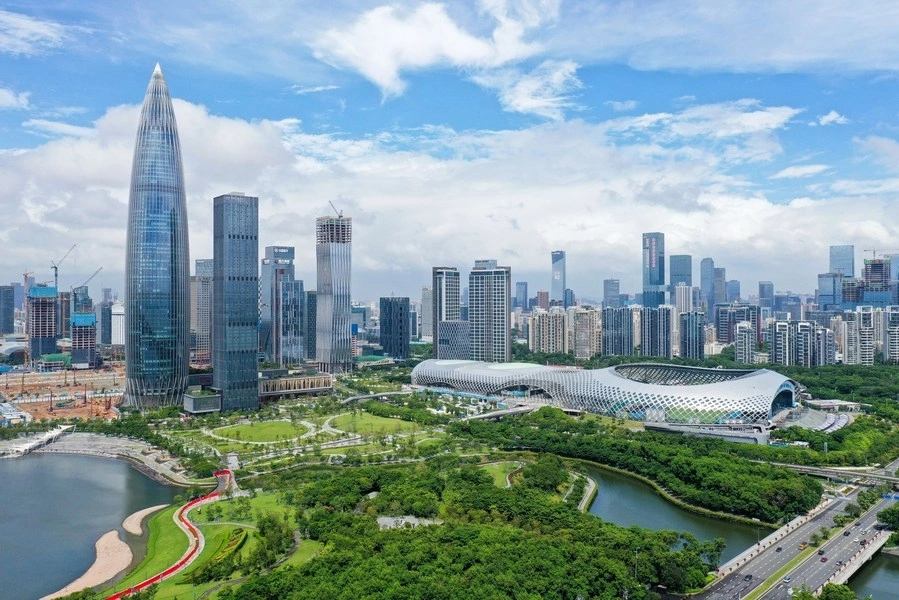
Chinas southern tech hub of Shenzhen. Photo from X

China's southern tech hub of Shenzhen. Photo from X

This reflects a broader shift in which science operates as a national system.

Research institutes define priorities, companies develop applications, the state coordinates resources, and the domestic market absorbs outputs. This close integration has given rise to what analysts describe as a "big system." In this model, each component is designed to support and reinforce the others, forming an interconnected ecosystem.

By comparison, the U.S. maintains a more decentralized structure built around leading institutions and independent research centers. Large-scale science projects in the U.S. remain among the world’s most advanced, including particle accelerators at Fermilab, laser systems at Lawrence Livermore and space programs led by NASA.

However, these projects typically operate independently within specific agencies or national laboratories rather than as part of a unified industrial system.

Europe emphasizes cross-border collaboration. Facilities such as those operated by the European Organization for Nuclear Research are jointly funded and managed by multiple governments, allowing sharing of costs and knowledge. However, differing national priorities can slow coordination, and links between research and industrial production remain limited.

China is meanwhile emerging with its own model, defined by centralization and integration, with research projects embedded in industrial clusters to speed up the translation of scientific advances into commercial products.

This divergence is reshaping global technological competition. While the U.S. and Europe continue to lead in fundamental research, China is increasingly aligning scientific discovery with large-scale industrial production, accelerating its progress toward technological leadership.