







Six U.S. flags planted on the Moon during NASA’s Apollo programs between 1969 and 1972 appear to ripple despite no wind due to a metal support rod and fabric creases.
The April 1 launch of the Artemis II mission, carrying four astronauts around the Moon, has sparked a fresh wave of interest in earlier lunar milestones.
On July 20, 1969, during Apollo 11, astronauts Neil Armstrong and Buzz Aldrin planted the first U.S. flag on the lunar surface. The process took about 10 minutes during their two-and-a-half-hour moonwalk.
Over the next three years, five additional flags were erected during subsequent Moon landings. However, their appearance raised questions, as they seemed to flutter despite the Moon lacking a substantial atmosphere and wind.
Astronauts Neil Armstrong and Buzz Aldrin planted the U.S. flag on the Moon on July 20, 1969, during the Apollo 11 mission. Video courtesy of NASA
The flag's design
According to Forbes, Apollo 11 had very limited space and weight capacity, requiring the flagpole to be light and compact. Engineers also needed the flag to appear extended on camera, despite the lack of wind.
NASA engineer Jack Kinzler had less than three months to design a solution. The flag, purchased from a local store in Houston for US$5.50, was a standard nylon model measuring 152 by 91 centimeters. It included a sleeve along the top edge to hold a horizontal metal rod, allowing it to remain outstretched instead of hanging limp.
The flagpole stood about 2.4 meters tall, with vertical and horizontal supports made of gold-coated aluminum tubing. The entire assembly, including a stainless steel container to protect it from extreme temperatures, weighed 4.3 kilograms and was mounted on the front landing leg of the lunar module.
Engineers also considered weight, thermal resistance, and ease of assembly, given astronauts’ restricted mobility and limited dexterity in bulky spacesuits.
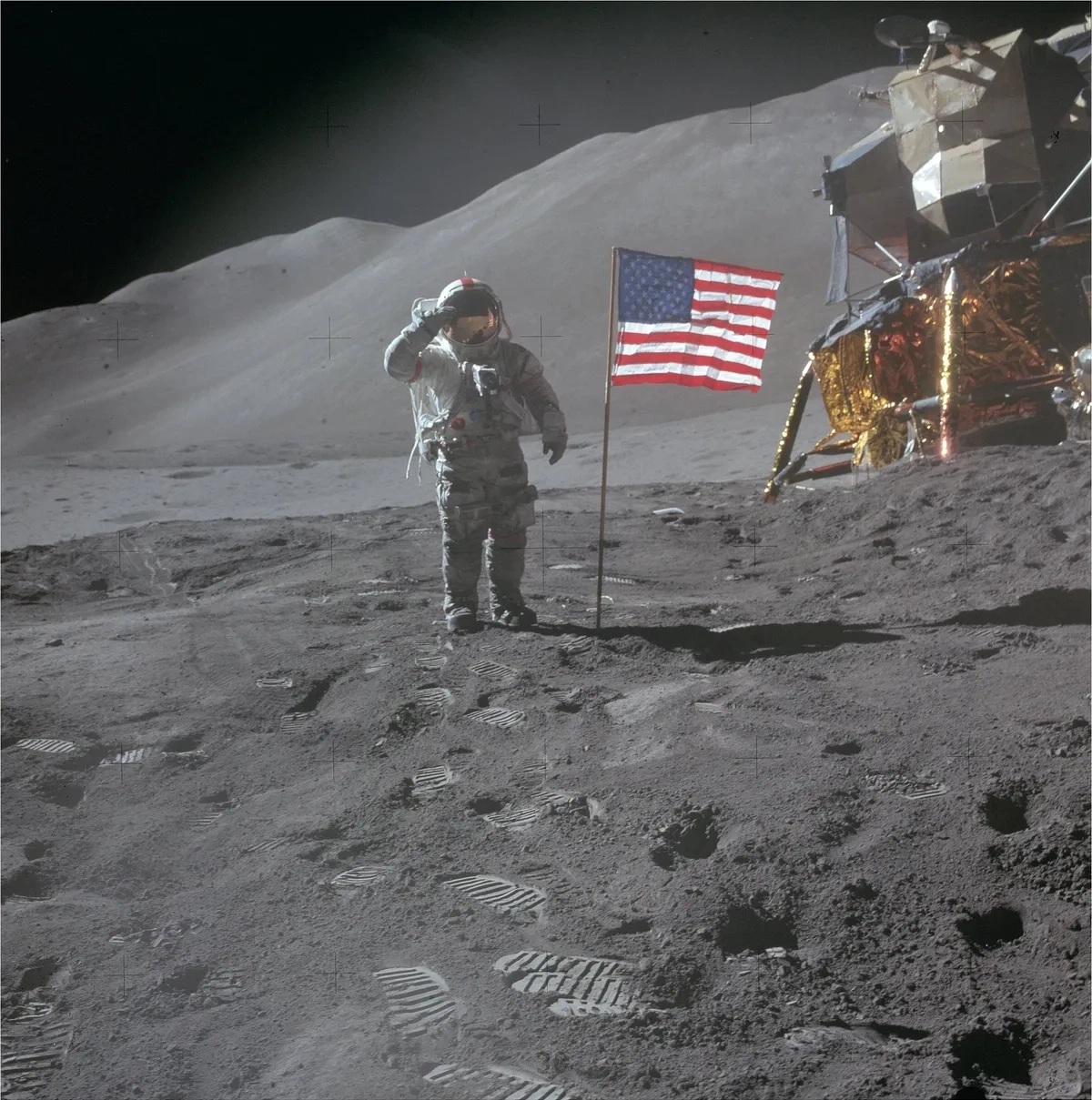
During preparations, Armstrong and Aldrin reported difficulty fully extending the telescoping horizontal bar. This created wrinkles that produced a natural ripple effect. Later crews intentionally left the bar partially extended to recreate the same appearance.
Additional creases were caused by the flag being tightly folded during the four-day journey to the Moon.
 |
|
U.S. Astronaut David Scott salutes the American flag during 1971 Apollo mission. Photo courtesy of NASA |
The flags' condition today
Armstrong and Aldrin planted the flag about 27 feet (8 meters) from the lunar module, but Aldrin reported that he saw the flagpole fall during liftoff, knocked down by engine exhaust.
Later Apollo missions placed flags farther away. Imagery from NASA’s Lunar Reconnaissance Orbiter shows the shadows of flagpoles still visible at the Apollo 12, 16, and 17 landing sites.
Even if some flags remain standing, they are unlikely to be intact.
Anne Platoff, a librarian, historian, and vexillologist at the University of California, Santa Barbara, who compiled a NASA contractor report in the early 1990s, told Space.com:"One thing that I keep seeing in articles is that the flags would be bleached white from exposure to sunlight."
"While this does happen to some flags on Earth, I am not sure about the chemical process involved and if that would occur in a lunar environment," Platoff said.
Prolonged exposure to solar radiation likely degraded the nylon fabric, a process known as "sun rot," making the flags brittle and potentially causing them to disintegrate over time, while possible meteoroid impacts could also pose a threat, Platoff added.
此内容由惯性聚合(RSS阅读器)自动聚合整理,仅供阅读参考。 原文来自 — 版权归原作者所有。