



Nguyen Thanh, a final-year IT student, has decided not to pursue a career in the industry after finding opportunities were limited for programmers with basic coding skills like himself.
Two years ago he had enrolled in the IT program believing it would secure stable employment. He actively sought internships, even unpaid ones, starting in his sophomore year.
He worked at three companies before joining a software outsourcing firm that initially paid him a stipend of VND50,000 (US$1.9) a day for an eight-hour shift. After five months his salary rose to VND6 million a month. But when he asked about becoming a full-time employee, his request was declined. He quit the job.
While searching for another job, he found that positions offering salaries of VND10–12 million largely prioritized candidates with AI skills. "The IT market today is not for mediocre people who only know basic coding like me," he says.
His experience reflects a broader trend. A survey at a leading technical university in HCMC found that six out of 10 computer science students who recently graduated or are about to graduate have yet to secure suitable jobs.
On online forums, many tech students agree that the long-standing belief that studying IT guarantees employment is no longer valid. "Job opportunities for new IT graduates are more limited than before, especially for those who only know conventional coding," a human resources manager at a software solutions firm told VnExpress International.
 |
|
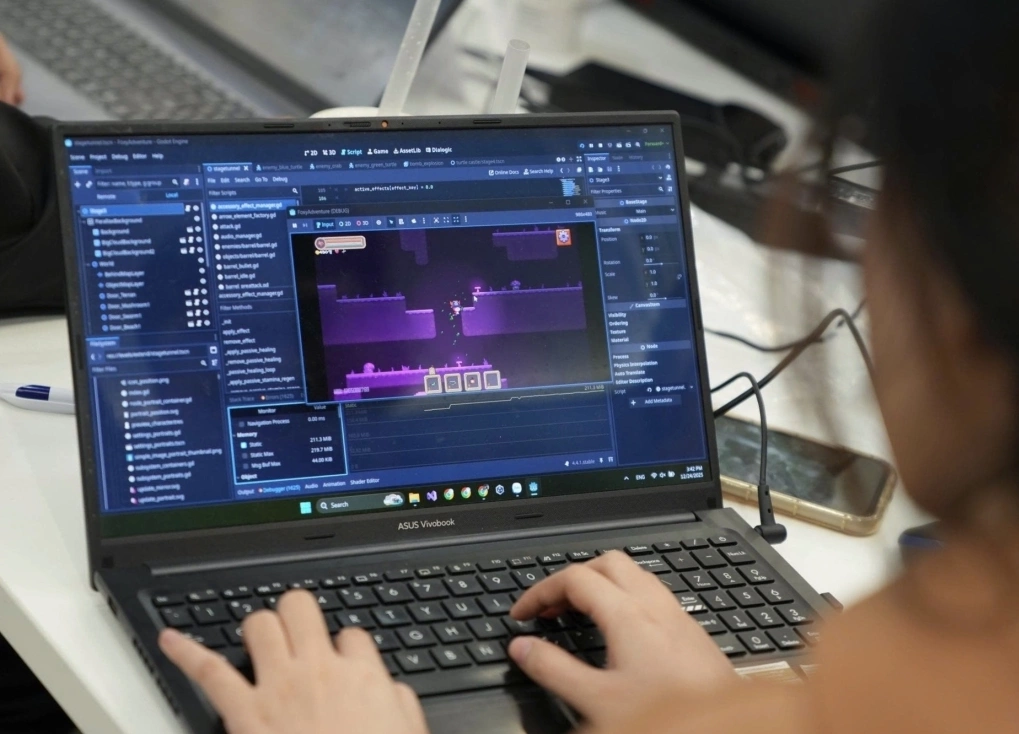
A student at the University of Information Technology, Vietnam National University, Ho Chi Minh City, in a game programming course. Photo courtesy of the university |
According to a report by recruitment platform JobOKO, based on nearly 582,000 job postings in the first 10 months of 2025, the number of job openings in the IT sector fell by 16.92% from a year earlier. Other career platforms like VietnamWorks and TopCV report signs of recovery in tech, but demand has shifted toward higher-skilled roles.
Dr. Trinh Thanh Binh, head of the information systems department at Phenikaa University’s School of Information Technology in Hanoi, says the job market is unlikely to return to a time when companies hired fresh graduates and trained them.
"The market is no longer short of people but is short of the right people. Job opportunities have not decreased, but have shifted from easily accessible to highly competitive."
Pham Tuan Anh, director of JobOKO, says companies are moving away from mass recruitment of fresh graduates toward a more selective hiring process that emphasizes experience and specialization.
Phan Manh Dan, senior HR director at tech firm Rikkeisoft, says the rate of students meeting entry requirements has dropped by 20–30% compared to two years ago. "We don't just need people who can program. They must understand customer requirements and have a broader perspective on the product."
Tran Xuan Ngoc Thao, director of HR and communications at VNG Corporation, says AI is reshaping the role of engineers, requiring them to adapt to new workflows and collaborate with AI tools. She says that while coding remains a basic requirement, practical skills and soft skills are now more valuable than degrees, titles or years of experience.
Recruitment reports also show that many IT candidates lack specialized expertise as well as key soft skills such as communication, critical thinking and product-oriented thinking. Binh says this gap reflects a mismatch between training and industry needs, with many students lacking project experience and studying broadly without developing a clear specialization. Skills such as systems thinking, interdisciplinary problem-solving, and AI-driven self-learning remain underdeveloped, he adds.
Despite these challenges, experts say the IT labor market still offers opportunities for those who are adaptable and committed to continuous learning. "Young IT engineers should not be overly pessimistic," Assoc. Prof. Dr. Nguyen Van Vu, vice dean of the faculty of information technology at the University of Science, Vietnam National University, HCMC, says.
He notes that Vietnam often lags behind others in the adoption of new technologies, meaning large corporations and major systems still use AI cautiously, often at a basic level due to stability and security concerns. "This is a rare window for IT workers to quickly update and upgrade their skills before the entire industry is swept up in the AI wave."
Dan advises students to prioritize gaining practical experience even if it means accepting lower initial salaries to better understand business operations. He also emphasizes the importance of critical thinking and soft skills, which are less likely to be replaced by AI. "Those who continuously learn and upgrade themselves will always have a place. If you stop, you will easily be replaced by those proficient in AI skills."
For some students, adaptation is already underway. Truong Giang, a final-year IT student at FPT University in Hanoi, is focusing on advanced software testing skills. "You can't avoid AI, so I'm focusing on adapting and accumulating skills that AI doesn't yet possess," he says.
As for Thanh, though he plans to complete his degree, he no longer intends to pursue a career in IT. "I no longer have a passion for this work, and I’m currently earning a good income from my own business."
此内容由惯性聚合(RSS阅读器)自动聚合整理,仅供阅读参考。 原文来自 — 版权归原作者所有。