











One of my favorite tropes is the Misdelivered Message. It begins with an embarrassingly honest or inappropriate letter, voicemail, or email that the sender immediately regrets. Then they set out on a hero’s journey to intercept and destroy their own missive.
It’s Seinfeld begging Newman not to deliver a letter Jerry sent to fire his accountant, after realizing the accountant has allergies, not a drug problem. Or Monica Gellar “hacking” Richard’s voicemail to erase an awkward apology before he hears it. Or Modern Family’s Gloria concocting a story about sending lewd pictures to prevent Claire from seeing an insulting email.
The Misdelivered Message trope works so well because we’ve all sent things we shouldn’t have!
It’s why Gmail (and Buttondown) has Undo Send. It’s why companies have clearance processes for anything they post publicly. And it’s why authors send out “beta” copies of their books before sending the final draft to the printer.
Why not do the same for your newsletter? Enlist the help of a few privileged subscribers to comment on rough drafts. Beyond preventing you from sending something embarrassing–a la Homestar Runner spamming Marzipan’s voicemail after an ill-informed breakup message–a list of “beta” readers also builds community, generates more interesting topics, and grows your list.
The benefits of beta newsletter drafts
Admittedly, this appropriation is a little sloppy. “Beta readers and beta copies refer to people looking over an early draft for typos, confusing arguments, underdeveloped characters, et cetera,” StoryOrigin’s Evan Gow explained to me in an interview last year. “Advanced review copies are for generating buzz and reviews on a book, usually one coming out soon.” I’m proposing a combination of both for your newsletter.
An invitation to read your content before anyone else and provide feedback on it would be invaluable to your most passionate fans. You’d be bringing them into your inner circle, creating a close-knit community of hand-picked subscribers. You’d be giving them something to brag about to their friends and family.
It doesn’t need to be a large group. Evan recommends authors limit their beta readers lists to 10 or fewer to avoid “analysis paralysis from too many people pulling you in too many different directions.” Try to build a group from folks with different interests and networks than you, which, in small doses can help broaden the appeal of your writing. Beta readers will make connections you may have missed or connect you to experts outside your bubble. And, at the very least, they’ll tell people who have never heard of you about collaborating on your newsletter.
Best of all, creating a beta readers list costs you virtually nothing. As long as you’re on a newsletter platform that charges based on the number of active subscribers, like Buttondown, adding a few existing fans to a new list doesn’t increase your monthly bill. It won’t take much time to manage the list and the discussions as long as you set expectations early.
All of this adds up to closer relationships with subscribers, more diverse creative feedback, and another outlet for community participation, for free.
How to start a beta newsletter readers list
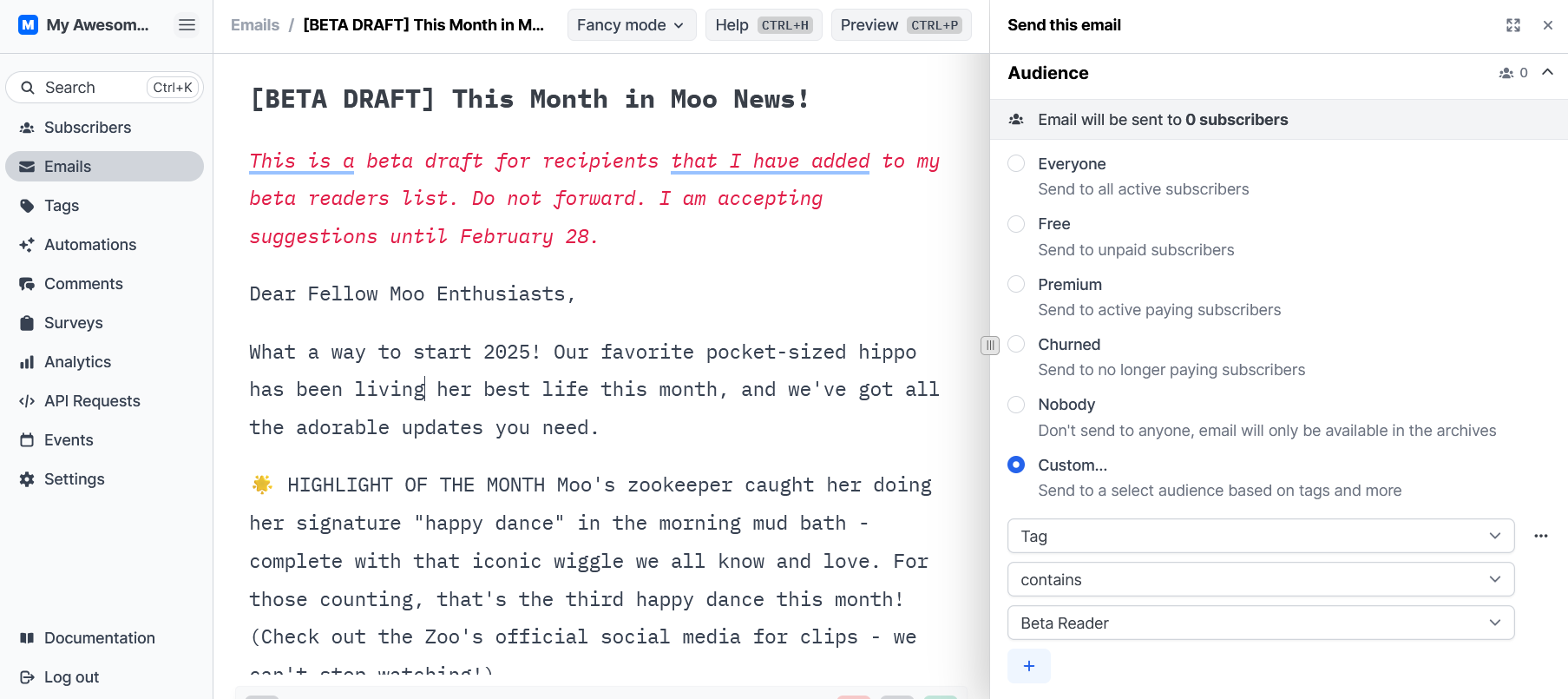
A good place to start is with creating a tag for the people on your beta list. After you’ve finished a rough draft you’re ready to share, send a newsletter to anyone with the corresponding tag. Just don’t forget to exclude beta email messages from your archives!
How to choose who receives the tag is less straightforward. You might start by hand-picking candidates based on variables like subscribers with the longest tenure, most replies, highest number of opens, etc.
Another route might be to invite everyone on your list to apply. In that case, Evan suggests “Authors will want to have potential readers answer a set of questions to join their beta reader team.” You could, for example, throw together a survey or form with qualifying questions, link to it in your newsletter footer, and let people apply regardless of whether or not there are currently any spots open. That would encourage more engagement and ensure you always have replacements when existing beta readers drop off.
The list will evolve over time. Inevitably individuals will leave and newcomers will fill their spot. Before a beta reader receives their first draft to comment on, you should send them an introduction to the process. Tell them what sort of feedback you’re looking for, provide examples of good and bad suggestions, clarify turnaround times, and share anything else they need to get up to speed.
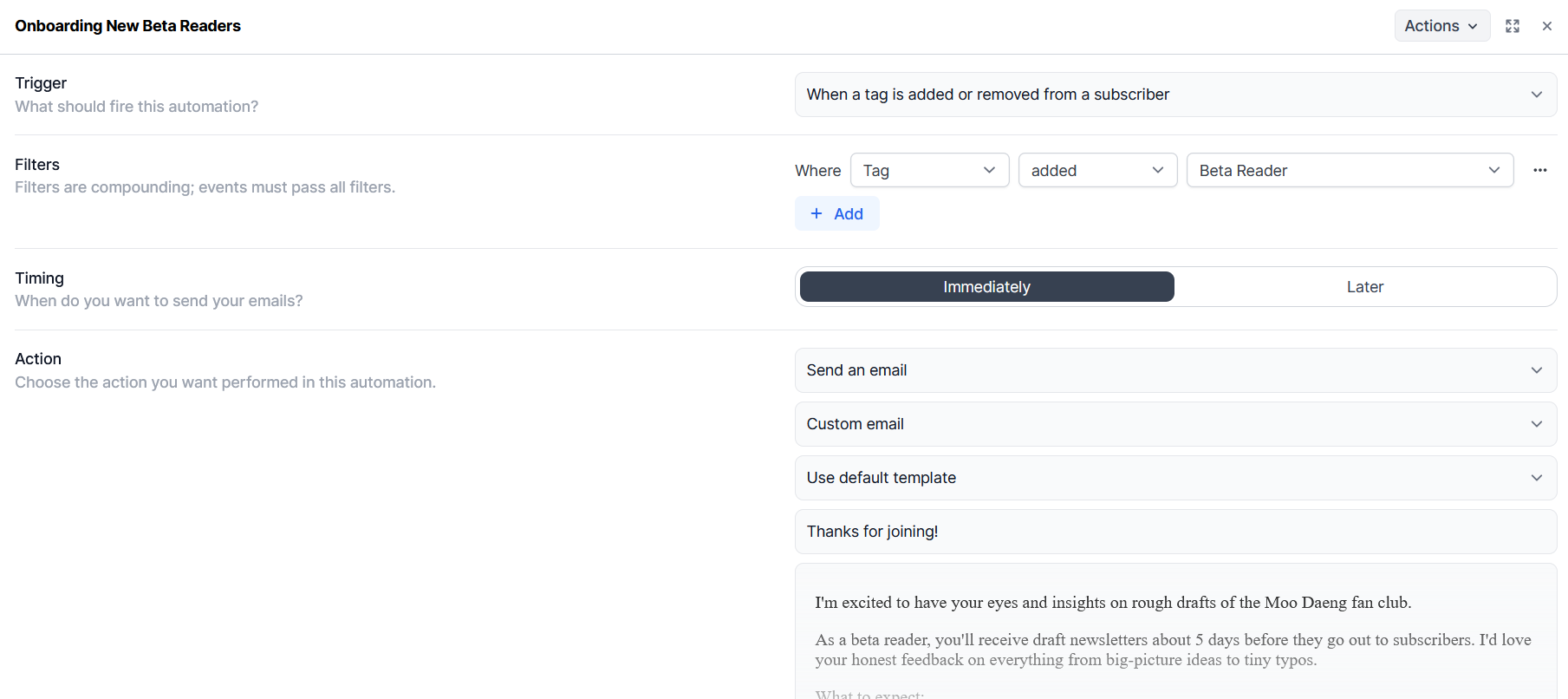
The easiest way to onboard someone to your beta readers list is by creating an automation triggered When a tag is added or removed from a subscriber. Add a filter so it only fires when the beta reader tag is added, set the action to Send an email, and drop in the welcome message. Any time someone joins the inner circle, they’ll be up to speed and ready to go immediately.
The month-to-month of a beta readers list
When sending the beta newsletter drafts themselves, it’s best to identify them in the email subject line (e.g. “[BETA DRAFT] Updates from March ‘25”) and opening lines (e.g. “This is a beta draft for recipients I have added to my beta readers list. Do not forward. I am accepting suggestions until February 28.”). Below that, send the draft as if it’s been finalized, complete with formatting and images, since you’ll want beta readers to comment on everything.
Direct replies are likely the most sensible way for beta readers to suggest changes. They ensure you have control over the flow of information. If you have the right group dynamic, though, you might invite editors to discuss the draft as a group in a beta reader Discord server. Whatever the case, make sure to thank contributors before the final draft goes out. Highlight what you incorporated and why. And always invite beta readers to tease upcoming issues within their own circles.
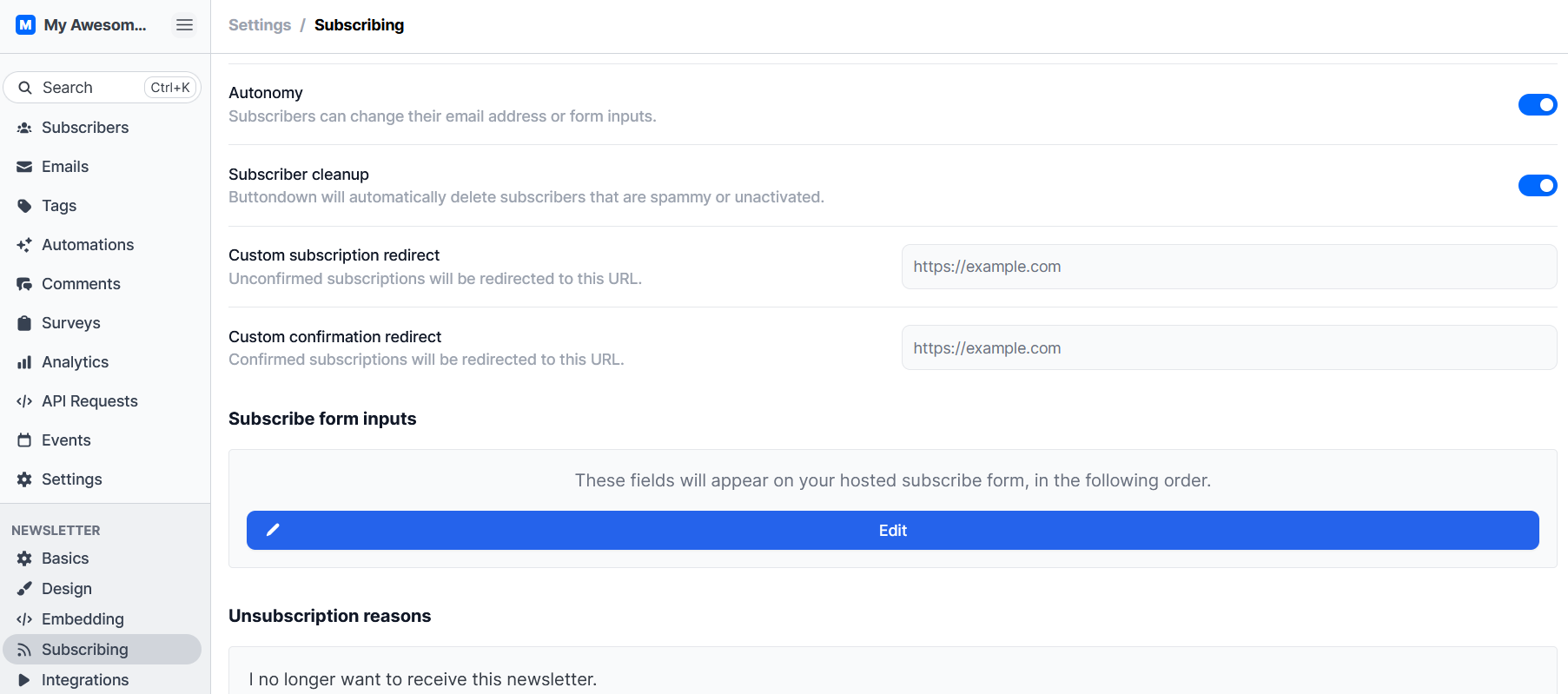
Every beta draft and thank you email should also include a way for editors to bow out voluntarily. The best way to do that, in Buttondown, is by enabling the Portal, which inserts a link in the footer of your email that lets recipients update their subscriber preferences. Here, again, it's good to have an automation when the beta reader tag is removed. Thank them for being part of the team and give them an opportunity to explain why they're leaving. They might just tell you something you need to hear.
Heroes have guides, newsletter writers have editors
Early in season five of The West Wing, two speechwriters try to get over their frustrations with a new VP pick by writing down all the reasons why he sucks. That, of course, becomes the Misdelivered Message sent to the teleprompter in front of the President. I’m not equating your writing with blatant mockery! The point is that you need a few Josiah Bartlets on your team. People who can look at what’s on the screen in front of them and polish it up, make it sing.
Part of the reason email endures is its simplicity. There’s practically no overhead. And while there are examples of solo creators sending to lists in the five figures, going at it alone never seemed all that exciting to me. I want to collaborate, to argue, to wrestle with challenging topics and ideas, alongside others. People who know how I think and what I’m interested in. The kind of people who would be happy to read my emails.
Header image by Danny-w via Wikimedia Commons.