


Introduction
Buttondown is a tool for sending newsletters of all types: marketing-y ones for Shopify stores, thought-leader-y ones for folks selling consulting services and info-products, silly ones for folks running small private newsletters.
The single most common "how do I send emails better?"-type question we get is: "how long should my emails be?"
There is a lot of folk wisdom floating around this question, often coming from well-intentioned but poorly-reasoned places. "Keep it short and sweet!" "Have exactly two CTAs, one after the third paragraph and one at the end!" "Keep people in the inbox as long as possible!"
I don't have a particularly principled answer to this question, but I do have a bunch of data...
Methodology
Here's how I collected the data:
- I sample one hundred thousand bulk emails sent from Buttondown over the last twelve months.
- I calculate the word count of each email, clamping it to the nearest hundred.
- I then calculate the click rate of each email.
A couple caveats:
- Buttondown has click tracking turned off by default. Naturally, this means the one hundred thousand emails must specifically come from newsletters who have opted into click tracking.
- Clicks are defined as a unique tuple of "URL, subscriber" — so if a subscriber clicks the same link twice, it only counts as one click, but if they click two different links, it counts as two clicks.
- I discarded emails with word counts below 50 and above 3000, as they were fairly noisy and did little else than clutter the final resulting graph.
- I ignored clicks outside the context of the email itself (such as 'view on web' or 'unsubscribe' links), though I think those will be interesting for follow-up analyses
Data
You're here for the headline, not the flowery prose, so let me jump to the interesting stuff:
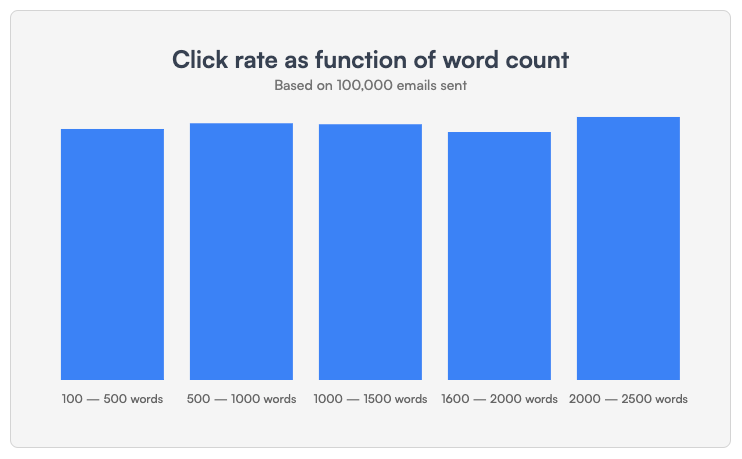
Unsatisfying, I know. No pretty linear relationship! No mandate to write exactly X words per email, and no more!
I think you should take this as instead as a simple lesson: write the correct number of words for your email. If you're writing a short, pithy newsletter, don't pad it out with fluff. If you're writing a long, thoughtful essay, don't cut it short because you're worried about click rate.
Further analyses
I think playing around with this dataset is fun and useful, and I plan to do more of it in the future. Here are some ideas I have:
- How does the presence/absence of a pre-header affect open rate?
- How does the length of a subject line affect open rate?
- Do questions in subject lines increase open rate?
If you have any ideas, please reach out — I'd love to hear them!