









Every day, for the past 63,500 days or so, the New York Times has rolled off the press “All the news that’s fit to print,” as its masthead has read since 1896.
And every weekend, its flashier companion, the New York Times Magazine, has gone to press alongside the paper. Launched the same year as the Times’ slogan, the Magazine had pictures when newspapers only had print, longer-form pieces versus the paper’s prosaic prose. The magazine is where you'll find an editorial about ethical minefields and the story behind tap water—while the paper is where you’d read of actual ethics violations and new taxes to overhaul tap water infrastructure.
Both are words on paper, distributed on a regular, if different, cadence. But the medium defined the message, and the Times and the Magazine to this day are uniquely positioned.
Newsletters and blogs inhabit a similarly overlapping space. Both are words on screens, published on a regular, if often different, cadence. Yet that can make all the difference.
It’s hard to leave your roots behind.
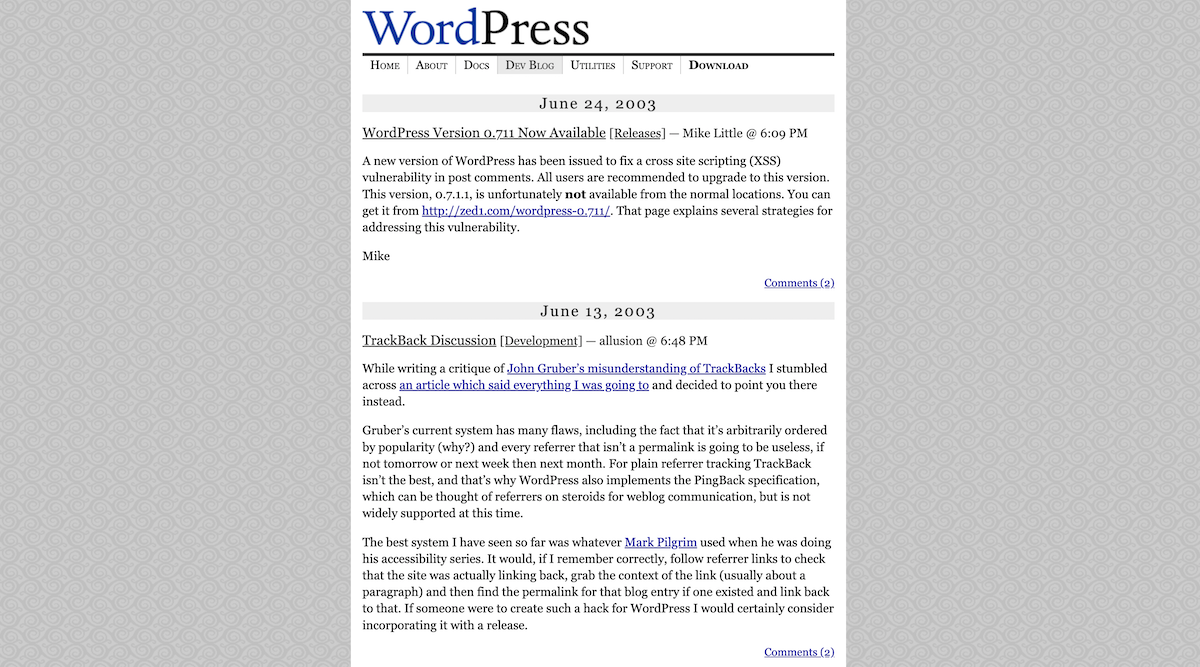
The original WordPress blog—with a discussion of Trackbacks
Blogs, originally weblogs, started as the late-’90’s impulse to share your favorite things online. “I thought if I couldn't find something I was looking for on the Web, I should make a page about it,” said Justin Hall of his website in 1994. One new interest-driven page after another turned his site into one of the first blogs.
From the beginning, blogs could be whatever you wanted them to be. What they shared was their frequent updates, less professional writing style, and a reverse-chronological feed with the newest articles showing first. That flexibility helped them become the default way to build a website.
But what blogs offer in permanence and positioning, they lack in instancy and audience reach. Blogs spawned in the desktop PC era, when you’d sit down at your computer to check your favorite sites. Then social media ate their lunch, smartphones put always-fresh feeds and notifications in our pockets, and blogs became the slower, more reflective way to publish.
Into the void entered newsletters. First popularized by LISTSERV in 1986, newsletters didn't really hit their stride until spam was brought mostly under control in the 2010s and free email newsletter plans made sending affordable.
Newsletters offer immediacy. New issues show up in your inbox, no need to check sites for updates. They keep a publication top-of-mind. Even if a newsletter goes quiet for a while, they can bounce back from newsletter hiatus easily where a blog might struggle to get the word around. They’re in many ways the newspaper reincarnated on screens, delivered to your digital doorstep.
They’re more limited, too. They require a subscription, constricting your audience that might otherwise grow organically when Google shows your blog posts in search results. Newsletters thrive on a more casual, conversational style, and as such tend to age worse than most blog posts. And newsletters need to be kept shorter; Gmail truncates emails over 102KB, so readers might have to tap a “Display entire message” button to load longer issues.
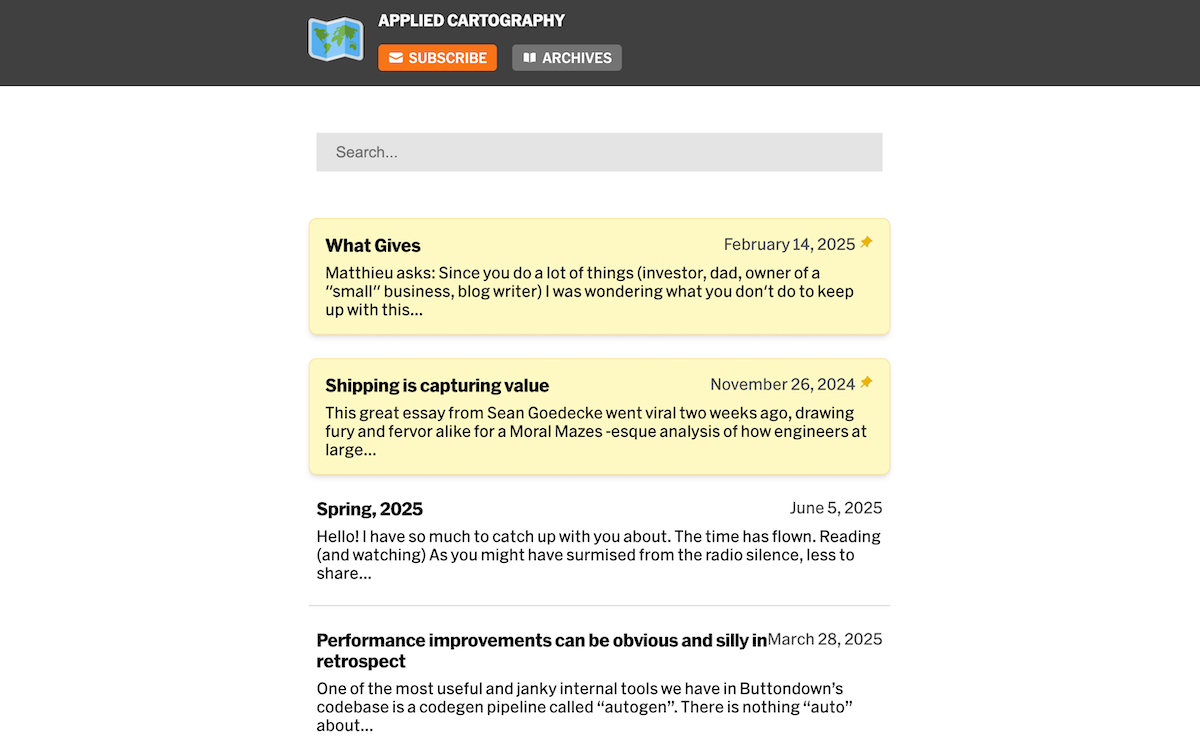
Buttondown’s archives aren’t all that different from a blog
But as newsletters’ archive pages increasingly look like blogs, complete with comments and a reverse-chronological feed, the differences are less than they used to be. If anything, the greatest distinction is often in how the author thinks of their publication.
A blog-first newsletter or a newsletter-first blog?
Blog posts live on your site forever (unless you go to the trouble of deleting them). They might be read today, or a decade from now. They’re more likely to be stumbled upon by a stranger, stopping by from a Google query.
Those considerations are why blog posts, typically, are written for an average casual reader with less connection to time. A blog post is less likely to mention a holiday this weekend or topics for the next post, as that’d date the writing and confuse future readers. Blog posts are also written without the assumption that readers have read previous articles from the site, and are more likely to link to other articles.
Newsletters, conversely, are in-the-moment. They’re meant to be read the day they’re delivered, so they might mention the day and surrounding holidays or events. They’re written for a specific audience of opt-in readers, who likely have subscribed for a while and share inside jokes or recognize references to older issues.
Blog-first newsletters—where one writes for a blog, with a companion newsletter—share more of the former’s characteristics. These tend to use email as a notification system. “Hi everyone, here’s a new post,” followed by a link to a blog post, or the blog post’s text copied verbatim. They’re less conversational. They’re more random and meandering. Blogs can contain multitudes, and may even publish online content that’s never sent to the newsletter. Email’s simply a delivery mechanism, and you’re unlikely to reply.
Newsletter-first blogs—where one writes a newsletter, then shares each issue in a blog-style archive—often include more conversational artifacts. They, unlike blog posts, might open with a greeting and close with a signature. They’re more likely to be insider-friendly, referencing older posts and “as we talked about last week”. And they’re more likely to stick to a core north star to keep subscribers’ interest, since every post goes to every subscriber. The blog’s simply an archival mechanism, and you’re unlikely to read the content from the blog unless you’re digging through the archives.
The medium shapes the message
The differences are immediately apparent on Ben Thompson’s Stratechery, the subscription newsletter that inspired Substack’s creation.
Stratechery publishes two types of writing: Daily Updates emailed most weekdays to paid subscribers, and Weekly Articles published on Stratechery’s blog and emailed to all subscribers.
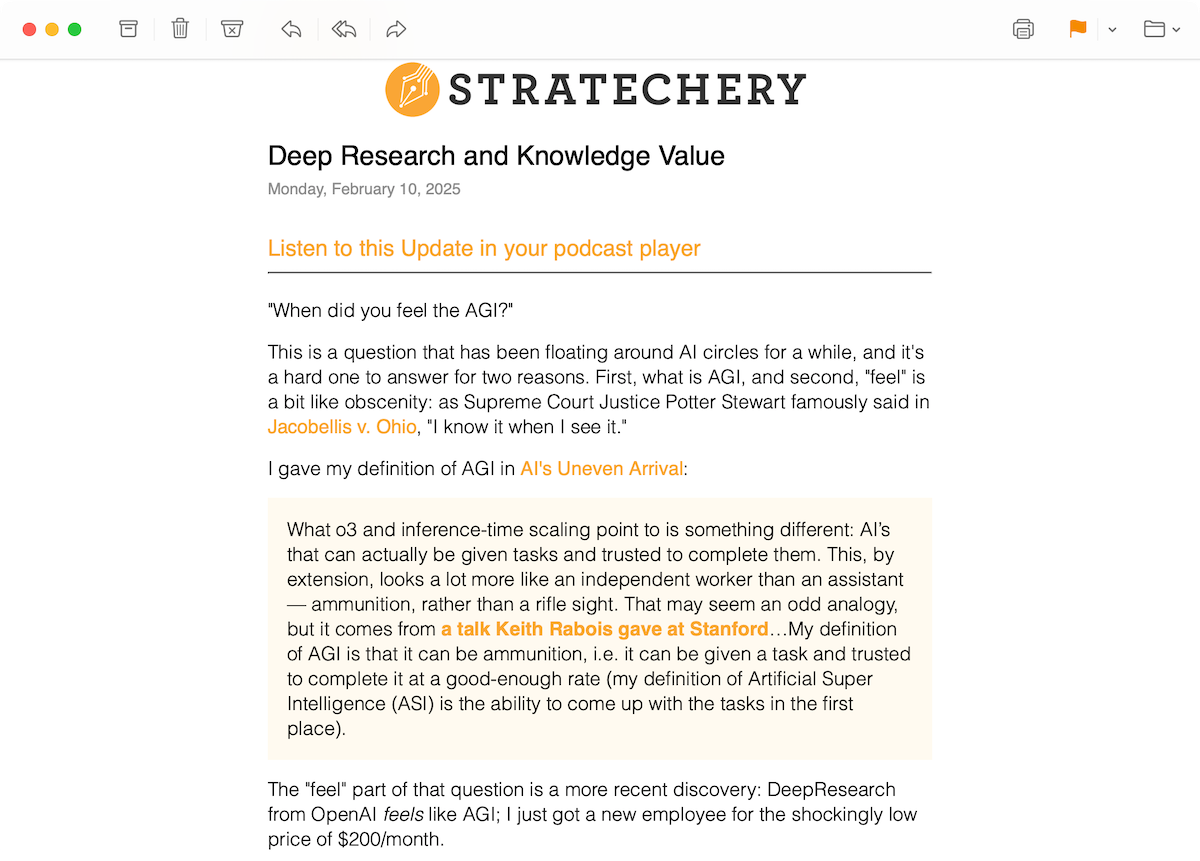
A Stratechery Daily Update, complete with a greeting and mentions of recent podcast episodes
Daily Updates are classic newsletters. They’re shorter, timely, about things happening this week in tech. They mention upcoming earnings reports and interviews Thompson will be publishing soon, to prime subscribers to read future issues. They feature “sharp, punchy writing,” as journalist Felix Salmon noted, something crucial as “newsletters need voice.” And each Update ends with both a thanks for subscribing and a wish to “Have a great day!,” things you’d expect in an email, not a blog post. Updates are archived on Thompson’s site, but they’re newsletter-first writing, written to be read today.
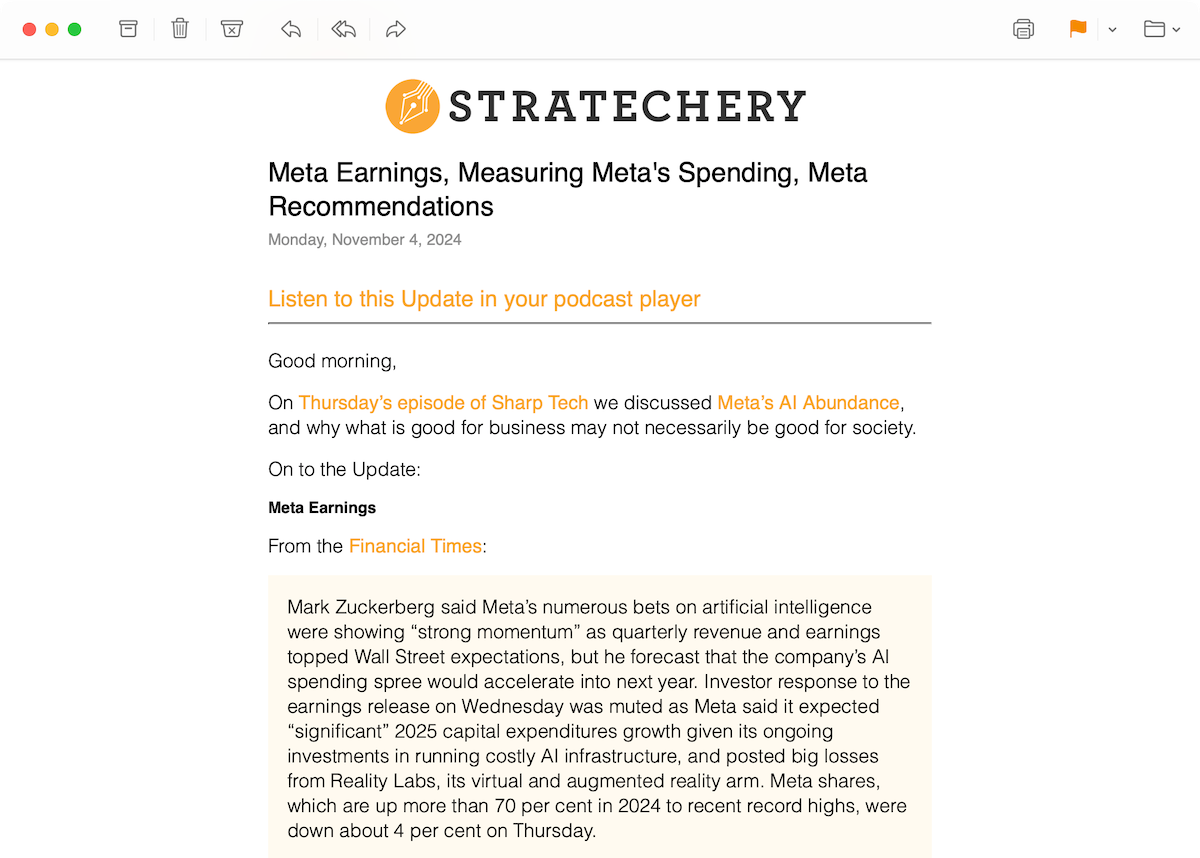
A Stratechery Weekly Article, no greeting or mentions of days of the week in sight
Weekly Articles are, as you might expect, classic blog posts. They’re longform, defining big-picture ideas like aggregation theory or the power of platforms. They reference the past more than the future, building less time-bound arguments that might mention “upcoming” events but never “tomorrow’s” event. They jump right into the story, no salutation or thanks for subscribing needed. Weekly Articles are shared via email, but they’re blog posts, first and foremost, written for posterity.
“Part of the difference implied by the assumed reading context of email inbox vs. open web page or feed reader is the perceived immediacy of the thing,” says Chris Krycho on what distinguishes newsletters from blogs, and that rings true for the two types of content that Thompson publishes. One’s newsletter-first, the other’s blog-first, and the distinction remains clear even when the writing is distributed the same email list and archived in the same site.
Just because something’s sent through email doesn’t make it a newsletter-first newsletter. As Rob Hope discovered “after inspecting 1000’s of ‘newsletters,’” the vast majority are what he called “website-first newsletters” with content published first online then distributed via email, and “newsletter-first newsletters,” with content published first via email then archived online. And I would argue that the author’s intention for the content makes as much of a difference, as anything.
Which should you choose?
Do you love digging deep and writing things that will hopefully stand the test of time? You might be a blogger at heart. You’ll still want a newsletter, but it’ll be a delivery mechanism more than your publishing medium.
Do you love interacting with people, thrive off reply loops and conversations? Do you prefer writing in the moment, off-the-cuff, about what’s happening now? You’re a newsletter writer at heart. You’ll still want a blog, or an archive at least, but it’ll be a way to preserve your words more than your primary focus.
Or, you might want both. Add a blog-style feel to your newsletter with a “best of” archive for posterity. Or start a pop-up newsletter to complement your blog, occasionally, with more timely coverage.
You could also blur the lines between publication types. Publish your newsletter with dynamic blocks that show only in the email (for more casual writing and time-centric messaging). Or, conversely, do the same with a blog post, making a director’s cut with extra conversational commentary for the newsletter copy to reward readers who prefer feeling like they get something unique.
“You don’t want to lose track of your reason for writing the newsletter in the first place,” cautions publishing advisor Anne R. Allen. Sometimes, thinking through the types of writing you prefer will help clarify if yours is a blog-first or newsletter-first publication, then keeping that north start in mind will help you pace yourself as you find the rhythm and cadence that define your writing.