








A felt-tip pen. A very old typewriter. Scissors and cow gum. A local photocopying shop.
And a thought, an almost subversive thought: “I can do this.”
When British bank clerk Mark Perry heard the Ramones’ debut album in 1974, the music bug bit him. Hard. “I wanted to be involved even though I wasn’t a musician,” Perry told The Guardian, years later. The music business was too corporate to break into. But here was a band breaking the rules, making music that moved.
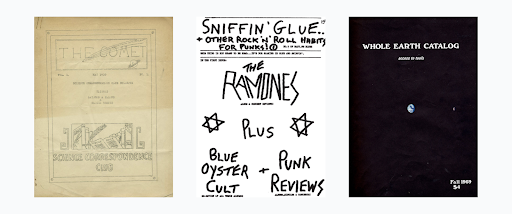
So he made a zine. Raw, authentic, hand-crafted, “not so much badly written as barely written,” a review complained, admiringly. Scissors and glue provided the page layout, Xerox the printing press. Passion provided the rest.
Out of little more than enthusiasm, Sniffin’ Glue became the defining punk rock zine. 50 painstakingly-assembled first-issue copies grew to a final print-run of 15,000 copies a year later, propelled a teammate to journalism fame, and led Perry to form his own band.
And the world was left with a template for indie publishing, as the Xerox machine gave way to BBS, blog posts, and email newsletters. When one has something to say, you can do worse than to let it all out, authentically, in the best continuation of the spirit of the zines.
A magazine by any other name
A zine is a tough thing to nail down. You know them when you see them.
They’re indie magazines, often hand or typewriter written, with photos glued in and captions scribbled in pen, then copied and stapled together into a facsimile of a magazine. They’re passion projects from an individual or a group of friends, the opposite of corporate mass-media. They might be one-off, or published on a schedule.
They’re “any self-published, cheap/free publication (typically a magazine-style format) that has a small circulation (although this is not always the case) and often covers one particular topic,” says Molly Tie, though we’re left to assume that the singular topic might not be set-in-stone, either.
They’re “bursts of raw emotion,” wrote author Stephen Duncombe, “unfettered, authentic expression.” “They’re often first-person and about a really specific thing. And delightful,” said Julia Evans. “Zines are whatever you want ‘em to be & that’s kind of the beauty of it!,” opined a Redditor.
Comet, a sci-fi journal printed in May 1930, is often referenced as the first Zine (then called “fanzines”). Sniffin’ Glue, from July 1974, as the Zine that took them mainstream. Factsheet Five in 1982 as the zine about zines, featuring thousands of indie works in each edition. But Martin Luther’s Ninety-five Theses are also a zine, if you squint. As was Thomas Paine’s Common Sense.
They’re joined by passion, by the most accessible printing methods of their day, by publishing without waiting for permission. Your best blog posts, social media, and newsletters, the self-published, handwritten ones that aren’t shuffled through ten internal quality control checks and a CEO’s stamp approval, are their modern day spiritual descendants.
You started writing because you loved it. Loved something, anyhow, enough to write about it. You didn’t care what readers thought; you’d be grateful to have them at all. So you wrote in the moment, with little thought of the morrow, and put some of your best ideas out there.
Then the crowds show up, consistency becomes a constraint, and you freeze. What started as a passion project starts feeling a bit corporate, professional. You’re scared to let your hair down, with so much on the line.
Perry knew the feeling. When it all got too big, he shut it down. “This is the punk thing to do,” he told his partner Danny Baker. There’s a time and a place for that, too, for zines and newsletters alike with a limited shelf life.
But the lesson of zines is that first, you’ve got to give it your all.
Write urgently. Publish quickly.
It’s hard to imagine Perry publishing a zine if he’d waited a year or two. The Punk Rock scene would have grown up and gone mainstream; the indie opening would have slipped by. The same goes for many of the zines that were most influential, a product of their time that resonated because they were relevant.
The same goes for the ideas, the words you’ll write down. Write them down when they’re on the top of your mind, while you’re still excited to get them out. For ideas have a half-life of their own. Wait and they’ll go stale, and you’ll second-guess if they’re worth publishing.
Which is part of what makes newsletters the perfect digital counterpart to zines, if you don’t take them too seriously. Open your email newsletter app (Buttondown, say, though we’re biased), draft the idea that’s on your mind, and hit Send. Don’t worry about formatting and framing; just get the ideas out there. Sometimes short, sometimes long, but every time something you’re excited to share. Only do it if you’re having fun—and don’t wait until it feels like work.
Don’t copy edit anything.
Sniffin’ Glue was a mess, by any literary and journalistic standards. “Grammar was non-existent, layout was haphazard, headlines were usually just written in felt tip, swearwords were often used in lieu of a reasoned argument,” wrote Tony Fletcher. But it worked. Together, the messiness “...gave Sniffin' Glue its urgency and relevance.”
The Comet, often referenced as the original zine, had a more prim background. Yet even with its scientist readership, a formal membership structure, and the more proper prose of its day, it too slipped into far more casual language than would be expected of a magazine.
“Remember, we are at a critical period; we have obtained the interest of some of the worlds [sic] greatest scientists and we have to prove to them that we have the GUTS (to use plain language) to PUSH FORWARD and not retrogress back to barren failure,” wrote Frank Eason in the inaugural issue.
It’s not that you should purposefully add typos, broken links, and misplaced images to your emails. But if you’re never making any mistakes, you might be sending your emails too slowly.
One typo in an otherwise professional email stands out more than one a plaintext newsletter sprinkled with the mistakes that we all make in texts and chats. If anything, those bits make your newsletter real, show that a human wrote it with all the imperfections and urgency that AI bots lack.
You’ll gain the support of your true fans who subscribed for your passionate ideas, and keep from locking yourself in the paralysis of indecision while waiting for the perfect email to send.
A common tip for drummers is to hold the drumsticks less tightly, to give them room to bounce. “Making progress requires you to release a little, to lighten up on your grip,” wrote Basecamp founder Jason Fried in a recent newsletter, a tip that applies as well to rhythm as to writing.
Write it. Send it. Leave no time to rethink. You’ll gain more from the momentum of publishing than from the extra time polishing.
Curation is creation.
Sometimes it’s not something you want to say as much as something you want to share. Many zines were a mashup of photos and quotes as much as they were urgently written texts. One of the most influential in the 90’s, Factsheet Five’s whole stated purpose was to highlight the best zines others had made.
The world’s changed, in the nearing-100-years since zines were first published. “Information was hard to find and there was a lot less of it,” said online zine Phrack’s latest edition #71 about their first edition from 1985. “In 2024, we have the opposite situation. There is a flood of information, and the problem is finding signal in the noise.”
Curation worked for the zines when there was too little information. It’s what made the Whole Earth Catalog, Stewart Brand’s trendsetting tech product catalog with zine-style elements irresistible; it had things you couldn’t find anywhere else. “Where were the gigs? Who were the decent new bands? Where can we read interviews with punk musicians, the likes the mainstream press won’t touch?,” That’s what people read Snifin’ Glue for, said Molly Tie. And with today’s information overload, your taste and obscure interests and the rabbit holes they lead you down are as interesting to your readers as the longer-form ideas you write from them.
You can curate ideas and share links, directly. Or, you can invite the tastemakers, the people you look up to, the bands and makers that inspired you to start a newsletter, to see if they’d do an interview with your newsletter. Give them a space to tell their story, and send it to your list.
One interesting person and finding at a time, you’ll build a following and keep your newsletter’s energy high even when you don’t have anything unique to write.
Build in constraints.
Everything’s not meant to last forever. The Whole Earth Catalog, for all its impact, was published for only three years. Snifin’ Glue’s founder Mark Perry shuttered his zine a year after it launched, before it became commercial and turned into a job.
“Countless publications have started and then never made it past one or two issues,” wrote author Hua Hsu in a New Yorker essay about zines. “What mattered was that you tried at all.”
Maybe your newsletter will carry on for years, a constant of your creative output. Or maybe it’s meant for a single time and place, with an expiration date. That’s how Craig Mod runs his popup newsletters, with a single purpose centered around a walking trip and a new subscriber list that’s archived once the walk is complete. “Deadlines are probably the most powerful tool for subverting our inner procrastination dingdongs,” says Mod. It’s far easier to send a weekly update without running out of things to say, if you know it’s only for so long.
When the time’s up, say goodbye. Then start anew, when the time’s right again. You’ll find something else to say, and this time, you’ll do it better, be yourself even more than you were ready to last time around.
Stay humble. Stay foolish.
“It is difficult to realize in this age of machinery that man comes into life equipped with a machine far more wonderful, more complicated, more delicate and with greater possibilities of achievement than any human mechanism that has ever or will ever be devised,” wrote Lilith Lorraine neé Mary Maude Dunn Wright in The Comet’s inaugural edition. “This machine is the human brain.”
Brain. Soul. Taste. Guts. The typo-ridden, xeroxed zines are infused with them. They hold no loftier purpose than getting ideas out into the world, aim no higher than winning readers and influencing them.
The zeitgeist-setters shut down their zines when they’d run their course, turned off the copiers, moved on to the next thing. Along the way they changed things, as only crazy ones could do. You have to be crazy to put your ideas out into the world, crazy to think someone will care. And the fun fact is, they will care. You’ve got this chance to find people who are wired like you, for whom the same ideas will light up their eyes. You and they are hungry for connection, for ideas, and your zine, or its more modern encapsulation in a newsletter, is just crazy enough that it might work.
And when it works, when the readers show up and you’re tempted to start worrying about retention, remember where it all started. As Stewart Brand wrote in the parting words of his Whole Earth Catalog, “Stay hungry. Stay foolish.”
“The frame of mind of the young hitchhiker is one of the freest frames of mind there is,” described Brand decades later as the inception of the phrase. “You're always a little bit hungry and you know you are being completely foolish.” Guiding words that made enough of an impression on a young Steve Jobs, he’d quote them decades later in his Stanford commencement address.
That’s as good advice as any to keep your newsletter fresh. Dream big. Write the oddball stuff you obsess over. Experiment. Be raw, real.
“Do you think it’s possible to be original or individual in this day and age?,” asked Jessie Pink of Sniffin’ Glue creator Mark Perry.
“I think so,” said Perry, “if you don’t try too hard.”