


For an uncomfortably hot minute, English was the official language of email.
A few programs let you send accented and non-English characters, sure. But if you were emailing people in the early 90s who didn’t use the same client as you, chances were slim to none that a non-English message would be readable in their inbox.
Even when sender and receiver made sure to use the same software and settings, message transfer agents without the right character set might corrupt the email body somewhere in the middle. The most reliable option was transliteration–converting foreign scripts into a romanized form that could survive email transmission.
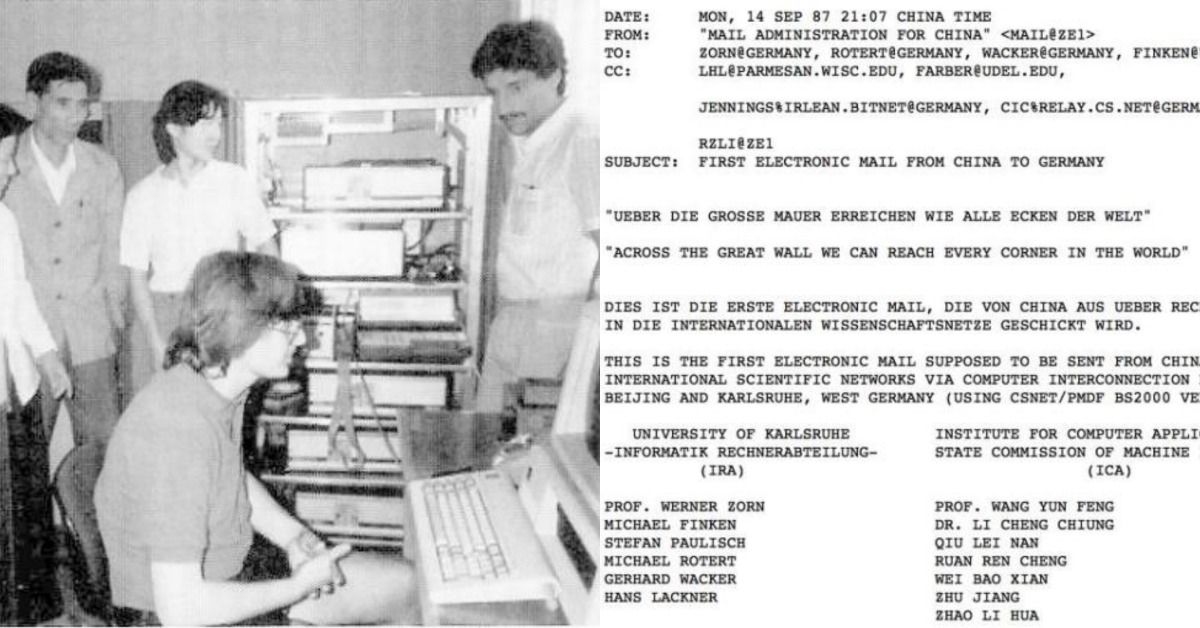
Image via Our China Story
The first email between Germany and China on September 14, 1987, for example, was both historic and riddled with typos. It used UEBER instead of ÜBER, GROSSE instead of GROẞE, and none of the Chinese names displayed Pinyin’s accented letters. Here two countries were trying to communicate across a “great wall” and stuck using a language foreign to both of them.
Email attachments, written in machine language, had their own translation problems. Solving those, it turned out, ended up expanding email’s borders spectacularly.
Sending files the hard way
Before 1992, anything you emailed needed to be in 7-bit ASCII, a handful of symbols and punctuation marks, ten digits, and the English alphabet. Something like, say, a file written in 1s and 0s, would almost certainly blow up. Nothing of the original content would remain after leaving your outbox, instead showing characters illegible to both humans and computers.
“I wrote a dumb little program called uuencode to address this.” Mary Ann Horton wrote on her personal blog. “All it did was turn a binary file into a text file by making it about 30% larger. Three bytes of binary content became 4 ordinary printable characters.” So you’d manually convert a file you wanted to email into something that looked like gibberish and paste that into your message body. Then, tell your recipient to copy the wall of text and decode it using Mary’s other program uudecode. Absurd today, practically sorcery in the 90s.
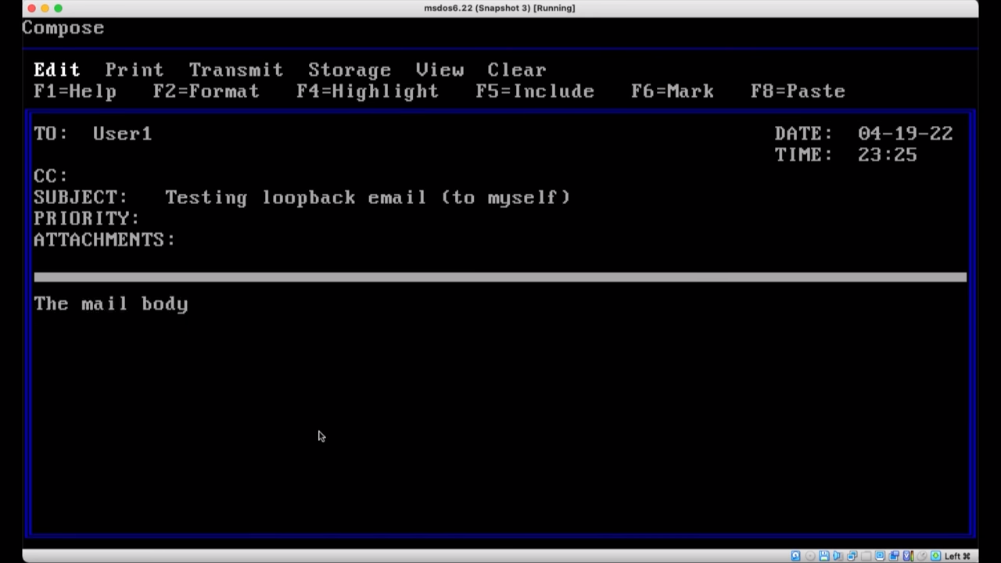
Microsoft Mail 2.1 via RetroSpector78 YouTube Channel
Microsoft Mail and cc:Mail streamlined the process a bit by encoding files for users in the background, no manually invoking uuencode required. It was a popular solution but not a codified standard.
Then came Multipurpose Internet Mail Extensions or MIME, the internet protocol that standardized email attachments and ended the era of English as electronic mail’s lingua franca.
Making email multilingual by default
Drafted by Nathaniel Borenstein and Ned Freed, RFC 1341 set out to “provide facilities to include multiple objects in a single message, to represent body text in character sets other than US-ASCII, to represent formatted multi-font text messages, to represent non-textual material such as images and audio fragments, and generally to facilitate later extensions defining new types of Internet mail for use by cooperating mail agents.”
The first draft of the MIME protocol proposed seven recognized categories in the content-type header: text, multipart, application, message, image, audio, and video. And on March 11th, 1992, Borenstein sent an email with the first modern(ish) email attachments to show off how content-types might work.

The first standardized email attachment was a photo of The Telephone Chords, Borenstein’s barbershop quartet, accompanied by an audio recording. “There were several predecessor attachment technologies, but this is probably the oldest "attachment" that your current software might still be able to read.” In the recording you hear them singing:
Let me send you email if you have the time
Let me sing you email now that we have MIME
You have lots of bandwidth, I have lots of bits
Let's use MIME for email, plain text is the pits!
Video was technically possible. But in Borenstein’s words, “Even a short video would have killed the Internet at that point, and I was actually criticized for wasting precious bandwidth on 52 seconds of sound!”
Ultimately, though, RFC stands for Request For Comments. An RFC is far from an endorsement from the Internet Engineering Task Force (IETF) or a finalized protocol.
Steve Crocker, the man who set the collaborative tone of the earliest RFCs declared that they could contain “specific suggestions or implementation techniques without introductory or background explication, and explicit questions without any attempted answers.” And there’s no more relevant example of that than Borenstein’s April Fool’s RFC 1437 proposing matter-transport/sentient-life-form as a new MIME content-type.
Endorsement or no, between the original proposal in 1992 and a follow-up revision in 1996, MIME became a de facto standard, and email attachments a new default as more and more email processors adopted it. Compliance has always been normative rather than prescriptive—adopted widely due to practical necessity rather than formal enforcement.
No single entity requires platforms like Buttondown and others to use MIME. In fact, if you sent an email in 7-bit ASCII, backward compatibility recommendations from IETF ensure that it would likely make the trip without issue.
Try to email an image attachment without adding content-Type: image/jpeg in the header, however, and the overwhelming majority of email processors will reject it. Send something written in German or Chinese without content-Type: text/plain; charset="UTF-8" and it’ll show up as mojibake, 90s hacker wordplay for “the garbage that comes out when one tries to display international character sets through software not configured for them.” MIME is a (just!) tyranny of the majority.
“Multimedia junkies like me were able to make common cause with the deep desire of people around the world to send email in languages other than English.” That’s how MIME reached critical mass, according to its creator. “These problems could have been solved separately, but a standard that solved both surely hastened adoption, perhaps even making the difference between success and failure.”
In hindsight, expanding the range of supported character sets may have had an even more profound impact on global communication than the ability to attach files to emails. Documents, images, and videos got bigger. Cloud storage got cheaper. And attachments plateaued in importance—while the increasingly global nature of the internet made multilingual support critical.
Outliving the paperclip icon
When you add a file larger than 25mb to a message in Gmail, it’s automatically converted to a Google Drive link. iCloud Mail does something similar for anything over 20mb. Outlook has its own size limits and workarounds. MIME never defined a size limit for attachments. So we switched to Dropbox or Drive or iCloud because they were simpler. They had fewer restrictions and caveats than attachments. Foreign scripts have no such problem.
Paste “ÜBER DIE GROẞE MAUER ERREICHEN WIR ALLE ECKEN DER WELT” into virtually any email client today and it’ll send just fine. All that to say file sharing and email evolved somewhat independently of each other while language and email are and will always be intrinsically connected.
Think about it this way: There are thousands of content-type values accepted by MIME today. And there will be more. Meanwhile, the IETF began pushing for UTF-8, the character set still used by the overwhelming majority of emails today, in 1998. “The Internet is international.” is the first line of RFC 2277. By 2002, UTF-8 covered most of the world’s living languages. The Laotian script was in 1991 and Laos didn’t even have internet access until 1997! Egyptian hieroglyphs were added in 2009 and Mayan numerals in 2018 (six years after the Mayan calendar, ahem, ended).
Attaching an .exe to an email is almost impossible today, thanks to both file size limitations and virus concerns. And more than a few people wouldn’t know what to do with a .txt attachment. In the time we went from emailing .wav files to .mp3s to SoundCloud links, the character sets we’ve been using have remained relatively unchanged. But most people know how to write and send an email in their own language. All thanks to a couple of guys with wild ideas.
“The IETF didn’t care about multimedia,” Ned Freed, the second MIME author explained to Network Wold in 2011. “They cared about internationalization. They wanted to put internationalized characters into e-mail messages. Obviously, if you can do multimedia, you can do that. People were a little skeptical, I guess, about the more grandiose nature of our vision. What they really wanted to do was a much simpler hack on top of existing e-mail systems.”
Email doesn’t need to do anything more, to be anything more than what it was in 1992. No one wanted Google’s doomed push for AMP (especially considering Borenstein himself patented “Dynamic Email” the same year he submitted the MIME proposal). It was superfluous.
If you want to start a club, build a community, spin up a newsletter, or maybe just practice your Japanese with a pen pal–email has everything you need. And it has for well over three decades.
¯_(ツ)_/¯