







Andy Dehnart's a writer and TV critic who lives in Florida with his husband and their tuxedo cat. He publishes reality blurred, where he's offered his reality TV reviews, analysis, and reporting since July 2000.
He's also a teacher; having taught writing and journalism for 20 years at a university, he now works with writers and bloggers individually. And just to make sure his life is extra-full, he's currently vice president of the Television Critics Association, and at work on a book.
We chatted with Andy to learn about his work and how he uses Buttondown to stay connected with his audience.
What inspired you to get started as a writer?
As a journalist and publisher, two teachers in high school, Mrs. Predmore and Mr. Sauer, showed me how fun it could be to write and design. As a blogger, well, I got fired from a freelance gig. As a TV critic, it was just my love for TV, and desire to share my thoughts with others and talk to other fans.
In that lovely essay, you wrote: "I’ve never had a grand vision, but instead just followed my instincts, writing about what inspired me or inflamed me. I’ve experimented with different formats and posts, and redesigned more than once.". Mind sharing an example of an instinctive zag or experiment that you're particularly proud of?
A lot of the evolution is gradual, going from a paragraph of snark in the early years to thousand-word reviews today. What stands out the most are those times I've realized I can be playful, like reviewing this ridiculous Netflix show by being absurd, or do something another publication might not, like take an incredibly long deep dive into The Amazing Race.
Do it! Just start, keep going, and experiment along the way. If something's working, do more of that; if something isn't, stop! I think sometimes we wait to have the perfect idea before we even try something, which is an easy way to never do it.
Tell me a bit more about your newsletter itself, and how it differs from your core site.
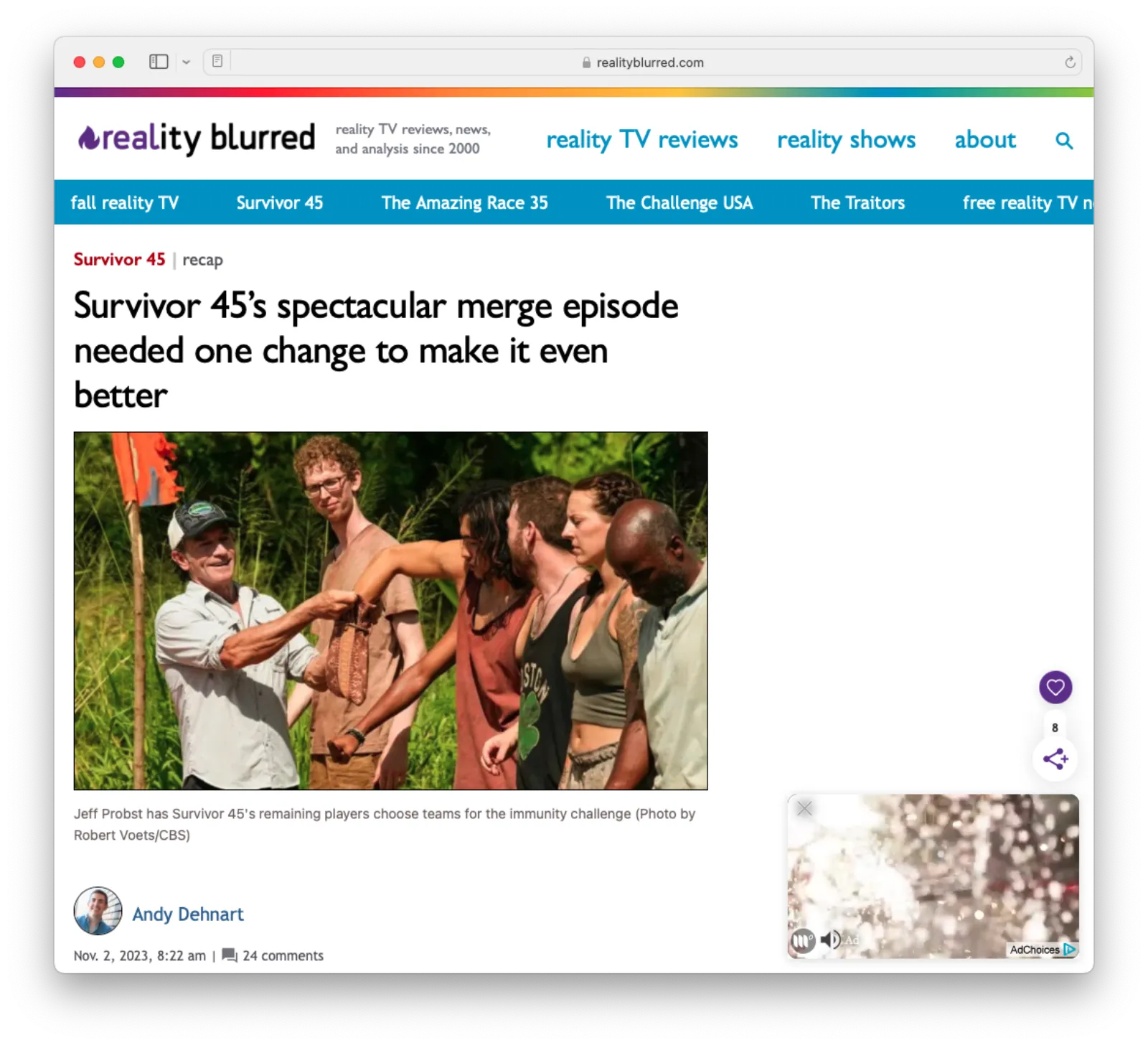
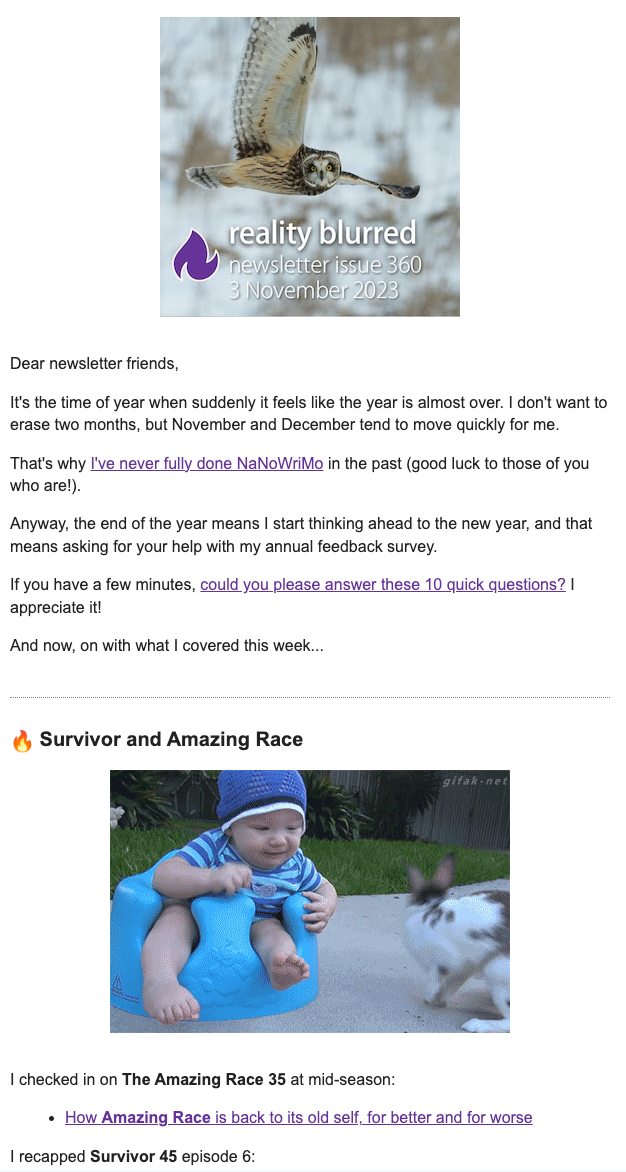
I think of my newsletter as an extension of my website, reality blurred. Since I'm already publishing there, I use my newsletter to highlight what I've written that week, and to share what's happening in my life and content that doesn't appear on the site.
The newsletter began as an automated feed from Feedburner, just sending the RSS feed via e-mail. About seven years ago, I turned it into a hand-crafted, end-of-week update—including those same links but also other content.
So now I'll also include, for example, the behind-the-scenes of how I found the Love is Blind cast contract, or rave about shows I love, or recommend an insightful TikTok video.
What made you decide to make that shift into more bespoke content, rather than just an RSS roundup?
I think it was a realization that those e-mail addresses represented a real opportunity to connect directly with people who showed interest in my work, and I was not really giving them the time and attention they deserved. Meanwhile, social networks where I'd built followings were putting barriers between those people and me, such as asking me to pay just to show my content to them. The more directly I can connect with readers and fellow reality TV fans, the better!
Where did you first learn of Buttondown, and what made you decide to give it a try?
I'd been looking for alternatives to Substack, for so many reasons. I received a newsletter from someone—I wish I recall who it was so I could thank them!—and followed its footer link to Buttondown.
The features attracted me, and the personal touches and the strong, human voice quickly convinced me. Having published on the internet for almost a quarter-century now, I find myself wanting to work with other small organizations, because I've been burned by the massive, profit-driven corporations and the projects they've abandoned. And seeing someone's passion for their work gets me excited, too.
Now, when I have a question, I appreciate knowing that I'll reach a person who works directly with Buttondown, and that's invaluable.
Buttondown's just made sending a newsletter easier all around, from formatting text to looking at analytics to see what worked and what didn't.
What are some ways Buttondown has helped you run your publication?
Buttondown's just made sending a newsletter easier all around, from formatting text to looking at analytics to see what worked and what didn't.
My favorite part is the ability to offer readers the ability to set their own price for an optional subscription. I don't want to play games with my readers, offering coupons and discounts, so I love that they can choose their own price, and adjust any time.
I love being surprised by new feature announcements, or things that I didn't think I needed but now use (like auto-generated ALT text—which I don't always use, but often helps me get started).
What advice would you give to someone starting their own newsletter?
I'd give the same advice as I give to the writers I work with, the students I've taught, and any aspiring creator: Do it! Just start, keep going, and experiment along the way. If something's working, do more of that; if something isn't, stop! I think sometimes we wait to have the perfect idea before we even try something, which is an easy way to never do it.
At the risk of making people's eyes roll out of their heads, I write about and love reality TV because I think true stories—even the silliest ones—have the power to change the world. One way to do that is to decide to share our stories with the world, whatever those may be.