





Inboxes used to have physical limits. A mail tray could fit only so many A4 sheets before toppling or hitting the bottom of a wire outbox stacked atop it. And yet, the conversations and language surrounding inboxes from 70 years ago aren’t all that different from the gripes we have about their digital facsimiles today.
The Oxford English Dictionary attributes the first use of the word inbox to 1958, when K.E. Boulding wrote that an executive should not be reduced to “receiving sentences and paragraphs in his ‘In’ box and grinding them into different sentences and paragraphs in his ‘Out’ box in the manner of a mill grinding wheat into flour.” But I found at least one earlier instance of the word in a declassified CIA memo from five years earlier. That prior use asked that analysts limit their “in-box” time to 21% of their schedule. Either quote could be plopped into a Cal Newport book or an Atlantic article today without anyone knowing it's older than email itself.
Inbox overload was such a perennial problem, in fact, that one of the most popular managerial exercises of the late 1950s put job applicants in a room with a basket full of memos and letters–some urgent, some pointless–with a limited time to triage them. A magazine article from the time detailed how participants in the Port of New York Authority “in-basket” simulations were constantly "interrupted by phone calls and their attention diverted by visitors who come in either to waste their time or to discuss other headaches.” It’s not a one-to-one of what we have today but it ain’t far off!
On a desk versus on a screen
One of the first things that people did with computers was send messages to each other. At MIT in the 1960s, users would write a note in a text file, name it something like “To Bob Smith”, and save it in a public directory where Bob would see it. Essentially a mailroom without mailboxes or delivery people.
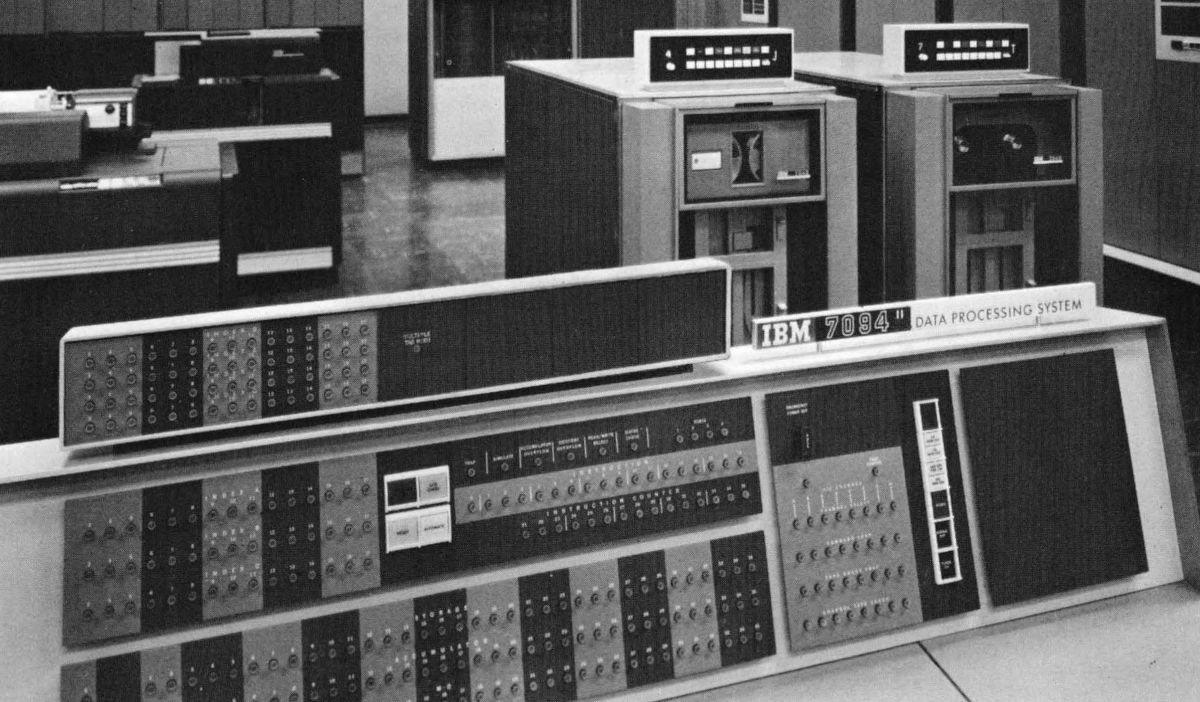
A few MIT users got together and proposed software to make the ad hoc electronic messaging more official. “The MAIL command will create or append to the front of a file called MAIL BOX. System messages to the user will be placed in a file called URGENT MAIL,” read Programming Staff Note 39 in December 1965. “The LOGIN command will notify the user if he has either kind of mail.” Tom Van Vleck, arriving several months after the note was published, saw that no one had actually created the proposed command and so wrote the MAIL program alongside his colleague Noel Morris.
No one would call these digital receptacles “inboxes” for a few more years. But they were the first place to hold and store electronic mail. And, like the in-basket simulations interspersed with unimportant birthday announcements, people almost immediately started abusing their access to co-workers' eyeballs. In Where Wizards Stay Up Late, there is the timeless story of an employee annoyed by “a colleague who, while working in the next office, would constantly send me e-mail and it never failed to surprise him when I got up and walked next door to respond to him.” No longer limited by the constraints of time or physical space, people started changing how they viewed inboxes.
Stephen Lukasik, the head of ARPA, for example, didn’t want to delete emails after he’d read them. So he asked his team to create a tool that would list out his messages, let him skip around his mailbox, and place certain types of messages in a separate file. That same year, the intern working on the program was tasked with setting memory limits on his bosses’ inboxes. He "estimated the largest possible mailbox size, doubled that, and concluded that assuming a mailbox was never larger than 5,000 messages was safe.” Two of his superiors exceeded that limit three months later.
A physical inbox would start to become ridiculous at 40 or 50 messages. But within a year of moving them onto a hard drive it was normal to fill an inbox with a hundred times that number. Still, I’m not sure that the total volume of communication had skyrocketed so much as been smashed into a million tiny pieces. “There is a natural hesitancy to publish something unpolished, and we hope to ease this inhibition,” Steve Crocker sent to the Network Working Group in 1969. “The minimum length for a NWG note is one sentence.” RFCs and other ARPANET messages were not dependent on a mail carrier or a pneumatic tube system and could be sent and received at any time of day, so why not fire one off every time you had a random thought?
Further complicating the shift to digital inboxes was the proliferation of email programs. Each one had used its own nouns and verbs to describe the movement of electronic mail, with users on different systems developing their own habits. For example, one of the earliest documents I could find that uses “inbox” to describe where electronic messages initially land was a 1976 ARPANET report. It outlines how three different users might organize their emails in three different ways. “The originator Jones has saved a copy in the [folders] UFO-STUFF and COPIES, the latter holding copies of all messages he has sent. Brown has filed the message under FROM-JONES and under UFOs. Smith merely lets all of his messages collect in his inbox.” We inbox zero folks have been shaming the rest of you for more than 50 years!
But even as the frequency and diversity of email changed how people communicated, the anchor to existing systems was impossible to reel in. In a report on the MS Personal Message System from 1977, Crocker wrote about how he consulted secretaries with no computer background about what to call certain email objects and actions. “Their choices were so well-ingrained that they could not believe there was any question about their selection. Telling them of the terms used by some computer systems often evoked laughter.” The language of email was determined as much by the systems and people that preceded it as by the people who invented it, and inboxes were essential vocabulary.
What we talk about when we talk about email
There were a surprising number of distinct email commands and software by the time SMTP rolled out. Richard Stallman’s ZMail was the first program I could find that used the word inbox to describe “your newly arrived mail,” while still experimenting with phrases like “unseen” instead of “unread” and “expunge” in place of “empty trash.” Xerox’s Grapevine, also from 1983, mentions inbox 50 times in just 15 pages, while around the same time EtherMail used mailbox and inbox interchangeably. None of those mention an outbox, though, making Mailway–Alaska’s 1984 electronic mail system for its Department of Education–among the earliest programs to use in and out boxes in tandem.
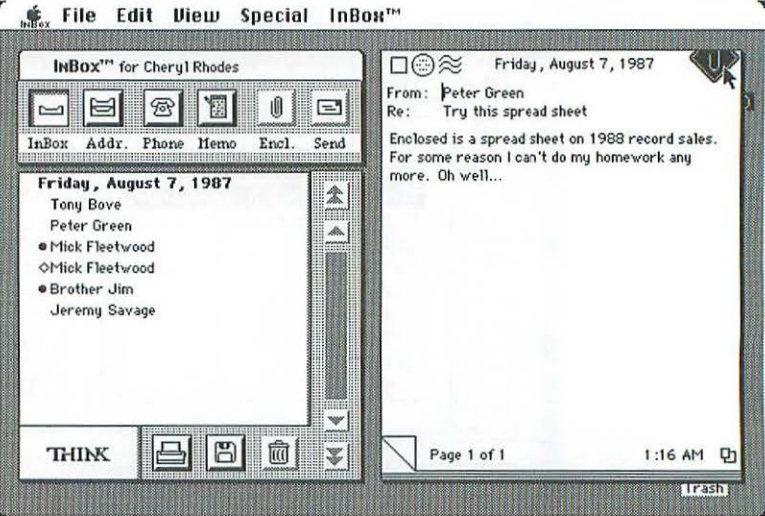
Eventually inboxes moved from text to graphic interfaces and the connection to their real-world counterparts only became stronger. GE’s BusinessTalk had one of the earliest icons of a physical inbox in email software. But Think Technologies took it a step further with its InBox client, which displayed messages as if they arrived on a pad of paper, complete with a postage stamp and a paperclip for “enclosures” (five whole years before email attachments got their own RFC standard). Unlike ARPANET mailboxes, InBox limited users to 500 messages in their account.
By 1990, there were around 12 million inboxes around the globe. While most were still tied to workplace platforms like Microsoft Mail and Lotus Notes, software better suited to individuals like Eudora and Pine were taking off. All of them had folders to organize a user’s messages and all of them placed incoming emails in the inbox. You might open a message with a keystroke instead of reaching across your desk, then file it away with a mouse click instead of the file cabinet next to your desk, but the ritual was similar.
For me, though, the philosophical divergence between the inboxes of 1958 and 2026 was the starkly different experience of cloud-based email. I had assumed the physical limitations of an inbox were based on volume. But a free Hotmail account in 1996 would have struggled to reach ARPANET’s 5,000-message limit with its 2 MB cap. The far more important physical limitation, I think, was one of location and availability.
In 2002, a Pew survey found that 15% of respondents checked email while on vacation. That would have been unthinkable just a few years prior. Then, when Pew asked the same question as part of a survey on BlackBerry and PDA users in 2008, the checking-on-vacation cohort more than doubled to 34%.
If you applied to the Port of New York Authority and took one of its “in-basket” simulations in 1960, you’d be confronted with a pile of messages to consider, all the while being repeatedly interrupted as part of the test. Not all that different from a growing inbox sandwiched between Slack notifications and last-minute Zoom calls. The in-basket simulation and the job it afforded you would never follow you home, though.
It’s funny that the first two recorded uses of the word were already grappling with problems many consider exclusively modern: a place where workers would waste more than 21% of their working hours and a medium that encourages repackaged ideas over new ones. Inboxes were chaotic in the 1950s and only marginally more so in the 2020s. If we stopped bringing them with us into bedrooms, bathrooms, family dinners, dance recitals, and date nights, maybe we'd be as zen as we like to think everyone was all those years ago.
| Image | Credit |
|---|---|
| Header photo | Wikimedia Commons |
| IBM 7094 computer at MIT | 7094 II Data Processing System Training Manual |
| Think Technologies’ InBox email client | The Well-Connected Macintosh |