



Three-quarters of enterprise leaders tell us they’re adopting agentic AI. Only a small minority have it running in meaningful production beyond “agentish” chatbots and true scaled multiagent systems are rarer still. That’s the gap between the chase and the catch, and it’s the story of 2026. The technology is a runaway train. The enterprise is the heavy load it has to pull.
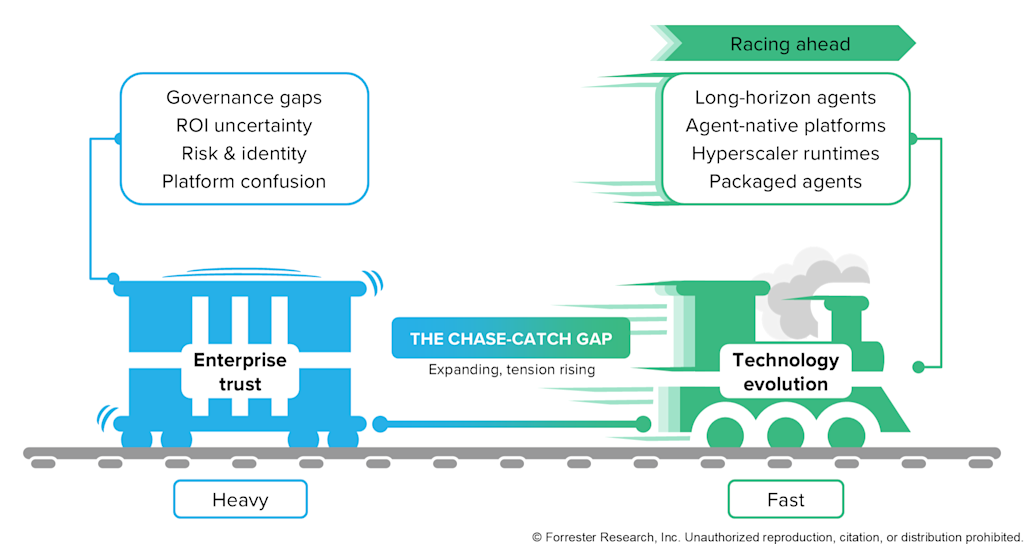
My colleagues and I just published The State Of Agentic AI, 2026, talking to the architects building agentic systems and digging through Forrester’s survey data to put meat on the bones of the story. Our read is that the technology has arrived and enterprise readiness hasn’t caught up. That shouldn’t surprise anybody. We’ve seen this story before. The harder question is whether readiness can ever catch a technology moving this fast.
The capabilities are here, and they arrived faster than anybody expected. The vendor market is reorganizing itself in real-time around agents. Agents now run for hours, days, even months. OpenAI has operated an internal software development workflow with minimal intervention for months. Cursor has deployed long-running coding agents. Anthropic has demonstrated multiday research agents. The proofs are in.
A long-running agent doesn’t behave like a chatbot. It behaves like a distributed system, and distributed systems demand orchestration, identity, and context discipline that most companies have never built. Scaling fails on task complexity, not agent count, and most teams aren’t managing that complexity at all. Stitch a dozen isolated agents together without shared registries or routing and coordination falls apart into duplication and drift.
Interest is everywhere. Scale is rare. The reasons are stubbornly consistent, and they start with money. ROI uncertainty traps enterprise ambition in pilot mode, because most companies can’t justify production beyond narrow efficiency gains. Governance gaps drive agentic sprawl. More than half of enterprises report it even after adopting the NIST AI RMF, because a policy document can’t control an autonomous, tool-invoking system. And platform confusion freezes commitment while teams argue over whether to bet on a SaaS agent, an SI-built system, or a custom build.
Underneath all of it sits the trust tax. Every autonomous action has to be logged and defensible to an auditor, and right now that cost is too high. Even the leaders feel it. Bank of New York is about as far out front as a regulated enterprise gets, and it still hasn’t captured the full value agentic promises. But BNY has something most don’t. Its workforce is ready to manage highly autonomous agents inside a tightly regulated business. That readiness is gold.
This is the part executives underestimate. Autonomous systems that act continuously across boundaries no human can monitor in real time are both promising and perilous. In Forrester’s Security Survey, 2026, 49% of security decision-makers named agentic AI as a concern. These threats are new in kind, not just degree. Agents can impersonate each other and escalate privileges because nonhuman identity is still a mess. Their populations grow faster than anyone can keep track of, and when coordination breaks, a small misjudgment becomes an outage.
You can’t govern that with quarterly reviews. You govern it with instrumentation that runs while the agent does, with identity and policy enforced as code rather than written down and hoped for.
The companies pulling ahead aren’t the ones with the most agents. They’re the ones laying the track the train will run on. Three moves matter most:
Then scale in stages. Start with bounded tasks behind approval gates and rollback paths. Widen autonomy only when the controls earn it.
The train is moving, and fast. The only question now is whether it’s headed where you want it to go.
Read The State Of Agentic AI, 2026 for the full picture. It maps the six use-case categories where agents are actually delivering and lays out the control-plane playbook for closing the gap. Then schedule a session and we’ll help you sequence it.
此内容由惯性聚合(RSS阅读器)自动聚合整理,仅供阅读参考。 原文来自 — 版权归原作者所有。