







This blog was authored by Hannah Jachim, Researcher
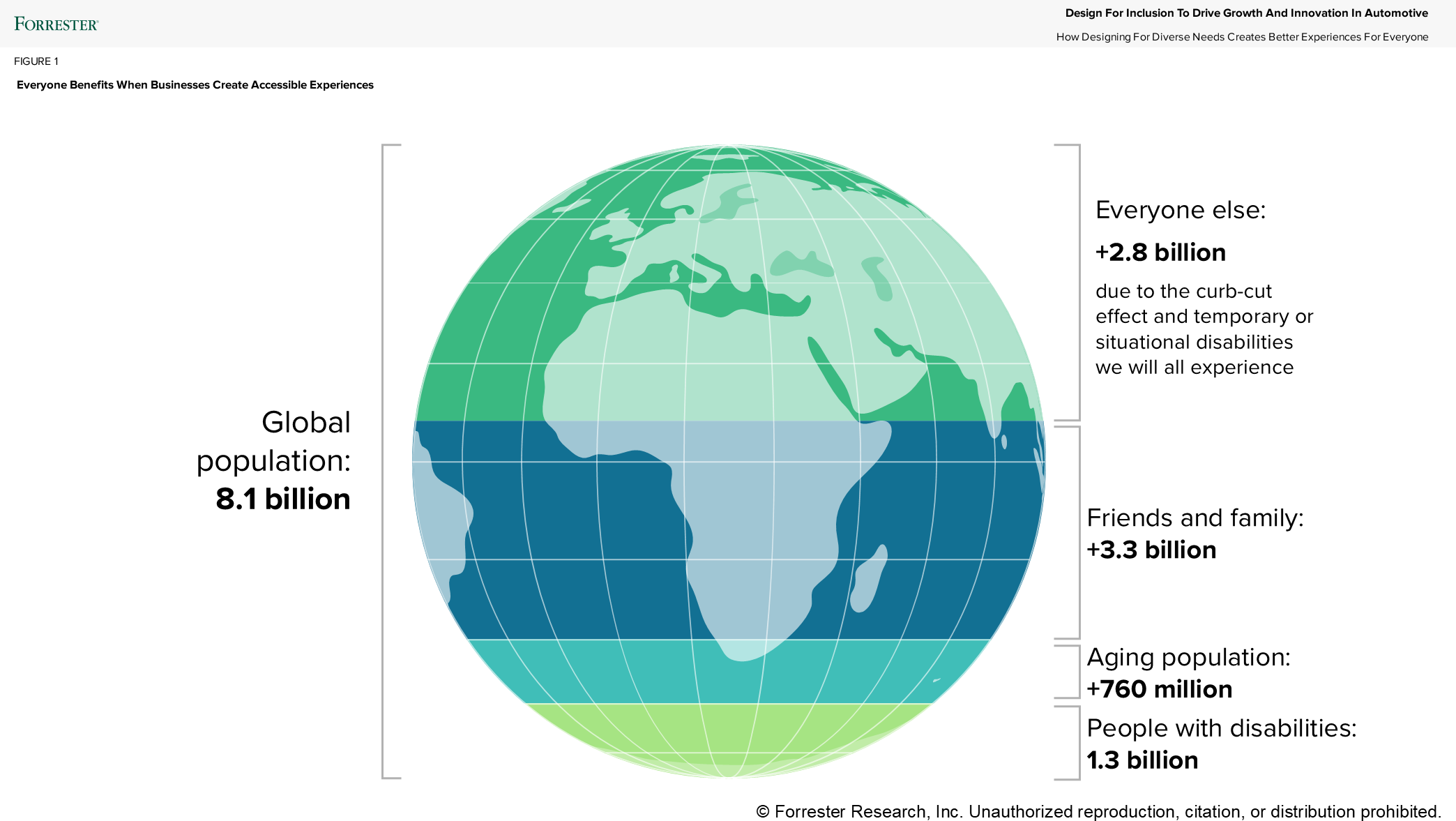
Automotive firms are under pressure to innovate while managing cost and complexity. Margins are tight. Customer expectations are shifting. Yet many OEMs still design for an “average” driver who no longer reflects reality. But when OEMs design for diverse needs, they unlock innovations that create better experiences for everyone – the curb-cut effect – and turn accessibility features into mainstream advantages (see Figure). Our latest report, Design For Inclusion To Drive Growth And Innovation In Automotive, shows that inclusive design is no longer only a compliance or ethical consideration but a strategic lever for growth, innovation, and brand differentiation.
What’s Holding The Industry Back — And How To Move Forward
Long-standing assumptions about target users, brand identity, and design influence how OEMs prioritize features, define users, and make design decisions. These challenges translate into a set of common barriers, with corresponding actions OEMs can take to address them, such as:
Solution: Expand research and testing to reflect real-world diversity. Engaging a broader range of users throughout the entire product design and development process helps teams uncover unmet needs and build solutions that enable a wider range of customers to use their product while improving the experience of all customers.
Solution: Align teams around shared inclusive design requirements early on and apply those requirements to the full ecosystem. Make easy customizability of physical and digital experiences the default (e.g. installing standard fixing points in the car for common adaptations, letting users switch off functions, move HMI modules or choose preferred input methods). This allows users to adapt the car to their needs.
Solution: Use moments of transformation such as the shift to EVs, software-defined vehicles and autonomous vehicles to rethink design fundamentals. Treat these inflection points as an opportunity to break from legacy constraints, reimagine user needs, and build more inclusive experiences from a clean slate.
Read our full report, Design For Inclusion To Drive Growth And Innovation In Automotive, to explore these barriers to inclusion in automotive in more detail and learn how to embed inclusive design as a core part of business. To discuss what this means for your organization, schedule an inquiry or a guidance session.
此内容由惯性聚合(RSS阅读器)自动聚合整理,仅供阅读参考。 原文来自 — 版权归原作者所有。