







- Affairs
- June 18, 2026
- 4 Min Read
Colombia goes to the polls this week – not only to decide its next president but also to choose its future direction.
On Sunday, Colombians will head to the polls to elect their next president. The neck-and-neck contest pits two of Latin America’s most polarising figures against each other, which is saying something. In one corner is Abelardo de la Espriella, also known as “El Tigre”: a 47-year-old lawyer and lifestyle entrepreneur who presents himself as a Colombian-Caribbean equivalent to Javier Milei, Donald Trump or Nayib Bukele.
To his critics, De la Espriella is a tacky, opportunistic grifter who made a fortune in Miami by representing people linked to corruption scandals and paramilitary groups (including the likes of Nicolás Maduro’s ally Alex Saab, who has been charged with money laundering). He has returned to mansplain and insult the residents of his motherland, while disingenuously promising to save them. His enemies warn that he will be a menace to Colombia’s unique biosphere and inevitably become Trump’s puppet, before taking off again on a private jet to the US or Italy, where he has property and passports.
In the other corner is Iván Cepeda, a Bogotá-born philosopher who spent part of his early years in Soviet-aligned Prague and Cuba, before studying at Bulgaria’s Sofia University. Cepeda became a human-rights campaigner after the assassination of his father, a Marxist senator, in 1994; today he is known for his ill-fitting, Mao-collared outfits. His opponents accuse him of being a terrorist sympathiser with awful teeth and bad posture, who will turn the country into a communist narco-state. They see him as cog in the long-running effort to destroy the nation and turn it into another Cuba or Venezuela. Cepeda is the candidate favoured by the incumbent, Petro, who is the first leftist elected to lead Colombia.
These are obviously caricatures but the stakes in this election feel extreme, with political polarisation at an all-time high. Colombians in both camps are convinced that the other side threatens what remains of their country’s democracy, institutions and economy. “Remember Hugo Chávez,” says the right. “Remember fascism,” says the left.
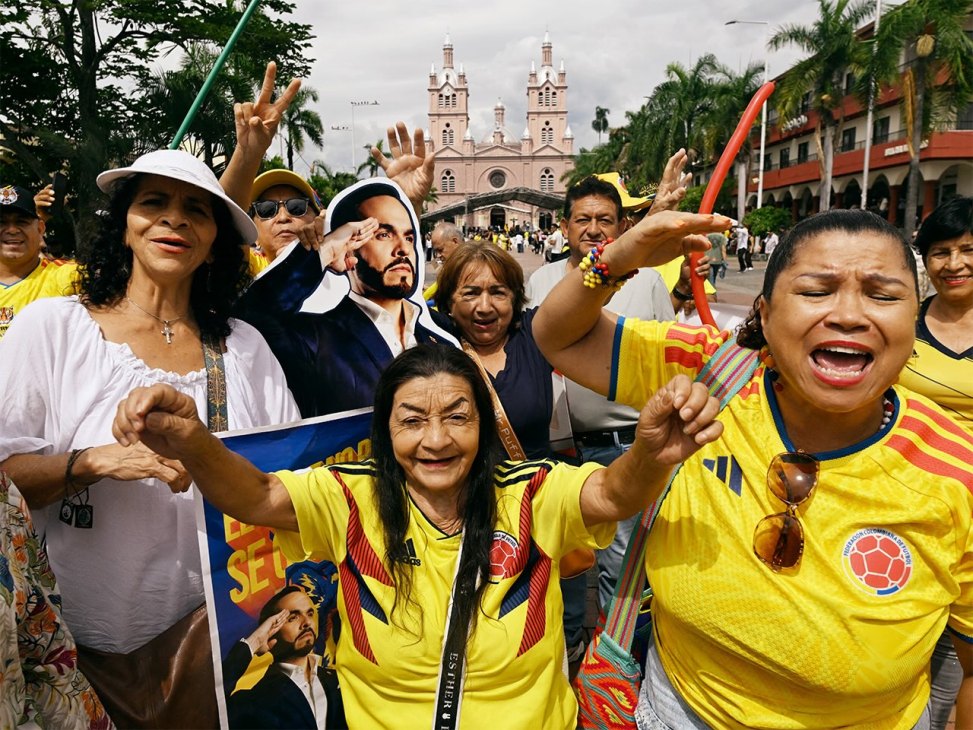
Will Colombia choose a showman who swears to “stand firmly for the homeland” and bring prosperity to the poor through unspecified policies or a boring commie dinosaur who pledges to defend the nation’s natural beauty and increase social spending at all costs? El Tigre’s campaign has been far more fiesta-flavoured and AI-enhanced than Cepeda’s familiar leftist repertoire of marches, slogans, victimhood and clenched fists; both sides, meanwhile, have played dirty. It would be incredibly entertaining to follow if the consequences weren’t so serious.
De la Espriella frames his political inexperience as a strength, hoping that his outsider status will lure voters who feel perennially left behind. Cepeda cites the opposite: he has been everywhere, walking up and down the country beside victims of war. Polls suggest that El Tigre has the edge. He was the unexpected winner of the first round on 31 May, with 43.7 per cent of the vote, ahead of Cepeda’s 40.9 per cent. The result stunned supporters of the latter, who had convinced themselves that they were heading for a landslide. It also marked the defeat of the traditional right, pushed aside by a loud insurgent from the coastal provinces.
There are, however, millions of votes still in play. Both candidates have accordingly spent the past few weeks desperately courting Colombia’s four million or so undecided voters. Cepeda has even tried to be funny – which is clearly not his natural register. De la Espriella has toned down his opposition to adoption by same-sex couples and his threats to end the 2016 peace process and pull Colombia out of multilateral bodies. He promises that, following his vision, Colombia can become as successful as, say, South Korea – though he has yet to explain how. Despite its distaste for his loud antics, shady past and questionable wardrobe, the centre seems to be leaning towards El Tigre.
Whoever wins on Sunday, it’s clear that Colombia urgently needs a proper third way. Those who are not on the extremes are called tibios, which means “lukewarm”. Maybe this election will prove that it’s time for the country to embrace moderation. Colombia has been passing the baton from extreme left to extreme right since its inception, resulting in a traumatised society. It’s time for the tibios to lead.