


惯性聚合 高效追踪和阅读你感兴趣的博客、新闻、科技资讯
阅读原文 在惯性聚合中打开

推荐订阅源

Stack Overflow Blog
Stack Overflow Blog
D
Darknet – Hacking Tools, Hacker News & Cyber Security
爱范儿
爱范儿
奇客Solidot–传递最新科技情报
奇客Solidot–传递最新科技情报
有赞技术团队
有赞技术团队
罗磊的独立博客
博客园 - 三生石上(FineUI控件)
小众软件
小众软件
L
LINUX DO - 最新话题
T
Troy Hunt's Blog
博客园_首页
量子位
Jina AI
Jina AI
S
SegmentFault 最新的问题
IT之家
IT之家
Hacker News - Newest:
Hacker News - Newest: "LLM"
大猫的无限游戏
大猫的无限游戏
N
News | PayPal Newsroom
P
Proofpoint News Feed
Cyberwarzone
Cyberwarzone
S
Securelist
Google Online Security Blog
P
Privacy International News Feed
博客园 - Franky
美团技术团队
钛媒体:引领未来商业与生活新知
钛媒体:引领未来商业与生活新知
NISL@THU
NISL@THU
C
Cisco Blogs
V
Vulnerabilities – Threatpost
腾讯CDC
The Hacker News
The Hacker News
K
Kaspersky official blog
C
Cyber Attacks, Cyber Crime and Cyber Security
雷峰网
雷峰网
CTFtime.org: upcoming CTF events
Security Archives - TechRepublic
A
About on SuperTechFans
Webroot Blog
Webroot Blog
The Register - Security
Scott Helme
Scott Helme
B
Blog
Security Latest
Security Latest
Last Week in AI
Last Week in AI
Google DeepMind News
W
WeLiveSecurity
freeCodeCamp Programming Tutorials: Python, JavaScript, Git & More
T
Tenable Blog
Blog — PlanetScale
Blog — PlanetScale
让小产品的独立变现更简单 - ezindie.com
S
Schneier on Security

Monocle

Air-con has become the latest front in a culture war – but more hot air is the last thing our overheating cities need All aboard as the Emirates’ first train service takes to the rails The seven standout shows at Paris Fashion Week Men’s spring/summer 2027 Where to eat and beat the heat in Paris: three new restaurants favoured by the fashion crowd What can be gleaned from Washington’s Reflecting Pool on the week of the US’s 250th birthday? Inside Monocle's July/August 2026 issue What makes Copenhagen a great city? Its ability to learn from its mistakes Stadium designer Alex Thomas’s top-10 sports venues in the world The case for keeping the economy – and the office – cool Cities are like theatres, we the actors. What part do you want to play? Cities are like theatres, we the actors. What part do you want to play? Onion – The Mansion: The latest outpost of a fashion retailer born of a musician’s side hustle Summer playlist: Celebrate the summer with these 40 scorching songs Meet the practice behind the Obama Presidential Center’s brand identity For all its problematic elements, the Fifa World Cup remains the greatest show on Earth Despite its enormous scale, Tokyo remains a city where good manners thrive Heatwave be damned! Paris Fashion Week Men’s brings leather and layers to the runways The Amble EV is gearing up to reinvent the way we drive Our summer issue is out now and measures the immeasurable – what makes a city worth living in? The art of the amble: Exploring the social rituals of evening walks across Spain, Italy and Greece Greetings from the past: A look back at postcards serving as snapshots of history It takes a village: Three new co-living developments that are bringing generations together The People’s charter for living well in cities: 13 rules for oafs, oiks and rapscallions How a city splashed out on staying cool: Zürich’s best fountains How The Lobb Club became Bangkok’s coolest tennis hangout Why does everyone want to be a member of Madrid’s Real Club de Campo Villa? A shore cure for urban fatigue: How Sydney, New York and Kobe are rethinking their waterfronts How Dubai, New York, Paris and Shenzhen are building their flying-taxi networks Saddle up at Polo Palladio for a taste of Jaipur’s social scene Tyler Brûlé introduces Monocle's 2026 Quality of Life survey on CNN Monocle’s Quality of Life Survey 2026: The 20 most liveable cities in the world At 25, Vienna’s MuseumsQuartier remains a model for putting art and design at the centre of city life The 10 best spring/summer 2027 collections at Milan Fashion Week Men’s Can Flame Tree Season create Dubai's own cherry-blossom moment? Who is Andy Burnham? The man hoping to be the UK’s seventh prime minister in 10 years Berlin swimmers take the plunge amid efforts to reclaim bathing in the Spree Manifesta makes a case for site-specific biennials as it arrives to Ruhr for its 16th edition The Monocle Quality of Life Survey’s top cities throughout the past decade Six beautiful travel books from Monocle to guarantee a well-spent summer Storied US news programme ‘60 Minutes’ might be old but it doesn’t need to change How London’s Workshop Café & Academy is bringing a touch of luxury to the daily grind How London’s Workshop Café & Academy is bringing a touch of luxury to the daily grind Seven little luxuries that make life worth the luggage allowance Spain’s newest art initiative Bienal Climática bridges Avilés’s industrial past with its ecological future Spain’s newest art initiative Bienal Climática bridges Avilés’s industrial past with its ecological future ‘Everything has its perfect timing’: Káryyn on summer songs and the album that took 16 years to make Why are we asking AI all our silly questions when our partners have all the answers? How one intrepid iPhone kept a cabin entertained from Madrid to Montevideo Running brands are going the extra mile as South Koreans take to the great outdoors Andy Burnham seems on course for Downing Street – but Keir Starmer hasn’t been a total failure Art Basel brings fun back to the fair with the element of surprise ‘Silence is part of our products’ performance’: Amundsen Sports’ CEO on building an outdoor-clothing brand using natural fabrics Peacocks on safari and other observations from this year’s Pitti Immagine Uomo Is AI-created art worthy of display? A new Los Angeles museum thinks so Colombia’s presidential election is a choice between extremes. The country needs to return to the centre Hermès goes big, bright and bold at its new London flagship The UK’s under-16 social-media ban won’t make Big Tech safer The US’s 250th anniversary celebrations come out swinging with a show of pumped-up machismo at the White House AI won’t replace jobs humans are good at. Now people just need to prove their worth SpaceX IPO, diamond smuggling and the inconvenient truth about Mars The 2026 Women’s Prize winners talk rejection, process and finding stories worth telling There’s a place for your backpack on the train – it’s not your back Want to know why São Paulo is so vibrant and ambitious? Here are 10 observations The biggest contest of the 2026 World Cup is off the pitch Japan must prioritise pragmatism with China over provocation Few artists made a bigger splash than David Hockney, who has died at 88 Why US cities are poised to be fantastic World Cup hosts Copenhagen’s 3 Days of Design proves that big things can come in small packages Tacky? Yes. Patriotic? Often. But the World Cup needs its anthems A sticky World Cup tradition: Tracking down Panini football stickers Dane in the life: Takeaways from Copenhagen’s 3 Days of Design AI isn’t reinventing the wheel but it should heed the lessons of human innovation Seven Amsterdam bookshops worth writing home about Amid rising regional tensions and soaring travel costs, Gulf residents are choosing staycations The Mercadona doctrine and how to make yourself at home part-time Montevideo might be small but it knows how to appreciate good architecture London’s Quentin Blake Centre for Illustration opens in a bid to draw new audiences to the art form A shore thing: Konfekt’s summer issue is an ode to sun, sand and sea ‘What we are dealing with is a moral trauma’: How NGO Superhumans is helping to rehabilitate battle-scarred Ukrainians A shore thing: Konfekt’s summer issue is an ode to sun, sand and sea Mark Carney is the gaffer to get behind as World Cup co-host Canada readies for kick-off Couture is ‘a dance with the materials’: Iris van Herpen on keeping the art of fashion alive See the best of the Swedish capital with Monocle’s guide to Stockholm From the Pope to Bad Bunny, ‘Madrileños’ have plenty to put their faith in this weekend At the Black Sea Security Forum in Odesa, Ukraine looks increasingly like the leader of the free world Forget Milan, Paris and London: Helsinki is where talent scouts head to look for the best fashion designers Looking to the sky reveals much about what’s happening on the ground Is Lisbon’s art market on the up? Arco Lisboa, the city’s growing contemporary art fair, has put on a promising display Off the wall: How Frank Bowling painted his way to prominence Dress codes for dummies: Can AI save Chad and Britney from their worst wardrobe impulses? What is so special about ‘Le Petit Prince’? Electric bikes are handy but why must they be used as garbage bins on wheels? The best new books, films, museums and albums in June Ibiza is hoping to capitalise on Dubai’s affluent tourist exodus – but it would do well to remember its roots Songtsam: Modern Chinese hospitality Editor’s letter: Andrew Tuck on the booming business of coffee What’s hot in the world of coffee? We spill the beans on the global market Not your average joe: 25 of the world’s best coffee shops, run by next-generation owners Breaking new ground: 25 exceptional brands that are leading the coffee industry Travel across L’Empordà, Spain – a coastline of storied hotels, seafront tables and surrealist heritage
How Iranians have been coping with the US-Israel conflict through limited internet access
Stefanie Glinski · 2026-05-29 · via Monocle

For Iranian Sajjad Javanmardi, learning how to live amid war was a slow and difficult process. In the early days of the US-Israel conflict with Iran, he wanted to find ways to make himself useful to his community. He tried photography to “document history.” He joined relief efforts, clearing rubble after airstrikes and distributing meals. He visited graveyards to mourn with those who lost loved ones. He learned the names of shopkeepers on his street in Tehran and bought food from them instead of ordering from delivery apps.

Javanmardi’s struggle to adjust to wartime life is not a unique one. And while physical destruction tends to represent the most immediate consequence of international conflict, its secondary effects also take a serious toll on society. In Iran’s case, foreign intervention is but one of several factors causing instability – the regime’s response to the war has drastically changed life for the nation’s people. 

Young people gather overlooking Tehran at night

When the war began on 28 February, Iranian authorities imposed a near-total nationwide internet blackout, cutting off access to messaging apps, social media and other major global platforms. While some top officials, businesses and journalists regained limited access through a pay-to-access two-tiered system or black-market VPNs, these services are prohibitively expensive for most citizens.

Though a state-controlled version of the internet is available, the shutdown has had dire effects on the country, both on its economy as well as its ability to communicate with the rest of the world. For Iran’s online businesses, the impact of the blackout has been detrimental: small e-commerce companies and start-ups have been crippled, while freelancers working with international clients have lost their income. Some experts estimate that it has cost the Iranian economy upwards of $1bn (€858.7m). 

Internet connection was partially restored on 26 May after 88 days of outage. To understand what life has been like since the conflict began – and without online connectivity – Monocle spoke with four Iranians about how they have adjusted in the wake of war. 

Sajjad Javanmardi 
A few weeks into the war, Javanmardi was sitting at his favourite café in a leafy neighbourhood in central Tehran when he realised that his experience running start-ups could be a boon, even without reliable internet. The 27-year-old entrepreneur established Place-less, an offline initiative designed to support struggling online artists and businesses. “I’ve helped to set up so many start-ups but I realised that it was time to help sustain them,” he says.

Sense of place: Sajjad Javanmardi, 33

Place-less organises in-person events in Tehran and other areas, bringing artists, designers, poets, jewellers and other independent creators together for pop-up marketplaces. With limited access to the internet, the events are marketed by word of mouth. “When airstrikes were still hitting Tehran, many people were trying to figure out how to get back to their routines and recover lost income,” says Javanmardi. “At our last event, we had about 20 businesses and 17 artists, selling everything from artwork and photography to jewellery. Place-less has turned into a support network for many.”

Darya Nazeri
As negotiations between the US and Iran have stalled, with only a fragile ceasefire remaining in place, coming together in physical spaces has helped people to cope with and navigate everyday realities. While social meet-ups – such as run clubs, park picnics and mountain hikes – were common before the war, they have since taken on a deeper meaning for many Iranians. From the early days of the conflict, people began attending community gatherings, which then transformed into informal support networks.
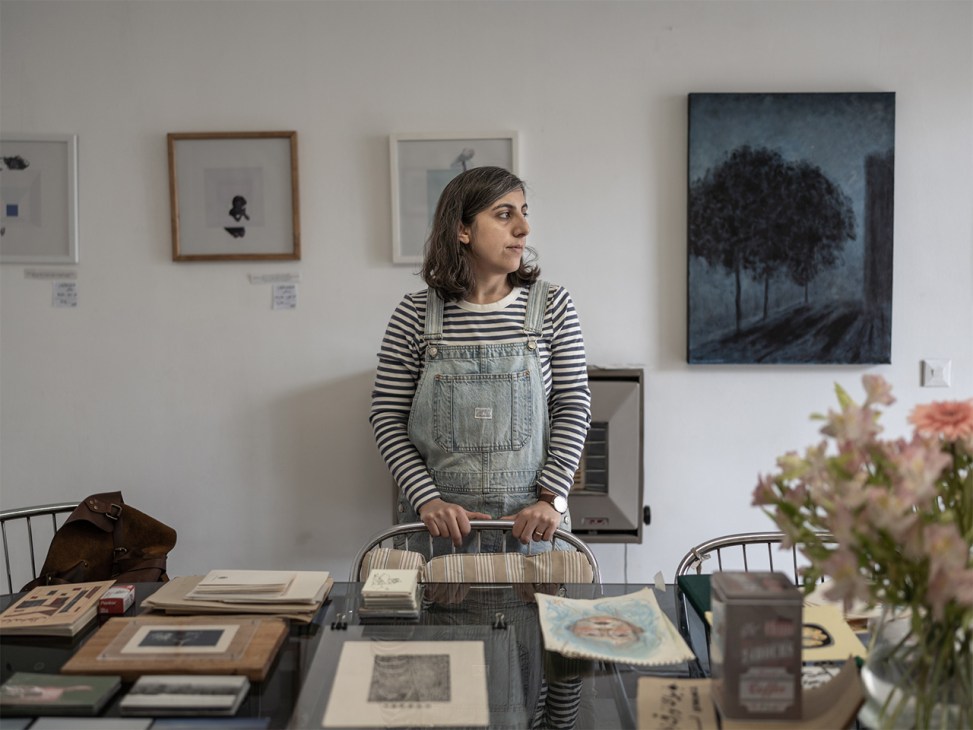
Art of the matter: Darya Nazeri, 33

The war altered Darya Nazeri’s routine completely. A biomedical-engineer-turned-artist and street photographer, she sells her work through an online shop. When the war began, she started spending more time painting and taking photos with friends. The 33-year-old artist lives with her husband, Milad, in central Tehran. When an airstrike hit her neighbourhood, shattering their flat’s windows, the couple decided to leave the city temporarily. They traversed the country by train and bus, selling their art and inviting people to draw with them in cities as far away as Mashad, near the Afghan border. “In a way, we transformed my online art shop into something physical,” she says. “The direct connection with people across the country had a very positive impact on me. It reminded me that we are all in this together and it has somehow made me feel proud to be Iranian.”

Marjan Rabiee
When an airstrike destroyed her printing house, Marjan Rabiee lost her entire source of income. At a loss of what to do, the 40-year-old turned a long-term passion into a new career. An avid motorbike rider, she won a national championship several years ago. In the wake of losing her business, she began teaching “women how to ride motorbikes and scooters,” she says, “even though women can’t officially hold a motorbike licence in Iran.”

Marjan Rabiee, 40, says that her entire business had been destroyed

While street riding is prohibited, racing is different – Rabiee explains that women are allowed to participate in official competitions. “Here motorbike racing [is] still a sport that is mostly practised by men,” she says. “While I race other women, it’s a very limited space. Racing is mostly funded by brand sponsorships and there’s little financial support from companies for women, as few of us [practice it].” By teaching them how to ride, Rabiee hopes that it will open the door for more women to try the sport.

With constrained access to the global internet, Iranians looked for ways to get outside. “Since the ceasefire, my client base has been increasing,” she adds. Rabiee believes that the sport provides a good reason to get out of the city – she often takes her 19-year-old son on rides to the mountains “to breathe”.

Reza Talebzade
Reza Talebzade left Tehran in the early days of the war. His cousin was killed in a US-Israeli strike in Iran last June, devastating his family. When the airstrikes began again in February, he didn’t want to take any risks. 
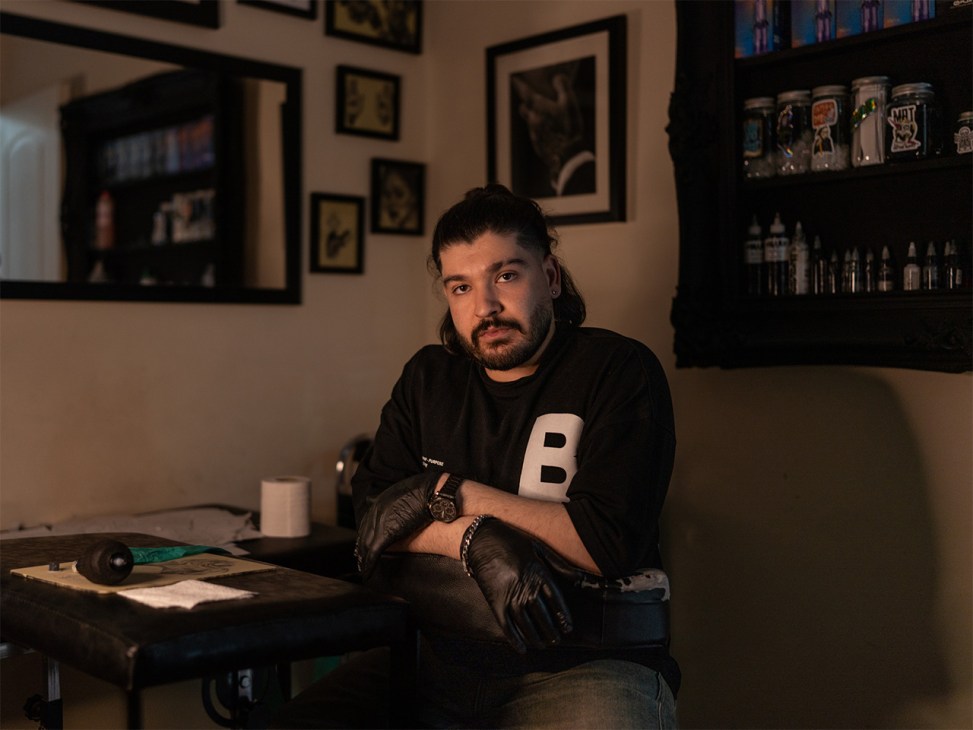
Spilling ink: Reza Talebzade, 25, is a tattoo artist in Tehran

Since returning to Tehran, the 25-year-old tattoo artist has thrown himself back into his work, operating out of a small basement studio. Business was hard even before the war, as sanctions made it difficult to source equipment, causing long delays and rising costs. Since the conflict began and internet access was restricted, Talebzade’s appointment list has shrunk. “A lot of my clients look for tattoo designs online,” he says. “Without that access, many cancelled their appointments.” But the lack of internet connection hasn’t stopped people from getting memorial tattoos, with requests coming in for names and pictures of loved ones who were killed. “I’ve had a growing number of clients asking for tattoos related to the war,” he says. “People who have lost loved ones want a permanent reminder and a way to cope with the loss.”