







Each day, millions of people depend on our app to get the most reliable real-time info for their commute. To get that info into riders’ hands, we depend on two critical data standards: the General Transit Feed Specification, or GTFS (for buses and trains) and the General Bikeshare Feed Specification, or GBFS (for bikeshare, but also scooters and carshare).
Today, a third open data standard enters the chat.
It’s called the General On-Demand Feed Specification, or GOFS (see a pattern here?) and it brings demand-responsive transportation like on-demand transit, paratransit, taxis, and ridehail into Transit and other apps.

What took root as an internal project at Transit has since branched out to include a growing roster of private companies and public agencies. As this new data standard bloomed, it became clear that the entire industry, not just Transit, could benefit. So today we’re handing it over to MobilityData, the non-profit that already manages GTFS and GBFS.
Thanks to an open-source governance structure overseen by MobilityData, everyone is invited to work with GOFS. That means anyone who runs an on-demand transit, taxi, or ridehail service. Anyone who wants to add these services to their own apps. And anyone who wants to help make GOFS better.

As more and more transit agencies added demand-responsive options in the past few years, demand also grew to integrate these services into multimodal trip planners like Transit.
One of those integrations was for dial-a-ride service in rural Minnesota, which made Transit the first major app to support the GTFS-Flex extension. Although it handles specific cases well — like buses that deviate from a fixed route, or demand-responsive service that can only do pickups and dropoffs at designated stops — we also encountered the downsides of GTFS-Flex: it’s a complex format, and critically, it doesn’t include any real-time information.
Increasingly, there was demand for us to add real-time info about point-to-point, on-demand transit, taxis, and ridehail. You’re used to these types of apps: they give you an ETA before you tap a button to request a ride. Something smaller than a bus (like a minibus, minivan, taxi or car) picks you up at your door, then drops you off at your destination or a nearby transit station.

The problem was that each of these services developed its own API to share real-time information.
There was the Uber API. The Lyft API. The API for Spare, and the API for Via. The API for RideCo, and the API for Padam. Each one was built juuuuuust a little differently from the others, but they all provided the same basic info: a service zone, a pickup ETA, a fare estimate, and a link to the booking app.
Every time a new API came along, our dev teams would have to start from scratch, figure out how the API worked, then integrate it into the app.
After one too many nights wading through custom API documentation, we realized: there had to be something better than juggling this panoply of proprietary integrations. Couldn’t there be a shared, common, standard way to get the job done every time a demand-responsive service wanted to integrate with our trip planner?
Turns out, the answer is a resounding YES.

Back in 2021, MobilityData put together the GOFS working group to determine what an open data standard for demand-responsive transportation might look like. We took part and, after the working group concluded, we were inspired to launch a data standard of our own.
We developed a minimalist JSON spec that asks operators for only the basic fields needed to show on-demand service in the app. It was similar to what companies were already providing in their proprietary APIs, and it was compatible with what the working group had outlined, but used a lightweight, easier-to-implement format. We called it GOFS-lite.
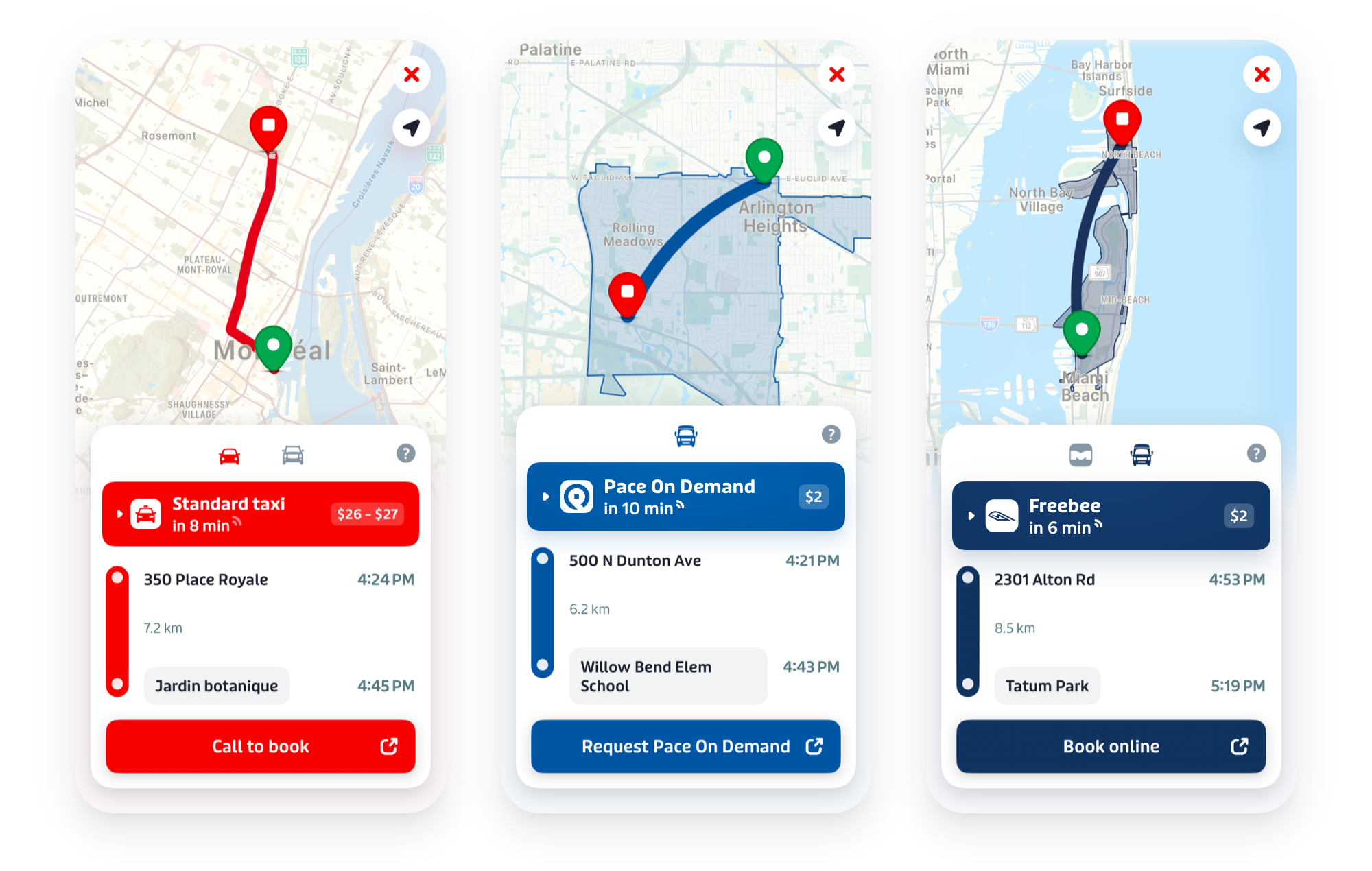
The first to embrace GOFS-lite was the Montreal Taxi Registry, who used it to bring the city’s taxis into Transit’s trip planner. Next came our partners at Pace in suburban Chicago and their Pace On Demand service. Then came on-demand transit in Miami Beach. The list kept growing: companies including DemandTrans, Ecolane, Freebee, and Pantonium have all produced GOFS-lite feeds for on-demand services to appear in the app.

With GOFS-lite gaining momentum, MobilityData approached us earlier this year with an idea: what if they took ownership of GOFS-lite, adopted an open-source governance model that follows the Mobility Data Interoperability Principles, and turned the straightforward format we had pioneered into the official GOFS standard?
It made sense to us: Transit is in the business of building the best app, not managing a data specification. And MobilityData are the experts at getting everyone around the table to lay down their proprietary swords and adopt open standards. GTFS and GBFS already have entire communities working on them, including transit agencies, data producers, service operators, apps, and more. Most of the time, this work happens online. Sometimes, folks gather around an actual table to hash things out IRL.

We’ve spent years around those tables, working with other companies to build new functionalities into GTFS, and with bikeshare operators as the first app to support GBFS. Now, it’s time for the same kind of open, collaborative community to develop around GOFS, too.
So if you work at a transit agency that has point-to-point on-demand service, if you work for a city with a taxi fleet, if your state or province allows ridehail services: start making GOFS part of your checklist. It’s open-source. Governed by an industry non-profit. And best of all, it’s easy to implement.
And if you work at a company that operates demand-responsive services, or if you build trip planners, passenger information screens, apps, or websites? Join us in adopting GOFS and contributing to the GOFS GitHub.

So head on over to GOFS.org, take your seat at the table, and help build the future of urban mobility.
We’ll see you there!
Questions? Check out Transit’s guidance for demand-responsive service, read the announcement from MobilityData, and get your goss about GOFS right from the source at GOFS.org.

“Four years ago, we introduced an open, standardized, lightweight format to share real-time information about demand-responsive transportation. Since then, the effort has grown to include multiple data producers. Transferring stewardship to MobilityData is a natural next step to grow the community of GOFS data producers and consumers, so demand-responsive transportation can become an integral part of multimodal trip planning for even more passengers.”
— Guillaume Campagna, Chief Technology Officer, Transit

“Moving ahead with GOFS is an exciting new chapter for on-demand transportation data. It fits right alongside GTFS and GBFS: each specification remains focused, while they all work together seamlessly. We are deeply grateful to everyone who contributed to the early development of GOFS, especially the original working group, and to our friends at Transit for their leadership with GOFS-lite. With this new direction, we can make the standard stronger, more useful for everyone, and help shape a more connected and resilient future for mobility.”
— Eric Plosky, Executive Director, MobilityData

“Miami Beach was the first city to provide real-time access to Freebee’s on-demand service using GOFS, enabling residents and visitors to plan their trips in the same way they would with fixed-route transit. This early adoption underscored the City’s commitment to innovation and demonstrated how GOFS can bridge the gap between flexible, demand-responsive services and everyday trip planning.”
— Mikhail Ryabov, P.E., Transportation Manager, City of Miami Beach

“Taxis play an important role in the urban mobility environment, providing a complementary service to public transport. The Registry strengthens the taxi sector by unifying real-time data, supports urban planning with traffic information, and optimizes on-demand mobility tools by standardizing their availability through the GOFS specification. It currently provides real-time geolocation for 3,300 taxis, making them more accessible and competitive in sustainable transport ecosystems.”
— Kim Thibault, Senior Planning Advisor, Agence de mobilité durable de Montréal

As the only provider of on-demand public transit in the Chicago region, Pace recognizes the importance of accurate, real-time information for riders. GOFS enables this by ensuring data is open and usable across platforms such as Transit. With MobilityData guiding its future, Pace looks forward to continuing its efforts to build a more convenient and accessible system.

“At DemandTrans Solutions, we are proud to support Pace in delivering real-time On Demand service information through the Transit app using the GOFS standard. Producing a GOFS feed has proven straightforward, and the benefits of an open, interoperable data standard for demand-responsive transportation are clear. By making this data easily accessible in navigation apps, riders gain a seamless way to plan demand-responsive trips alongside fixed-route services, enhancing both usability and convenience. We value Transit’s role as the first consumer of GOFS data and strongly support MobilityData’s leadership in advancing GOFS so more agencies, producers, and riders can benefit from open standards.”
— Todd Voirol, Chief Technology Officer, DemandTrans Solutions
此内容由惯性聚合(RSS阅读器)自动聚合整理,仅供阅读参考。 原文来自 — 版权归原作者所有。