惯性聚合 高效追踪和阅读你感兴趣的博客、新闻、科技资讯
阅读原文 在惯性聚合中打开

推荐订阅源

F
Full Disclosure
WordPress大学
WordPress大学
小众软件
小众软件
Cloudbric
Cloudbric
AWS News Blog
AWS News Blog
腾讯CDC
量子位
人人都是产品经理
人人都是产品经理
大猫的无限游戏
大猫的无限游戏
freeCodeCamp Programming Tutorials: Python, JavaScript, Git & More
V
Vulnerabilities – Threatpost
Scott Helme
Scott Helme
Hugging Face - Blog
Hugging Face - Blog
博客园_首页
C
CXSECURITY Database RSS Feed - CXSecurity.com
The Hacker News
The Hacker News
奇客Solidot–传递最新科技情报
奇客Solidot–传递最新科技情报
IT之家
IT之家
Jina AI
Jina AI
Attack and Defense Labs
S
SegmentFault 最新的问题
Simon Willison's Weblog
The Cloudflare Blog
阮一峰的网络日志
阮一峰的网络日志
T
Tailwind CSS Blog
Last Week in AI
Last Week in AI
博客园 - 【当耐特】
Google Online Security Blog
美团技术团队
OSCHINA 社区最新新闻
OSCHINA 社区最新新闻
V
Visual Studio Blog
罗磊的独立博客
L
LINUX DO - 最新话题
博客园 - Franky
博客园 - 叶小钗
Apple Machine Learning Research
The Last Watchdog
The Last Watchdog
J
Java Code Geeks
AI
AI
C
Cisco Blogs
酷 壳 – CoolShell
酷 壳 – CoolShell
C
Cyber Attacks, Cyber Crime and Cyber Security
Cisco Talos Blog
Cisco Talos Blog
博客园 - 三生石上(FineUI控件)
雷峰网
雷峰网
Help Net Security
Help Net Security
钛媒体:引领未来商业与生活新知
钛媒体:引领未来商业与生活新知
云风的 BLOG
云风的 BLOG
I
Intezer
S
Securelist

Ittavern.com

Wimage - Hosting Open-Source Image Uploader with Podman and external S3 Storage Switching from Hugo to picopaper Encryption using SSH Keys with age in Linux ETag in nginx - Simple Resource Caching Sending nginx Logs to Loki with Grafana Alloy How to: Cisco ISE backup to SFTP repository with public key authentication Dummy IP & MAC Addresses for Documentation & Sanitization Deploying ISSO Commenting System for Static Content using Docker Generate a Vanity v3 Hidden Service Onion Address with mkp224o mtr - More Detailed Traceroute - Network Troubleshooting My Personal Backup Strategy - August 2024 iperf3 - User Authentication with Password and RSA Public Keypair Adding a trash can to Linux with trash-cli Bandwidth Measurement using netcat on Linux Getting started with rsync - Comprehensive Guide Cron Jobs on Linux - Comprehensive Guide with Examples SSH Server Hardening Guide v2 Port Knocking with knockd and Linux - Server Hardening Getting started with rclone - Data transmission Getting started with dig - DNS troubleshooting Getting started with Fail2Ban on Linux Getting started with netcat on Linux with examples URL explained - The Fundamentals Troubleshooting Asking The Right Questions Create tmux layouts using bash scripts Getting started with tcpdump - Ittavern.com Curl on Linux - Reference Guide Getting started with nmap scripts My Offsite Backup - March 2023 Getting started with iperf3 - Network Troubleshooting ICMP echo requests on Linux and Windows - Reference Guide Simulate an unreliable network connection with tc and netem on Linux Detecting Rogue DHCP Server - Ittavern.com Basics of the Linux Bash Command History with Examples Getting started with GNU screen - Beginners Guide Basics of Power over Ethernet (PoE) Difference between RSS and Atom SSH Troubleshooting Guide - Ittavern.com Backup Guide - how to secure crucial data SSH - run script or command at login Linux - unmount a busy target safely Visual guide to SSH tunneling and port forwarding Guide to Wireshark display filters Online Security Guide - Ittavern.com My IT EDC tool kit v2212 10 prompts - 1000 AI generated images - openAI Dall-E SSH - How to use public key authentication on Linux Ways to support open-source projects Getting started with nmap - Ittavern.com nginx - simple and native authentication function Linux - How to work with complex commands EICAR test file - riskless method to test your antivirus and firewall solution Linux - connect to a serial port with screen Podman / Docker - expose port only to the localhost of the host machine Tmux - reload .tmux.conf configuration file My use cases for CyberChef Nginx - simple permanent or temporary redirects Getting started with tmux - Ittavern.com Tmux - synchronize the input of all panes within a window Nginx - check your public IP CyberChef - How to remove empty lines
ssh-audit Primer - Audit your SSH Server
2024-08-28 · via Ittavern.com

As the name already implies,ssh-audit helps you to audit SSH clients and servers. It is lightweight, open-source, supports both versions of SSH and is available for Linux and Windows.

In this article we'll use Linux on both sides.

The Basics

After installation, the basic syntax of an audit is ssh-audit DESTINATION. By default it uses the standard SSH port 22 - to change the port, simply add it to the destination DESTINATION:2222.
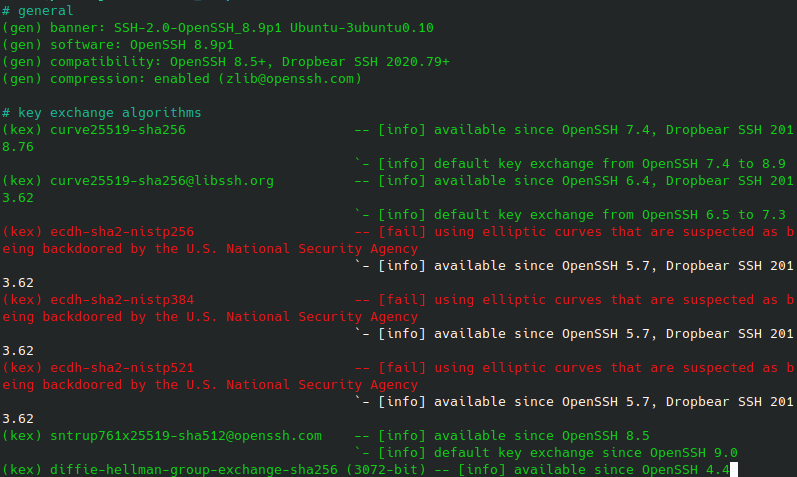
On the left, it starts with the referenced information, categorizes it with [info],[warn] and other labels and adds a short description on the right.

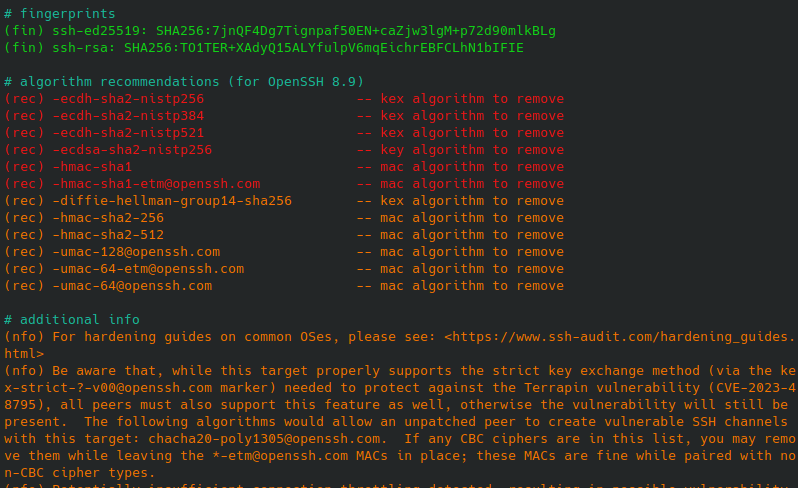
It has many sections - starting with various information about key, cipher and algorithms information and information about the fingerprint, recommendations and additional information at the end.
General options #

Force a certain SSH version:
-1, --ssh1
-2, --ssh2
Choose an Internet Protocol Version:
-4, --ipv4
-6, --ipv6
Removes the colors in the terminal:
-n, --no-colors
For a more detailed output:
-v, --verbose
-d, --debug
In particular, the debug option is useful if you need to troubleshoot a connection or want the raw data.

Batch Audit of multiple Servers

Especially in larger environments, it makes sense to work with the following options if you want to automate processes.

Target list of hosts from file #

Create a simple list of hosts:

cat ssh-servers.txt 
10.10.50.50:22
10.20.30.40:22

Now you can use the -T, --targets=<hosts.txt> options to run through the list of hosts:

ssh-audit -T ssh-servers.txt

There are some options that might be helpful:

Add a timeout in case a host is unavailable so the run can continue:
-t, --timeout=<secs>
Set the minimum output level for the logs:
-l, --level=<level> # (info|warn|fail)
Formatting the results in JSON:
-j, --json
This options removes a lot of formatting and empty lines which makes it easier to work with the results:
-b, --batch

Saving Results to file #

Simply redirect the results into a new file with >, append to a file with >> or pipe it to tee when you need to display the results at the same time.

ssh-audit -T ssh-servers.txt > ssh-servers-results.txt

Work with Policy Sets

You can create custom policy sets and test against them. This is helpful if you have a standard that you want to enforce and audit your environment against.

Let's say you already have a hardened SSH server that you want to use as a reference. Use -M, --make-policy=reference-policy-ssh.txt to create a reference policy set that you can use later.

ssh-audit -M reference-policy-ssh.txt 10.10.50.51

Wrote policy to reference-policy.txt.  Customize as necessary, then run a policy scan with -P option.

You then can use -P, --policy=reference-policy-ssh.txt to run the reference policy against another server:

ssh-audit -P reference-policy-ssh.txt 10.10.50.50

Host:   10.10.50.50
Policy: Custom Policy (based on 10.10.50.50 on 2024/08/28) (version 1)
Result: ✔ Passed

Deviations will be listed and you can make changes accordingly.

The policy file looks like thi:

 cat reference-policy-ssh.txt                                                                                                                         
# Custom policy based on 10.10.50.51 (created on 2024/08/28)                                                                                         
# The name of this policy (displayed in the output during scans).  Must be in quotes.                                                                       
name = "Custom Policy (based on 10.10.50.51 on 2024/08/28)"                                                                                            
# The version of this policy (displayed in the output during scans).  Not parsed, and may be any value, including strings.                                  
version = 1                                                                                                                                             
# When false, host keys, kex, ciphers, and MAC lists must match exactly.  When true, the target host may support a subset of the specified algorithms and/or
 algorithms may appear in a different order; this feature is useful for specifying a baseline and allowing some hosts the option to implement stricter contr
ols.
allow_algorithm_subset_and_reordering = false

{...}