







GitHub Security Lab CTF 4: CodeQL and Chill - The Java Edition
CVE-2020-9297
https://securitylab.github.com/advisories/GHSL-2020-028-netflix-titus/
简介
题目介绍:用户控制的数据被传入支持Java EL表达式的Bean Validation库函数ConstraintValidatorContext.buildConstraintViolationWithTemplate,但问题是如何获取RCE。因此,远程代码执行。这似乎问题已经结束,但事实并非如此。想要RCE并不像仅仅传递一个EL表达式那么简单。一些问题,如用户输入的小写字母,使我们无法获得利用。解释如何使用CodeQL找到流向目标函数的特定用户控制数据的,了解远程代码成功执行有哪些要求。
官方给的漏洞成因代码:
@Override
public boolean isValid(Container container, ConstraintValidatorContext context) {
    if (container == null) {
        return true;
    }
    Set<String> common = new HashSet<>(container.getSoftConstraints().keySet());
    common.retainAll(container.getHardConstraints().keySet());
    if (common.isEmpty()) {
        return true;
    }
    context.buildConstraintViolationWithTemplate(
            "Soft and hard constraints not unique. Shared constraints: " + common
    ).addConstraintViolation().disableDefaultConstraintViolation();
    return false;
}
大致逻辑如下图,关键点在buildConstraintViolationWithTemplate方法调用上。
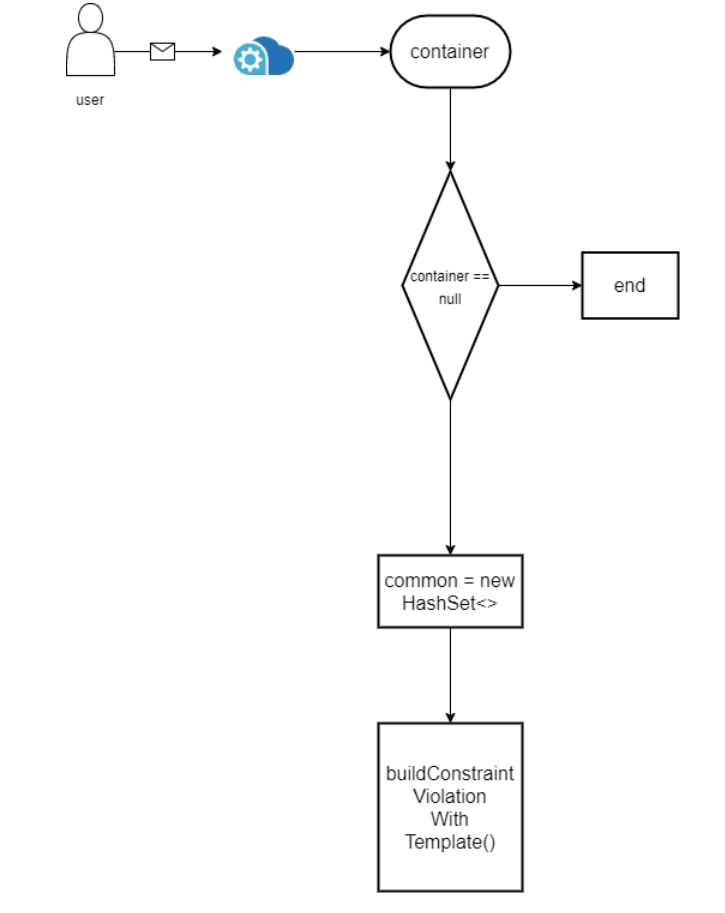
数据流和污点跟踪分析
1.1 Source
找到漏洞的一个重要部分是找到所有用户控制的数据从哪里来。在挑战页面本身就有提示–函数isValid的第一个参数。
因此,isSource谓词:
/**
 *@name Source
 *@derscription
 */
import java
import semmle.code.java.dataflow.DataFlow

/*
Map overrides of isValid method from ConstraintValidator
*/
class ConstraintValidator extends RefType {
	ConstraintValidator() {
		this.hasQualifiedName("javax.validation", "ConstraintValidator")
	}
}

class ConstraintValidatorIsValid extends Method {
	ConstraintValidatorIsValid() {
		this.getName() = "isValid" and
		this.getDeclaringType().getASourceSupertype() instanceof ConstraintValidator

	}
}

predicate isSource(DataFlow::Node source) {
	exists(ConstraintValidatorIsValid isValidMethod |
		source.asParameter() = isValidMethod.getParameter(0)
	)
}

//There has to be a query in scope even when you use Quick Evaluation
select "Quick-eval isSource"
第一个container是符合要求,但要求只有6个结果也就是说有两个不符合要求。
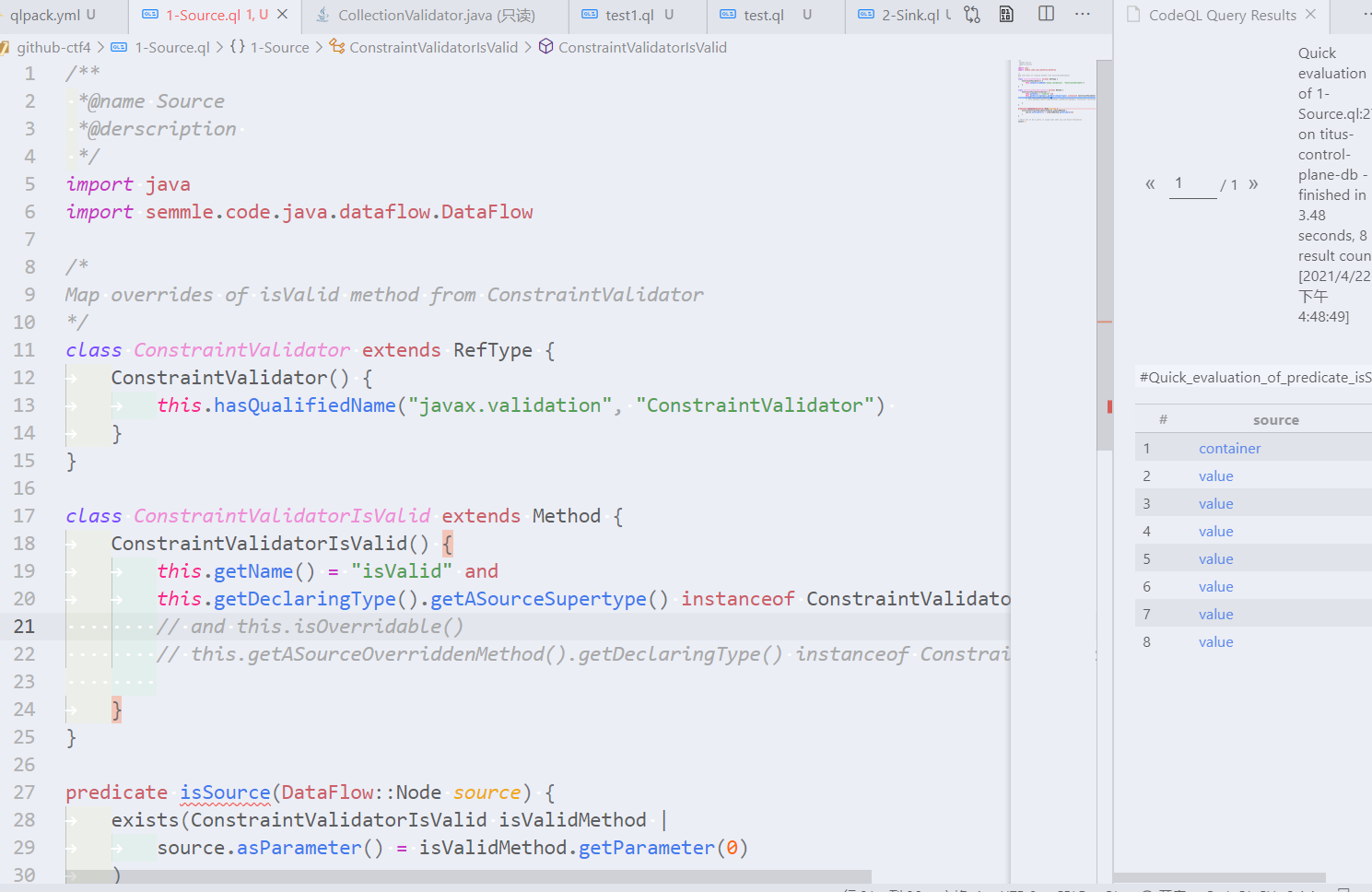
根据提示:Map overrides of isValid method from ConstraintValidator,所以排除不是重写的方法即可。

只需要在加一行and this.isOverridable()判断即可,或者注释掉第四、五行再去掉第六行注释也可以。getASourceOverriddenMethod首先会判断是否是重写的方法。
class ConstraintValidatorIsValid extends Method {
	ConstraintValidatorIsValid() {
		this.getName() = "isValid" and
		this.getDeclaringType().getASourceSupertype() instanceof ConstraintValidator
        and this.isOverridable()
        // this.getASourceOverriddenMethod().getDeclaringType() instanceof ConstraintValidator

	}
}
1.2 Sink
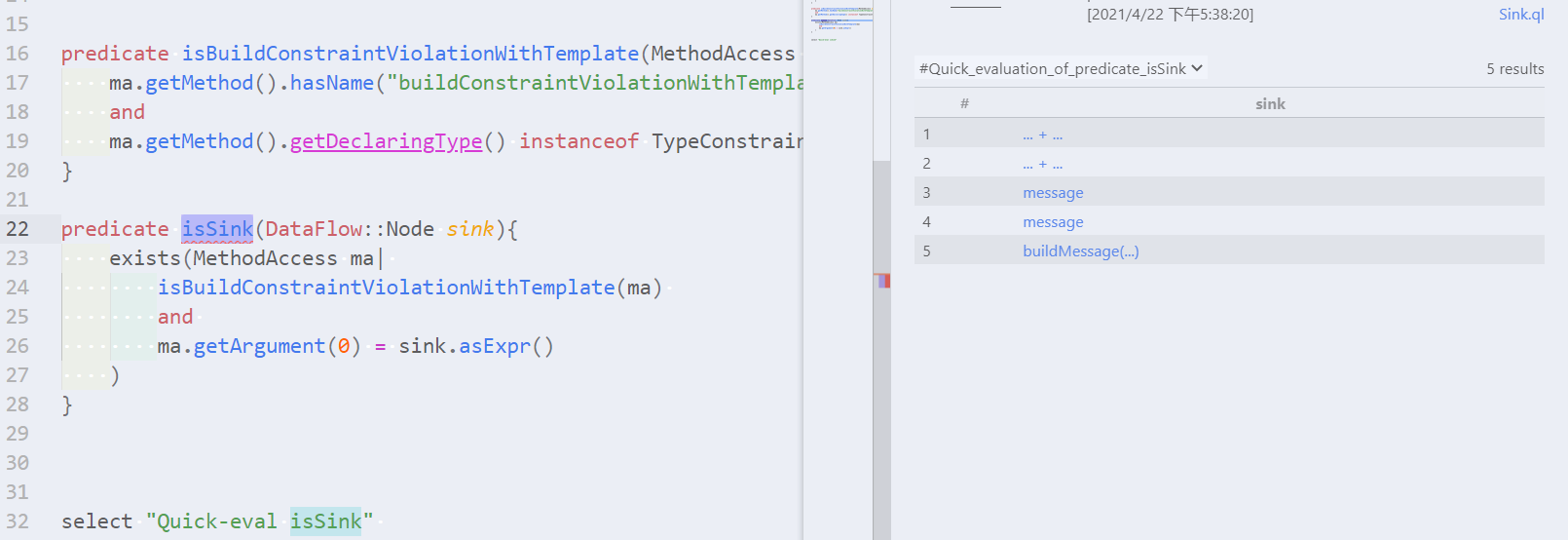
根据提示Sink是ConstraintValidatorContext.buildConstraintViolationWithTemplate(...)调用的第一个参数,要求5个结果。
/**
 *@name Sink
 *@derscription
 */

import java
import semmle.code.java.dataflow.DataFlow

class TypeConstraintValidatorContext extends RefType {
    TypeConstraintValidatorContext() {
        this.hasQualifiedName("javax.validation", "ConstraintValidatorContext")
    }
}


predicate isBuildConstraintViolationWithTemplate(MethodAccess ma){
    ma.getMethod().hasName("buildConstraintViolationWithTemplate")
    and
    ma.getMethod().getDeclaringType() instanceof TypeConstraintValidatorContext
}

predicate isSink(DataFlow::Node sink){
    exists(MethodAccess ma|
        isBuildConstraintViolationWithTemplate(ma)
        and
        ma.getArgument(0) = sink.asExpr()
    )
}


select "Quick-eval isSink"
1.3 TaintTracking configuration
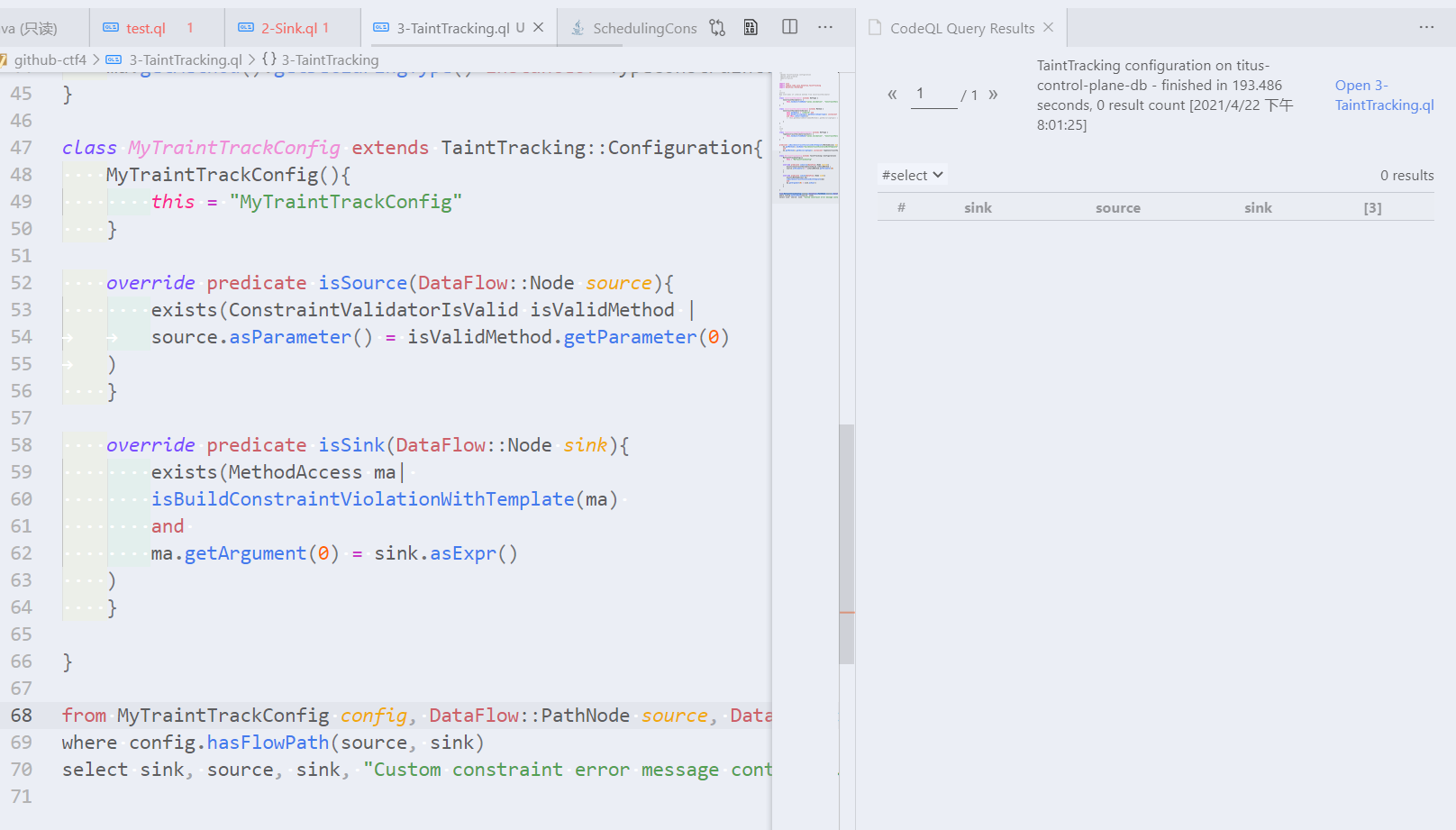
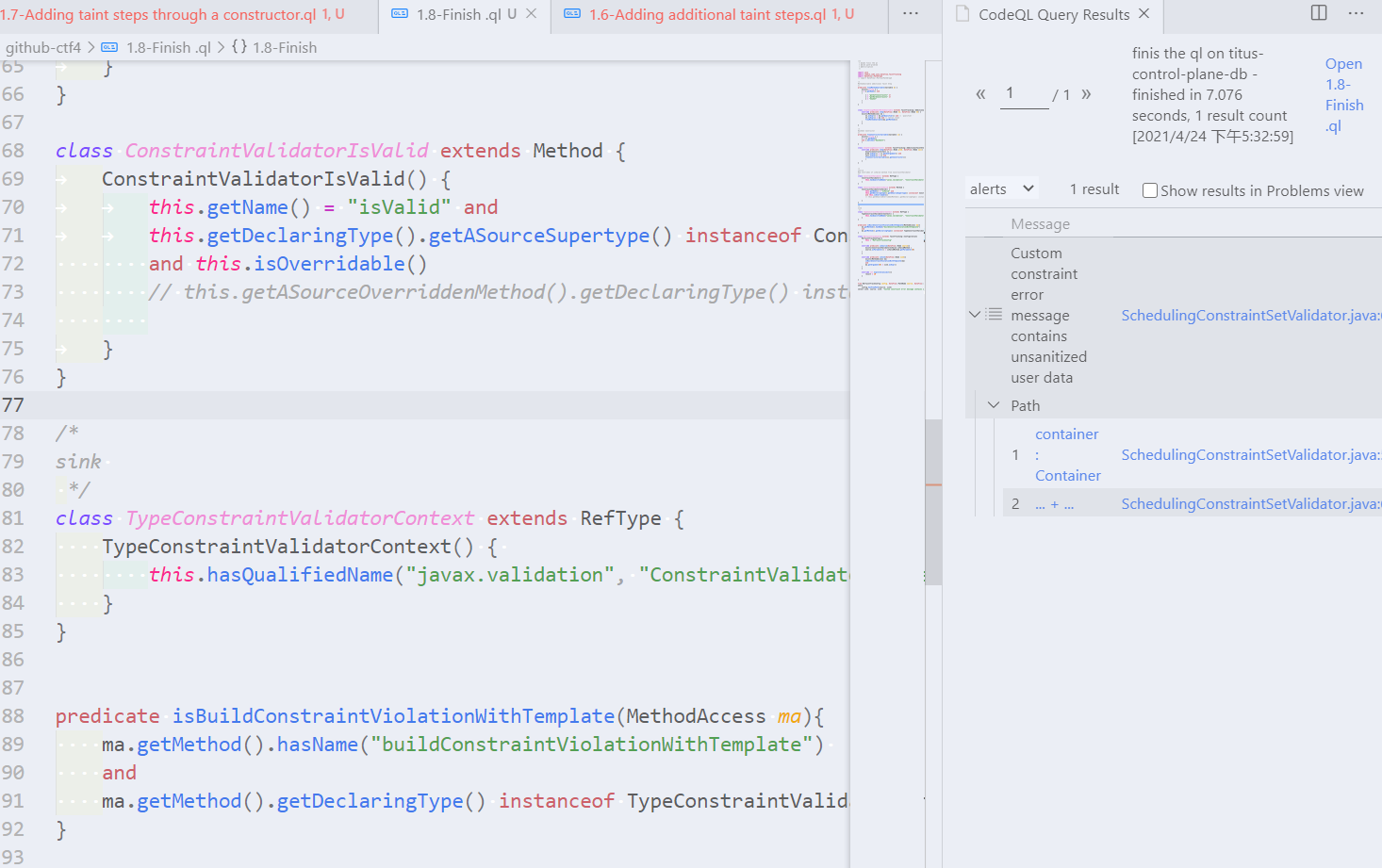
题目给了TaintTracking configuration模板,如果前面isSource和isSink谓词都是正确的话,可以得到正确的路径。
/** @kind path-problem */
import java
import semmle.code.java.dataflow.TaintTracking
import DataFlow::PathGraph

class MyTaintTrackingConfig extends TaintTracking::Configuration {
    MyTaintTrackingConfig() { this = "MyTaintTrackingConfig" }

    override predicate isSource(DataFlow::Node source) {
        // TODO
    }

    override predicate isSink(DataFlow::Node sink) {
        // TODO
    }
}

from MyTaintTrackingConfig cfg, DataFlow::PathNode source, DataFlow::PathNode sink
where cfg.hasFlowPath(source, sink)
select sink, source, sink, "Custom constraint error message contains unsanitized user data"
没有任何结果,和出题人意料一样。
1.4 Partial Flow to the rescue
没有任何结果查询刚学的CodeQL新手小白估计此时都会束手无策了,我们确定了source和sink,这表明我们的分析在从源到汇的路径上缺少一个步骤。,但CodeQL也考虑到了这种情况,故内置Partial Data Flow来debug。Partial Data Flow允许寻找从一个给定的source到任何可能的sink的流动,让sink不受限制,同时限制从source到sink的搜索步骤的数量。因此,可以使用这个来跟踪污点数据从源头到所有可能的汇的流动,并查看流动在哪里停止被进一步track。
About:
中文对照翻译:
如果存在从
source到node的部分数据流路径,则保留。node和最近的源之间的近似距离是dist,并被限制为小于或等于explorationLimit()。这个谓词完全不考虑sink的定义。该谓词用于数据流探索和调试,如果源的数量太大,和/或探索限制设置得太高而没有使用障碍,则可能表现不佳。 这个谓词默认是禁用的(没有结果)。用一个合适的数字覆盖
explorationLimit()来启用这个谓词。 在 “路径问题 “查询中使用,请导入 “PartialPathGraph “模块。
Partial Flow 模板
/** @kind path-problem */
import java
import semmle.code.java.dataflow.TaintTracking
import DataFlow::PartialPathGraph // this is different!

class MyTaintTrackingConfig extends TaintTracking::Configuration {
    MyTaintTrackingConfig() { ... } // same as before
    override predicate isSource(DataFlow::Node source) { ... } // same as before
    override predicate isSink(DataFlow::Node sink) { ... } // same as before
    override int explorationLimit() { result =  10} // this is different!
}
from MyTaintTrackingConfig cfg, DataFlow::PartialPathNode source, DataFlow::PartialPathNode sink
where
  cfg.hasPartialFlow(source, sink, _) and
  source.getNode() = ... // TODO restrict to the one source we are interested in, for ease of debugging
select sink, source, sink, "Partial flow from unsanitized user data"

predicate partial_flow(PartialPathNode n, Node src, int dist) {
  exists(MyTaintTrackingConfig conf, PartialPathNode source |
    conf.hasPartialFlow(source, n, dist) and
    src = source.getNode() and
    source =  // TODO - restrict to THE source we are interested in
  )
}
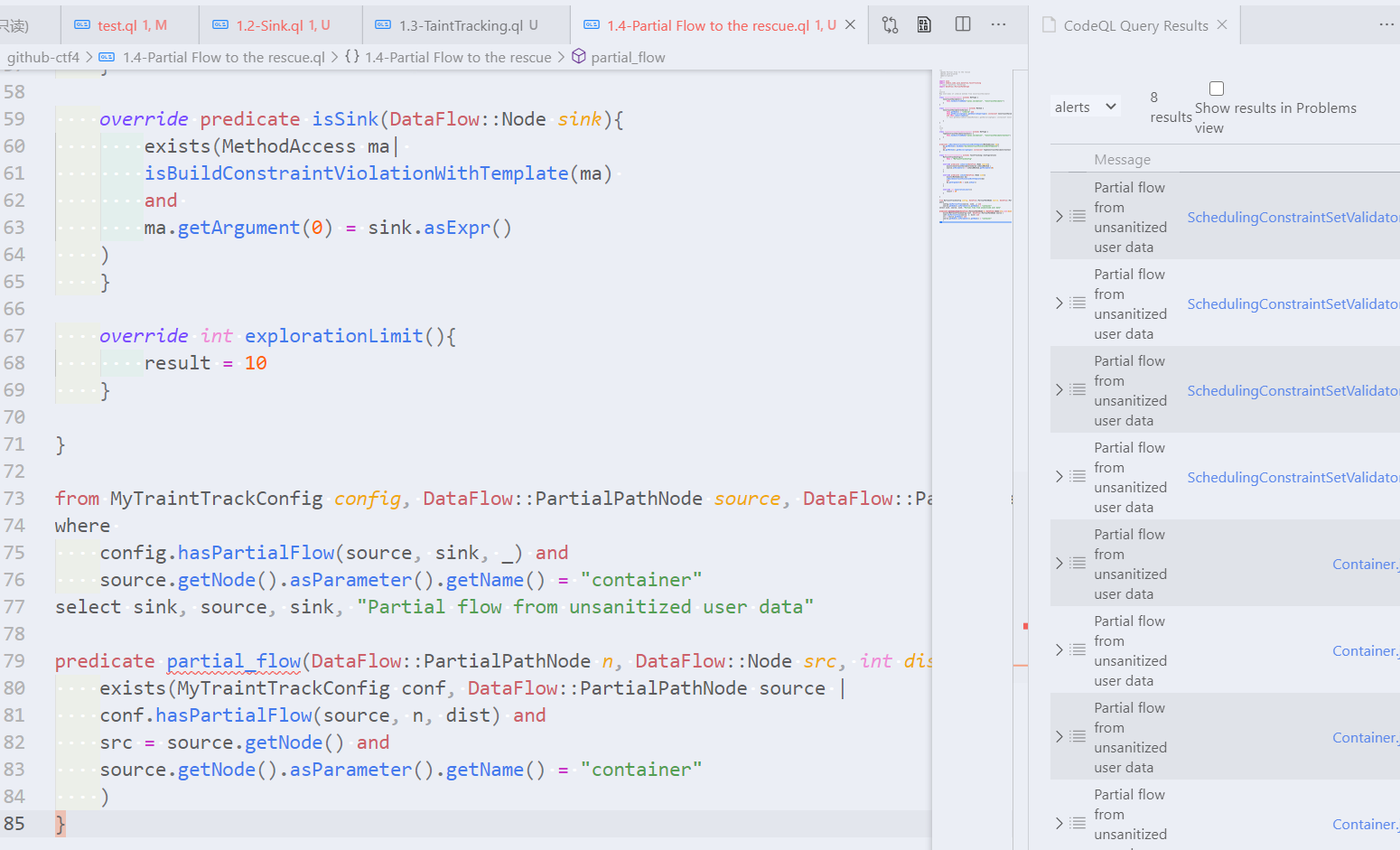
在76行和83行都是source.getNode().asParameter().getName() = "container",在题目开头描述了container很可能是不安全的。这里也可以这么写source.getNode().getLocation().getFile().getBaseName() = "SchedulingConstraintValidator.java"对source文件来限制。
/**
 *@name Partial Flow to the rescue
 *@kind path-problem
 *@derscription
 */

import java
import semmle.code.java.dataflow.TaintTracking
// import DataFlow::PathGraph
import DataFlow::PartialPathGraph

/*
source
Map overrides of isValid method from ConstraintValidator
*/
class ConstraintValidator extends RefType {
	ConstraintValidator() {
		this.hasQualifiedName("javax.validation", "ConstraintValidator")
	}
}

class ConstraintValidatorIsValid extends Method {
	ConstraintValidatorIsValid() {
		this.getName() = "isValid" and
		this.getDeclaringType().getASourceSupertype() instanceof ConstraintValidator
        and this.isOverridable()
        // this.getASourceOverriddenMethod().getDeclaringType() instanceof ConstraintValidator

	}
}

/*
sink
 */
class TypeConstraintValidatorContext extends RefType {
    TypeConstraintValidatorContext() {
        this.hasQualifiedName("javax.validation", "ConstraintValidatorContext")
    }
}


predicate isBuildConstraintViolationWithTemplate(MethodAccess ma){
    ma.getMethod().hasName("buildConstraintViolationWithTemplate")
    and
    ma.getMethod().getDeclaringType() instanceof TypeConstraintValidatorContext
}

class MyTraintTrackConfig extends TaintTracking::Configuration{
    MyTraintTrackConfig(){
        this = "MyTraintTrackConfig"
    }

    override predicate isSource(DataFlow::Node source){
        exists(ConstraintValidatorIsValid isValidMethod |
		source.asParameter() = isValidMethod.getParameter(0)
	)
    }

    override predicate isSink(DataFlow::Node sink){
        exists(MethodAccess ma|
        isBuildConstraintViolationWithTemplate(ma)
        and
        ma.getArgument(0) = sink.asExpr()
    )
    }

    override int explorationLimit(){
        result = 10
    }

}

from MyTraintTrackConfig config, DataFlow::PartialPathNode source, DataFlow::PartialPathNode sink
where
    config.hasPartialFlow(source, sink, _) and
    source.getNode().asParameter().getName() = "container"
select sink, source, sink, "Partial flow from unsanitized user data"

predicate partial_flow(DataFlow::PartialPathNode n, DataFlow::Node src, int dist) {
    exists(MyTraintTrackConfig conf, DataFlow::PartialPathNode source |
    conf.hasPartialFlow(source, n, dist) and
    src = source.getNode() and
    source.getNode().asParameter().getName() = "container"
    )
}
1.5 Identifying a missing taint step
You must have found that CodeQL does not propagate taint through getters like container.getHardConstraints and container.getSoftConstraints. Can you guess why this default behaviour was implemented?
你一定发现,CodeQL不会通过getters传播污点,比如
container.getHardConstraints和container.getSoftConstraints。你能猜到为什么要实施这种默认行为吗?
答案:
默认步骤是小心翼翼地避免假阳性,特别是对于生产级别的查询。追踪漏洞可以让我们看到流程在哪里停止了。猜测是,getters/setters方法经常会覆盖有污点的数据,而让它不受约束也可能会返回非常多的结果。当一个写得不好的查询消耗会所有的内存时,分析部分流量时,需要限制来源的数量。
例如:
public class SomeThingObject {
    private String tainted;
    private int something;

    public SomeThingObject(String tainted, int something) {
        this.tainted = tainted;
        this.something = something;
    }

    public String getTainted() {
        return tainted;
    }

    public String getSomething() {
        return something;
    }
}

SomeThingObject stb = new SomeThingObject("tainted", 123);
int notTainted = someObject.getSomething()
dangerousSink(notTainted);
如果我们认为字符串 “tainted “是一个危险的用户输入,那么stb实例也会被污染。正因为如此,假设该实例上的每个getter都会返回一个有污点的值,就会导致dangerousSink调用中出现假阳性。这可能就是为什么CodeQL默认情况下不会将污点传播给有污点的对象实例上的getter。
1.6 Adding additional taint steps
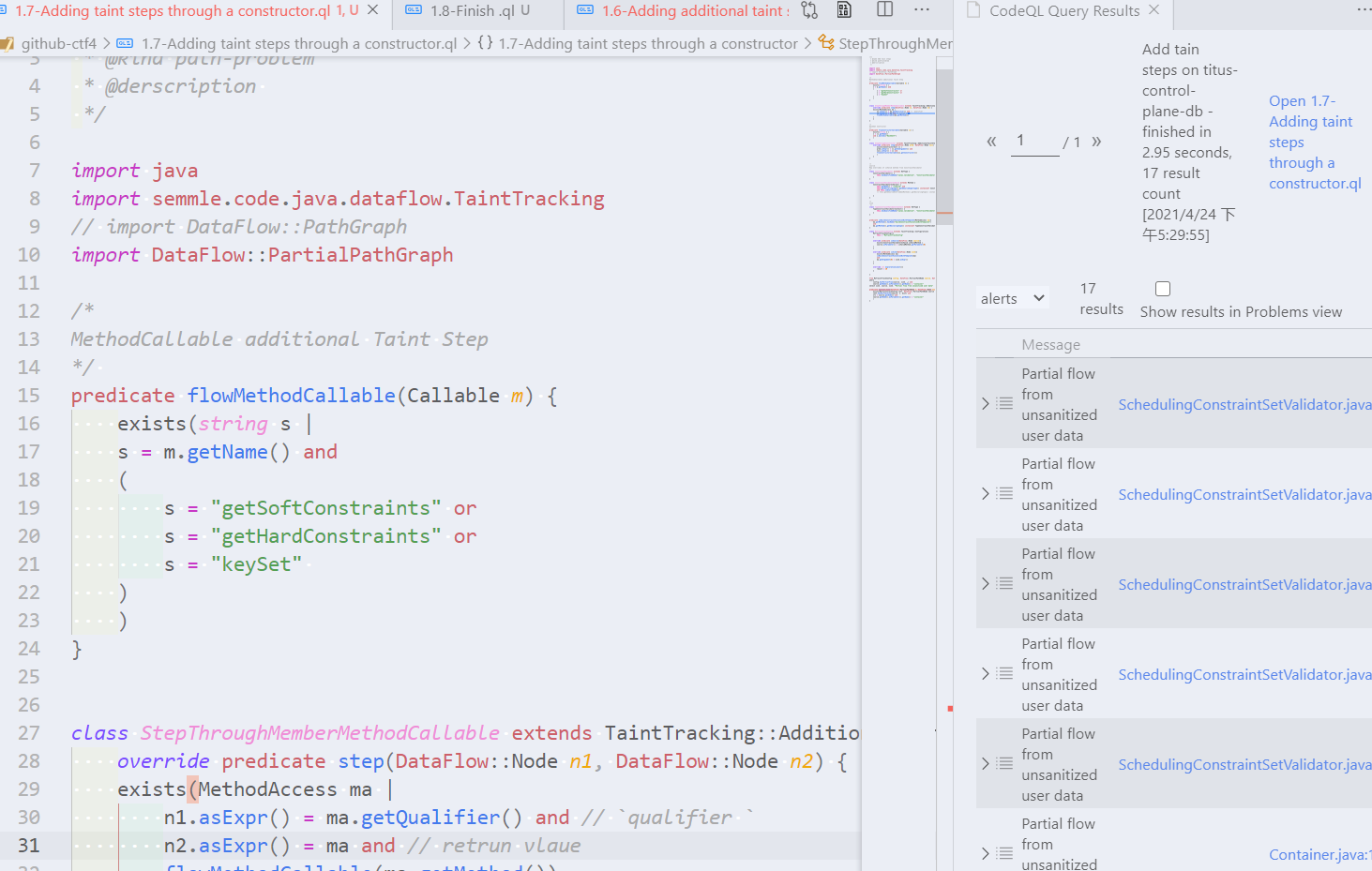
分析1.4的结果,可以发现在停止getSoftConstraints和getHardConstraints被进一步track。
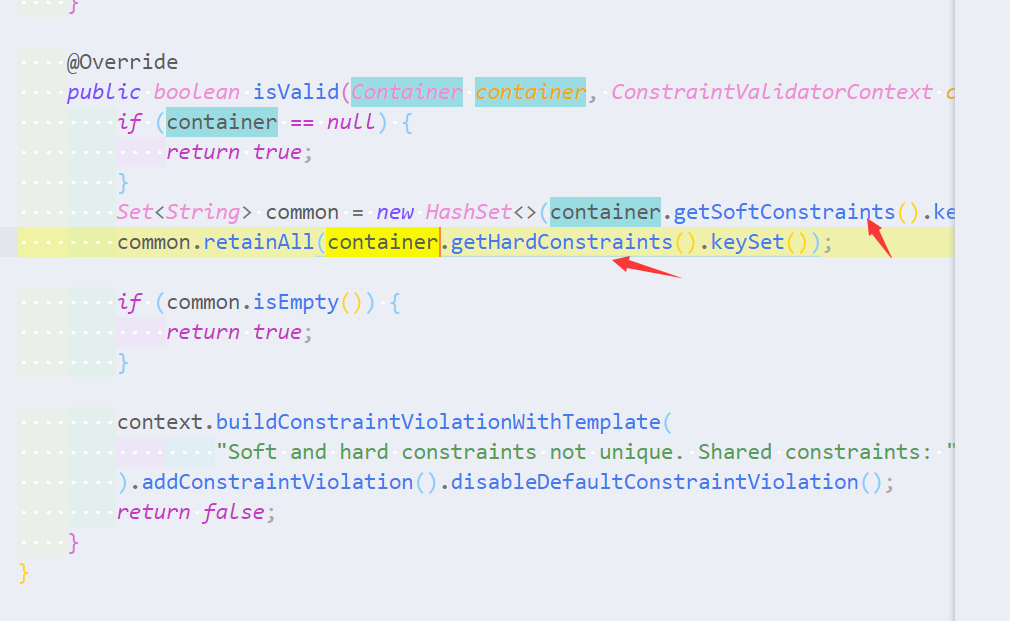
CodeQL允许在在TaintTracking::Configuration中声明额外的污点步骤,也就是谓词isAdditionalTaintStep。
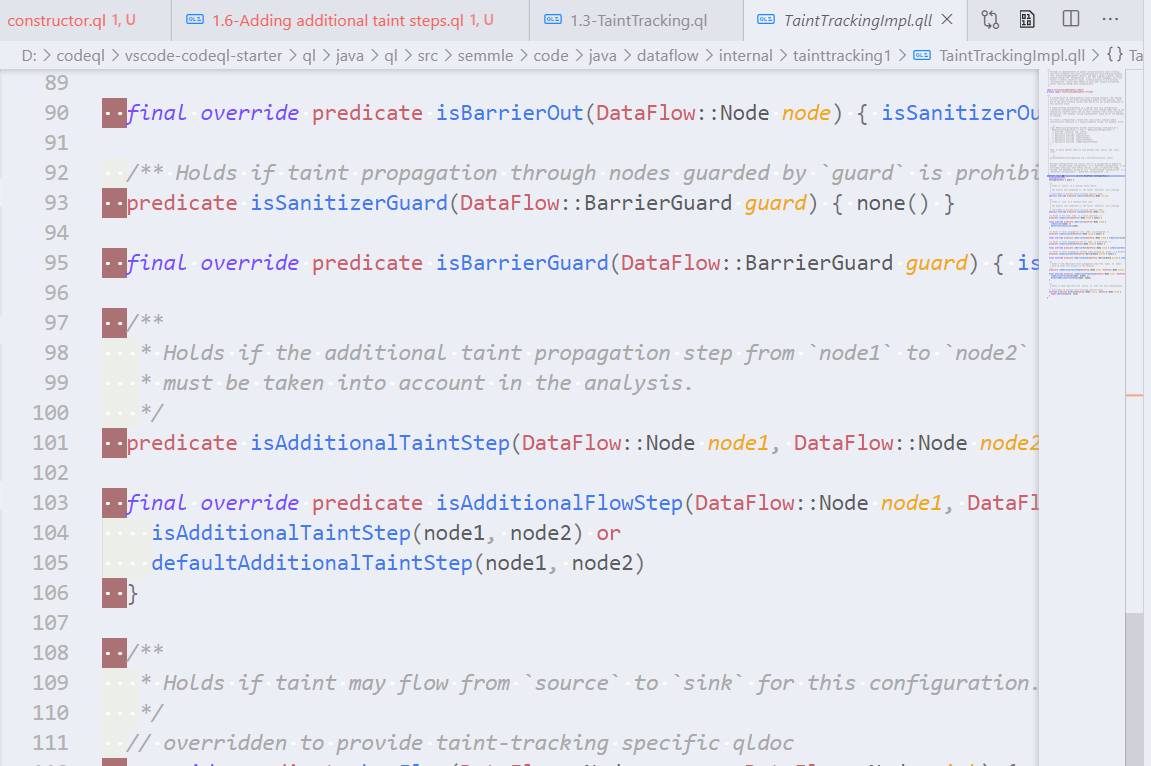
但这里官方推荐另一种更通用的方法,使用TaintTracking::AdditionalTaintStep类。
class MyAdditionalTaintStep extends TaintTracking::AdditionalTaintStep {
  override predicate step(DataFlow::Node pred, DataFlow::Node succ) {// pred 先前 Previously  succ 先后 Successively
    exists( | | )
  }
}
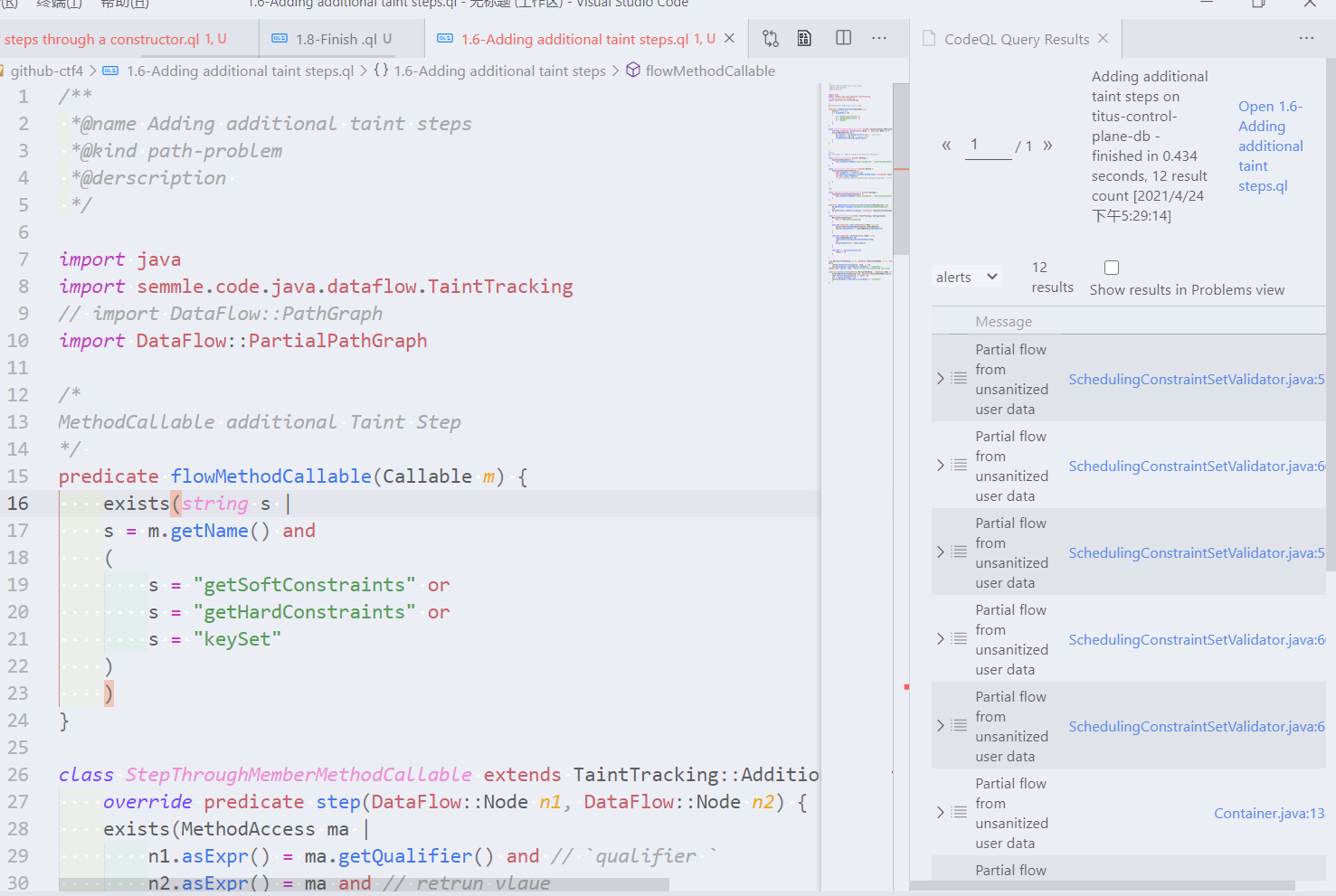
根据提示:在步骤谓词中,你应该指出这2个nodes是MethodAccess的2个元素:一个是它的qualifier ,一个是在调用发现的返回值。利用模板进行进一步track
predicate flowMethodCallable(Callable m) {
    exists(string s |
    s = m.getName() and
    (
        s = "getSoftConstraints" or
        s = "getHardConstraints" or
        s = "keySet"
    )
    )
}

class StepThroughMemberMethodCallable extends TaintTracking::AdditionalTaintStep {
    override predicate step(DataFlow::Node n1, DataFlow::Node n2) {
    exists(MethodAccess ma |
        n1.asExpr() = ma.getQualifier() and // `qualifier `
        n2.asExpr() = ma and // retrun vlaue
        flowMethodCallable(ma.getMethod())
    )
    }
}
1.7 Adding taint steps through a constructor
要求为HashSet构造函数加AdditionalTaintStep
/*
HashSet Contructor
*/
predicate flowContructorCallable(Callable cc) {
    exists(string s |
    s = cc.getName()
    and s.matches("HashSet%")
    )
}

class StepThroughConstructor extends TaintTracking::AdditionalTaintStep {
    override predicate step(DataFlow::Node pred, DataFlow::Node succ) {
        exists(ConstructorCall cc |
        pred.asExpr() = cc.getAnArgument() and
        succ.asExpr() = cc and
        flowContructorCallable(cc.getConstructor())
        )
    }
}
1.8 Finish
最终的QL结果:
/**
 * @name finis the ql
 * @kind path-problem
 * @derscription
 */

import java
import semmle.code.java.dataflow.TaintTracking
import DataFlow::PathGraph
// import DataFlow::PartialPathGraph

/*
MethodCallable additional Taint Step
*/
predicate flowMethodCallable(Callable m) {
    exists(string s |
    s = m.getName() and
    (
        s = "getSoftConstraints" or
        s = "getHardConstraints" or
        s = "keySet"
    )
    )
}


class StepThroughMemberMethodCallable extends TaintTracking::AdditionalTaintStep {
    override predicate step(DataFlow::Node n1, DataFlow::Node n2) {
    exists(MethodAccess ma |
        n1.asExpr() = ma.getQualifier() and // `qualifier `
        n2.asExpr() = ma and // retrun vlaue
        flowMethodCallable(ma.getMethod())
    )
    }
}

/*
HashSet Contructor
*/
predicate flowContructorCallable(Callable cc) {
    exists(string s |
    s = cc.getName()
    and s.matches("HashSet%")
    )
}

class StepThroughConstructor extends TaintTracking::AdditionalTaintStep {
    override predicate step(DataFlow::Node pred, DataFlow::Node succ) {
        exists(ConstructorCall cc |
        pred.asExpr() = cc.getAnArgument() and
        succ.asExpr() = cc and
        flowContructorCallable(cc.getConstructor())
        )
    }
}


/*
source
Map overrides of isValid method from ConstraintValidator
*/
class ConstraintValidator extends RefType {
	ConstraintValidator() {
		this.hasQualifiedName("javax.validation", "ConstraintValidator")
	}
}

class ConstraintValidatorIsValid extends Method {
	ConstraintValidatorIsValid() {
		this.getName() = "isValid" and
		this.getDeclaringType().getASourceSupertype() instanceof ConstraintValidator
        and this.isOverridable()
        // this.getASourceOverriddenMethod().getDeclaringType() instanceof ConstraintValidator

	}
}

/*
sink
 */
class TypeConstraintValidatorContext extends RefType {
    TypeConstraintValidatorContext() {
        this.hasQualifiedName("javax.validation", "ConstraintValidatorContext")
    }
}


predicate isBuildConstraintViolationWithTemplate(MethodAccess ma){
    ma.getMethod().hasName("buildConstraintViolationWithTemplate")
    and
    ma.getMethod().getDeclaringType() instanceof TypeConstraintValidatorContext
}

class MyTraintTrackConfig extends TaintTracking::Configuration{
    MyTraintTrackConfig(){
        this = "MyTraintTrackConfig"
    }

    override predicate isSource(DataFlow::Node source){
        exists(ConstraintValidatorIsValid isValidMethod |
		source.asParameter() = isValidMethod.getParameter(0)
	)
    }

    override predicate isSink(DataFlow::Node sink){
        exists(MethodAccess ma|
        isBuildConstraintViolationWithTemplate(ma)
        and
        ma.getArgument(0) = sink.asExpr()
    )
    }

    override int explorationLimit(){
        result = 10
    }

}

from MyTraintTrackConfig config, DataFlow::PathNode source, DataFlow::PathNode sink
where
    config.hasFlowPath(source, sink)
select sink, source, sink, "Custom constraint error message contains unsanitized user data"
参考
https://github.com/atorralba/GHSL_CTF_4
https://securitylab.github.com/ctf/codeql-and-chill/
https://github.com/github/securitylab/discussions/141
https://xz.aliyun.com/t/7979#toc-6