

惯性聚合 高效追踪和阅读你感兴趣的博客、新闻、科技资讯
阅读原文 在惯性聚合中打开

推荐订阅源

WordPress大学
WordPress大学
GbyAI
GbyAI
P
Proofpoint News Feed
B
Blog
MyScale Blog
MyScale Blog
V
V2EX
B
Blog RSS Feed
Microsoft Security Blog
量子位
Jina AI
Jina AI
博客园 - 叶小钗
Recent Announcements
有赞技术团队
有赞技术团队
罗磊的独立博客
L
LangChain Blog
I
InfoQ
云风的 BLOG
云风的 BLOG
freeCodeCamp Programming Tutorials: Python, JavaScript, Git & More
人人都是产品经理
人人都是产品经理
小众软件
小众软件
V
Visual Studio Blog
月光博客
月光博客
The Cloudflare Blog
雷峰网
雷峰网

Nautilus

Can the Sugar Molecules That Coat Our Cells Predict Our Health? These Ancient Baby Predators Challenge Our Understanding of Evolution This “Roasted Exoplanet” Has a Wild Orbit Today Was the Day Galileo Caved See the Southern Lights from Space in New ISS Video Qatari Sand Cats Caught on Camera for the First Time How to Protect Earth Against Violent Space Weather In the Midst of Tornado Season, a Surprisingly Short History of Predicting Twisters Can “Dante’s Inferno” Tell Us Something About Space Rocks? How to Dodge a Mountain Lion The Inventor of the Thinking Machine Didn’t Worry. Neither Should You Science Is Political—and Spiritual Take a Gander at an Ancient Supernova in the Heart of the Milky Way The Model for Botticelli’s Venus Died at 23 The Birth-Control Pill May Encourage Binge Eating This Shark Can Walk on Land Aliens Probably Have Consciousness If You’re Counting on Calcium and Vitamin D Supplements to Prevent Fractures, Think Again Saving a Tiny Endangered Porpoise One Pixel at a Time This Cosmonaut Was the First Woman in Space Does This Protein Hold the Key to Differences in Aging Between Males and Females? The Nautilus Reading List of Books on Evolution Does Cooperation Beat Cheating After All? Is This the King of GLP-1s? What Is a Trillion, Really? Bad Third-Grade Behavior Could be a Preview of Educational Failure These Ancient Millipedes Paved the Way for Terrestrial Life ISS Astronaut Shares Incredible Photos of Volcanoes Taken From Space The Ancient Roots of Modern Winemaking How to Feel at Home in the Modern World
Goblin Sharks Caught on Camera in Their Natural Habitat f...
Jake Currie · 2026-06-13 · via Nautilus

Goblin sharks are far from nature’s cuddliest creations. With their long snouts, sharp, thorn-like teeth, and protruding jaws they’re downright ugly. These living fossils have been lurking in the depths for around 120 million years, but unfortunately, most of our knowledge about them comes from accidental catches by fishing trawlers.

Living goblin sharks have been observed, but only briefly. These specimens were brought to the surface and watched in shallow waters for short periods of time until they perished. While these unlucky goblin sharks yielded valuable information about how they capture prey in their gnarly jaws, researchers haven’t been able to see them in their native habitat, thousands of feet beneath the ocean—until now.
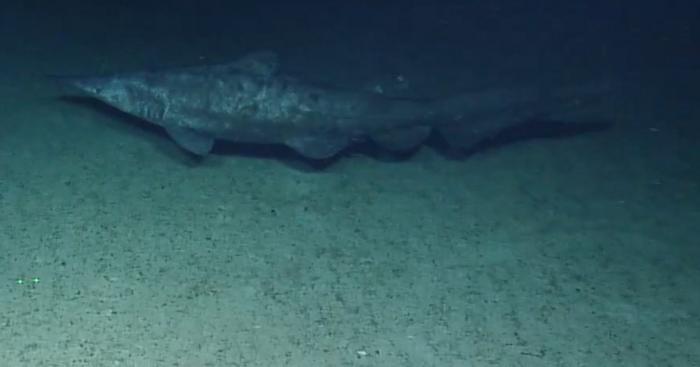
SHARK!: This still from a video shows a goblin shark. Known for their unusual facial features, this one is pictured swimming near Jarvis Island in 2019. Still by Ocean Exploration Trust, Nautilus Live.

Goblin sharks were recently caught on camera in their natural environment for the first time, and the observations were detailed in a new paper published in the Journal of Fish Biology. “Seeing the most iconic of all the deep-sea sharks alive and looking healthy in its natural habitat is a unique honor,” study author Aaron Judah of the University of Hawai’i at Mānoa said in a statement.

Read more: “The Evolutionary Wonders in the Deep Sea

The researchers caught glimpses of the enigmatic sharks in two video recordings, both captured by deep-sea submersibles exploring the depths of the Pacific Ocean between Australia and Hawaii. The first was a male recorded in 2019 near an unnamed seamount near Jarvis Island. Its location came as something of a surprise. “I was shocked to hear this because this species was not to be known to be in the Central Pacific,” said Judah.

SLOW SWIM: This video shows a Goblin shark swimming near Jarvis Island in 2019. Video by Ocean Exploration Trust, Nautilus Live.

The second shark, believed to be a female, was recorded in 2024 on the slope of the Tonga Trench, located southeast of Fiji. This observation extended the known depth range for the goblin shark by nearly 2,300 feet. In fact, it’s the deepest any species of the goblin shark’s order, lamniformes (the mackerel sharks), have been known to dive. “The goblin shark is one of these deep-sea charismatic animals that I never thought we’d see alive, and then to do so was amazing,” study author Alan Jamieson of University of Western Australia said.

Who knows what else is lurking out in the depths?

Enjoying Nautilus? Subscribe to our free newsletter.

Lead image: Minderoo-University of Western Australia Deep-Sea Research Center and Inkfish