


惯性聚合 高效追踪和阅读你感兴趣的博客、新闻、科技资讯
阅读原文 在惯性聚合中打开

推荐订阅源

S
Schneier on Security
Exploit-DB.com RSS Feed
Know Your Adversary
Know Your Adversary
G
GRAHAM CLULEY
V
Vulnerabilities – Threatpost
P
Palo Alto Networks Blog
Security Latest
Security Latest
P
Privacy & Cybersecurity Law Blog
Simon Willison's Weblog
A
Arctic Wolf
T
Tor Project blog
T
Threatpost
NISL@THU
NISL@THU
I
InfoQ
H
Hackread – Cybersecurity News, Data Breaches, AI and More
Apple Machine Learning Research
cs.CV updates on arXiv.org
aimingoo的专栏
aimingoo的专栏
Microsoft Azure Blog
WordPress大学
WordPress大学
K
Kaspersky official blog
W
WeLiveSecurity
L
LINUX DO - 热门话题
小众软件
小众软件
Recorded Future
Recorded Future
B
Blog RSS Feed
H
Help Net Security
奇客Solidot–传递最新科技情报
奇客Solidot–传递最新科技情报
IT之家
IT之家
L
Lohrmann on Cybersecurity
Last Week in AI
Last Week in AI
Stack Overflow Blog
Stack Overflow Blog
Cyber Security Advisories - MS-ISAC
阮一峰的网络日志
阮一峰的网络日志
V
Visual Studio Blog
Blog — PlanetScale
Blog — PlanetScale
雷峰网
雷峰网
爱范儿
爱范儿
C
CXSECURITY Database RSS Feed - CXSecurity.com
T
Threat Research - Cisco Blogs
C
Cyber Attacks, Cyber Crime and Cyber Security
H
Hacker News: Front Page
博客园 - 三生石上(FineUI控件)
N
Netflix TechBlog - Medium
P
Proofpoint News Feed
有赞技术团队
有赞技术团队
N
News and Events Feed by Topic
云风的 BLOG
云风的 BLOG
Scott Helme
Scott Helme
V2EX - 技术
V2EX - 技术

GitLab

Modernize Java with Cursor and GitLab Automate work item assignment with GitLab Duo GitLab Transcend Hackathon: What developers built on GitLab Orbit Turn multi-step software delivery into agentic flows you can trust GitLab Duo Security Review spots logic flaws scanners miss Bring GitLab Duo Agent Platform to your terminal Forrester Consulting: GitLab Duo Agent Platform delivers 400% ROI GitLab 19.2 release notes | GitLab Docs When a version bump breaks your build, GitLab fixes it Green DevOps: Why carbon measurement belongs in your CI/CD pipeline GitLab Patch Release: 19.1.2, 19.0.4, 18.11.7 How we used AI agents to migrate GitLab rate limiting Keep your GitLab seats in check with restricted access GitLab Patch Release: 18.8.11 | GitLab Docs Claude Sonnet 5 on GitLab: More reliable, more efficient What Google Antigravity agents get full context with GitLab Orbit GitLab Patch Release: 19.1.1, 19.0.3, 18.11.6 GitLab 19.1 release notes | GitLab Docs AI Catalog updates for governance and operations One vulnerability view: From scanner coverage to AI governance GitLab named a Leader in the 2026 Gartner® Magic Quadrant™ for DevSecOps Platforms GitLab and Capgemini accelerate DevSecOps transformation Introducing the 2026 EMEA GitLab Partner Award winners GitLab Patch Release: 19.0.2, 18.11.5, 18.10.8 Introducing GitLab Orbit GitLab: Built for the agentic engineering era GitLab on Google Cloud: Fully managed, compliant, and AI-ready Shai-Hulud copycat campaign targets Python developers through PyPI typosquatting Mythos-class Claude Fable 5 arrives on GitLab Duo Agent Platform GitLab Patch Release: 19.0.1, 18.11.4, 18.10.7 Claude Opus 4.8 on GitLab: Complex agentic work, less disruption Agentic coding is only as good as its context GitLab Patch Release: 18.9.8, 18.8.10, 18.7.7, 18.6.8, 18.5.7 Full security scanner coverage of your codebase in minutes Reduce supply chain risk with SBOM-based dependency scanning Transform MRs from manual tasks to an automated workflow Track CI component usage across your organization Manage CI/CD credentials with GitLab Secrets Manager More AI models for GitLab Duo Agent Platform Self-Hosted GitLab 19.0 | GitLab Docs GitLab Dedicated for Government now GovRAMP-authorized Beyond BYOK: Why governance matters for AI agents Fix bugs with Codex and GitLab 5 ways to fix misleading vulnerability severities with policy Harden your pipeline perimeter for the era of AI-assisted coding GitLab Patch Release: 18.11.3, 18.10.6, 18.9.7 GitLab Act 2 Consolidate your GitLab stack with Gitaly on Kubernetes Limit token exposure with fine-grained PATs Automate deployment processes with GitLab Duo Agent Platform Claude Code and GitLab: Three workflows that ship 8 Agentic AI patterns reshaping team collaboration How to detect and prevent Contagious Interview IDE attacks Atlassian will train on your data: Opt out with GitLab Automate detection testing with GitLab CI/CD and Duo
GitLab Flex: Commit once, reshape your seats and AI spend
Talia Armato-Helle · 2026-06-10 · via GitLab

The agentic era made your needs harder to predict, and the way you buy software hasn't caught up. Six months out, you don't know how many seats you'll need, how much AI your teams will consume, or which new capabilities you'll want to turn on. Yet the contract you sign today fixes all three up front and won't budge until renewal. GitLab Flex was built to solve this predicament. It's one annual commitment you can reshape month to month across seats, AI usage, and new capabilities, without re-procurement.

Fixed contracts, moving needs

The shift to agentic software engineering introduced uncertainty on three fronts at once:

  • How many seats. The agentic era is changing who builds. Some companies are adding people who never worked in GitLab before so they can build directly on the platform, and want to grow seats. Others are reshaping their org structure and contractor mix around agents, which can push seat needs up or down. Your seat count six months out moves in both directions, and an annual contract locks you in with a single guess.
  • How much AI usage. Agent usage grows on its own curve of use cases, enablement, and technology advancements.
  • Which capabilities. New agentic infrastructure capabilities ship constantly. You can't know at signing which ones you'll want to adopt mid-year.

A traditional contract asks you to lock all three in advance and live with the guess until renewal. Guess high and you overpay for idle seats and capacity you never use. Guess low and adopting anything new means re-opening procurement cycles that stall the team right when it has momentum. Either way, the contract is fixed while your needs keep moving.

Annual budgets adapted monthly

GitLab Flex is one annual dollar commitment against a published rate card. From that single commitment you draw down platform seats, GitLab Credits, and eligible usage-based capabilities — across GitLab.com multi-tenant SaaS, Self-Managed (including air-gapped), and GitLab Dedicated single-tenant SaaS. The point is that the commitment flexes on exactly the three things you can't predict.

Adjust seats without waiting for renewal. When a team wraps a project and rolls off, you don't keep paying for idle seats until the contract comes up again. You can reallocate next month's reservations toward another team's seats, or toward AI usage inside the existing agreement.

Scale AI usage with predictable economics. Consumption draws from your annual commitment at the published rate. Usage above the full commitment bills on-demand at $1 per credit, so a busy month doesn't turn into a surprise. Larger commitments unlock better unit pricing, and reserved capacity costs less than unplanned usage.

Add new capabilities without new procurement. Eligible capabilities released after you sign land on the same rate card. When you want to turn one on, you draw it from the commitment you already have without the added steps of re-procurement.

If you've used consumption pricing elsewhere — cloud credits, observability credits — the drawdown will feel familiar. Here's what's different: With Flex, your seats and your usage live under the same commitment, so you can move budget between them. Most models keep seat licenses and usage credits in separate buckets you can't rebalance without going back to the table.
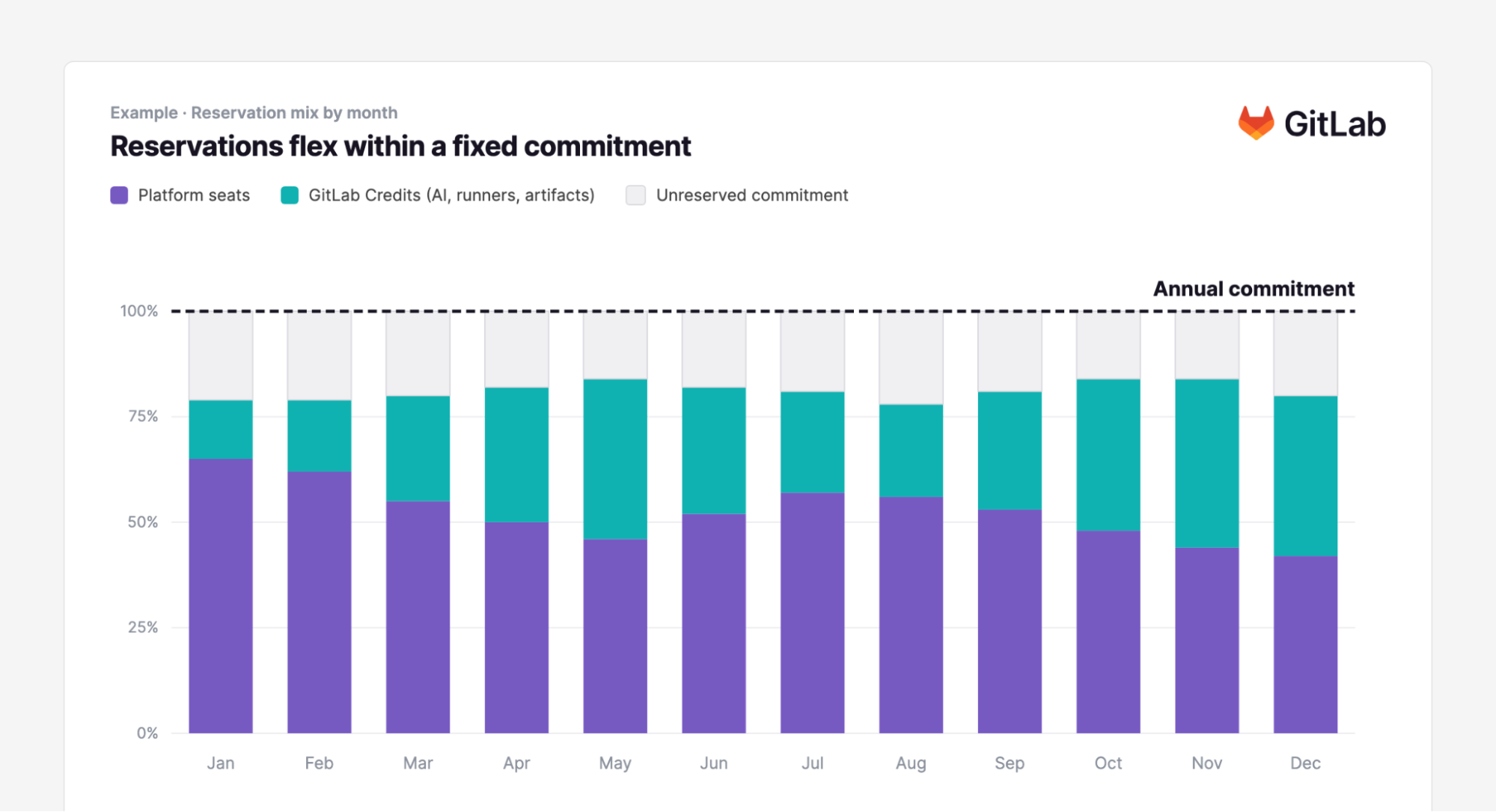
Stacked bar chart showing 12 months of GitLab Flex reservations. Platform seats and GitLab Credits shift proportions month to month within a fixed annual commitment, with an unreserved buffer that varies by month.One annual commitment. Monthly reservations across seats and usage-based GitLab Credits. Reshape spend as needs shift. No amendment required.

One agreement, any mix

A single Flex agreement can combine any of the following, all drawing from the same annual commitment:
  • Platform seats. GitLab Premium and Ultimate at published rates, with volume discounts tied to your commitment level. (The Flex volume discount is the starting point for seat discounts, automatically applied based on total commitment size. Seat discounting can go above the Flex discount level with additional approvals.)
  • GitLab Credits. Credit-metered capabilities like GitLab Duo Agent Platform, hosted runners, and artifact management, each at a published credit rate.
  • Every deployment type. GitLab.com, Self-Managed, Dedicated, and air-gapped, all under one agreement — so your mix can shift over the term without restructuring.

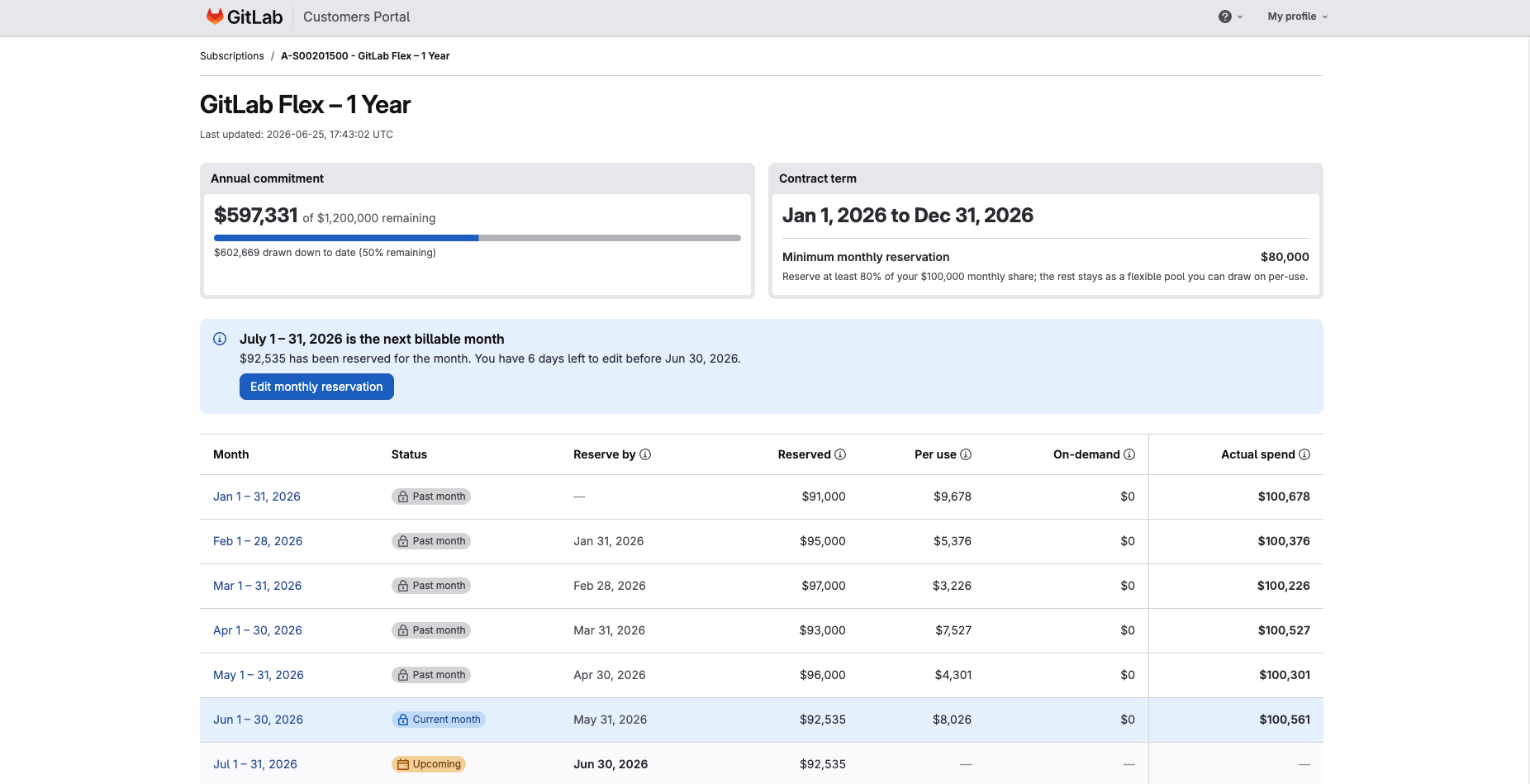
Image example of what a customer portal may look like with GitLab Flex reservations. Annual Commitment, Contract Term, and Monthly adjustment table shown to illustrate how the product will work. Actual layout and experience is subject to change.Adjust monthly reservations across seats and usage-based GitLab Credits. Reshape spend as needs shift. No amendment required. (The image above is illustrative of the product in a customer portal, actual layout and experience subject to change.)

Volume economics with spend controls

  • Larger annual commitments unlock better unit pricing across the rate card, and reserved capacity costs less than unplanned usage.
  • Subscription-level and per-user caps help your team stick to budgets along with admin controls at the project-group level.
  • Unreserved seats draw at the effective price, the same pre-negotiated rate as reserved seats.
  • Usage above the full Flex commitment bills at on-demand rates at $1 per credit or your negotiated per-seat price.
  • Cloud-connected customers are billed automatically; air-gapped customers are invoiced twice a year.

Keep your current plan through renewal

GitLab Premium and GitLab Ultimate remain available at direct seat pricing. Flex is the recommended structure for new agreements, but existing customers can continue on their current contract through renewal. With Flex, tier capabilities do not change: GitLab Premium and Ultimate features remain.

If you are approaching renewal and want to evaluate Flex, your account team can model both options against your current capabilities and AI usage so you can compare before committing.

Start with a model built for what comes next

The shift to agentic software engineering is not only a product shift. It is a budgeting and planning shift. GitLab Flex gives organizations one agreement for platform and AI spend, plus a clearer operating model for managing both and a structure built to keep pace as needs change.

Customers can request orders with GitLab Flex now, with fulfillment rolling out throughout the quarter.

Request GitLab Flex

To explore the full set of platform innovations announced at Transcend, including GitLab Orbit, Agentic Git, and AI Governance, visit our What's New portal.