


惯性聚合 高效追踪和阅读你感兴趣的博客、新闻、科技资讯
阅读原文 在惯性聚合中打开

推荐订阅源

C
Check Point Blog
Recent Commits to openclaw:main
T
The Exploit Database - CXSecurity.com
I
Intezer
P
Privacy & Cybersecurity Law Blog
C
CERT Recently Published Vulnerability Notes
T
Tor Project blog
K
Kaspersky official blog
AWS News Blog
AWS News Blog
Schneier on Security
雷峰网
雷峰网
www.infosecurity-magazine.com
宝玉的分享
宝玉的分享
G
Google Developers Blog
OSCHINA 社区最新新闻
OSCHINA 社区最新新闻
Cyber Security Advisories - MS-ISAC
Forbes - Security
Forbes - Security
T
The Blog of Author Tim Ferriss
S
Security @ Cisco Blogs
NISL@THU
NISL@THU
N
News and Events Feed by Topic
CTFtime.org: upcoming CTF events
爱范儿
爱范儿
GbyAI
GbyAI
奇客Solidot–传递最新科技情报
奇客Solidot–传递最新科技情报
Google Online Security Blog
Blog — PlanetScale
Blog — PlanetScale
Help Net Security
Help Net Security
F
Full Disclosure
V
Vulnerabilities – Threatpost
cs.AI updates on arXiv.org
A
Arctic Wolf
D
Docker
T
Tailwind CSS Blog
L
LangChain Blog
The Last Watchdog
The Last Watchdog
美团技术团队
博客园 - Franky
H
Hacker News: Front Page
Stack Overflow Blog
Stack Overflow Blog
W
WeLiveSecurity
Exploit-DB.com RSS Feed
Recorded Future
Recorded Future
V
Visual Studio Blog
N
Netflix TechBlog - Medium
Hacker News: Ask HN
Hacker News: Ask HN
博客园 - 司徒正美
Cyberwarzone
Cyberwarzone
S
Schneier on Security
Know Your Adversary
Know Your Adversary

Deno

Deno 2.8 | Deno Claw Patrol: an open-source security firewall for agents | Deno Fresh 2.3: Zero JS by default, View Transitions, and Temporal support | Deno Deno 2.7: Temporal API, Windows ARM, and npm overrides | Deno Build a dinosaur runner game with Deno, pt. 6 | Deno Build a dinosaur runner game with Deno, pt. 5 | Deno Introducing Deno Sandbox | Deno Build a dinosaur runner game with Deno, pt. 4 | Deno Build a dinosaur runner game with Deno, pt. 3 | Deno Build a dinosaur runner game with Deno, pt. 2 | Deno React / Next.js Denial-of-Service Vulnerability: Deno Deploy users protected | Deno Deno 2.6: dx is the new npx | Deno Build a dinosaur runner game with Deno, pt. 1 | Deno React Server Functions / Next.js Vulnerability: Deno Deploy users protected | Deno My highlights from the new Deno Deploy | Deno Deno's Other Open Source Projects | Deno How Deno protects against npm exploits | Deno Help Us Raise $200k to Free JavaScript from Oracle | Deno Deno 2.5: Permissions in the config file | Deno Fresh 2.0 Graduates to Beta, Adds Vite Support | Deno Deno 2.4: deno bundle is back | Deno JavaScript™ Trademark Update | Deno What's coming to JavaScript | Deno A brief history of JavaScript | Deno Reports of Deno's Demise Have Been Greatly Exaggerated | Deno An Update on Fresh | Deno How Plaid migrated 100 services to a new database platform 5x faster with Deno | Deno Deno 2.3: Improved deno compile, local npm packages, and more | Deno Add JSR packages with pnpm and Yarn | Deno Zero-config Debugging with Deno and OpenTelemetry | Deno Exploring Art with TypeScript, Jupyter, Polars, and Observable Plot | Deno Deno v Oracle Update 3: Fighting the JavaScript Trademark | Deno Build a custom RAG AI agent in TypeScript and Jupyter | Deno How to get deep traces in your Node.js backend with OTel and Deno | Deno toranoana.deno #20 登録受付中(2025年3月14日) | Deno Node just added TypeScript support. What does that mean for Deno? | Deno The Dino 🦕, the Llama 🦙, and the Whale 🐋 | Deno Publish a lint rule, get a prize | Deno Deno 2.2: OpenTelemetry, Lint Plugins, node:sqlite | Deno If you're not using npm specifiers, you're doing it wrong | Deno How Deno's documentation is evolving | Deno Oracle justified its JavaScript trademark with Node.js—now it wants that ignored | Deno Introducing the JSR open governance board | Deno Intro to Wasm in Deno | Deno Announcing OpenAI on JSR | Deno Deno in 2024 | Deno Goodbye WinterCG, welcome WinterTC | Deno Build a SolidJS app with Deno | Deno Run your Next.js SSR app on Deno Deploy | Deno Solve Advent of Code 2024 with Deno and Win Prizes! | Deno Deno v. Oracle: Canceling the JavaScript Trademark | Deno Deno 2.1: Wasm Imports and other enhancements | Deno Build a Typesafe API with tRPC and Deno | Deno Self-contained Executable Programs with Deno Compile | Deno Build a Database App with Drizzle ORM and Deno | Deno Introducing your new JavaScript package manager: Deno | Deno Announcing Growthbook on JSR | Deno Build an Astro site with Deno | Deno How to convert CommonJS to ESM | Deno Announcing Deno 2 | Deno The Final Touches: What’s New In v2.0.0-rc.10 | Deno Announcing Stable V8 Bindings for Rust | Deno Deno 2.0 Release Candidate | Deno Secure, efficient private npm registries with Cloudsmith and Deno | Deno Painting the Plane as We Fly It: Designing JSR | Deno Introducing Web Cache API support on Deno Deploy | Deno Deno 1.46: The Last 1.x Release | Deno Protect your cloud spend with new Deno Deploy spend limits | Deno What we got wrong about HTTP imports | Deno Benchmarking AWS Lambda Cold Starts Across JavaScript Runtimes | Deno Announcing Supabase on JSR | Deno Deno 1.45: Workspace and Monorepo Support | Deno Introducing KV Backup for Deno Subhosting | Deno A Gentle Intro to TypeScript | Deno Announcing Hono on JSR | Deno How We Made the Deno Language Server Ten Times Faster | Deno How the Guardian uses Deno to audit accessibility and performance across their 2.7 million articles | Deno Introducing More Flexible Domain Association for Deno Subhosting | Deno The stabilization process of the Standard Library has begun | Deno Deno 1.44: Private npm registries, improved Node.js compat, and performance boosts | Deno How we built a secure, performant, multi-tenant cloud platform to run untrusted code | Deno The Deno Standard Library is now available on JSR | Deno How to document your JavaScript package | Deno Your Low Code Solution Needs an Escape Hatch | Deno Deno 1.43: Improved Language Server performance | Deno How Slack used Deno to save months of engineering effort in launching their new platform | Deno JSR Is Not Another Package Manager | Deno Announcing the Hookdeck SDK on JSR | Deno Announcing the Neon Serverless Driver on JSR | Deno An intro to TSConfig for JavaScript Developers | Deno How we built JSR | Deno How Netlify used Deno Subhosting to build a successful edge functions product | Deno Introducing Simpler Project Creation in Deno Deploy | Deno Deno 1.42: Better dependency management with JSR | Deno Introducing deployctl, the command line interface for Deno Deploy | Deno Introducing JSR - the JavaScript Registry | Deno How to add Monaco to a Next.js app and securely run untrusted user code | Deno Survey Results and Roadmap | Deno Deno 1.41: smaller deno compile binaries | Deno Webhooks suck, but here are alternatives | Deno
Deno Deploy is Generally Available | Deno
2026-02-03 · via Deno

What if deploying a web app was as simple as running it locally? No adapters. No build config. No vendor-specific config files. Sveltekit, Next, Astro — whatever you’re using.

That’s Deno Deploy, the easiest way to deploy and run any JavaScript or TypeScript to the web, and today it is generally available.

Watch the full announcement video here.

As part of this announcement, we’ll share how Deno Deploy simplifies building and deploying code, as well as introduce Deno Sandbox, a new service on Deno Deploy that allows you to programmatically manage microVMs for executing any code securely.

Any framework, any build process

Deno Deploy supports all major JavaScript frameworks, regardless of whether you are building or running with Deno. Not only that, but it will automatically detect which framework you’re using, and run the build commands specific to your framework. This allows us to make the most of your framework’s features, such as with the "use cache" directive in Next.js 16.

Zero-config continuous deployment

Deno Deploy is built for modern development workflows and is flexible enough to fit you and your team’s needs.

If you connect your GitHub repo to Deno Deploy, you’ll automatically get zero-config continuous delivery:
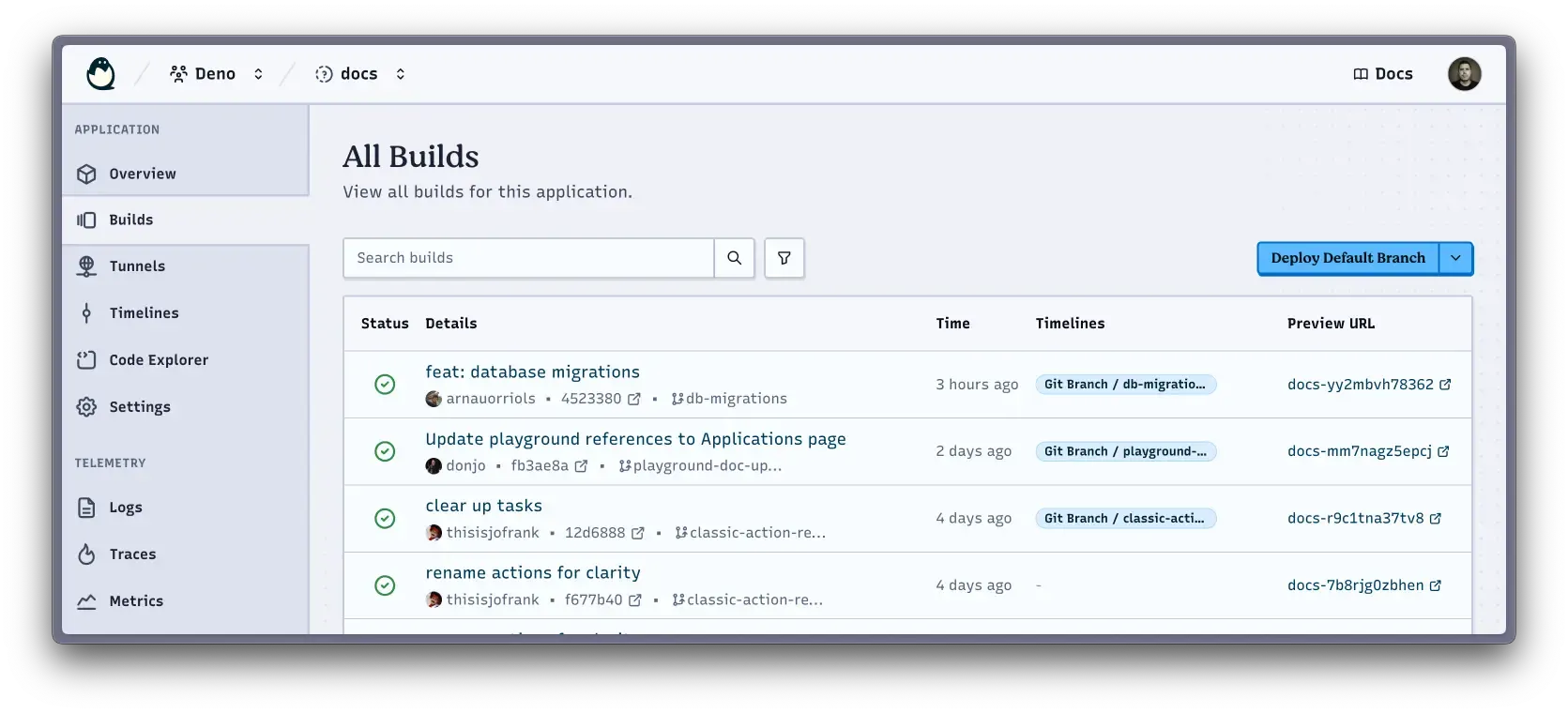
  • live previews for every git commit
  • each pull request will be tracked as a “timeline”, each with their own isolated database (more on that below)
  • promoting to prod and easy rollbacks via the UI

Builds on Deno Deploy

If you want more control over your release process, there’s the new deno deploy subcommand that you can use from your terminal (great for testing and quick iterations) or from your CI environment.

Built-in databases

In addition to supporting Deno KV, our global key-value store, Deno Deploy now also supports Postgres databases. Not only can you easily link third party databases, but thanks to our partnership with Prisma, you can also provision new databases for free right through our dashboard.

Deno Deploy will provision a new database for every pull-request opened. This avoids dangerous mistakes and makes development easier.

Not only that, but your application code remains the same in all contexts, even though the database is different. That’s because environment variables are managed automatically by Deno Deploy:

import { Pool } from "npm:pg";


const pool = new Pool();

Deno.serve(async () => {
  
  const result = await pool.query("SELECT * FROM users WHERE id = $1", [123]);

  return new Response(JSON.stringify(result.rows), {
    headers: { "content-type": "application/json" },
  });
});

In addition to all that, you can now explore your data right in the Deno Deploy console.
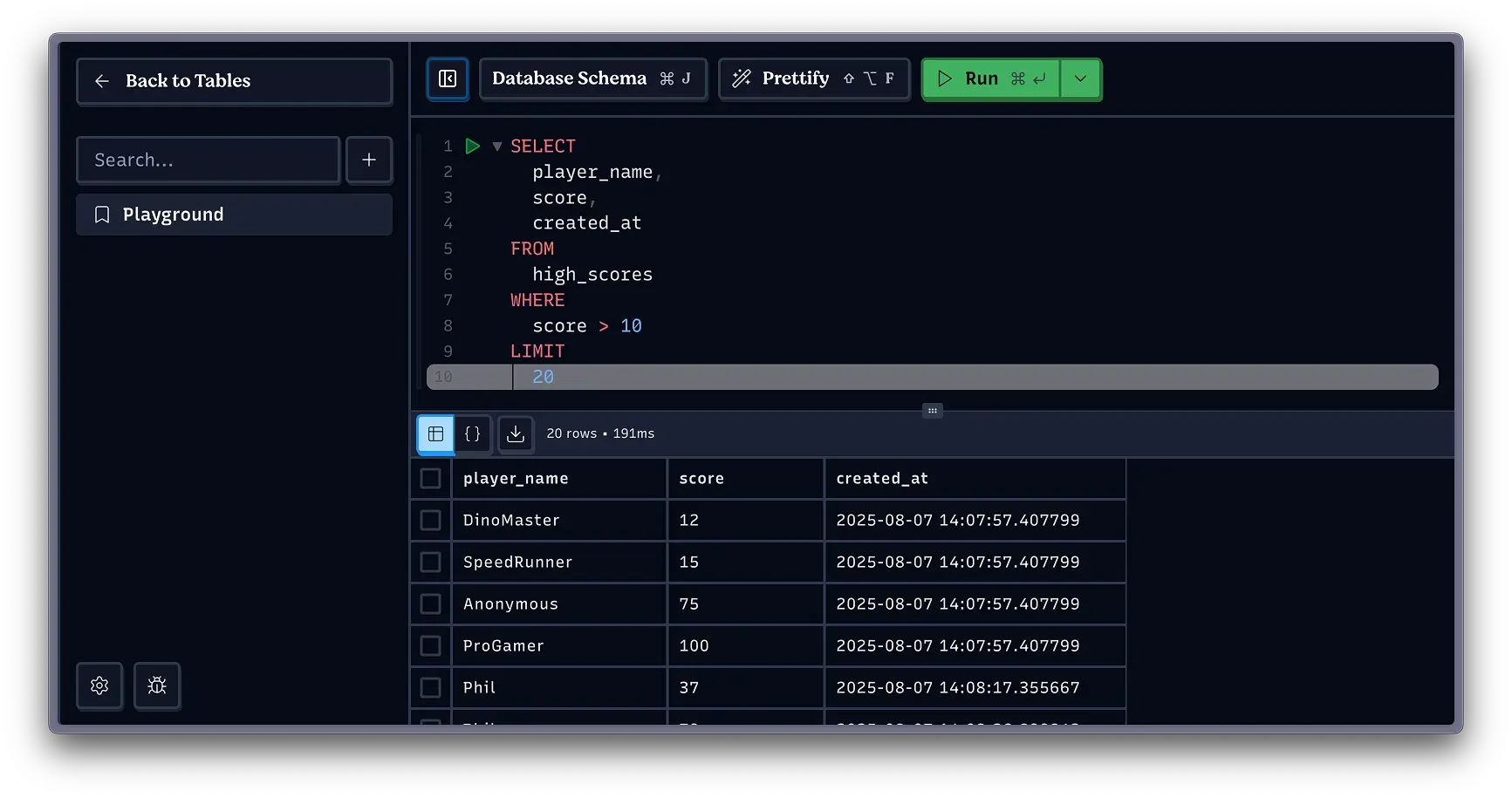
Database explorer

Want to see a specific database supported? Let us know on Twitter, Bluesky, or Discord!

Streamlined local development with --tunnel

One of the biggest headaches when deploying software is that a project that works locally behaves differently in production. We’ve bridged those two environments, making it easy to develop locally with confidence using the flag --tunnel.

Simply add the flag to your command and you will automatically pull centrally managed environment variables from Deno Deploy, run your dev server locally, expose a public, shareable URL instantly, and send telemetry data to Deno Deploy.

The --tunnel flag simplifies working on the same code base across a team, as you can all access the same environment variables, as well as serving your local version on a public URL for easier sharing. Also, it is currently available for the run and task commands, but expect that it will become even more powerful as more utilities are added.

First class, automatic observability

Any project hosted on Deno Deploy, regardless of Node or Deno, or even if there are specific telemetry instrumentation, will automatically show logs, traces, and metrics in the application console.

By default, Deno will capture the following: console.log, fetch, http, V8 events, garbage collection, and IO. Your logs will also be automatically associated with the request, so triaging and debugging is much simpler. Check out our documentation for more examples.

Safe, Instant Compute with Deno Sandbox

Read the full Deno Sandbox announcement here.

We’ve noticed a rise of LLM generated code deployed to Deno Deploy and wanted to make that path as smooth as possible. Our key design considerations were:

  • speed: the user edits, AI regenerates, and changes appear immediately, and
  • security: full isolation and a secrets model that survives prompt injection

With this in mind, we have built a new primitive called Deno Sandbox, which are real linux microVMs that boot in under a second, offering instant safe compute programmatically.

Here’s an example of a script that will create a Deno Sandbox, writes a dev server, runs it, and exposes a port for anyone to access:

import { Sandbox } from "@deno/sandbox";

await using sandbox = await Sandbox.create({ port: 8000 });

await sandbox.fs.writeTextFile(
  "main.ts",
  "export default { fetch: () => new Response('hi') }",
);

const p = await sandbox.sh`deno serve --watch main.ts`.spawn();

console.log("deno now listening on", sandbox.url);

await p.output();
$ deno -NRE main.ts
deno now listening on https://22313a1bbdf94b27803a3f929a5af33a.sandbox.deno.net
Watcher Process started.
deno serve: Listening on http://0.0.0.0:8000/
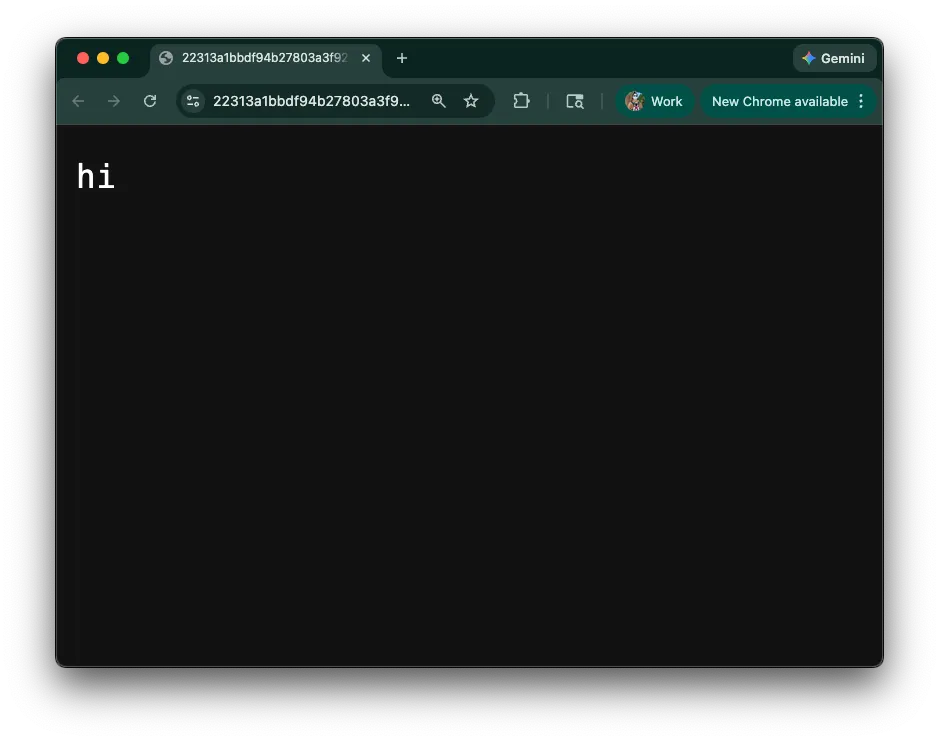
Deno Sandbox server output

Read the full announcement on Deno Sandbox.

Pricing

Deno Deploy comes with a generous free plan, offering one million requests per month, 100 GB of egress, and 15 CPU hours. For those needing more resources, there are various pro plans available, allowing for flexible scaling based on usage.
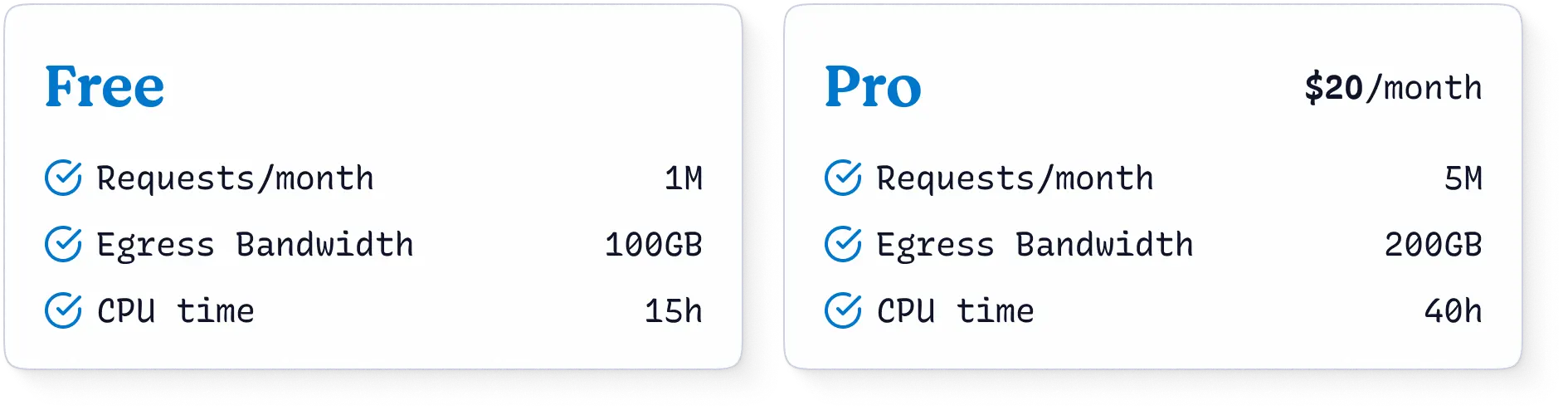
Pricing

For teams with greater security, support, and performance needs, we offer custom enterprise pricing. Learn more on our pricing page.

What’s next

Deploying one of the simple starter apps here is an easy way to dive into the new Deno Deploy and see what it’s all about. You can sign up, create an organization, and start deploying apps for free.

  • Deploy on Deno — A simple hello world site
  • Deploy on Deno — A next.js project
  • Deploy on Deno — A Fresh project
  • Deploy on Deno — An Astro project

We’re excited to see what you — or your AI agents — build with Deno Deploy.

What are you building with Deno? Let us know on Twitter, Bluesky, or Discord!