


惯性聚合 高效追踪和阅读你感兴趣的博客、新闻、科技资讯
阅读原文 在惯性聚合中打开

推荐订阅源

D
Darknet – Hacking Tools, Hacker News & Cyber Security
NISL@THU
NISL@THU
S
Securelist
O
OpenAI News
S
Security Affairs
Cyberwarzone
Cyberwarzone
T
Threatpost
Simon Willison's Weblog
The Last Watchdog
The Last Watchdog
L
LINUX DO - 最新话题
C
Cisco Blogs
PCI Perspectives
PCI Perspectives
SecWiki News
SecWiki News
S
Secure Thoughts
GbyAI
GbyAI
I
Intezer
AWS News Blog
AWS News Blog
F
Fortinet All Blogs
I
InfoQ
阮一峰的网络日志
阮一峰的网络日志
Google Online Security Blog
www.infosecurity-magazine.com
A
About on SuperTechFans
S
Schneier on Security
P
Proofpoint News Feed
雷峰网
雷峰网
Exploit-DB.com RSS Feed
小众软件
小众软件
H
Heimdal Security Blog
Microsoft Security Blog
K
KPMG report finds enterprise disconnect between AI and its ROI | CIO
T
The Exploit Database - CXSecurity.com
T
Threat Research - Cisco Blogs
V
V2EX
L
Lohrmann on Cybersecurity
Security Latest
Security Latest
A
Arctic Wolf
Apple Machine Learning Research
H
Hacker News: Front Page
Cisco Talos Blog
Cisco Talos Blog
Webroot Blog
Webroot Blog
T
Tenable Blog
MyScale Blog
MyScale Blog
博客园 - 司徒正美
S
SegmentFault 最新的问题
Y
Y Combinator Blog
腾讯CDC
Hacker News: Ask HN
Hacker News: Ask HN
M
MIT News - Artificial intelligence
G
GRAHAM CLULEY

Deno

Deno 2.8 | Deno Claw Patrol: an open-source security firewall for agents | Deno Fresh 2.3: Zero JS by default, View Transitions, and Temporal support | Deno Deno 2.7: Temporal API, Windows ARM, and npm overrides | Deno Build a dinosaur runner game with Deno, pt. 6 | Deno Build a dinosaur runner game with Deno, pt. 5 | Deno Deno Deploy is Generally Available | Deno Introducing Deno Sandbox | Deno Build a dinosaur runner game with Deno, pt. 4 | Deno Build a dinosaur runner game with Deno, pt. 3 | Deno Build a dinosaur runner game with Deno, pt. 2 | Deno React / Next.js Denial-of-Service Vulnerability: Deno Deploy users protected | Deno Deno 2.6: dx is the new npx | Deno Build a dinosaur runner game with Deno, pt. 1 | Deno React Server Functions / Next.js Vulnerability: Deno Deploy users protected | Deno My highlights from the new Deno Deploy | Deno Deno's Other Open Source Projects | Deno How Deno protects against npm exploits | Deno Help Us Raise $200k to Free JavaScript from Oracle | Deno Deno 2.5: Permissions in the config file | Deno Fresh 2.0 Graduates to Beta, Adds Vite Support | Deno Deno 2.4: deno bundle is back | Deno JavaScript™ Trademark Update | Deno What's coming to JavaScript | Deno A brief history of JavaScript | Deno Reports of Deno's Demise Have Been Greatly Exaggerated | Deno An Update on Fresh | Deno How Plaid migrated 100 services to a new database platform 5x faster with Deno | Deno Deno 2.3: Improved deno compile, local npm packages, and more | Deno Add JSR packages with pnpm and Yarn | Deno Zero-config Debugging with Deno and OpenTelemetry | Deno Exploring Art with TypeScript, Jupyter, Polars, and Observable Plot | Deno Deno v Oracle Update 3: Fighting the JavaScript Trademark | Deno Build a custom RAG AI agent in TypeScript and Jupyter | Deno How to get deep traces in your Node.js backend with OTel and Deno | Deno toranoana.deno #20 登録受付中(2025年3月14日) | Deno Node just added TypeScript support. What does that mean for Deno? | Deno The Dino 🦕, the Llama 🦙, and the Whale 🐋 | Deno Publish a lint rule, get a prize | Deno Deno 2.2: OpenTelemetry, Lint Plugins, node:sqlite | Deno If you're not using npm specifiers, you're doing it wrong | Deno How Deno's documentation is evolving | Deno Oracle justified its JavaScript trademark with Node.js—now it wants that ignored | Deno Introducing the JSR open governance board | Deno Intro to Wasm in Deno | Deno Announcing OpenAI on JSR | Deno Deno in 2024 | Deno Goodbye WinterCG, welcome WinterTC | Deno Build a SolidJS app with Deno | Deno Run your Next.js SSR app on Deno Deploy | Deno Solve Advent of Code 2024 with Deno and Win Prizes! | Deno Deno v. Oracle: Canceling the JavaScript Trademark | Deno Deno 2.1: Wasm Imports and other enhancements | Deno Build a Typesafe API with tRPC and Deno | Deno Self-contained Executable Programs with Deno Compile | Deno Build a Database App with Drizzle ORM and Deno | Deno Introducing your new JavaScript package manager: Deno | Deno Announcing Growthbook on JSR | Deno Build an Astro site with Deno | Deno How to convert CommonJS to ESM | Deno Announcing Deno 2 | Deno The Final Touches: What’s New In v2.0.0-rc.10 | Deno Announcing Stable V8 Bindings for Rust | Deno Deno 2.0 Release Candidate | Deno Secure, efficient private npm registries with Cloudsmith and Deno | Deno Painting the Plane as We Fly It: Designing JSR | Deno Introducing Web Cache API support on Deno Deploy | Deno Deno 1.46: The Last 1.x Release | Deno Protect your cloud spend with new Deno Deploy spend limits | Deno What we got wrong about HTTP imports | Deno Benchmarking AWS Lambda Cold Starts Across JavaScript Runtimes | Deno Announcing Supabase on JSR | Deno Deno 1.45: Workspace and Monorepo Support | Deno Introducing KV Backup for Deno Subhosting | Deno A Gentle Intro to TypeScript | Deno Announcing Hono on JSR | Deno How We Made the Deno Language Server Ten Times Faster | Deno How the Guardian uses Deno to audit accessibility and performance across their 2.7 million articles | Deno Introducing More Flexible Domain Association for Deno Subhosting | Deno The stabilization process of the Standard Library has begun | Deno Deno 1.44: Private npm registries, improved Node.js compat, and performance boosts | Deno How we built a secure, performant, multi-tenant cloud platform to run untrusted code | Deno The Deno Standard Library is now available on JSR | Deno How to document your JavaScript package | Deno Your Low Code Solution Needs an Escape Hatch | Deno Deno 1.43: Improved Language Server performance | Deno How Slack used Deno to save months of engineering effort in launching their new platform | Deno JSR Is Not Another Package Manager | Deno Announcing the Hookdeck SDK on JSR | Deno Announcing the Neon Serverless Driver on JSR | Deno An intro to TSConfig for JavaScript Developers | Deno How we built JSR | Deno How Netlify used Deno Subhosting to build a successful edge functions product | Deno Introducing Simpler Project Creation in Deno Deploy | Deno Deno 1.42: Better dependency management with JSR | Deno Introducing deployctl, the command line interface for Deno Deploy | Deno Introducing JSR - the JavaScript Registry | Deno How to add Monaco to a Next.js app and securely run untrusted user code | Deno Survey Results and Roadmap | Deno Deno 1.41: smaller deno compile binaries | Deno
CommonJS is hurting JavaScript | Deno
Andy Jiang · 2023-06-30 · via Deno

JavaScript, the undisputed king of web development, is being sabotaged — not by a rival language or a revolutionary new technology, but by its own baggage from the past. This insidious saboteur is none other than CommonJS, the antique module system that we’ve tolerated for far too long.

The rise of CommonJS

About 15 years after its invention, JavaScript started expanding beyond the browser to the server. Bigger projects were being built with the language and JavaScript needed a better way to handle a lot of source code. It needed modularization.

In 2009, Mozilla developer Kevin Dangoor made a call to arms. In “What Server Side JavaScript needs”, he laid out a lot of what the nascent field of server side JS was missing, including a module system.

JavaScript needs a standard way to include other modules and for those modules to live in discreet namespaces. There are easy ways to do namespaces, but there’s no standard programmatic way to load a module (once!). This is really important, because server side apps can include a lot of code and will likely mix and match parts that meet those standard interfaces.

— Kevin Dangoor, What Server Side JavaScript needs (2009)

Within a week, 224 people had joined the then-called ServerJS google group, including npm founder Issac Schlueter, and Node.js creator Ryan Dahl (here’s where he introduces Node to the group). This mailing list would go on to spec out the first versions of CommonJS, the module system that became part of Node.

The proposed CommonJS syntax (require(), module.exports, etc.) do not look like client-side JavaScript. This was by design. Dangoor’s intention to distance CommonJS from browser JavaScript was made clear from his message in the CommonJS Google Group in 2009:

I really think that the needs of server side code are different enough than the needs of client side code that we’re better off drawing from Python and Ruby than from Dojo and jQuery.

Beyond Node.js several other early server-side JavaScript runtimes adopted CommonJS, like Flusspferd, GPSEE, Narwhal, Persevere, RingoJS, Sproutcore, and v8cgi (most built by the core CommonJS group).

But as Node.js became the de-facto server-side JavaScript runtime with CommonJS as its main module system, the wider CommonJS standardization efforts lost steam. There were fewer needs for standards when there was only one main runtime: Node.js implementation became the standard.

In retrospect, it seems to me like the goal of CommonJS was (or at least, should have been) to discover Node, and enable what we’ve built here. Some mistakes were made, because hindsight doesn’t go in the direction you’d like it to, but overall, I think the whole CommonJS project can be considered a success.

— Issac Schlueter, comment on Breaking the CommonJS standardization impasse (2013)

Despite being the default module system, CommonJS have some core problems:

  • module loading is synchronous. Each module is loaded and executed one by one, in the order that they are required.
  • difficult to tree-shake, which can remove unused modules and minimize bundle size.
  • not browser native. You need bundlers and transpilers to make all of this code work client-side. With CommonJS, you are stuck with either big build steps or writing separate code for client and server.

By 2013, the CommonJS group was starting to wind down. But by that year, The TC39 committee that oversaw updates to the core JavaScript language were already working on a successor to CommonJS modules: ECMAScript modules.

ECMAScript Modules are web-first

With the ES6 language spec, the TC39 committee finally introduced a module system built right into the JavaScript language. The goal is to build a single module loader system that is suitable for the web, which includes asynchronous module loading, compatibility with browsers, static analysis, and tree shaking.

ES modules assume they’ll fetch data over a network rather than in a filesystem, delivering better performance and user experiences.

Now that a module loading system is built right into the language, everyone will agree to use that so we can focus our energy on higher level, more important problems, right?

Anakin Padme 4 panel meme about ESM vs. CommonJS

…right?

Node decides to support both CJS and ESM

ES Modules and Common JS go together like old bay seasoning and vanilla ice cream

— Myles Borins, from a talk on Modules Modules Modules

(I’m from Maryland so this sounds great to me.)

Borins was one of the developers on the Node ‘modules team’ tasked with implementing ES modules in Node. Despite successfully adding ESM to Node, the team couldn’t come to a clear consensus on interoperability between ESM and CJS. Yet Node couldn’t rip out CJS since its so deeply embedded. This meant that the interoperability problem was pushed to package authors.

Here’s a snippet of a module’s package.json needed to support both ESM and CJS:
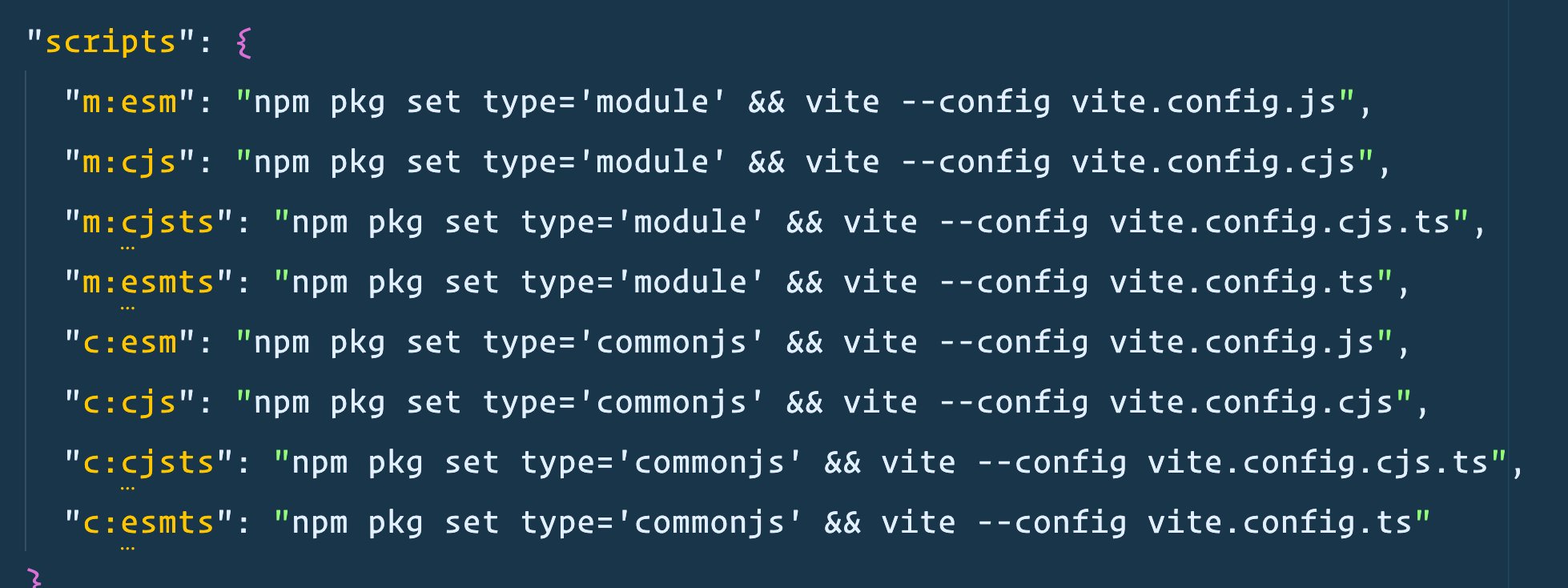
Publishing a module to support esm and cjs “publishing packages that work in esm and cjs is such a nightmare” — Wes Bos

Other module authors have found success supporting CommonJS and ESM using dnt. Simply write your module in TypeScript and this build tool will transform it to Node.js, emit ESM/CommonJS/TypeScript declaration files, and a package.json.

It’s clear that supporting CommonJS in 2023 has become too big of a problem to ignore. It’s time we bury CommonJS and transition into an all ESM future.

So long and thanks for all the requires

We envision a future where after installing a module, developers will be able to run the code in Node.js or the Browser without requiring a build step.

— Myles Borins, The Current State of Implementation and Planning for ESModules (2017)

In 2009, CommonJS was exactly what JavaScript needed. The group took a tough problem and forced through a solution that continues to be used millions of times a day.

But with ESM as the standard and the focus shifting towards cloud primitives — the edge, browsers, and serverless compute — and CommonJS simply doesn’t cut it. ESM is a better solution for developers, as they can write browser-compliant code — and for users who get a better end experience.

Join the discussion.

Don’t miss any updates — follow us on Twitter.