





In 2023, Deno shifted into high gear with respect to Node/npm compatibility and performance work, while continuing to move towards our goal of radically simplifying web development. Here’s a summary of what changed in 2023:
package.json files and has the ability to import
built-in Node modules using node: specifiers like node:fs and
node:crypto. Read more.Deno.serve, was stabilized and
HTTP throughput improved ~73% over the year.deno compile got support for
workers, dynamic imports,
and npm modules.ReadableStream and
WriteableStream) and AbortController throughout its APIs to narrow the gap
between browser and server-side programming.deno.json , now doubles as an import map.
We flattened the schema, added glob support, and a useful top-level
"exclude" attribute — all which allows for terse adjustments to how Deno is
executed.Let’s dive deeper into the changes below.
In a significant move toward ecosystem harmony, Deno expanded its capabilities
in 2023 by incorporating built-in Node modules, such as node:fs and
node:child_process, accessible through the node: specifier. This addition
builds on the native npm support introduced in late 2022, using the npm:
specifier, further bridging the gap between Deno and the Node ecosystem. As of
now, Deno boasts
partial or full support for 38 of the 42 Node built-in APIs,
marking a substantial stride in compatibility.
To facilitate a smoother transition from Node to Deno, we introduced several new features:
--unstable-byonm flag
allows the use of your preferred npm package manager within Deno, enhancing
flexibility.--unstable-sloppy-imports flag,
we’ve relaxed the strictness of module imports, accommodating a wider range of
coding styles and practices.--unstable-unsafe-proto flag
introduces support for Object.prototype.__proto__, a feature upon which
numerous npm packages depend.These enhancements are particularly useful for developers looking to run existing Node projects in Deno without extensive modifications.
A notable advancement in the past year was the
stabilization of the Node-API. This
development eliminates the need for the --unstable flag when utilizing npm
packages dependent on Node-API, thereby broadening the range of supported npm
packages and streamlining the integration process.
Deno.serve()We’ve significantly streamlined web server creation in Deno by introducing and
stabilizing the Deno.serve() function, allowing developers to launch a server
with minimal code:
Deno.serve((req) => new Response("Hello, world"));
This enhancement is part of our ongoing commitment to simplify development
processes and reduce the need for extensive boilerplate code. The Deno.serve()
function embodies this philosophy, enabling efficient and concise server setup.
Performance has seen substantial improvements through targeted optimizations in the core libraries and the event loop mechanism. In benchmark tests using a basic “Hello, world” server setup, Deno’s HTTP throughput has seen remarkable gains, nearly doubling since late 2023. When compared to a similar Node.js server, Deno now demonstrates a ~61% increase in throughput, alongside notable enhancements in tail latency and memory efficiency.
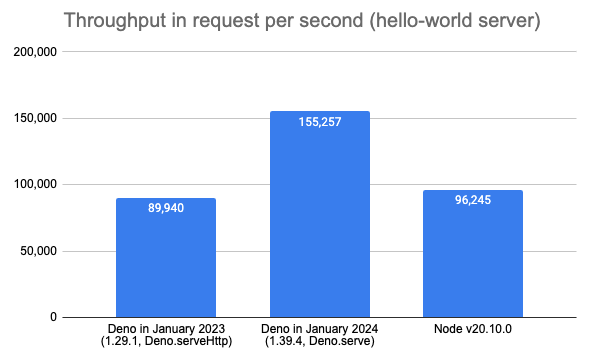
These advancements are not limited to Deno-specific projects; they extend to
modules and applications utilizing the node:http module, thanks to
Deno.serve’s underlying architecture.
A key factor in these performance gains is the improved integration of Deno’s HTTP interfaces with the Hyper and Reqwest libraries. This integration has minimized unnecessary data allocation and duplication across different layers of the Deno runtime.
Furthermore, we’ve optimized the Deno event loop, responsible for managing asynchronous operations and resource monitoring, to reduce overhead and enhance the runtime’s overall efficiency. These collective improvements underscore our dedication to providing a robust, high-performance environment for web development.
deno.jsonAt Deno, we stand by the principle of zero-configuration programming,
particularly valuing the simplicity of single-file programs, even for those
written in TypeScript. Recognizing that larger projects often demand more
sophisticated setups, we’ve continuously improved our optional deno.json
configuration file to meet these complex needs without sacrificing ease of use:
deno.json to double as an
import map, effectively reducing the need for separate configuration files and
simplifying project setups.
Learn more about import maps.deno fmt now supports semicolons, offering
more flexibility in code styling to accommodate diverse developer preferences.package.json enhances
compatibility, making it easier for projects to transition between Node and
Deno environments.
See how we improved compatibility.deno.json
structure, making it more intuitive and easier to navigate for developers.
Discover the simpler structure.deno.json allows for
more precise control over file and directory inclusion or exclusion in various
operations such as formatting, linting, and testing.
Explore glob support details.These enhancements are part of our ongoing commitment to making Deno not only powerful and versatile for large-scale applications but also simple and accessible for smaller projects.
Deno’s Language Server Protocol (LSP) integration elevates the development experience within editors and IDEs, offering robust features like precise go-to-definition, comprehensive IntelliSense, and seamless code formatting for TypeScript projects. This year, we’ve dedicated significant effort to enhance the LSP, making coding in Deno smoother and more intuitive:
npm: and node:
specifiers, streamlining the use of Node modules within Deno.deno.json file is detected in your project, ensuring
immediate access to Deno’s powerful tooling.To fully leverage these improvements, try the Deno extension for Visual Studio Code, designed to integrate these enhancements directly into your development workflow.
Deno has now integrated WebGPU, a cutting-edge technology that empowers developers to harness the power of GPU hardware directly with JavaScript. This high-performance, low-level interface is designed for a wide range of applications, from graphics rendering to data analysis, and machine learning, all within the familiar environment of web-standard JavaScript.
After a year of dedicated development, WebGPU is accessible in Deno behind the
--unstable-webgpu flag, marking a significant milestone in expanding the
capabilities of Deno applications. This feature is especially promising for
developers looking to push the boundaries of what’s possible with JavaScript in
areas requiring intense computational power.
We are also actively developing features to enable WebGPU for rendering in native GUI windows, further broadening the potential use cases for Deno developers. Stay updated on this feature’s progress.
To explore practical applications and see WebGPU in action within Deno, visit our WebGPU examples repository, which provides a variety of sample projects and code snippets.
Jupyter, the open source notebook tool, added support for JavaScript and TypeScript using Deno. This means data science, visualization, and more can all be done using modern JavaScript and TypeScript and web standards APIs.
Here’s an example of grabbing data with fetch and visualizing it with
observablehq/plot:
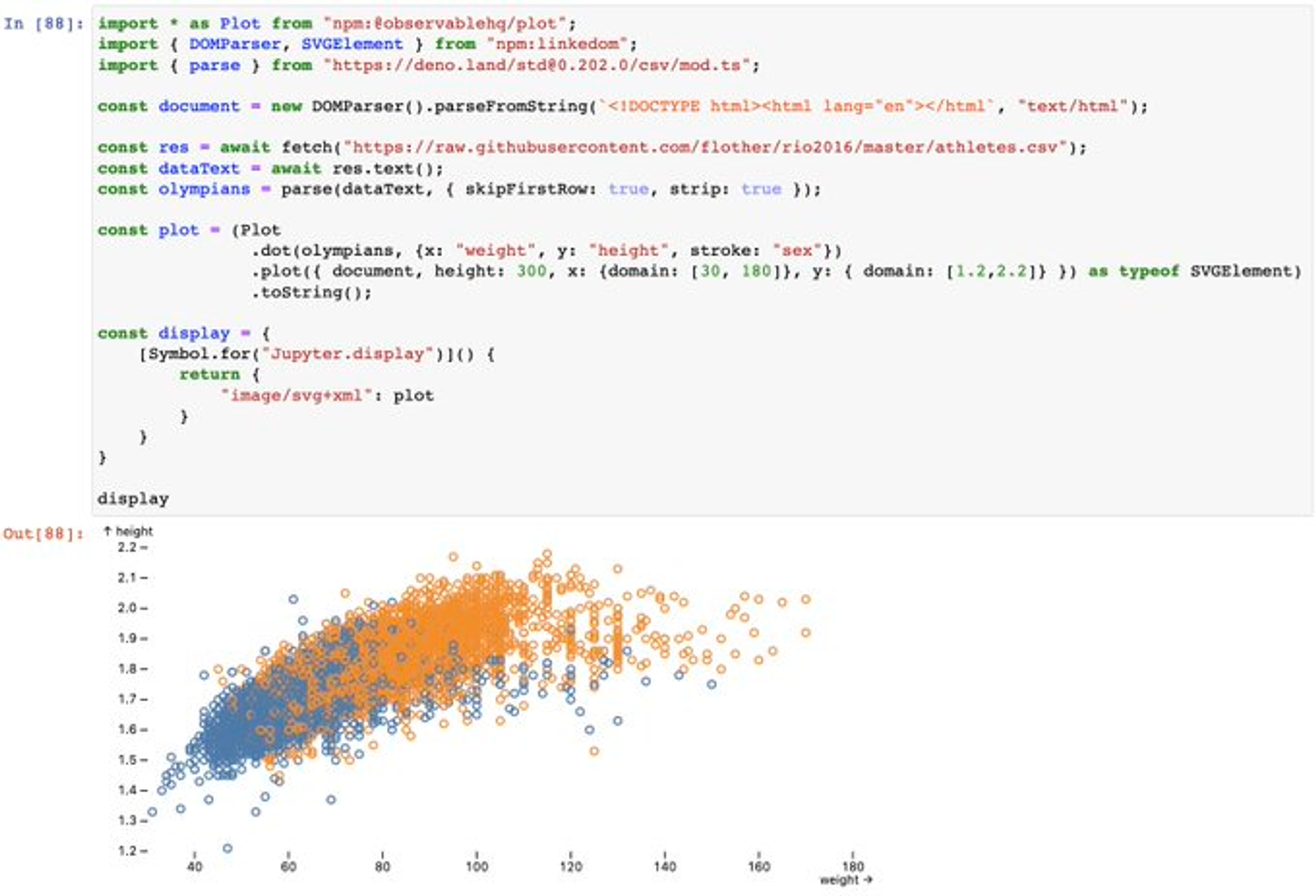
Jupyter support has also enabled building generative AI/ML models using JavaScript and TypeScript, as Andrew Ng and DeepLearning.AI have developed a generative AI course on building LLM Apps with LangChain.js that uses Deno.
Deno’s surface area touches a wide range of open source projects, which we eagerly contribute to in order to expand Deno’s feature set and optimize performance. This year, we released a few Rust crates that developers might find useful independently of Deno itself:
rustls-tokio-stream a
Rust crate that replaces tokio-rustls adding more advanced features like
supporting duplex I/O via tokio::io::split. Critically it does not require
either read or write polling to perform handshakes.fastwebsockets is a minimal,
fast WebSocket server implementation that sits behind Deno’s WebSocket
implementation. It completely passes the Autobahn TestSuite and fuzzed with
LLVM’s libfuzzer. You can use it as a raw websocket frame parser and deal with
spec compliance yourself, or you can use it as a full-fledged websocket
server.monch is a parser inspired
by nom, but specifically for strings and
with some additional combinators we use in Deno. It backs deno_task_shell.deno_task_shell is a cross
platform shell implementation that helps deno task run across windows and
unix. Think of it as a more advanced version of the common Node.js utility
cross-env.We continued to make Fresh, Deno’s modern full stack web framework that sends zero client-side JavaScript by default, easier to use and more performant.
_layout files to allow for sharing components across routes,
increased flexibility
in organizing code with route groups,
and removed boilerplate in passing data from a route handler to a component by
introducing async route components.
We
also improved linting rules and error messages in the editor,
as well
as simplified testing.We’ve got a lot planned for Fresh in 2024, such as view transitions, hot module reloading, and faster JSX transforms.
Though we’ve covered the big updates from our open source projects, the overall Deno picture would be incomplete without mentioning developments on the commercial side.
Though Deno Subhosting has been around for a while powering Netlify’s edge functions and Deco.cx’s customer’s e-commerce stores, this year we made it self-service so that anyone can deploy and run their user’s code programmatically via our Subhosting API for free. It’s built to run third-party, untrusted code securely, as it’s designed from the ground up for maximum tenant isolation. (Not sure what to use Deno Subhosting API for? Check out this tutorial on how to build your own cloud IDE.)
We’re made strides towards our vision of radically simplifying web development with the launch of cloud primitives: Deno KV, Queues, and Cron. They’re built right into the runtime so you can get setup without juggling API keys or futzing with config:
const kv = await Deno.openKv();
These cloud primitives seamlessly become globally distributed services when you use Deno Deploy, optimizing your servers and applications for performance.
We’ve also broadened access to Deno KV by turning it into its own open sourced binary, added support to remotely connect to any Deno KV instance, made it accessible in Node/npm via our official Deno KV npm module, as well as adding support for continuous replication with point-in-time recovery to S3 and GCS.
We’ve got some big plans to simplify cloud development even further with more features and new primitives, so stay tuned.
We’re preparing for Deno 2, which will offer improved compatibility with Node and npm, by providing a migration guide to ensure a smooth transition. Alongside an improved runtime, we also have some exciting announcements around managing and optimizing dependencies for your projects. Stay tuned in the coming weeks for a more detailed roadmap of what’s to come. If you want a sneak peak - look here.
Don’t miss any updates! Follow us on Twitter.
此内容由惯性聚合(RSS阅读器)自动聚合整理,仅供阅读参考。 原文来自 — 版权归原作者所有。