





Deno 1.26 has been tagged and released with the following new features and changes:
Cache Web API--allow-sys permission flagDeno APIsDeno.serve() APIIf you already have Deno installed, you can upgrade to 1.26 by running:
If you are installing Deno for the first time:
curl -fsSL https://deno.land/x/install/install.sh | sh


iwr https://deno.land/x/install/install.ps1 -useb | iex
Click here for more installation options.
Cache Web APIWe added support for the Cache API in this release.
The API allows you to cache Request/Response objects. This is helpful when you dynamically generate responses. It allows you to cache a response for a GET request and serve response from the cache for similar requests.
Here’s a small example that generates response based on name query:
import { serve } from "https://deno.land/std@0.158.0/http/server.ts";


const CACHE = await caches.open("v1");

serve(async (req: Request) => {

  const res = await CACHE.match(req);
  if (res) {
    res.headers.set("x-cache-hit", "true");
    return res;
  }

  const { searchParams } = new URL(req.url);
  const name = searchParams.get("name");
  const response = new Response(`Hello ${name}!`);

  await CACHE.put(req, response.clone());
  return response;
});
The cache is persisted to the file system. So restarting Deno will not flush the cache.
The following APIs are implemented:
CacheStorage::open()CacheStorage::has()CacheStorage::delete()Cache::match()Cache::put()Cache::delete()Few things that are different compared to browsers:
match() & delete() don’t support query options yet.The WebCrypto Secure Curves specification adds support for Curve25519 and Curve448 to the WebCrypto API.
Deno v1.26 implements the CFRG curves Ed25519 and X25519.
const key = await crypto.subtle.generateKey("X25519", true, ["deriveKey"]);
We plan to add support for Ed448 and X448 in future releases.
--allow-sys permission flagDeno has a number of APIs that provide information about user’s operating
system, eg. Deno.osRelease(), Deno.systemMemoryInfo().
Previously access to these APIs required the --allow-env flag, which was
unfortunate as it meant you had to grant permission to read all environment
variables in order to access information about the OS.
Deno v1.26 introduces a new --allow-sys permission flag, that guards access to
these APIs, which means you no longer need to also make your environment
variables available.
The following APIs require the --allow-sys flag:
Deno.hostname()Deno.networkInterfaces()Deno.loadavg()Deno.getUid()Deno.getGid()Deno.osRelease()Deno.systemMemoryInfo()Similarly to other permission flags, you can grant access to APIs granularly by
providing an allow list of APIs, eg. --allow-sys=hostname,osRelease.
This release fixes a lot of bugs related to npm specifiers and adds several new
features. Support for npm modules is still experimental and requires the
--unstable flag.
--node-modules-dir flagnpm specifiers resolve npm packages to a central global npm cache. This works
well in most cases and is ideal since it uses less space and doesn’t require a
node_modules directory. That said, you may find cases where an npm package
expects itself to be executing from a node_modules directory. To improve
compatibility and support those packages, a new --node-modules-dir flag has
been added.
For example, given main.ts:
import chalk from "npm:chalk@5";

console.log(chalk.green("Hello"));
Running this script with a --node-modules-dir like so…
deno run --unstable --node-modules-dir main.ts…will create a node_modules folder in the current directory with a similar
folder structure to pnpm.
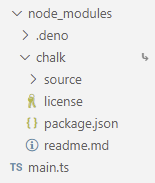
Note that this is all done automatically when calling deno run and there is no
separate install command necessary.
In the case where you want to modify the contents of the node_modules
directory before execution, you can run deno cache with --node-modules-dir,
modify the contents, then run the script. For example:
deno cache --unstable --node-modules-dir main.ts
deno run --allow-read=. --allow-write=. scripts/your_script_to_modify_node_modules_dir.ts
deno run --unstable --node-modules-dir main.ts
--reload=npm: and --reload=npm:<package>The --reload flag reloads external resources that were previously cached. This
release adds more targeted --reload=npm: and --reload=npm:<package> support.
For example, to reload all npm packages use the --reload=npm: flag when
running your script:
deno run --unstable --reload=npm: main.ts
Or to reload just a single package, such as chalk:
deno run --unstable --reload=npm:chalk main.ts
--compat mode removedIn order to not have two separate execution modes, the unstable --compat mode
has been deprecated in favor of npm specifiers.
We’ll continue working on npm support and land TypeScript & editor integration within the coming weeks. For our full npm specifier roadmap, see https://github.com/denoland/deno/issues/15960
Deno v1.26 includes implementations for several previously unsupported APIs in the Node.js compatibility layer. Additionally, the entire compatibility layer’s test suite has been updated for compatibility with Node.js v18.8.0. Previously, the test suite targeted Node.js v16.13.0. This change was made in preparation for Node.js 18 entering Long Term Support (LTS) in October.
Please note that the entire Node.js compatibility layer still requires the use
of the --unstable flag.
The Node.js streams implementation in Deno has been updated to use the
readable-stream@4.1.0 npm module. This change will allow Deno to better keep
up with breaking changes and new features. For more context on this decision,
please see
this blog post.
Within the compatibility layer, the stream and stream/promises modules are
now implemented via readable-stream. This refactor also introduces several new
APIs, including Readable.toWeb(), Writable.toWeb(), and Duplex.toWeb()
which are used to convert various types of Node.js streams to Web streams.
The fs.ReadStream and fs.WriteStream implementations have also been updated
to improve compatibility with the implementations in Node.js. Thanks to
@PolarETech for this work.
child_process APIsThe child_process module has added support for spawnSync(), exec(),
execSync(), and execFileSync().
Thanks to @iuioiua and
@PolarETech for contributing spawnSync() and
exec(), respectively.
process.getuid() and process.getgid()On non-Windows platforms, the user identifier and group identifier of the
process can be accessed via process.getuid() and process.getgid(). On
Windows this functionality does not exist, and these methods are undefined.
Thanks to @iuioiua for contributing this feature.
Deno APIsThe following APIs have been stabilized in this release and no longer require
the --unstable flag to be used.
Deno.hostname()Deno.refTimer()Deno.unrefTimer()Deno.stdin.setRaw() APIIn this release, the unstable Deno.setRaw(rid) API has been removed in favor
of Deno.stdin.setRaw(). We plan to stabilize this API in the next minor
release.
Deno.serve() APIWe received a lot of positive feedback for the new unstable Deno.serve() API
which provides a fast HTTP server.
In this release we fixed several reported bugs like spurious hangs on Windows, blocking of concurrent requests or partials writes.
We continue to improve our server implementation and want to stabilize this API in Deno v1.27.
Over the last few releases, we have been making continual performance improvements as part of an internal initiative to find bottlenecks and reduce latency and processing overhead wherever we can. We will be writing about this work in more detail soon so keep an eye on the blog for updates. In the meantime, we can share some benchmarks we have done comparing the v1.24.3 release to the latest and greatest in this release.
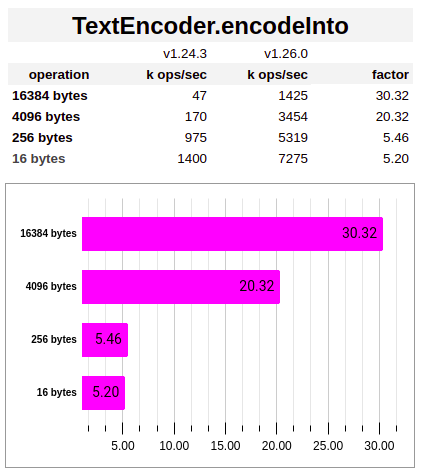
Text encoding into an existing TypedArray sees a huge 5x improvement in max throughput for small payloads and up to 30x for larger payloads. See denoland/deno#15922.
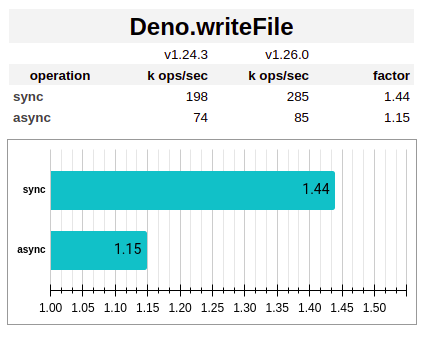
Writing a small file is now 1.44x faster for synchronous write
(Deno.writeFileSync()) and 1.15x faster for async (Deno.writeFile()).
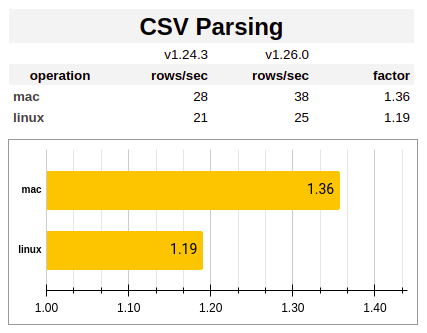
CSV parsing performance regressed recently with a change we made in how we do our text encoding/decoding. We are working on bigger improvements here but this release sees a nice bump of 1.36x on Mac and 1.19x on Linux in benchmarks we have done.
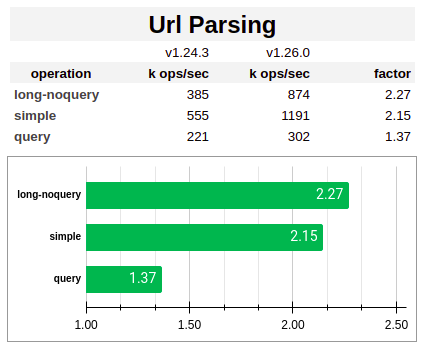
URL parsing is now up to 2.27x faster for Urls with no query string and 1.37x faster for a more complex Url with multiple query string parameters. See denoland/deno#15663.
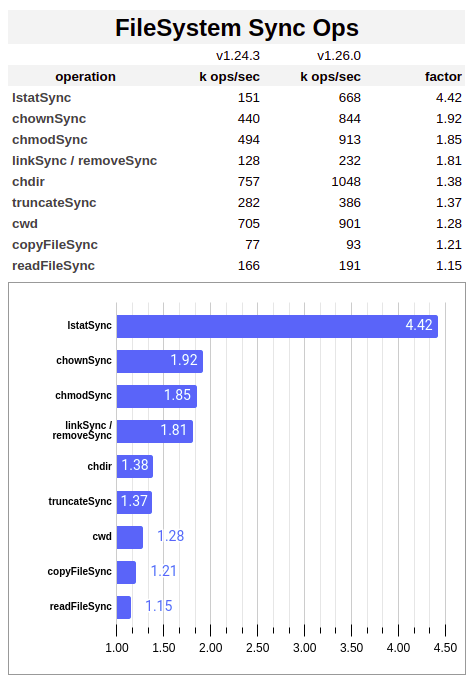
There have been a number of recent improvements to file system operations with
more to come. This is a summary of the kind of improvements you should see in
this release compared to v1.24.3. On MacOS, Deno.copyFileSync now uses APFS’
copy-on-write clonefile syscall when possible. See
denoland/deno#15873.
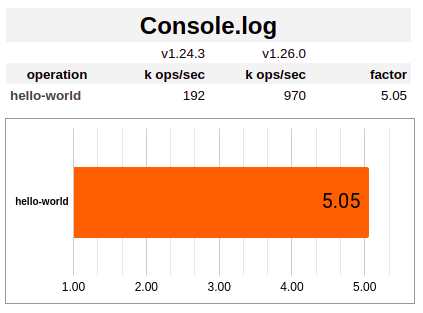
console.log() is now 5x faster for small payloads!
denoland/deno#15931.
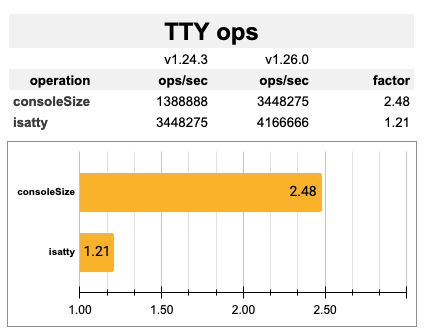
TTY methods like Deno.consoleSize are up to 2.4x faster compared to v1.24.3.
denoland/deno#15976.
Deno got a new interactive “Download…” message display.
In non-TTY environments, Deno will fall back to previous way of displaying “Download …” on a separate line for each file.
As mentioned recently we have been focusing on making Deno the smoothest developer experience. The past while we have had a team focused on doing that and one of the areas they have been tackling has been around discovery. Deno and the wider JavaScript/TypeScript ecosystem is vast and can be complex to navigate, and we have tried to make it easier for you to find what you are looking for.
Some of the things we have changed recently to try to make that experience better have been:
std), and all third party modules.deno.land/x by actual
code usage. Previously this was ranked by GitHub stars, which provided a very
skewed view of the Deno third party ecosystem.deno.land for
built-in APIs categorizing each API to help make
discovering the breadth of built-in capabilities of Deno easier to discover.deno.land may
not benefit everyone trying to discover Deno or attempting to share
information about Deno.Things that will be coming in the near future:
While we have been focused on the discovery aspect recently, we are also forming plans to re-focus on making the intelligent editor experience even better as well as improve the experience around the built-in tools within the Deno CLI.
Deno v1.26 ships with the latest stable version of TypeScript. For more information on new features in TypeScript see TypeScript’s 4.8 blog post
此内容由惯性聚合(RSS阅读器)自动聚合整理,仅供阅读参考。 原文来自 — 版权归原作者所有。