


惯性聚合 高效追踪和阅读你感兴趣的博客、新闻、科技资讯
阅读原文 在惯性聚合中打开

推荐订阅源

雷峰网
雷峰网
Recorded Future
Recorded Future
B
Blog
OSCHINA 社区最新新闻
OSCHINA 社区最新新闻
博客园 - 聂微东
让小产品的独立变现更简单 - ezindie.com
量子位
GbyAI
GbyAI
IT之家
IT之家
Microsoft Azure Blog
I
InfoQ
S
SegmentFault 最新的问题
T
Tailwind CSS Blog
有赞技术团队
有赞技术团队
M
MIT News - Artificial intelligence
罗磊的独立博客
MongoDB | Blog
MongoDB | Blog
The Cloudflare Blog
CTFtime.org: upcoming CTF events
腾讯CDC
小众软件
小众软件
博客园 - 三生石上(FineUI控件)
aimingoo的专栏
aimingoo的专栏
博客园 - Franky
Martin Fowler
Martin Fowler
P
Proofpoint News Feed
月光博客
月光博客
博客园_首页
C
Check Point Blog
宝玉的分享
宝玉的分享
Security Archives - TechRepublic
T
Tenable Blog
Vercel News
Vercel News
SecWiki News
SecWiki News
Security Latest
Security Latest
Microsoft Security Blog
cs.CL updates on arXiv.org
阮一峰的网络日志
阮一峰的网络日志
Hacker News - Newest:
Hacker News - Newest: "LLM"
Google Online Security Blog
N
News and Events Feed by Topic
Y
Y Combinator Blog
U
Unit 42
The Register - Security
云风的 BLOG
云风的 BLOG
K
Kaspersky official blog
WordPress大学
WordPress大学
Blog — PlanetScale
Blog — PlanetScale
N
Netflix TechBlog - Medium
Jina AI
Jina AI

Deno

Deno 2.8 | Deno Claw Patrol: an open-source security firewall for agents | Deno Fresh 2.3: Zero JS by default, View Transitions, and Temporal support | Deno Deno 2.7: Temporal API, Windows ARM, and npm overrides | Deno Build a dinosaur runner game with Deno, pt. 6 | Deno Build a dinosaur runner game with Deno, pt. 5 | Deno Deno Deploy is Generally Available | Deno Introducing Deno Sandbox | Deno Build a dinosaur runner game with Deno, pt. 4 | Deno Build a dinosaur runner game with Deno, pt. 3 | Deno Build a dinosaur runner game with Deno, pt. 2 | Deno React / Next.js Denial-of-Service Vulnerability: Deno Deploy users protected | Deno Deno 2.6: dx is the new npx | Deno Build a dinosaur runner game with Deno, pt. 1 | Deno React Server Functions / Next.js Vulnerability: Deno Deploy users protected | Deno My highlights from the new Deno Deploy | Deno Deno's Other Open Source Projects | Deno How Deno protects against npm exploits | Deno Help Us Raise $200k to Free JavaScript from Oracle | Deno Deno 2.5: Permissions in the config file | Deno Fresh 2.0 Graduates to Beta, Adds Vite Support | Deno Deno 2.4: deno bundle is back | Deno JavaScript™ Trademark Update | Deno What's coming to JavaScript | Deno A brief history of JavaScript | Deno Reports of Deno's Demise Have Been Greatly Exaggerated | Deno An Update on Fresh | Deno How Plaid migrated 100 services to a new database platform 5x faster with Deno | Deno Deno 2.3: Improved deno compile, local npm packages, and more | Deno Add JSR packages with pnpm and Yarn | Deno Zero-config Debugging with Deno and OpenTelemetry | Deno Exploring Art with TypeScript, Jupyter, Polars, and Observable Plot | Deno Deno v Oracle Update 3: Fighting the JavaScript Trademark | Deno Build a custom RAG AI agent in TypeScript and Jupyter | Deno How to get deep traces in your Node.js backend with OTel and Deno | Deno toranoana.deno #20 登録受付中(2025年3月14日) | Deno Node just added TypeScript support. What does that mean for Deno? | Deno The Dino 🦕, the Llama 🦙, and the Whale 🐋 | Deno Publish a lint rule, get a prize | Deno Deno 2.2: OpenTelemetry, Lint Plugins, node:sqlite | Deno If you're not using npm specifiers, you're doing it wrong | Deno How Deno's documentation is evolving | Deno Oracle justified its JavaScript trademark with Node.js—now it wants that ignored | Deno Introducing the JSR open governance board | Deno Intro to Wasm in Deno | Deno Announcing OpenAI on JSR | Deno Deno in 2024 | Deno Goodbye WinterCG, welcome WinterTC | Deno Build a SolidJS app with Deno | Deno Run your Next.js SSR app on Deno Deploy | Deno Solve Advent of Code 2024 with Deno and Win Prizes! | Deno Deno v. Oracle: Canceling the JavaScript Trademark | Deno Deno 2.1: Wasm Imports and other enhancements | Deno Build a Typesafe API with tRPC and Deno | Deno Self-contained Executable Programs with Deno Compile | Deno Build a Database App with Drizzle ORM and Deno | Deno Introducing your new JavaScript package manager: Deno | Deno Announcing Growthbook on JSR | Deno Build an Astro site with Deno | Deno How to convert CommonJS to ESM | Deno Announcing Deno 2 | Deno The Final Touches: What’s New In v2.0.0-rc.10 | Deno Announcing Stable V8 Bindings for Rust | Deno Deno 2.0 Release Candidate | Deno Secure, efficient private npm registries with Cloudsmith and Deno | Deno Painting the Plane as We Fly It: Designing JSR | Deno Introducing Web Cache API support on Deno Deploy | Deno Deno 1.46: The Last 1.x Release | Deno Protect your cloud spend with new Deno Deploy spend limits | Deno What we got wrong about HTTP imports | Deno Benchmarking AWS Lambda Cold Starts Across JavaScript Runtimes | Deno Announcing Supabase on JSR | Deno Deno 1.45: Workspace and Monorepo Support | Deno Introducing KV Backup for Deno Subhosting | Deno A Gentle Intro to TypeScript | Deno Announcing Hono on JSR | Deno How We Made the Deno Language Server Ten Times Faster | Deno How the Guardian uses Deno to audit accessibility and performance across their 2.7 million articles | Deno Introducing More Flexible Domain Association for Deno Subhosting | Deno The stabilization process of the Standard Library has begun | Deno Deno 1.44: Private npm registries, improved Node.js compat, and performance boosts | Deno How we built a secure, performant, multi-tenant cloud platform to run untrusted code | Deno The Deno Standard Library is now available on JSR | Deno How to document your JavaScript package | Deno Your Low Code Solution Needs an Escape Hatch | Deno Deno 1.43: Improved Language Server performance | Deno How Slack used Deno to save months of engineering effort in launching their new platform | Deno JSR Is Not Another Package Manager | Deno Announcing the Hookdeck SDK on JSR | Deno Announcing the Neon Serverless Driver on JSR | Deno An intro to TSConfig for JavaScript Developers | Deno How we built JSR | Deno How Netlify used Deno Subhosting to build a successful edge functions product | Deno Introducing Simpler Project Creation in Deno Deploy | Deno Deno 1.42: Better dependency management with JSR | Deno Introducing deployctl, the command line interface for Deno Deploy | Deno Introducing JSR - the JavaScript Registry | Deno How to add Monaco to a Next.js app and securely run untrusted user code | Deno Survey Results and Roadmap | Deno Deno 1.41: smaller deno compile binaries | Deno
The State of Edge Functions 2023: The Year of Globally Distributed Apps | Deno
2023-06-06 · via Deno

Earlier this year, we kicked off the first edition of the State of Edge Functions Survey, where we invited developers to share their experience with and predictions about edge functions. With nearly a thousand responses, we have closed the survey and are excited to present the report. Given that edge functions are a nascent technology, we hope the report provides insight into common use cases, frustrations, and upcoming trends.

Read on for our analysis or view the full results of the survey.

Didn’t participate in this year’s report? Get notified when we open the next survey.

Edge functions as “glue code”

Gluing together APIs and databases was the most common use case, followed closely by authentication and load balancing:
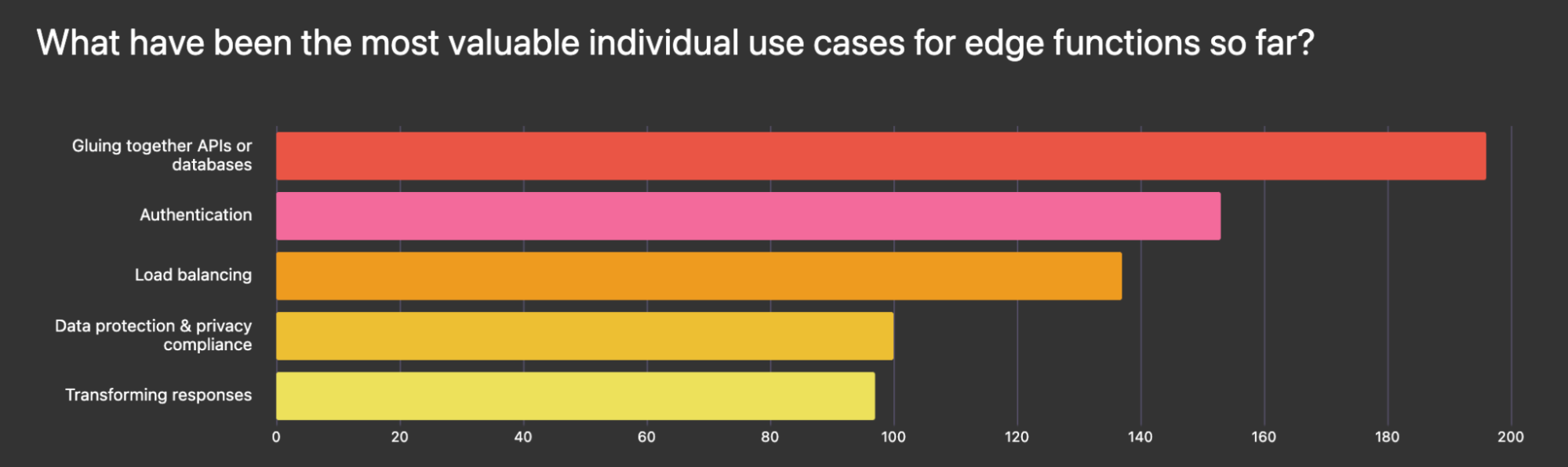
The most common use cases for edge functions

Tying together APIs is a common use case not only for edge functions, but also serverless functions in general, as creating and deploying many single-purpose functions as microservices made it easier for development teams to build and ship quickly.

Authentication is the second mentioned use case for edge functions, which may not have been as common for single origin serverless functions due to edge functions’ minimal latency. Authenticating users, critical for the vast majority of apps, demands high performance for a seamless user experience, which edge functions are uniquely suited to offer.

As the ecosystem around serverless at edge continues to grow, we’ll see more edge-specific, use-case specific, middleware, such as this minimal dependency authentication solution.

More complex edge functions require state

For more complex use cases, state was the most important need:
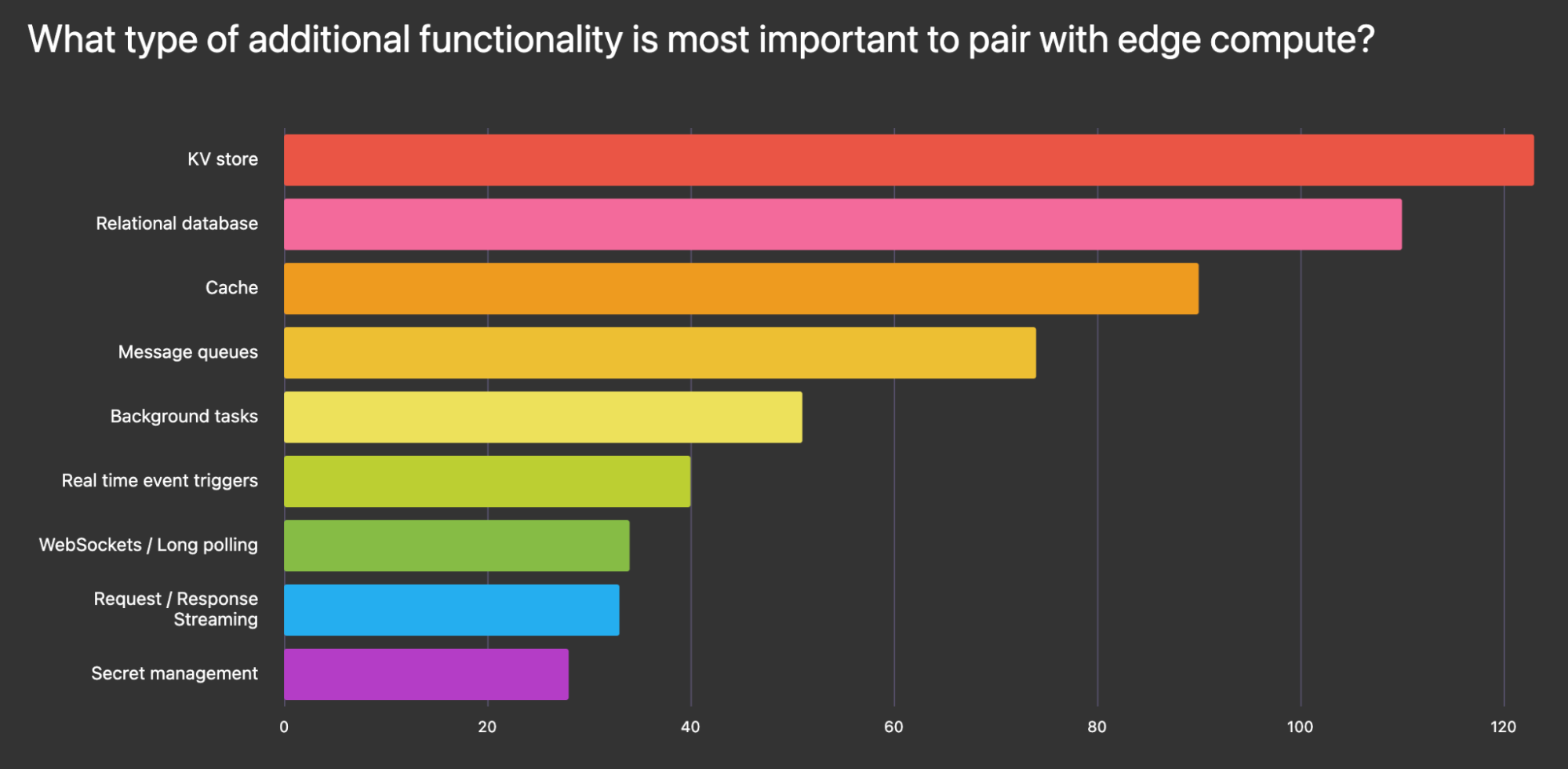
Most important edge function needs were persistent data storage

This makes sense, as persistent data storage unlocks a whole new class of use cases, such as hosting entire web apps at the edge. Specific technologies called out were Workers KV, Workers D1, and PlanetScale.

For quickly building stateful apps at the edge, Deno KV is a globally distributed, zero config KV store that allows you to connect to it with a single line of code and without needing to copy and paste any keys.

Edge functions mean better performance

Most developers leaned on edge functions to drive site speed and performance gains, followed closely by cost savings:
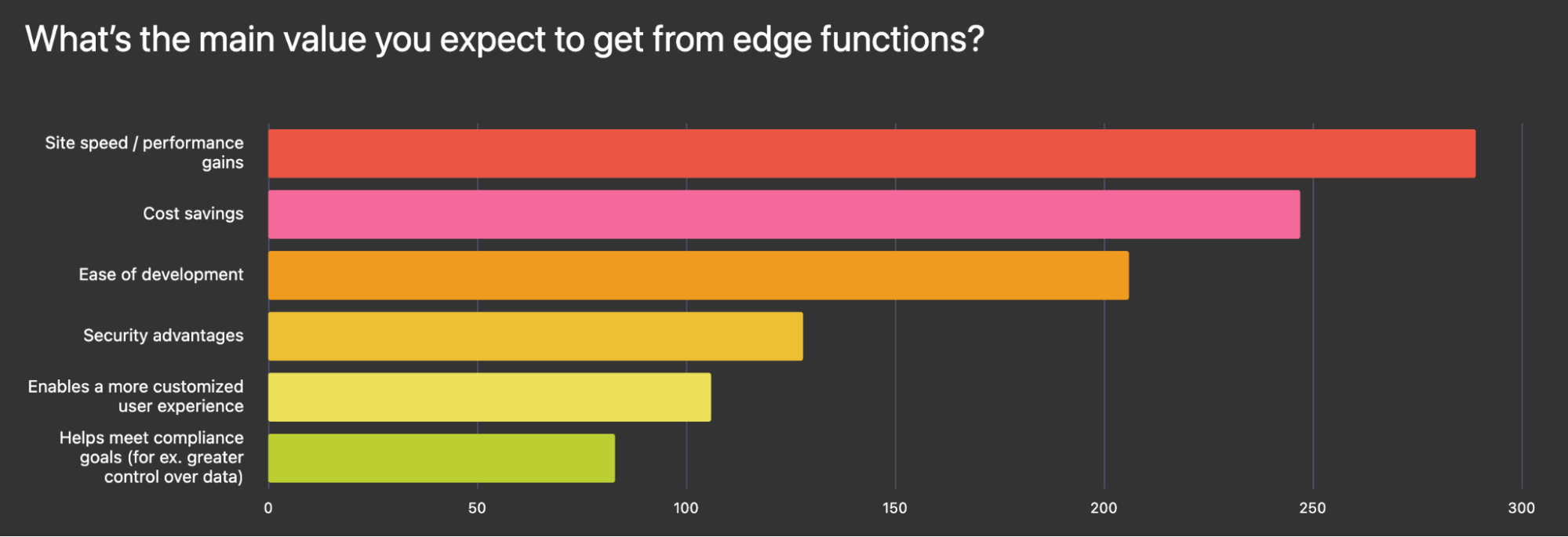
The main value developers get from using edge functions

Every millisecond of latency counts, especially in e-commerce, gaming, media sites, etc., where real dollars are at stake. It’s understandable that the performance boost from removing network latency by running functions, and more commonly entire web apps, at the edge is a huge value add for developers, their users, and their businesses.

Time to first byte (TTFB) is not only much lower, but with edge-native full-stack web frameworks such as Fresh, where zero JavaScript is sent to the client by default and all pages are server-side rendered, developers can build e-commerce applications that achieve a perfect Pagespeed score and maximize revenue.

Most developers struggle with debugging, testing, and observability

Debugging, testing, and observability were the most commonly cited challenges by developers:
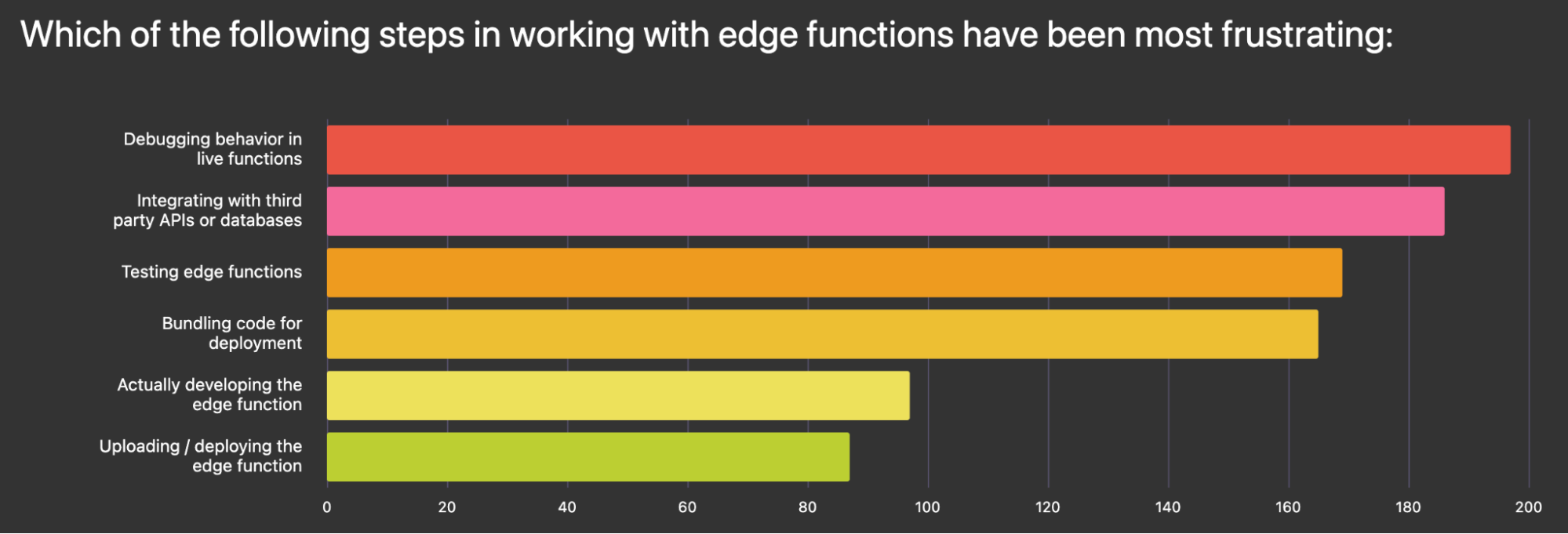
The top frustrations around edge functions revolve around debugging, testing, and observability

The challenge around troubleshooting edge functions arises in two areas: lack of helpful logging and auxilliary tooling from edge function providers, as well as lack of third party tooling focused on edge functions. Currently, monitoring edge functions fall back to tools intended for servers or virtual private machines, such as New Relic, Spunk, or Sentry.

While testing a single edge function or microservice can be straightforward, acceptance, integration, and e2e testing were difficult given the limitations of current testing frameworks. Creating reliable tests for these situations often required development teams to build custom testing solutions.

Full-scale apps at the edge are a reality

The majority of surveyed developers have built and deployed entire web apps at the edge:
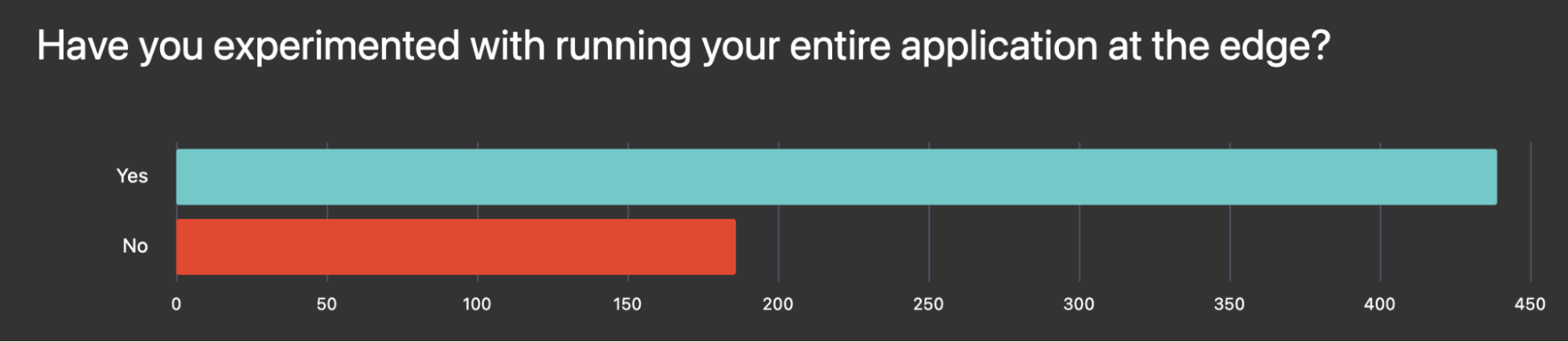
Most developers have hosted entire apps at the edge

In addition, more than half of surveyed developers believe that new sites and apps would run fully at the edge within the next 3 years. We agree, since web infrastructure — from machines in basements to serverless in cloud to serverless at edge — historically trended towards improved user performance.

As the tooling and ecosystem around serverless compute at edge matures, use cases will evolve from CDN proxies, API servers, and load balancers to full stack SaaS, e-commerce, web apps, etc. due to improved performance and user experiences.

Though many approaches towards building full-stack apps usually combine static JAMstack with edge functions for dynamism or using an edge-native framework like HonoJS or Fresh, we anticipate more tools for globally distributed full-stack web apps, such as this SaaS template designed built for the edge called SaaSKit.

What’s next

Thank you to all the developers who took the survey and gave back to the serverless community through contributing to the report. If you would like to be notified about next year’s survey and report, please subscribe to the State of Edge Functions newsletter here.

Don’t miss any updates — follow us on Twitter.