



惯性聚合 高效追踪和阅读你感兴趣的博客、新闻、科技资讯
阅读原文 在惯性聚合中打开

推荐订阅源

G
GRAHAM CLULEY
T
Tenable Blog
Know Your Adversary
Know Your Adversary
C
CXSECURITY Database RSS Feed - CXSecurity.com
P
Privacy International News Feed
S
Security Affairs
NISL@THU
NISL@THU
O
OpenAI News
Attack and Defense Labs
Application and Cybersecurity Blog
Hacker News: Ask HN
Hacker News: Ask HN
Webroot Blog
Webroot Blog
Schneier on Security
S
SegmentFault 最新的问题
S
Schneier on Security
G
Google Developers Blog
V
V2EX
C
Check Point Blog
U
Unit 42
Google DeepMind News
T
Threatpost
阮一峰的网络日志
阮一峰的网络日志
T
The Exploit Database - CXSecurity.com
Recent Announcements
M
MIT News - Artificial intelligence
S
Secure Thoughts
博客园 - 司徒正美
Recorded Future
Recorded Future
P
Proofpoint News Feed
Spread Privacy
Spread Privacy
K
Kaspersky official blog
Cyber Security Advisories - MS-ISAC
AI
AI
博客园 - 聂微东
N
News and Events Feed by Topic
SecWiki News
SecWiki News
钛媒体:引领未来商业与生活新知
钛媒体:引领未来商业与生活新知
V
Vulnerabilities – Threatpost
P
Palo Alto Networks Blog
OSCHINA 社区最新新闻
OSCHINA 社区最新新闻
Engineering at Meta
Engineering at Meta
Recent Commits to openclaw:main
奇客Solidot–传递最新科技情报
奇客Solidot–传递最新科技情报
酷 壳 – CoolShell
酷 壳 – CoolShell
WordPress大学
WordPress大学
The Hacker News
The Hacker News
The Last Watchdog
The Last Watchdog
Project Zero
Project Zero
W
WeLiveSecurity
博客园 - Franky

News and Events Feed by Topic

Securing AI Data Center: Architecture, Security Posture, and Emerging Standards New NCCoE Project: Asset Management and Visibility for Operational Technology (OT) Environments NIST Guidelines for Secure Remote Access in Water and Wastewater Systems NIST Workshop on Hardware CPE and CVSS Updates NCCoE Two-Pager Now Available: Effective OT Backup Management The Department of Commerce’s CHIPS Program Announces a Letter of Intent with Coherent for up to $50 Million to Expand Indium Phosphide Production Now Available: Practical Guidelines for Preventing and Mitigating Ransomware NIST NCCoE Genomic Data PETs Testbed & Dioptra Webinar NIST Mathematical Proof Supports Transition to a Continuous-Monitor-and-Update Security Model for AI Systems NCCoE Cybersecurity Connections Event: Accelerating the Adoption of Mobile Driver's Licenses NIST Expands AI Consortium’s Scope, Calls for New Members Now Available: NIST SP 1800-41, Responding to and Recovering from a Cyber Attack NCCoE Manufacturing Project Update NIST NCCoE Cyber AI Profile Virtual Working Session Series: Usability of the Profile Draft PNT Profile Updated to Align with NIST CSF 2.0 NIST NCCoE Cyber AI Profile Virtual Working Session Series: Extending the Technical Content CAISI Signs Agreements Regarding Frontier AI National Security Testing With Google DeepMind, Microsoft and xAI NIST NCCoE Cyber AI Profile Virtual Working Session Series: Updates to Profile Elements and Contents NICE Releases NICE Framework Components v2.2.0 Adoption of Mobile Driver’s Licenses for Financial Institutions Webinar NIST Updates NVD Operations to Address Record CVE Growth New Publication: Automation of the NIST Cryptographic Module Validation Program NIST Workshop on AI Incident Management Cybersecurity for IoT Workshop: Future Directions New Live Guidelines for Secure Software Development, Security, and Operations Practices Workshop on Blockchain and Distributed Ledger Technologies Improving the Nation’s Cybersecurity - an Open Forum NIST Guidelines on Implementing Mobile Driver’s Licenses for Financial Institutions NICE Webinar: Beyond Technical Skills - The Human Element of a Cyber Career Artificial Intelligence (AI) for Manufacturing Workshop Safeguarding Health Information: Building Assurance through HIPAA Security 2026 Workshop on Blockchain and Distributed Ledger Technologies 2026 Time and Frequency Seminar NCCoE Project Portfolio Webinar MLXN: Machine Learning for X-ray and Neutron Scattering Comment Now: Draft Guidelines on Data Classification Practices Technologies and Use Cases for Smart Standards NIST Allocates Over $3 Million to Small Businesses Advancing AI, Biotechnology, Semiconductors, Quantum and More Building the Strategic Supply Chain Network Iris Experts Group Annual Meeting New Concept Paper on Identity and Authority of Software Agents SUSHI@NIST: Rolling Next-Generation Secure Hardware into Standards Now Available! Transit Cybersecurity Framework Community Profile Now Available: NIST NCCoE Project Portfolio Cyber AI Workshop #2 NIST Launches Centers for AI in Manufacturing and Critical Infrastructure Apply on USAJobs: Open CAISI Position for an AI Research Scientist Securing Smart Speakers for Home Health Care: NIST Offers New Guidelines Secure Software Development Framework (SSDF) Version 1.2 is Available for Public Comment Just Published! Final NIST Telehealth Smart Home Integration Cybersecurity White Paper Draft NIST Guidelines Rethink Cybersecurity for the AI Era Comment & Save the Date Now! NIST Cyber AI Profile Preliminary Draft & Workshop Final NCCoE IoT Secure Onboarding Publications Now Available! Mobile Driver’s License Project Update Webinar NCCoE Cybersecurity Connections – Strengthening the Cybersecurity Workforce New Draft White Paper | PQC Migration: Mappings to Risk Framework Docs Now Available: NIST Final SP 1800-37, Addressing Visibility Challenges with TLS 1.3 NIST Awards More Than $3 Million to Support Cybersecurity Workforce Development Across 13 States Feedback Requested: NIST Cryptographic Module Validation Program White Paper New NIST NCCoE Mobile Drivers Licenses Project Resources Now Available! CSF 2.0 Webinar Series: Deep-Dive into the CSF 2.0 Govern Function to Improve Cybersecurity Final Publication Available: NIST IR 8523, Multi-Factor Authentication for Criminal Justice Information Systems Federal Investments in IoT Infrastructure Offer 10-20x Return, NIST Study Finds Final NIST IR 8349 Released: Characterize & Secure Your IoT Devices NIST Revises Security and Privacy Control Catalog to Improve Software Update and Patch Releases We Want Your Feedback! Developing a Transit Cybersecurity Framework Community Profile Advances in Automation of Quantum Dot Devices Control Empowering Future Innovators: NIST CTL Connects Cybersecurity Students with Real-World Research NIST Awards Over $1.8 Million to Small Businesses Advancing AI, Semiconductors, Additive Manufacturing and More STPPA8: Special Topics on Privacy and Public Auditability — Event 8: Experimenting with Privacy-Enhancing Cryptography (PEC) Implementations NIST Finalizes ‘Lightweight Cryptography’ Standard to Protect Small Devices NIST Releases Test Tools to Accelerate Adoption of Emerging Route Leak Mitigation Standards Second Seminar on Building an In-Space Circular Economy Lessons Learned from the Consortium: Tool Use in Agent Systems
NIST Researchers Demonstrate that Superconducting Neural Networks Can Learn on Their Own
2025-08-18 · via News and Events Feed by Topic

Using detailed simulations, researchers at the National Institute of Standards and Technology (NIST) and their collaborators have demonstrated that a class of neural networks – electronic circuits inspired by the human brain – can be programmed to learn new tasks on their own. After initial training, the NIST superconducting neural networks were 100 times faster at learning new tasks than previous neural networks.

Neural networks make decisions by mimicking the way neurons in the human body work together. By adjusting the flow of information among neurons, the human brain identifies new phenomena, learns new skills, and weighs different options in making decisions.

The NIST scientists focused their efforts on superconducting neural networks, which transmit information at high speed--in part because they allow current to flow without resistance. Once cooled to just 4 degrees above absolute zero, they consume much less energy than other networks, including neurons in the human brain.
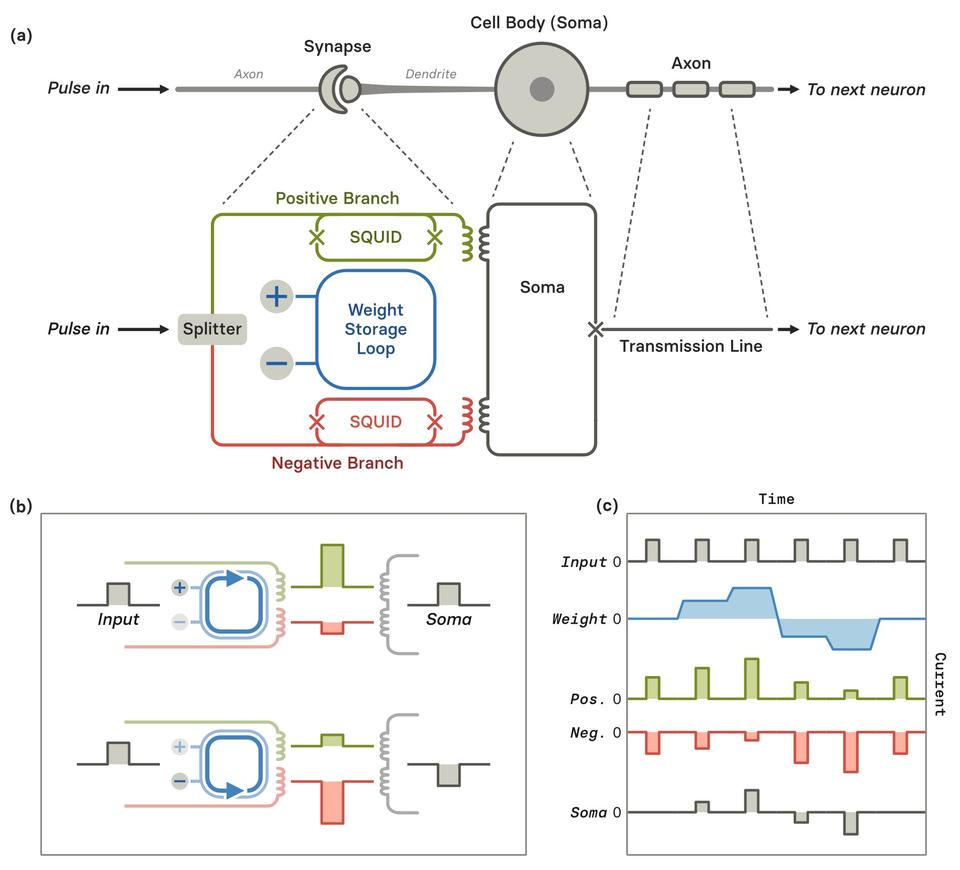
neural network diagram

(a) Biological neuron vs. NIST superconducting neuron design. In the NIST design, incoming pulses are split into two branches (green and red), each with an adjustable superconducting quantum interference device (SQUID) inductively coupled into a summation loop (soma); the soma combines the branch outputs and, when a threshold is crossed, launches an output pulse on a transmission line (axon) to the next neuron. A superconducting loop (blue) between the branches stores the neuron's weight as a persistent quantized current that can be varied.

(b) Weighting the neuron. Increasing the positive current in the weight loop strengthens the coupling of the positive branch to the soma and weakens the negative branch, yielding a larger positive net pulse after integration. Conversely, increasing the negative current strengthens the negative branch and weakens the positive branch, producing a larger negative net pulse. The synapse stores and applies the weight of the pulse passing between neurons.

(c) Example responses. With zero current in the weight loop, an input pulse produces no net signal in the soma. Adjusting the current positively or negatively produces, respectively, a positive or negative response in the soma to the same input.

Credit: S. Kelley/NIST

In their new design, NIST scientist Michael Schneider and his colleagues found a way to manipulate the building blocks of a superconducting neural network so that it could perform a type of self-learning known as reinforcement learning. Neural networks use reinforcement learning to learn new tasks such as acquiring a new language.

A key element in any neural network is how preferences, or weights, are assigned to pathways in the electrical circuitry, akin to the way the brain assigns weights to different neural pathways. Weights are adjusted in a neural network using the proverbial carrot and stick method – strengthening the weighting of pathways that provide the correct answer and weakening those that lead to incorrect answers. In the NIST system, self-learning is acquired because hardware that makes up the circuitry determines the size and direction of these weight changes, requiring no external control or additional computations to learn new tasks.

The researchers reported their findings online March 4 in Unconventional Computing.

The NIST design offers two advantages. First, it enables the network to learn continually as new data becomes available. Without that capability, the entire network would have to be retrained from scratch each time researchers add data or alter the desired outcome.

Secondly, the design automatically adjusts the weighting of different pathways in the network to accommodate slight variations in the size and electrical properties of the hardware components may happen during fabrication. That flexibility is a huge benefit for training neural networks, which ordinarily require precise programming of weighted values.

The design also has the potential to dramatically speed up training of neural networks and use significantly less energy than training designs based on semiconductors or software, Schneider said. With simulations demonstrating the feasibility of the hardware approach, Schnieder and his colleagues now plan to build a small-scale self-learning superconducting neural network.


Paper:

Schneider, M.L., Jué, E.M., Pufall, M.R., Segall, K. and Anderson, C.W. A self-training spiking superconducting neuromorphic architecture. Unconventional. Computing. 2, 5 (2025), published online March 4, 2025. https://doi.org/10.1038/s44335-025-00021-9