
惯性聚合 高效追踪和阅读你感兴趣的博客、新闻、科技资讯
阅读原文 在惯性聚合中打开

推荐订阅源

freeCodeCamp Programming Tutorials: Python, JavaScript, Git & More
GbyAI
GbyAI
OSCHINA 社区最新新闻
OSCHINA 社区最新新闻
博客园 - 三生石上(FineUI控件)
美团技术团队
Last Week in AI
Last Week in AI
WordPress大学
WordPress大学
L
LangChain Blog
雷峰网
雷峰网
让小产品的独立变现更简单 - ezindie.com
博客园 - 叶小钗
Engineering at Meta
Engineering at Meta
腾讯CDC
Recent Announcements
The Register - Security
有赞技术团队
有赞技术团队
Blog — PlanetScale
Blog — PlanetScale
博客园 - Franky
博客园 - 司徒正美
The Cloudflare Blog
Google DeepMind News
T
Tailwind CSS Blog
C
Check Point Blog
小众软件
小众软件
V
Visual Studio Blog
V
V2EX
F
Full Disclosure
J
Java Code Geeks
MongoDB | Blog
MongoDB | Blog
罗磊的独立博客
人人都是产品经理
人人都是产品经理
量子位
Apple Machine Learning Research
F
Fortinet All Blogs
Microsoft Security Blog
奇客Solidot–传递最新科技情报
奇客Solidot–传递最新科技情报
博客园 - 【当耐特】
博客园_首页
Y
Y Combinator Blog
N
Netflix TechBlog - Medium
酷 壳 – CoolShell
酷 壳 – CoolShell
Stack Overflow Blog
Stack Overflow Blog
Recorded Future
Recorded Future
G
Google Developers Blog
Vercel News
Vercel News
大猫的无限游戏
大猫的无限游戏
Microsoft Azure Blog
U
Unit 42
爱范儿
爱范儿
Jina AI
Jina AI

NETSCOUT

Resilience Is the Foundation of Modern Security Strategy | NETSCOUT How Machines Are Taking Over Network Traffic | NETSCOUT Why AI Moves Faster Than the Controls Built to Manage It | NETSCOUT NETSCOUT Named a SPARK Matrix™ Leader in Network Observability for the Third Consecutive Year | NETSCOUT Why CDNs Alone Are Not Sufficient for Modern DDoS Protection | NETSCOUT All That Glitters Isn’t Gold: Why AI Needs Better Data | NETSCOUT From Horseback to Real-Time Observability | NETSCOUT Why Digital Twins Are Now Mission-Critical for Scaling 5G with Confidence | NETSCOUT NETSCOUT Earns Six Leader Badges in the G2 Summer 2026 Grid Reports | NETSCOUT When Too Much Data Becomes Too Big an AI Problem | NETSCOUT 75,000 DDoS-for-Hire Actors Targeted by Law Enforcement | NETSCOUT What Is NETSCOUT Smart Data and Why Is It So Important? | NETSCOUT Understanding Network Traffic for Threat Hunting | NETSCOUT Black Box Versus Glass Box DDoS Protection Intellyx Names NETSCOUT to Prestigious 2026 Digital Innovator Award List How to Operationalize Threat Hunting with NETSCOUT, SIEM, XDR, EDR, and SOAR Solving Network Blind Spots Created by Massive Data Silos The Self-Healing Network: Why Your AI Strategy Needs a Neutral Lens Does It Feel Like a Stormy Season in Your Cloud? Four AI Trends Transforming Network Operations The 1 A.M. Cloud Migration Meltdown Communication Service Provider Supports Banking Application Success Across International Borders Defending Against DDoS Attacks at Scale AI-Driven Workflow Automation Is the New North Star for Communication Service Providers Key Takeaways from the EMA Network Management Megatrends 2026 The Digital Foundation of Public Trust Is More Than Skin Deep Unlocking the Full Value of 5G with Network Slicing NETSCOUT to Have a Strong Presence at Cisco Live Why Airlines and Airports Must Embrace Observability Ahead of the Summer Travel Surge Beyond “Best Effort”: Why Carrier Grade 5G Slicing Matters More Than Ever | NETSCOUT The Shrinking Lifespan of SSL/TLS Certificates | NETSCOUT From Packets to Insight: How Curated Network Data Powers AI | NETSCOUT Data Centers Are Feeling the Heat, and That’s OK | NETSCOUT If You Can’t See the Slice, You Can’t Sell the SLA | NETSCOUT Insights from the GigaOm Radar for Network Observability v6 Report | NETSCOUT How Shadow AI Creates Zombie Infrastructure NETSCOUT Earns Eight Leader Badges in the G2 Spring 2026 Grid Reports Your Modern Manufacturing Network Deserves a Modern Observability Strategy How Botnet-Driven DDoS Attacks Evolved in 2H 2025 The Hidden Cost of Poor Network Observability Insurance Systems Look Simple, but the Infrastructure Isn’t How AI is Transforming the RAN With the Right Data When Cloud SaaS DDoS Mitigation Offerings Aren’t Enough Frictionless Banking Experiences Start with Observability Colocation Growth Demands Scalable End-to-End Observability Bringing Shadow AI Into the Light AIOps Outcomes Depend on Data Quality, Not Algorithms Why AI, Zero Trust, and Modern Security Require Deep Visibility How Service Behavior Changes in Remote Locations The 10-Hour Problem: How Visibility Gaps Are Burning Out the SOC From Insight to Impact: Observability Fuels AI-Driven Innovation How Orphaned Applications Are Quietly Fueling Your Shadow IT Problem Why Today’s Security Tools Can’t See the Network Anymore How NETSCOUT Addresses Modern Network Observability Challenges Helping IT Organizations Prevent Disruptions Before They Impact Business How Hidden Blind Spots Quietly Became Cybersecurity’s Biggest Vulnerability The Blame Game! Is it the Network or Gaps in Observability? Six Winter 2026 G2 Leader Badges Prove This DDoS Protection Stands Out The Value of Combining Modern Observability Solutions for Actionable Insights AI Failure Is the Norm Because Most Initiatives Are Flying Blind NETSCOUT Distinguished by Frost & Sullivan with the 2025 Company of the Year Recognition 5 Emerging AI Data Trends Enterprise IT Teams Cannot Ignore What is Network Slicing NETSCOUT’s Omnis Cyber Intelligence Earns Security Today’s 2025 CyberSecured Award Turning a Flood of 5G Data into Rocket Fuel for AIOps NETSCOUT Recognized by Comparably as a Top Workplace for Q4 2025 How to deliver consistent ultra-low latency, high-throughput, and total reliability across complex networks Smart Data: The Super Fuel Driving Next-Gen Observability NETSCOUT Recognized for Leadership in Network Detection and Response Integrating Deep Packet Inspection in 5G Networks Removing Barriers to Digital Transformation Gain Real-time Visibility to Future Proof Your Network for Autonomous Operations Why Is Cloud Performance Still Foggy? Smarter DDoS Security at Scale How DPI Is Transforming Observability and Operational Resilience 10 Key Challenges to Optimizing Radio Access Networks in the 5G Era Why Arbor Edge Defense and CDN-Based DDoS Protection Are Better Together NETSCOUT’s Holiday Playlist for IT Teams and Leaders More Data Does Not Always Equate to Better Business Visibility Seeing Clearly with Deep Packet Inspection at Scale How to Ensure High Availability for FWA Services System Integrators and the Future of Enterprise IT The Transformative Power of ‘Thinking’ AI and the Implications for Business How Fast Can Your Organization Identify and Resolve IT Outages? Observability for the “Always On” Power Industry
Game-Changing AI in the RAN Plays by Its Own Rules | NETSCOUT
Jennifer.Steele · 2026-06-25 · via NETSCOUT

If you believe the hype, AI is on the verge of “taking over” the radio-access network (RAN), yet a new report from Senza Fili reveals the situation is far less dramatic.

In “Is AI taking over the RAN?,” Senza Fili Principal Analyst Monica Paolini suggests that AI is not replacing the RAN but rather exposing the limits of how service providers manage their networks today and how they will confront what comes next.

The Real Story Isn’t About AI

For the record, the telecom industry didn’t suddenly discover AI out of curiosity. Instead, AI was born out of necessity when networks reached levels of complexity that traditional operational models could no longer address. With more layers, more spectrum, more devices, more expectations, and flattening revenues, the economics simply won’t work without RAN automation.

And although the industry continues to promote an “AI in the RAN” story, the real goal is to run better, more efficient, more adaptive networks. Implementing AI isn’t the destination; it’s the path that will get us there.

Treat AI as a Strategy, Not as a Feature

In the report, Paolini highlights the reality of AI’s infancy as a counter to marketing hype, pointing out that AI deployments in the RAN remain narrow and task-specific, with the focus on things such as anomaly detection, energy optimization, and traffic management.

And while this is the deployment reality, many organizations are still approaching AI as something to “add” to the network, rather than something that fundamentally changes how the network operates.

As Paolini describes it, AI doesn’t just make existing processes faster; it changes the nature of those processes. AI surfaces patterns humans can’t see. It makes decisions in real time. It rewrites the boundaries of what’s operationally possible in RAN and 5G service assurance.

As a result, If the strategy is just to bolt AI onto legacy workflows, the return will always be limited.

A Trade-off No One Likes to Talk About

The caveat to advancement with AI is that the same technology that simplifies operations also makes things more complex.

AI-driven networks are more dynamic. They adapt in real time. They optimize continuously. But that also means they generate more changes, more interactions, and more opportunities for things to go wrong. Service providers can quickly find themselves replacing predictability with probabilistic behavior. And, while AI can reduce human error, it can also introduce new types of risk that have to be managed:

  • Opaque decision-making
  • Model bias
  • Cascading failures

Without some level of accountability, autonomy is a nonstarter.

Industry Needs to Slow Down to Make Progress

Although there is a growing sense of urgency around “AI-native RAN,” this report argues instead for a gradual, layered integration of AI that aligns with real operational needs and delivers measurable return on investment (ROI).
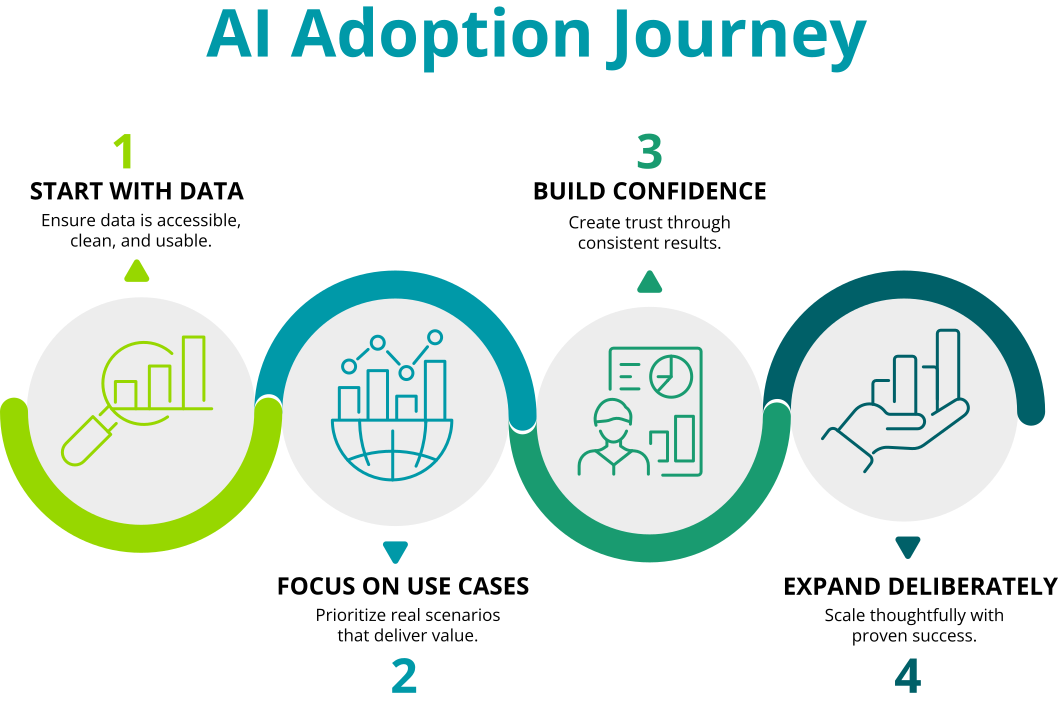
Chart on AI Adoption Journey

Choosing ROI Over Revenue Streams

Another area where reality diverges from the popular narrative is monetization.

For years, telecom has chased the idea that new technology layers (4G, 5G, and now AI) will unlock entirely new revenue streams. And yet, the results have been mixed.

In this report, a more grounded view is presented. AI’s most immediate and reliable impact is cost efficiency, not new revenue.

Reducing operational complexity, improving resource utilization, and avoiding unnecessary capital investments are tangible, controllable outcomes and a stronger foundation for long-term transformation.

The Future Is AI-Integrated

Eventually, we may in fact realize a fully AI-native RAN. But that future is tied to much longer technology cycles:

  • 6G timelines
  • New silicon architecture
  • Significant infrastructure refreshes

Instead, today’s AI should be layered into the RAN, one use case at a time, for bolt-on solutions, incremental wins, and more gradual change.

Success will not be measured by the operators with the “most AI,” but rather by the ones that integrate it most effectively across operations, processes, and decision-making.

Conclusion

While AI is not taking over the RAN, it is taking away our ability to ignore the fundamental challenges we’ve been managing for years:

  • Complexity
  • Inefficiency
  • Unsustainable operating models

The reality is AI isn’t the story at all but rather the catalyst.

The real question isn’t whether AI will transform the RAN. It’s whether the industry is ready to transform itself in the process.

If you’re thinking about where to start with AI or how to course-correct an existing implementation, this is exactly the conversation you need to be having.

Read the full report to unpack practical steps, evaluate the trade-offs, and explore strategic decisions shaping AI adoption in the RAN today.