



惯性聚合 高效追踪和阅读你感兴趣的博客、新闻、科技资讯
阅读原文 在惯性聚合中打开

推荐订阅源

钛媒体:引领未来商业与生活新知
钛媒体:引领未来商业与生活新知
SecWiki News
SecWiki News
MongoDB | Blog
MongoDB | Blog
V
Visual Studio Blog
Recent Announcements
腾讯CDC
云风的 BLOG
云风的 BLOG
IT之家
IT之家
D
Darknet – Hacking Tools, Hacker News & Cyber Security
C
Cybersecurity and Infrastructure Security Agency CISA
NISL@THU
NISL@THU
博客园 - 聂微东
奇客Solidot–传递最新科技情报
奇客Solidot–传递最新科技情报
Threat Intelligence Blog | Flashpoint
aimingoo的专栏
aimingoo的专栏
I
Intezer
WordPress大学
WordPress大学
Security Archives - TechRepublic
S
Securelist
S
Secure Thoughts
T
Tailwind CSS Blog
Scott Helme
Scott Helme
O
OpenAI News
Recorded Future
Recorded Future
小众软件
小众软件
爱范儿
爱范儿
H
Heimdal Security Blog
Latest news
Latest news
A
Arctic Wolf
Cloudbric
Cloudbric
Simon Willison's Weblog
N
News and Events Feed by Topic
C
Check Point Blog
量子位
Hacker News - Newest:
Hacker News - Newest: "LLM"
Hacker News: Ask HN
Hacker News: Ask HN
MyScale Blog
MyScale Blog
C
CERT Recently Published Vulnerability Notes
P
Privacy & Cybersecurity Law Blog
C
Cyber Attacks, Cyber Crime and Cyber Security
月光博客
月光博客
PCI Perspectives
PCI Perspectives
博客园_首页
T
Threat Research - Cisco Blogs
J
Java Code Geeks
有赞技术团队
有赞技术团队
V
Vulnerabilities – Threatpost
B
Blog RSS Feed
K
KPMG report finds enterprise disconnect between AI and its ROI | CIO
S
Schneier on Security

NETSCOUT

Why Customer Lifetime Value Begins on the Network | NETSCOUT Service Providers Rethink Fraud Detection in the 5G Era | NETSCOUT Resilience Is the Foundation of Modern Security Strategy | NETSCOUT How Machines Are Taking Over Network Traffic | NETSCOUT Why AI Moves Faster Than the Controls Built to Manage It | NETSCOUT NETSCOUT Named a SPARK Matrix™ Leader in Network Observability for the Third Consecutive Year | NETSCOUT Why CDNs Alone Are Not Sufficient for Modern DDoS Protection | NETSCOUT All That Glitters Isn’t Gold: Why AI Needs Better Data | NETSCOUT From Horseback to Real-Time Observability | NETSCOUT Why Digital Twins Are Now Mission-Critical for Scaling 5G with Confidence | NETSCOUT NETSCOUT Earns Six Leader Badges in the G2 Summer 2026 Grid Reports | NETSCOUT When Too Much Data Becomes Too Big an AI Problem | NETSCOUT Game-Changing AI in the RAN Plays by Its Own Rules | NETSCOUT 75,000 DDoS-for-Hire Actors Targeted by Law Enforcement | NETSCOUT What Is NETSCOUT Smart Data and Why Is It So Important? | NETSCOUT Understanding Network Traffic for Threat Hunting | NETSCOUT Black Box Versus Glass Box DDoS Protection Intellyx Names NETSCOUT to Prestigious 2026 Digital Innovator Award List How to Operationalize Threat Hunting with NETSCOUT, SIEM, XDR, EDR, and SOAR Solving Network Blind Spots Created by Massive Data Silos The Self-Healing Network: Why Your AI Strategy Needs a Neutral Lens Four AI Trends Transforming Network Operations The 1 A.M. Cloud Migration Meltdown Communication Service Provider Supports Banking Application Success Across International Borders Defending Against DDoS Attacks at Scale AI-Driven Workflow Automation Is the New North Star for Communication Service Providers Key Takeaways from the EMA Network Management Megatrends 2026 The Digital Foundation of Public Trust Is More Than Skin Deep Unlocking the Full Value of 5G with Network Slicing NETSCOUT to Have a Strong Presence at Cisco Live Why Airlines and Airports Must Embrace Observability Ahead of the Summer Travel Surge Beyond “Best Effort”: Why Carrier Grade 5G Slicing Matters More Than Ever | NETSCOUT The Shrinking Lifespan of SSL/TLS Certificates | NETSCOUT From Packets to Insight: How Curated Network Data Powers AI | NETSCOUT Data Centers Are Feeling the Heat, and That’s OK | NETSCOUT If You Can’t See the Slice, You Can’t Sell the SLA | NETSCOUT Insights from the GigaOm Radar for Network Observability v6 Report | NETSCOUT How Shadow AI Creates Zombie Infrastructure NETSCOUT Earns Eight Leader Badges in the G2 Spring 2026 Grid Reports Your Modern Manufacturing Network Deserves a Modern Observability Strategy How Botnet-Driven DDoS Attacks Evolved in 2H 2025 The Hidden Cost of Poor Network Observability Insurance Systems Look Simple, but the Infrastructure Isn’t How AI is Transforming the RAN With the Right Data When Cloud SaaS DDoS Mitigation Offerings Aren’t Enough Frictionless Banking Experiences Start with Observability Colocation Growth Demands Scalable End-to-End Observability Bringing Shadow AI Into the Light AIOps Outcomes Depend on Data Quality, Not Algorithms Why AI, Zero Trust, and Modern Security Require Deep Visibility How Service Behavior Changes in Remote Locations The 10-Hour Problem: How Visibility Gaps Are Burning Out the SOC From Insight to Impact: Observability Fuels AI-Driven Innovation How Orphaned Applications Are Quietly Fueling Your Shadow IT Problem Why Today’s Security Tools Can’t See the Network Anymore How NETSCOUT Addresses Modern Network Observability Challenges Helping IT Organizations Prevent Disruptions Before They Impact Business How Hidden Blind Spots Quietly Became Cybersecurity’s Biggest Vulnerability The Blame Game! Is it the Network or Gaps in Observability? Six Winter 2026 G2 Leader Badges Prove This DDoS Protection Stands Out The Value of Combining Modern Observability Solutions for Actionable Insights AI Failure Is the Norm Because Most Initiatives Are Flying Blind NETSCOUT Distinguished by Frost & Sullivan with the 2025 Company of the Year Recognition 5 Emerging AI Data Trends Enterprise IT Teams Cannot Ignore What is Network Slicing NETSCOUT’s Omnis Cyber Intelligence Earns Security Today’s 2025 CyberSecured Award Turning a Flood of 5G Data into Rocket Fuel for AIOps NETSCOUT Recognized by Comparably as a Top Workplace for Q4 2025 How to deliver consistent ultra-low latency, high-throughput, and total reliability across complex networks Smart Data: The Super Fuel Driving Next-Gen Observability NETSCOUT Recognized for Leadership in Network Detection and Response Integrating Deep Packet Inspection in 5G Networks Removing Barriers to Digital Transformation Gain Real-time Visibility to Future Proof Your Network for Autonomous Operations Why Is Cloud Performance Still Foggy? Smarter DDoS Security at Scale How DPI Is Transforming Observability and Operational Resilience 10 Key Challenges to Optimizing Radio Access Networks in the 5G Era Why Arbor Edge Defense and CDN-Based DDoS Protection Are Better Together NETSCOUT’s Holiday Playlist for IT Teams and Leaders More Data Does Not Always Equate to Better Business Visibility Seeing Clearly with Deep Packet Inspection at Scale How to Ensure High Availability for FWA Services System Integrators and the Future of Enterprise IT The Transformative Power of ‘Thinking’ AI and the Implications for Business How Fast Can Your Organization Identify and Resolve IT Outages? Observability for the “Always On” Power Industry
Does It Feel Like a Stormy Season in Your Cloud?
Eileen.Haggerty · 2026-05-29 · via NETSCOUT

How successful do IT teams feel they are at managing networking and security in the public cloud? Just over a third (36 percent) of IT professionals surveyed think their organization is completely successful in these environments. In reporting this finding, Enterprise Management Association (EMA) shared the top challenges reported by the respondents in its “Network Management Megatrends 2026” report:

  • Complexity of cloud-native networking constructs
  • Skills gaps on the network team
  • Limited end-to-end visibility across on-premises and cloud networks

These are critical concerns for any IT organization and are worth exploring further as observability strategies and tool consolidations become possible focal points for many companies in the next couple of years.

NetOps Success and Tool Satisfaction Lag

Research from EMA’s “Network Management Megatrends 2026” study suggests network operations (NetOps) teams see room for improvement in their company’s strategy execution and in the toolsets they rely on every day. Only 31 percent of responding IT professionals said their network operations strategies are fully successful, and just 32 percent reported being completely satisfied with their current troubleshooting tools. That dissatisfaction may propel action: 73 percent anticipate their organization may replace some network troubleshooting tools within the next two years.
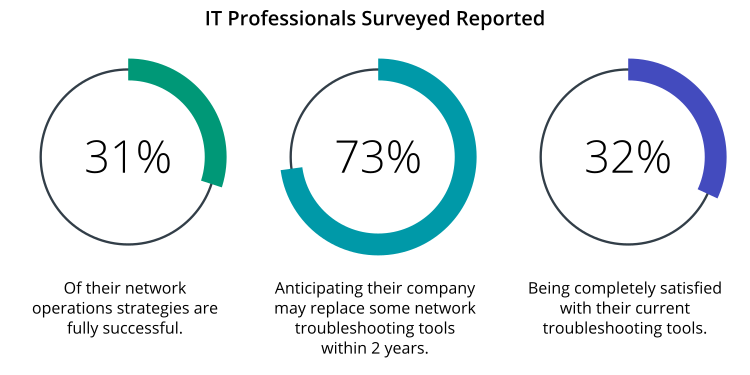
Diagram - IT Professionals Surveyed Reported

The study also sheds light on where those gaps in observability create the biggest operational loss. When respondents were asked what most often triggers a major “war room” collaboration to resolve a service performance issue, the top answer was cloud service models, such as infrastructure as a service (IaaS), platform as a service (PaaS), and software as a service (SaaS).  Consistent with that, public cloud (IaaS, PaaS) was also identified as the most challenging network domain to monitor and manage with existing tools. Containers/Kubernetes landed among the top five challenges overall.

The Rise in Kubernetes Use

Kubernetes is now the default choice for building scalable, observable systems, with 82 percent of container users deploying Kubernetes in production, according to a January 2026 announcement from the Cloud Native Computing Foundation. This was a significant increase from 66 percent in 2023.

The global Kubernetes market was valued at $2.11 billion in 2024, grew to $2.61 billion in 2025, and is expected to reach $14.6 billion by 2033: a staggering 24 percent compound annual growth rate (CAGR) from 2026 to 2033.

This growth makes sense, given Kubernetes offers flexibility and scale across private data centers, public cloud, or hybrid environments for both enterprises and service provider operations. However, as organizations add more production traffic through clusters, the network model becomes more dynamic, and that complexity can quickly outpace traditional monitoring approaches.

The Importance of Observability in Kubernetes Environments

Legacy monitoring tools often struggle in dynamic Kubernetes environments, where workloads are ephemeral, services are distributed, and connectivity spans clusters and clouds. That’s why modern observability has become so critical. It is proactive and context-aware, so operations teams can detect issues earlier, correlate symptoms across layers, and get to the root cause faster.

Performance Use Cases for Kubernetes: Enterprise

The following are Kubernetes-related performance and availability use cases in enterprise and service provider environments.

Many enterprises maintain private data center networks that support both legacy systems and cloud deployments. Hybrid workloads often operate in private cloud environments where Kubernetes coexists with virtual machines and bare-metal servers. In these settings, observability must provide the same rich insights into legacy and private cloud data center technologies, regardless of the technology deployed, be it Red Hat OpenShift Container Platform, OKD, or OSS vanilla Kubernetes.

Enterprises with public cloud deployments must contend with multiregional clusters and different managed services, such as AWS Elastic Kubernetes Service (EKS), Microsoft Azure Kubernetes Service (AKS), and Google Kubernetes Engine (GKE). And observability solutions must adapt to cloud-native APIs and services.

In both private and public cloud environments, observability solutions should:

  • Correlate Kubernetes events with network events
  • Map service dependencies
  • Detect security threats, such as lateral movement or data exfiltration
  • Enable automated troubleshooting and alerting

Enterprises often find observability in their Kubernetes environment particularly useful for visibility and control in networking, service discovery, and workload management. It helps:

  • Developers deploying new services for alerting on regressions or misconfigurations of applications early in the lifecycle
  • Development and operations (DevOps) for application performance tuning and service-level agreement (SLA) delivery
  • NetOps for visibility to quickly identify, pinpoint, and resolve issues such as slow services, failed requests, or misconfigurations

Kubernetes Use Cases: Service Provider

In the case of service providers, whose scale and multitenancy environments differ from enterprises, Kubernetes observability is essential and helps:

  • Monitor per-tenant traffic patterns
  • Isolate faults quickly
  • Enforce security and quality-of-service (QoS) policies dynamically

Does the Data Source Matter When It Comes to Observability?

EMA’s “Cloud Network Traffic Data” report revealed that packet data will play a critical role in both network and security operations over the next several years. It also indicated that there are challenges to collecting and analyzing packet data in the public cloud, including security risk, traffic encryption, and data quality.

Kubernetes networking is by nature dynamic. Pods are short-lived; IPs change constantly; and service-to-service communication can involve overlay networks, service meshes, and east-west traffic across clusters. Legacy tools are unlikely to be effective in this environment.

However, packet-based observability overcomes these characteristics with its ability to look at every packet sent across the environment. Every Domain Name System (DNS) lookup, Transport Layer Security (TLS) handshake, dropped packet, or application microburst is visible—because it’s in the packets. With full packet monitoring and analysis, leveraging deep packet inspection (DPI) at scale, operations teams gain:

  • Protocol-level visibility (not just L3/L4, but deep into HTTP, gRPC, DNS, and so forth)
  • Application performance insights, including retries, time-outs, and slow responses
  • Real-time security detection, such as lateral movement, exfiltration, policy violations, or distributed denial-of-service (DDoS) activity
  • Troubleshooting analysis including alerting, key performance indicators, error details, latency/jitter, and misconfigurations

NETSCOUT Recommendations

In private or public cloud environments, where observability has been a challenge, packets offer unmatched fidelity, accuracy, and context. Regardless of whether the requirement is for visibility in a single enterprise cluster or a multitenant platform serving thousands of customers, DPI-based observability delivers the real-time insight essential to optimize performance, reduce mean time to repair (MTTR), and enforce zero-trust policies.

Learn how NETSCOUT is overcoming the cloud visibility gap with the Omnis KlearSight Sensor for Kubernetes.